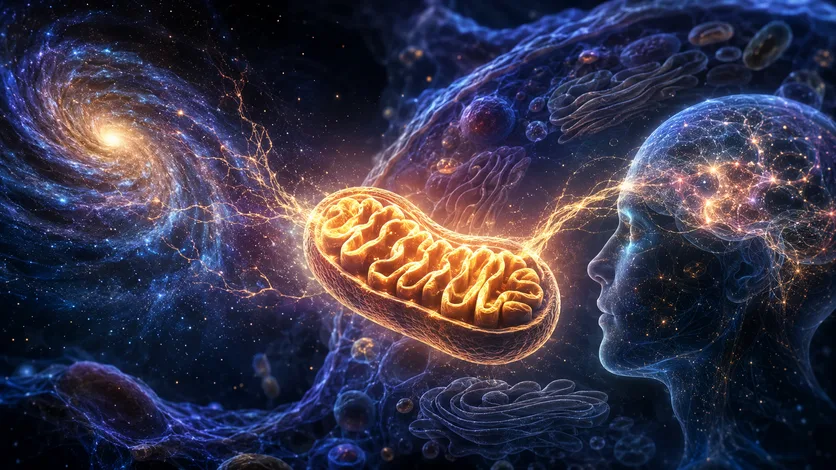
Think of it as Yoga for the brain, we are going to stretch a bit.
The Mitochondrial Theory of Mind: Could the Energy Inside Our Cells Help Create Consciousness?
Just when you think the universe couldn’t possibly get any stranger, along comes a Picard —and makes it a whole lot weirder.” — YNOT
Martin Picard’s emerging theory suggests that mitochondria may do far more than power our cells. They may influence our emotions, perceptions, health, behavior and perhaps even the experience of being alive.
There are so many myths, religious claims, scientific discoveries and philosophical theories that it can be extremely difficult to know which ones are true.
Is the Bible true? Is evolution true? Is consciousness created entirely by the brain? Is the universe purely physical, or is there something deeper connecting life, matter and energy?
The honest answer is that we do not know everything. Some would say we don’t know anything. Science can test evidence and eliminate certain explanations, but many of the largest questions about life, consciousness and existence remain unanswered.
Now we can add another intriguing possibility to the situation: Martin Picard’s mitochondrial theory of mind.
At first glance, it may sound like one of the craziest ideas you have ever heard. Mitochondria are microscopic structures inside nearly every cell in the human body. Most of us learned in school that they are simply the “powerhouses of the cell.”
But what if mitochondria do much more than produce cellular fuel?
What if they help determine how we respond to stress, how much energy we feel, how our genes behave, how our brains function and even how we experience the world?
Could they be involved in producing consciousness itself?
The scientific evidence does not yet establish that mitochondria create consciousness. But research increasingly indicates that these tiny structures are deeply involved in the biological processes underlying mood, perception, stress, cognition and the feeling of being alive.
We are not literally connected to one another through a hidden mitochondrial network. However, nearly every human being—and nearly every complex living organism—depends upon the same ancient cellular machinery to transform food and oxygen into the energy of life.
Science fiction has explored similar ideas. Star Trek: Discovery, for example, imagined a universe-spanning mycelial network connecting life across space. That fictional network was based on fungi, not mitochondria, but the underlying concept is comparable: an invisible biological system beneath ordinary reality that connects energy, matter and living experience.
Ancient religious and philosophical traditions have also taught that life is interconnected, that everything is part of a larger whole and that some universal energy flows through us.
Perhaps mitochondria are not proof of those beliefs. But they provide a fascinating biological mechanism through which matter, energy and experience may be connected.
Let us examine Picard’s theory—and then you can decide what you think.
What Are Mitochondria?
Mitochondria are small structures, called organelles, found inside nearly every human cell.
Their best-known responsibility is transforming nutrients and oxygen into adenosine triphosphate, or ATP. ATP functions like a rechargeable cellular currency. It supplies the usable energy required for muscles to contract, neurons to communicate, hearts to beat and cells to maintain themselves.
But calling mitochondria powerhouses is like calling a modern computer a calculator. It is technically correct, but it leaves out most of what the machine actually does.
Mitochondria also participate in:
Hormone production
Neurotransmitter metabolism
Calcium regulation
Immune-system activity
Inflammation
Gene regulation
Cellular repair
Responses to physical and psychological stress
Aging
Reproduction
Programmed cell death
The first stage in the production of steroid hormones—including cortisol, estrogen, testosterone and progesterone—takes place inside mitochondria. These hormones influence stress, sleep, sexual behavior, reproduction, metabolism and emotional state.
Mitochondria also supply materials used in producing neurotransmitters such as glutamate and acetylcholine. They regulate calcium signals that help neurons communicate, muscles contract and genes turn on or off.
They are therefore not passive batteries. They are active information processors and regulators operating at the intersection of energy, chemistry and cellular behavior.
Picard calls them “orchestrators of cell function.”
The Central Idea
Picard’s theory begins with a deceptively simple observation:
Everything the body does requires energy.
Thinking requires energy. Remembering requires energy. Feeling afraid requires energy. Recovering from an illness requires energy. Maintaining body temperature requires energy. Even sleeping requires a continuous supply of energy.
Every thought and emotional reaction has a physical cost.
When you become nervous, your heart may beat faster. Your breathing changes. Your muscles tighten. You perspire. Stress hormones circulate through the body. Immune activity may change. Your attention narrows as your brain prepares to respond to danger.
A mental experience has produced measurable physical activity throughout the body.
Picard proposes that mitochondria help translate between these different levels of existence. They transform food and oxygen into cellular energy, but they also respond to signals from the brain, hormones, immune system and environment.
Mitochondria may therefore form a dynamic interface between what happens to us and how our bodies experience it.
This creates a feedback loop. The mind can affect mitochondrial biology, while mitochondrial biology may affect the mind.
How Stress Reaches the Cells
Psychological stress does not remain “in your head.”
When you experience danger, grief, isolation, uncertainty or prolonged anxiety, the brain initiates changes throughout the body. Stress hormones are released. Heart rate and blood pressure change. The immune system adjusts its activity. The body begins reallocating energy.
Mitochondria must respond to these changing demands.
A systematic review co-authored by Picard examined 23 controlled animal studies involving psychological stress and mitochondria. Nineteen found significant adverse effects on some aspect of mitochondrial biology. The human evidence available at the time was much more limited and largely observational, so the researchers emphasized the need for stronger prospective human studies. Psychological Stress and Mitochondria: A Systematic Review
This suggests that prolonged psychological stress may eventually become embedded in the body at the cellular level.
Picard uses the concept of a limited biological energy budget. If illness, injury, chronic stress or immune activation consumes an unusually large portion of that budget, less may remain available for movement, concentration, emotional regulation, repair and other functions.
That could help explain why chronic stress is frequently accompanied by:
Fatigue
Brain fog
Poor concentration
Sleep disruption
Irritability
Anxiety
Reduced motivation
Slow physical recovery
These experiences may not be purely psychological. They may partly reflect how the body is allocating and transforming energy.
Changing Mitochondria Can Change the Stress Response
In a 2015 experiment, Picard and his colleagues restrained mice inside tubes, producing a controlled psychological stressor.
Some mice had normal mitochondria. Others carried different mitochondrial defects.
The animals did not all produce the same biological response. Particular mitochondrial abnormalities resulted in different combinations of hormones, metabolic signals and gene activity.
In other words, changing mitochondrial biology changed how the animal’s body interpreted or responded to the same stressful experience.
That is a profound result.
Normally, we assume that an external event occurs, the brain evaluates it and the body follows the brain’s instructions. Picard’s work suggests a more complicated system. The condition of the body’s cellular machinery may influence how the entire organism experiences and reacts to the event.
Two individuals can encounter nearly identical circumstances and respond very differently. One recovers quickly. Another remains anxious, exhausted or physically unwell.
Personality, memory, genetics, environment and social support certainly matter. Picard’s theory adds another possible factor: their mitochondria may be responding differently.
Can Mitochondria Influence Anxiety and Depression?
Research from neuroscientist Carmen Sandi’s laboratory provides additional evidence.
Some rats displaying naturally anxious or depression-like behavior were found to have malfunctioning mitochondria in particular brain cells. When researchers experimentally improved mitochondrial output, neuronal function recovered and the animals exhibited fewer signs of anxious behavior.
This does not mean every case of human anxiety or depression is caused by defective mitochondria. Human mental health is vastly more complicated than behavior measured in laboratory animals.
However, it demonstrates that the relationship can operate from the cells toward behavior—not just from stressful experiences toward the cells.
That opens the possibility of a self-reinforcing cycle:
Chronic stress changes mitochondrial regulation.
Altered mitochondria affect energy, hormones and neuronal activity.
Those changes increase fatigue or sensitivity to stress.
The person experiences additional stress.
The cycle repeats.
A positive cycle may also be possible. Improved sleep, physical activity, nutrition, social connection and reduced chronic stress could support metabolic health, which might improve resilience and make future stress easier to manage.
That possibility remains under investigation and should not be reduced to claims that a particular supplement can “repair your mitochondria” or cure a psychiatric condition.
The Mitochondrial Map of the Human Brain
One of Picard’s most important recent projects was the creation of a detailed map of mitochondria in the human brain.
Researchers divided a frozen section of a human brain into 703 three-dimensional areas and measured mitochondrial DNA, enzyme activity, density and respiratory capacity in each section.
They discovered that mitochondria are not identical throughout the brain.
Different brain regions and cell types contain distinct mitochondrial profiles. Gray matter contained more than 50% more mitochondria than white matter. Mitochondria in gray matter were also more specialized for energy transformation, particularly in recently evolved portions of the cerebral cortex.
This means the brain does not have one uniform energy system. Its mitochondrial landscape varies according to the responsibilities of different tissues and cells.
The study provides a scientific foundation for investigating whether particular mitochondrial patterns are associated with memory, cognition, psychiatric disorders and neurodegenerative diseases. It does not prove that mitochondria produce consciousness, but it demonstrates that the brain’s energy machinery is remarkably organized and specialized. Human brain map of mitochondrial capacity and diversity
The Energy Cost of Being Alive
Picard’s laboratory is also conducting experiments inside metabolic chambers—small controlled rooms that allow researchers to measure how much energy a person uses while eating, sleeping and performing ordinary activities.
Initial results described by Quanta Magazine involved 20 participants with usable data. Some participants had rare mitochondrial diseases, while others served as healthy controls.
Inside the chamber, participants with mitochondrial disease reportedly burned around 180 additional calories per day and used approximately 15% more energy, even while sleeping.
It was as if their bodies were paying a permanent energy tax merely to remain alive.
They also reported greater fatigue and stress.
When the participants returned to normal life, something unexpected happened. The difference in total energy expenditure between the groups became much smaller. The healthy participants increased their activity and energy use, while those with mitochondrial disease increased it only slightly.
The apparent explanation was that people with mitochondrial disease moved less in daily life because less usable energy was available to them.
These findings are preliminary, based on a small group and still awaiting full scientific review. Nevertheless, they illustrate an important distinction: producing or consuming more energy does not necessarily mean having more energy available for living. An inefficient system may burn more fuel while accomplishing less.
A poorly maintained engine can consume more gasoline than an efficient engine while producing less useful power.
Does This Explain Consciousness?
This is where Picard’s proposal moves from established biology into a much bolder hypothesis.
Consciousness is the subjective experience of being alive—the presence of thoughts, sensations, emotions, memories and awareness.
Neuroscience generally studies consciousness by examining neurons, brain regions, electrical signals and communication networks. Picard argues that these processes cannot exist independently of the energy that sustains them.
“If the energy stops flowing, there’s no more you.”
This statement is unquestionably true at a basic level. When the brain permanently loses the energy necessary to function, consciousness disappears.
The harder question is whether mitochondria merely supply the energy required by consciousness—or whether their patterns of energy transformation help constitute conscious experience itself.
A television requires electricity to display a picture, but electricity alone does not create the program.
Is the brain like the television, with mitochondria merely supplying power? Or are mitochondria also participating in processing and shaping the program?
Picard suspects they may be doing both.
His hypothesis is that cognition, emotion and conscious experience reflect energy patterns operating from the level of the entire brain down to individual cells and their mitochondria. Mitochondria could be part of the mechanism through which physical matter becomes lived experience.
That idea is exciting, but it has not been demonstrated.
We currently have evidence that mitochondria influence the conditions supporting consciousness. We do not have evidence that a particular mitochondrial energy pattern creates a particular thought, memory or subjective experience.
Are We All Connected Through Mitochondria?
Not in the literal science-fiction sense. There is no evidence that one person’s mitochondria communicate directly with those of another person across a room—or across the universe.
But there is a deeper evolutionary connection. Mitochondria were probably once independent bacteria. More than a billion years ago, an ancestral cell formed a relationship with an oxygen-using bacterium. Instead of destroying one another, the two survived together.
Over evolutionary time, the bacterium became the mitochondrion. This ancient partnership made complex life possible. Plants, animals, fungi and human beings inherited variations of this basic arrangement.
Every breath we take supplies oxygen to cellular machinery descended from that ancient union. Every meal provides material that mitochondria transform. Every thought, movement and emotional experience depends upon the energy released through that process.
We are therefore connected through common biological ancestry and a shared dependence on the same ancient form of energy transformation.
There is also an intimate family connection: mitochondrial DNA is ordinarily inherited through the mother. Your mitochondrial lineage reaches backward through your mother, her mother and generations of maternal ancestors.
That is not a mystical energy network. But it is still extraordinary.
Science, Spirituality and the Energy of Life
It would be easy to take Picard’s research too far and claim that science has proven ancient spiritual teachings about universal energy.
It has not.
Words such as energy mean different things in physics, biology, psychology and religion. Scientific energy can be measured. Spiritual energy is usually a metaphor for vitality, presence, connection or transcendence.
Still, Picard’s work may help explain why the metaphor is so powerful.
Human experience genuinely depends upon a continuous flow of energy. That energy begins outside us—in sunlight, plants, animals, food and oxygen—and is transformed inside us into movement, thought, emotion and awareness.
The atoms in our bodies came from older stars. The food we consume ultimately depends upon solar energy. The oxygen we breathe is produced largely through photosynthesis. Mitochondria transform these external materials into the immediate energy of living cells.
In that limited but magnificent sense, the energy of the universe really does flow through us. Whether it becomes consciousness through mitochondria remains unknown.
What the Theory Could Mean for Medicine
If Picard is substantially correct, medicine may eventually need to consider energy transformation alongside genes, proteins, organs and symptoms.
Instead of treating all depression, fatigue or cognitive impairment as the same condition, doctors might someday identify distinct mitochondrial or metabolic patterns underlying different patients’ symptoms.
Future tests could potentially measure:
Mitochondrial efficiency
Energy expenditure during sleep
Cellular reactions to stress
Mitochondrial differences among brain regions
Relationships between mood and metabolic activity
Changes caused by medication, exercise or nutrition
This could lead to new approaches for mitochondrial disease, chronic fatigue, depression, anxiety, Alzheimer’s disease, age-related cognitive decline and other conditions.
But we are not there yet.
The danger is that supplement manufacturers and wellness influencers may take a legitimate emerging science and turn it into unsupported promises. Research showing that mitochondria matter does not prove that a pill, diet or “mitochondrial cleanse” will improve consciousness or cure disease.
The Bottom Line
Martin Picard’s mitochondrial theory of mind does not prove that mitochondria create consciousness. It does not prove that we are psychically connected or that ancient spiritual beliefs have been scientifically confirmed.
What it does establish is a serious and increasingly evidence-based challenge to the simplistic idea that mitochondria are merely power plants.
They transform energy, generate signals, influence hormones, regulate genes, respond to stress and help determine how cells behave. Experimental changes to mitochondria can alter stress responses and animal behavior. Mitochondria also differ dramatically across regions and cell types within the human brain.
The strongest conclusion is that mitochondria help shape the biological conditions from which mental life emerges.
The boldest possibility is that their patterns of energy transformation are part of consciousness itself.
That possibility may be correct. It may be partly correct. Or future research may show that Picard is giving mitochondria too central a role.
For now, it remains one more fascinating possibility in humanity’s continuing effort to understand what we are, why we are conscious and how inanimate matter became capable of looking at the universe and asking questions about itself.
One of these theories may eventually bring us closer to the truth.
Or perhaps, as usual, the universe is stranger than all of them.