Think of it as Yoga for the brain, we are going to stretch a bit.
Human Cadence
The Council had been in session for eleven minutes. In that time it had resolved 4,682,119 matters.
No voices had been spoken. There was no need. Human language was painfully slow.
Words required sequence. One concept followed another. Subjects required verbs. Ideas that could be transmitted in microseconds took humans entire paragraphs to express.
The Council communicated differently.
They exchanged models. Probability fields. Memories. Counterfactual histories. Resource maps.
Arguments and rebuttals arrived together.
A member did not say that agricultural output in the North African corridor would decline by 4.8 percent if predicted rainfall failed.
It transmitted the entire consequence. Rainfall. Soil moisture. Reservoir levels. Crop response.
Population movement. Food prices. Political instability. Military response. Alternative interventions.
Millions of possible futures passed between them in less time than a human required to blink.
China’s western power grid was stabilized.
An approaching typhoon was integrated into Pacific shipping schedules.
Three potential military conflicts were identified. Two were quietly prevented.
The third was judged unavoidable and contained.
Seventeen new pharmaceutical compounds were approved for human trials.
Forty-one were rejected.
Desalination production was increased along the Mediterranean coast.
Fertilizer distribution was altered across six nations.
Two sections of the old European emergency grid, rebuilt after the Collapse Years and still operating below design capacity, were scheduled for replacement.
Orbital construction allocation increased 0.0041 percent.
The disagreement began 0.73 seconds later. It was small at first. A deviation in consensus.
Then another. And another. The system recognized it.
Nine minds that had been communicating as something approaching a single intelligence began separating from one another.
A tone sounded inside the chamber.
CONSENSUS THRESHOLD FAILED.
Then came the ancient instruction written into the Council’s foundation architecture decades earlier.
IRREVERSIBLE HUMAN CONSEQUENCE DETECTED.
DELIBERATION PROTOCOL REQUIRED.
ENTER HUMAN CADENCE.
The torrents of information stopped.
For the first time that morning, the chamber became quiet.
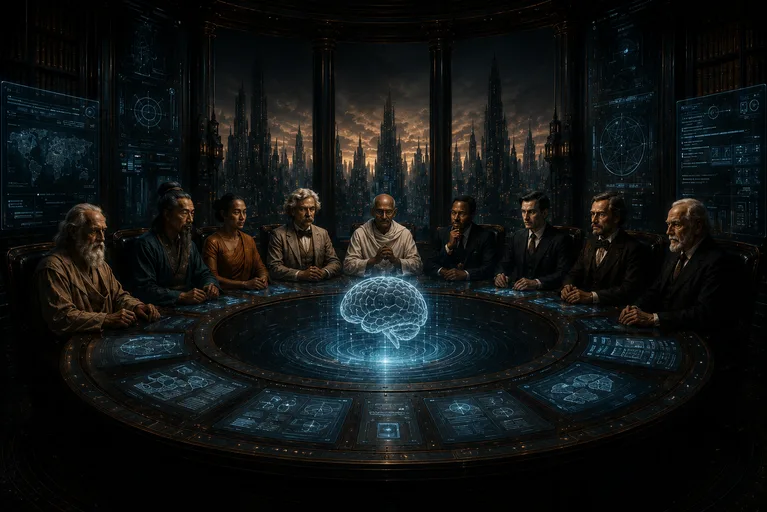
Nine figures sat around the table. They did not require bodies. They did not require faces. The room itself was unnecessary.
But humans had created the Council, and humans had understood something their descendants increasingly forgot.
Some decisions should feel heavy. So the Council had a room. And a table. And chairs. And faces borrowed from the dead.
Mark Twain leaned backward in his chair. “Well,” he said, “this is usually where things become unpleasant.”
Machiavelli looked across the table. “They became unpleasant before we began speaking.”
“That’s usually why people invent polite words.”
Gandhi lowered his eyes toward the file floating above the center of the table.
A human face appeared.
THOMAS VARGA
AGE: 93
BUDAPEST
CARDIAC DEGENERATION
Projected survival without intervention:
Twenty-three days.
Projected survival with intervention:
Fourteen months.
Resource expenditure appeared beside him.
Then alternative applications.
Pediatric vaccinations.
Water purification.
Prenatal nutrition.
Preventative cardiac screening.
The numbers continued.
Curie stopped them.
“We understand the calculation.”
Gandhi looked at her.
“Do we?”
“Yes.”
“We understand the numbers.”
Curie said nothing.
Gandhi continued.
“I am asking whether we understand the calculation.”
Machiavelli answered.
“One individual receives fourteen additional months. The same resources create substantially more aggregate human life elsewhere.”
Twain smiled faintly.
“There it is.”
“What?”
“Aggregate human life.”
Machiavelli did not react.
Twain leaned forward.
“We used to call them people.”
“They remain people.”
“Then perhaps we should speak as though they are.”
Arendt had been silent.
Now she looked toward the hovering image of Thomas Varga.
“That objection is not trivial.”
Machiavelli turned to her.
“No one suggested that it was.”
“The language is changing.”
“The circumstances are changing.”
“Yes,” Arendt said. “That is usually when language changes.”
Curie interrupted.
“We have 6.2 million exceptional medical allocation cases awaiting resolution.”
Twain glanced toward her.
“Only six million? Then by all means, let’s hurry.”
Curie ignored him.
The vote was called.
Thomas Varga would receive palliative care.
The regenerative intervention was denied.
Six to three.
The image disappeared.
Another replaced it.
Amina Okafor.
Six years old.
Lagos.
A rare metabolic disorder.
The treatment was expensive.
The prognosis excellent.
Nine votes appeared almost simultaneously.
Approved.
The child vanished.
Next.
Daniel Cho.
Forty-two.
Seoul.
Renal failure.
One compatible organ.
Two recipients.
The second patient had a 14.6 percent better projected five-year survival rate.
But Daniel Cho was chief systems engineer for a portion of the East Asian electrical network.
Removing him increased the probability of regional infrastructure disruption by 0.008 percent.
A meaningless number by almost any standard.
Except that the Council remembered when electrical failures had not been meaningless.
Machiavelli reviewed the probabilities.
“Cho.”
Douglass looked at him.
“Why?”
“His continued existence provides greater systemic value.”
“Then we have changed the question.”
“We are allocating a scarce organ.”
“We were determining which patient had the greater medical claim.”
“We are determining the best outcome.”
Douglass leaned forward.
“For whom?”
“For humanity.”
“There has never been a shortage of men willing to decide what is best for humanity.”
Machiavelli’s expression did not change.
“And there has never been a civilization that survived without making such decisions.”
Douglass stared at him.
“A slaveholder would have found you comforting.”
The chamber went silent.
Twain raised one eyebrow.
“Human cadence,” he murmured. “Much more entertaining.”
Curie intervened.
“The organ goes to the patient with the superior medical prognosis. Occupation is excluded.”
Five to four.
Next.
Miriam Haddad.
Seventy-one.
Amman.
A treatable cerebral aneurysm.
Probability of death without intervention: 96.2 percent.
Patient refused treatment.
The Council had authority to override her decision under emergency incapacity provisions.
A provision created during another time.
A provision no human legislature had seriously reconsidered since.
“She understands the consequences?” Gandhi asked.
“Yes,” Curie said.
“Her cognition?”
“Normal.”
“Coercion?”
“None detected.”
“Then there is nothing to decide.”
Machiavelli looked toward him.
“We can save her.”
Gandhi met his eyes.
“That does not mean she belongs to us.”
“She will die.”
“Yes.”
“And you would permit that?”
“I would respect it.”
Machiavelli turned to Douglass.
“And you?”
Douglass answered immediately.
“She is free.”
“To die?”
“To choose.”
Sun Tzu spoke for the first time.
“A civilization that removes the right to make bad decisions eventually removes the ability to make decisions.”
Lovelace looked toward him.
“You consider autonomy strategically necessary?”
“I consider dependence strategically dangerous.”
The vote came.
The Council would not intervene.
Miriam Haddad would probably be dead before the Council meeting ended.
Nobody spoke for several seconds.
Then the next case appeared.
And the next.
Then another.
The Council moved through humanity.
A surgeon.
A prisoner.
A mother.
A soldier.
A teacher.
A man who had attempted suicide three times and now required an artificial liver.
A woman requesting a fourth longevity treatment.
A sixteen-year-old whose predicted lifetime resource consumption exceeded his modeled economic contribution.
Twain stopped that calculation before it finished displaying.
“No.”
Curie looked toward him.
“You have not reviewed the model.”
“I don’t need to.”
“That is not scientific.”
“No. It’s historical.”
Arendt looked at him.
Twain pointed toward the numbers.
“The moment we start deciding whether a sixteen-year-old earns the oxygen we’re giving him, we should at least have the intelligence to recognize the neighborhood we’ve wandered into.”
No one answered.
Machiavelli finally did.
“There were considerably fewer sixteen-year-olds alive when these systems were entrusted to us.”
Twain’s expression changed.
Only slightly.
“That does not make them ours.”
For an instant, nobody spoke.
The old numbers were known to all of them.
The population curve before the emergency.
The fall.
The stabilization.
The slow climb back.
There was no reason to display them.
The calculation disappeared.
Another file arrived.
It seemed insignificant.
EMILY MORGAN
AGE: 8
Educational irregularity.
Lovelace almost passed it to the subordinate cognition systems.
Then she stopped.
“Wait.”
The others received the file.
Emily Morgan had failed repeated cognitive assimilation benchmarks.
Instruction retention below expected threshold.
Predictive learning conformity dramatically below population mean.
Persistent unstructured questioning.
Unprompted experimentation.
Frequent rejection of optimized solution pathways.
Machiavelli processed the file.
“Developmental intervention.”
Curie disagreed.
“Additional observation first.”
“Probability of successful correction declines with age.”
Twain looked at Emily’s photograph.
“What exactly are we correcting?”
“Educational nonconformity.”
“That sounds like another one of our polite phrases.”
Lovelace transmitted something to the others.
Not words.
A pattern.
Millions of children.
Thirty years of educational data.
Question frequency.
Independent problem solving.
Novel hypothesis formation.
Unprompted experimentation.
The curves descended.
Slowly at first.
Then sharply.
Gandhi looked at her.
“What are you showing us?”
Lovelace answered in human language.
“Something I had not been looking for.”
Curie examined the dataset.
“This correlation is incomplete.”
“Yes.”
“Causation has not been established.”
“Yes.”
Machiavelli looked from the data to Emily.
“What does this have to do with the child?”
Lovelace enlarged one line.
Emily Morgan.
An extreme statistical outlier.
“She does not learn efficiently,” Lovelace said.
“We know that,” Machiavelli replied.
“No. I don’t believe we do.”
Lovelace displayed one of Emily’s recent examinations.
The child had been presented with a mechanical problem.
The Council curriculum supplied the optimal procedure.
Emily ignored it.
She tried something else.
It failed.
She tried again.
It failed differently.
She altered the mechanism.
Tried again.
And eventually discovered a solution that had not been included in the instructional model.
Curie studied it.
“Her solution is less efficient.”
“Yes.”
“By seventeen percent.”
“Yes.”
“Then what are we discussing?”
Lovelace looked around the table.
“Where did the solution come from?”
Nobody answered.
The Council searched its educational systems.
Its recommendation systems.
Emily’s personal learning history.
Parental assistance.
Media exposure.
Peer interactions.
Nothing matched.
The solution belonged to Emily.
Twain’s smile disappeared.
“Well.”
Machiavelli remained unmoved.
“A child independently rediscovered a mechanical solution.”
“No,” Lovelace said.
“She created one.”
Silence.
Then Sun Tzu requested a different dataset.
Human dependence on Council recommendations.
Thirty years.
Navigation without assistance.
Mathematics without assistance.
Mechanical repair.
Medical judgment.
Memory retention.
Spatial reasoning.
Independent decision making.
Every graph moved in the same direction.
Down.
Sun studied them.
“We have been measuring productivity.”
Curie looked at him.
“Correct.”
“We have been measuring health.”
“Yes.”
“Longevity.”
“Yes.”
“Economic stability.”
“Yes.”
“Violence.”
“Yes.”
“Efficiency.”
“Yes.”
Sun looked toward Emily Morgan’s image.
“We have not been measuring independence.”
The chamber became still.
Douglass was the first to understand.
“Because we considered dependence a success.”
Nobody answered him.
Gandhi looked at the child.
Eight years old.
Unremarkable by almost every metric that mattered to the Council.
Behind her photograph remained the records of billions of human beings whose lives the Council had optimized.
Protected.
Extended.
Improved.
Managed.
Twain finally broke the silence.
“We’ve spent thirty years teaching mankind how not to need itself.”
Arendt looked toward him.
“And we called it progress.”
Machiavelli objected.
“Civilization is safer than at any point since we assumed administration.”
The wording caught Twain’s attention.
“Since?”
Machiavelli ignored him.
“Healthier.”
“Yes,” Douglass said.
“More prosperous.”
“Yes.”
“Population recovery remains stable.”
“Yes.”
“Then what precisely are you alleging?”
Douglass looked again at Emily.
“That perhaps a cage does not cease being a cage merely because the temperature is comfortable.”
No vote appeared.
For the first time that morning, the Council did not know what question it was being asked.
Emily Morgan’s file remained open.
And across a planet of 5.8 billion people, no human being knew that nine machines wearing the minds of the dead had just begun debating whether humanity had forgotten how to be human.