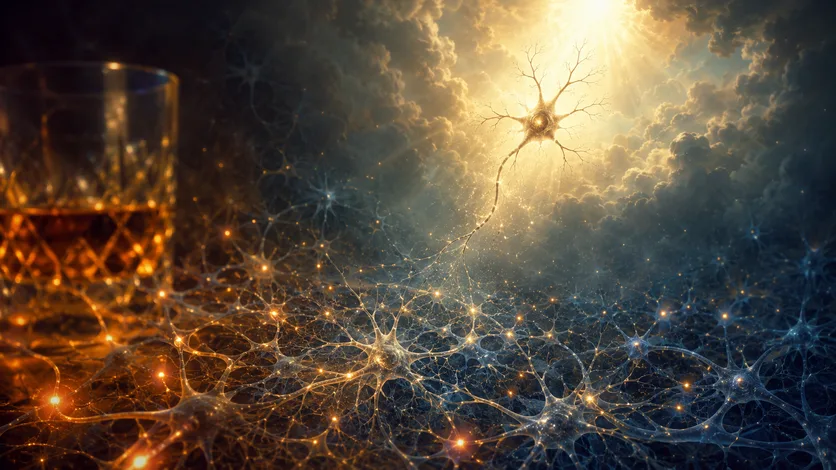
Think of it as Yoga for the brain, we are going to stretch a bit.
When a Neuron Dies Does It Go to Heaven?
A neuron may die, but a memory is rarely buried with it. The brain keeps no filing cabinet—only a magnificent web of connections, constantly losing threads, tying new ones, and somehow remembering the story and may be one day we can record it. -- YNOT!
The human brain is a peculiar machine. It is built mostly before we are old enough to complain about it, spends the next several decades rearranging itself, and somehow remembers your third-grade teacher’s face while refusing to tell you where you put your car keys five minutes ago.
Anyone working with AI and hallucinations appreciated the arrangement. Nature gives us one of the most complicated objects in the known universe and then neglects to include an instruction manual.
Most of the neurons in your brain were created before you were born. Unlike skin cells, blood cells, and the unfortunate lining of your stomach, mature neurons generally do not divide and replace themselves every few days. Many of them are built for the long haul.
A neuron created before your first birthday may still be working when you are eighty.
That is quite an employment contract.
Every day it maintains its electrical charge, repairs itself, replaces proteins, sends chemicals across synapses, strengthens some connections, weakens others, and communicates with thousands of neighboring cells.
Yet even neurons eventually die.
That raises an obvious and rather unsettling question:
If the neuron dies, does the memory stored inside it disappear?
Fortunately, the brain does not appear to operate like a warehouse where Neuron 8,742 contains Christmas 1976 and Neuron 22,981 contains the name of your first girlfriend.
Memories are distributed.
A memory is closer to a pattern spread across an enormous network.
The color of the room may involve one group of neurons. A person’s voice another. The smell of dinner another. The emotional significance of the event may involve still other circuits. The hippocampus helps tie parts of the experience together, while portions of the memory eventually become distributed through the cerebral cortex.
The memory, therefore, exists partly in the relationships among neurons: which cells communicate, how strongly they communicate, which connections become easier to activate, and which pathways tend to fire together.
In other words, the brain remembers not merely because neurons exist, but because they have relationships.
Apparently even brain cells cannot escape networking.
When one neuron dies, you ordinarily do not suddenly forget Christmas.
The surrounding network contains redundancy. Other neurons participate in the same pattern, and the brain can often route around small losses.
But as connections deteriorate, something interesting can happen.
The memory may remain while its resolution declines.
You still remember the vacation. You remember who was there.
You remember that something funny happened at dinner.
But you cannot remember the restaurant.
Then you cannot remember what was said.
Eventually you are left with the general story but fewer of the original details.
Memory loss can therefore resemble an old photograph gradually fading rather than a computer file suddenly being deleted.
And there is another complication. Every time you remember something, your brain reconstructs it. Memory is not a perfect recording.
The brain retrieves pieces, fills gaps, reinforces some connections, weakens others, and sometimes introduces information that was not part of the original experience.
Which explains why three people can attend the same family argument and twenty years later possess four different versions of it.
The Brain Is Not a Filing Cabinet, and Whiskey Is Not an Eraser
Then we come to alcohol. For generations people have said that drinking “kills brain cells.”
That statement contains enough truth to survive at a bar and not enough precision to survive comfortably in a neuroscience laboratory.
Heavy and prolonged alcohol exposure can indeed damage the brain and, under severe circumstances, contribute to neuronal injury and death.
But alcohol does not have to kill a neuron to interfere with your brain.
It can disrupt communication between neurons. That distinction is important.
Your brain depends upon exquisitely timed electrical and chemical signals. Alcohol changes that signaling. Attention declines. Reaction time slows. Judgment deteriorates. The hippocampus becomes less capable of turning an ongoing experience into a durable memory.
This is why an intoxicated person can sometimes walk, talk, argue, dance, send regrettable text messages, and apparently participate in an entire evening—and remember almost none of it the following morning.
The neurons were not necessarily destroyed. The recording system failed.
An alcohol blackout is therefore not primarily a case of memories being erased.
In many cases, the memories were never properly written down in the first place.
That may be the more frightening prospect.
Repeated heavy drinking can cause considerably more trouble.
Synapses can change.
Dendrites—the branching structures through which neurons communicate—can become altered.
Brain networks can become less efficient.
The hippocampus can be affected.
Nutritional deficiencies associated with alcoholism can produce additional neurological damage.
Inflammation, liver problems, and metabolic disturbances can pile onto the problem.
And research suggests that heavy alcohol exposure may interfere with neuroplasticity and the process by which new neurons develop in portions of the hippocampus.
That brings us to one of the most fascinating discoveries in modern neuroscience.
For many years scientists believed that adults simply stopped making neurons.
The story now appears more complicated.
There is evidence that some new neurons can continue developing in the adult hippocampus, although scientists are still debating exactly how much adult human neurogenesis occurs and how important it is at different ages.
These new neurons may do considerably more than merely replace old ones.
They may help the brain distinguish one experience from another, incorporate new information, adapt to changing circumstances, and prevent yesterday’s memories from overwhelming today’s reality.
That possibility is especially interesting because recent research into depression has found evidence that the process of developing new hippocampal neurons may become disrupted or “stalled” in people with major depressive disorder.
The stem-like cells appear to remain.
But fewer may successfully mature into functioning neurons.
If that finding is confirmed and expanded, it may help explain why depression affects much more than mood.
Depression can affect memory. Learning. Attention. Mental flexibility.
The ability to distinguish one negative event from another.
And the ability to stop the past from coloring every interpretation of the present.
Perhaps the brain’s great secret is that it is not really a machine at all.
It is an ecosystem. Cells are born. Connections grow.
Connections weaken. Some neurons die.
Others compensate. Memories migrate.
Networks reorganize.
The physical material changes continuously while somehow preserving enough of the pattern for you to remain recognizably yourself.
Your brain at seventy is not physically identical to your brain at seventeen.
Many of its molecules have been replaced.
Connections have changed. Some cells have disappeared.
New experiences have rewritten portions of the network.
Yet somewhere inside that constantly changing biological machinery remains the teenager, the child, the first love, the first failure, the embarrassing mistake, the triumph nobody else remembers, and perhaps the lyrics to a song you have not heard since 1983.
The lesson is not that every drink murders a neuron or that every forgotten name represents another dead brain cell.
Neuroscience is much more interesting than that.
The lesson is that memory depends upon the health of an enormous living network.
Sleep affects it. Stress affects it. Depression affects it. Alcohol affects it. Learning affects it. Exercise affects it. Age affects it.
And if you have 5 out of 7 like most, well you are losing the battle everyday. And almost everything we repeatedly ask our brains to do eventually leaves some mark upon the network.
Nature apparently gave us a brain that changes according to how we use it.
Which seems either remarkably generous or extraordinarily dangerous.
Knowing humanity, probably both. And this is why you can never believe what you believe remember when wake up with a hangover.
EXTRA CREDIT: The life of a Neuron
A neuron’s life cycle is very different from that of most cells in your body. Many neurons are built to last essentially your entire lifetime.
During fetal development, neural stem cells divide rapidly and produce huge numbers of neurons. Most neurons in the cerebral cortex are created before birth. After they are produced, they migrate to their proper location, extend axons and dendrites, form synapses, and become incorporated into neural circuits. During childhood and adolescence, the brain then goes through extensive synaptic growth, pruning, and remodeling.
In adulthood, the situation changes dramatically. Most mature neurons do not divide and replace themselves routinely. If a cortical neuron dies, the brain generally does not simply manufacture an identical replacement.
There is evidence for limited adult neurogenesis, particularly involving the hippocampus, although the amount occurring in adult humans remains scientifically debated. The hippocampus is important for learning, memory formation, spatial processing, and distinguishing similar experiences. This is why the depression study we were discussing is interesting: it concerns a brain region where production and maturation of new neurons may still have functional importance.
How long can a neuron live?
Potentially as long as you do.
A neuron formed before birth can still be functioning 80 or 90 years later.
That is remarkable when you consider what the cell has to maintain. Some neurons have axons extending several feet—for example, motor neurons running from your spinal cord toward your feet. The cell continuously repairs membranes, replaces proteins, maintains ion gradients, transports material along the axon, and remodels thousands of synapses.
But neurons can die because of trauma, stroke, oxygen deprivation, toxins, infection, neurodegenerative disease, or normal aging.
The brain also deliberately eliminates enormous numbers of neurons during early development. This is called apoptosis, or programmed cell death. Early in life the brain overproduces cells and connections and then eliminates some of them as circuits mature.
The more interesting part of your question is what happens to the information.
A neuron does not contain one memory
The common mental picture is something like:
Neuron #87341 contains my memory of Christmas 1978.
That isn’t how memory appears to work.
Information is primarily represented by patterns of connectivity and activity across populations of neurons.
A memory might involve thousands or millions of neurons spread across different brain regions.
For example, the memory of a childhood kitchen might involve:
visual cortical networks representing what it looked like,
auditory networks associated with people’s voices,
olfactory circuits representing smells,
hippocampal networks linking the event together,
emotional circuits involving the amygdala,
cortical networks storing facts about the people and place.
The important information lies partly in which neurons connect to which other neurons and how strong those connections are.
Think of the brain less like a hard drive containing individual files and more like an enormous adaptive network.
A simplified representation might be:
A → B = strong connection A → C = weak connection B → D = strong connection C → D = inhibited
That pattern itself contains information.
This process is called synaptic plasticity.
So what happens when one neuron dies?
Usually, surprisingly little.
Because memories are distributed across neural networks, losing one neuron generally doesn’t erase an entire memory.
Other neurons may already encode overlapping information. The brain can also reorganize its connections somewhat.
You can think of it like the Internet.
If one router disappears, the Internet doesn’t disappear. Traffic can often travel through alternative routes.
But if enough strategically important routers disappear, sections of the network begin failing.
The same principle applies to the brain.
Loss of a few neurons:
almost imperceptible
Loss of thousands or millions in an important network:
measurable cognitive impairment
Large-scale progressive loss:
memory and neurological disease
This is essentially what happens in diseases such as Alzheimer’s.
There’s another fascinating wrinkle: memories move
A newly formed memory depends particularly heavily on the hippocampus.
Over time, through a process called systems consolidation, aspects of that memory become increasingly represented across cortical networks.
Sleep appears to play an important role in this process.
That is one reason someone with hippocampal damage may remember events from decades ago while being unable to form normal new memories.
The old memories have become more distributed throughout the cortex.
A memory can therefore survive the death of some of its neurons
But there’s an even stranger consequence.
Your brain is constantly changing.
Proteins inside neurons are replaced. Synapses strengthen and weaken. Dendritic spines appear and disappear. Some neurons die. New connections form.
Yet your memory of something can persist for decades.
So the physical components carrying the memory are partially being replaced while the informational pattern persists.
It is somewhat analogous to a city.
Buildings get replaced. Roads get rebuilt. People move in and out.
Yet the city remains recognizable because its organizational structure persists.
That leads to one of neuroscience’s deepest unanswered questions:
How does the brain maintain a stable memory for 50 years when the molecular machinery making up the synapses turns over much faster than that?
We know mechanisms such as long-term potentiation, gene expression, synaptic remodeling, recurrent network activity, and structural changes contribute.
But we still do not completely understand how the brain maintains very long-term memories.
And that connects directly back to the depression finding: if the hippocampus continually introduces a small population of new neurons into an existing network, those neurons may not simply “store more data.” They may help the network reorganize, distinguish new experiences, and update old patterns without overwriting them.
That is potentially much more important than simply saying “the brain makes new neurons.”
Yes, that’s a reasonable way to think about it, with one important qualification: the death of a single neuron usually would not produce a noticeable loss of detail by itself.
Memories are distributed across networks of many neurons. If a small number of neurons or synapses are lost, the network may still reconstruct the memory from overlapping information. As more of the relevant network degrades, though, the memory can become less precise: exact wording disappears, faces become harder to picture, chronology blurs, or you retain the general event but lose peripheral details.
So memory loss often looks less like deleting a file and more like a photograph gradually losing resolution. You may still remember, “We went to that restaurant and had a great evening,” while forgetting where you sat, what everyone wore, or exactly what was said.
There is another complication: every time you retrieve a memory, the brain can reconstruct and modify it. So fogginess isn’t caused only by neurons dying. Synapses weaken, competing memories interfere, details stop being rehearsed, and recollection itself can reshape the memory.
In very simplified terms: healthy network → rich, detailed recollection → some degradation → gist remains but details fade → extensive network damage → portions of the memory may become inaccessible.
That distinction between preserving the gist and losing the detail is actually a major feature of human memory.
Yes—but the old phrase “alcohol kills brain cells” is too simplistic.
Alcohol can damage the brain, and chronic heavy drinking can ultimately injure or kill neurons, but much of alcohol’s effect on memory happens before any neuron actually dies. Alcohol disrupts neuronal signaling, changes synapses, reduces dendritic complexity, and interferes especially with the hippocampus, which is central to forming new memories. Long-term heavy drinking is associated with loss of gray and white matter and measurable cognitive deficits. (NIAAA)
A particularly good example is an alcohol blackout. During a blackout, you can be awake, talking, walking around and interacting with people. The neurons haven’t suddenly died. Instead, alcohol has disrupted the hippocampus enough that it fails to properly consolidate new experiences into long-term memories. That’s why the person may have no memory of several hours even though they appeared conscious during them. (NIAAA)
There are therefore several different effects worth separating:
Temporary intoxication: neurons communicate poorly. Attention, judgment and memory formation deteriorate, but this is mostly functional disruption rather than neuronal death.
Repeated heavy drinking: synapses and dendrites can change, neurons can shrink, brain networks become less efficient, and neuroplasticity can be impaired. (NIAAA)
Severe chronic alcohol exposure: actual neurological damage can occur. Alcohol itself can be neurotoxic, while nutritional deficiency, inflammation, liver dysfunction and metabolic abnormalities can compound the damage. (NIAAA)
And there’s an especially important connection to what we were just discussing: the hippocampus and new neurons.
Animal research strongly indicates that substantial alcohol exposure can suppress hippocampal neurogenesis. Human evidence is harder to measure directly, but heavy alcohol use is associated with hippocampal abnormalities and impaired memory. So alcohol potentially attacks memory from two directions:
existing network → poorer signaling and damaged connections and network renewal/plasticity → potentially reduced ability to generate and integrate new neurons
That could mean the problem isn’t simply, “I lost some neurons containing old memories.” It can also be, “my brain has become less capable of encoding, separating and reorganizing new experiences.”
One encouraging aspect is that some alcohol-related brain changes are reversible. The brain retains considerable plasticity, and cognitive function and brain structure can improve during prolonged abstinence, although recovery depends on the severity and duration of exposure and some damage can be permanent.
So I would picture it like this:
Occasional alcohol → temporarily disrupts the network. Repeated heavy alcohol → remodels and damages the network. Long-term severe exposure → can permanently destroy portions of the network.
And from a memory standpoint, interfering with the connections between neurons may be just as important as killing the neurons themselves.