Think of it as Yoga for the brain, we are going to stretch a bit.
The Nose Knows — Your Cat’s Secret Senses
You think you live in a house you can see. Your cat lives in the same house, in a version written entirely in scent, sound, and memory — and in that house, the cat knows more about you than you know about the cat. -- YNOT!
You and your cat share an address and almost nothing else. You move through the house reading it with your eyes. The cat moves through the same house reading it with its nose, its ears, and a tongue built like a machine tool — senses tuned to a world running parallel to yours, mostly underneath your notice. This chapter is a tour of that other house: what the cat is actually perceiving while it sits there looking like it is perceiving nothing at all.
THE NOSE RUNS THE HOUSE
Start with the numbers, because they are not close. Your nose carries about five million scent receptors. Your cat’s carries on the order of two hundred million. That is the honest arithmetic behind the claim you will see on posters — that a cat’s sense of smell is some fourteen times keener than yours. Fourteen times is the conservative version, and even the conservative version means this: where you smell “the kitchen,” the cat smells the individual ingredients of the kitchen, who cooked them, when, and whether the trash needs taking out.
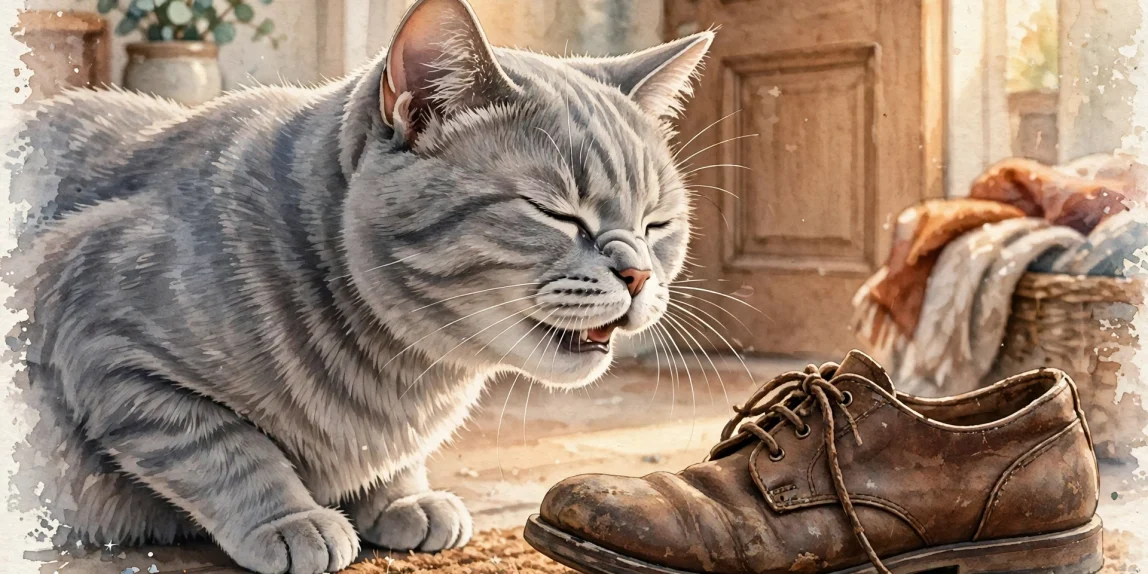
And the nose you can see is only half the equipment. A cat has a second scent organ, the vomeronasal organ — Jacobson’s organ — sitting in the roof of the mouth, specialized for reading pheromones and the heavy social chemistry cats leave for each other. When a scent is interesting enough to deserve the full laboratory, the cat opens its mouth slightly, curls the upper lip, and holds a face that looks for all the world like it just heard a bad joke. That is the flehmen response, and it is not disgust. The cat is drawing the scent across that second organ to have it analyzed properly. You are watching an animal taste a smell, and the smell deserved it.
Smell is not a hobby for a cat; it is the original equipment. Kittens are born with their eyes sealed shut, and for the first weeks of life they navigate the world — find their mother, find the milk, find their littermates in the pile — by scent alone. The nose is working before the eyes ever open. It never really retires. For the rest of the cat’s life, scent remains the ID card and the map: this person is mine, this room is safe, this blanket is home, that smell on your shoes is a strange cat and an outrage. The cat is not being nosy. The cat is reading its mail.
WHAT THE CAT KNOWS ABOUT YOU THAT YOU NEVER SAID
Here is where the posters get romantic, so let us be careful and land this at the strength the evidence actually supports. The solid part first: your cat knows your scent the way you know a face. Cats can tell their own person’s smell from a stranger’s — show them both and they linger over the stranger’s, because the stranger is news and you are the known world. They know your voice on the same terms. Your particular smell is, to the cat, a landmark: the smell of the safe person, the feeding person, home base.
Now the part about feelings. You will read that cats can smell your fear, your sadness, your anxiety. The strong version of that research — animals reading human emotion straight off body chemistry — belongs mostly to dogs, who have been studied at it for years. For cats, the honest version is smaller and, to my mind, more interesting. Your scent is not constant. It shifts with sweat, with stress, with illness, with hormones, with the medication you started last Tuesday. A cat that has memorized your baseline will notice when the reading changes, the same way it notices a moved chair — and may act different around you because of it: closer, or warier, or simply more attentive. The cat is not reading your mind. The cat is reading your chemistry, and your chemistry does not keep secrets as well as you do.
The same principle explains the rest of the poster’s claims, at their true size. Does the cat know who visited your home while you were out? The cat knows someone was there — a new scent on the couch, the mat, the air by the door — and will go investigate it like a detective working a scene, because that is exactly what it is. Does the cat know which places are safe and which are dangerous? The cat keeps a scent map of its territory, refreshed daily, and treats anything unfamiliar on that map as a question to be answered slowly, from a distance, or not at all. That is not superstition. That is an animal whose first and best instrument says: the world is what it smells like, and this does not smell like yesterday.
AND THE CAT MARKS YOU BACK
One short stop, because another chapter of this book — “Reading Your Cat,” the ears-tail-and-posture one — gives this its full treatment and there is no sense doing the job twice. When the cat rubs its cheeks and forehead against you, it is laying its own scent on you from glands in the face and mixing it with yours: one shared group smell, the paperwork of belonging. You are being filed. In Cat, being claimed and being loved are the same sentence. The details are in that chapter; here it is enough to know the traffic runs both ways — you are as legible to the cat as the cat, on its good days, is to you.
EARS LIKE SATELLITE DISHES
The ears are the second instrument, and they are not far behind the nose. You hear up to about twenty thousand cycles a second, and less every birthday. A cat hears on past sixty thousand — deep into the ultrasonic, which is not an accident of engineering. That is the band where rodents talk and rustle, the high squeaks and scratchings of prey that your ears file under silence. The cat staring at a blank wall is frequently a cat listening to a concert you are not equipped to attend.
The hardware moves, too. Each ear is run by its own set of muscles and can swivel like a dish — turning, tilting, aiming at a sound, the two ears working independently to triangulate where it came from. It is the same twilight-hunter kit another chapter of this book meets at three in the morning: built to find small things moving in dim light and near-darkness, by ear as much as by eye. You live with a creature whose resting state is a surveillance system. The least we can do is be flattered it mostly surveils for snacks.
THE TONGUE IS A TOOL, AND TASTE IS THE RUMOR
Then there is the sandpaper. A cat’s tongue is covered in tiny backward-facing spines called papillae, and in 2018 researchers at Georgia Tech put them under the microscope and found they are cleverer than anyone had said: each spine is hollow, shaped like a tiny scoop, and it wicks saliva down into the fur — all the way to the skin. That is how a cat actually gets clean with nothing but spit and persistence: the tongue is a comb and a delivery system in one, and the same spines strip meat off bone neatly enough to embarrass a fork. It is also why the licking feels like being sanded by a devoted carpenter, and why all that groomed fur, swallowed on the way through, occasionally returns as a hairball. Every tool has a byproduct.
The comedy is that taste — the sense the tongue is famous for — is the cat’s weakest channel. Cats run a few hundred taste buds to your nine thousand or so, and they are missing one entirely: cats cannot taste sweet. The receptor for it is broken in their wiring, permanently, in every cat from housecat to tiger. A cat is a true carnivore and its tongue keeps the faith — meat registers, sweetness is a rumor it has never heard. So when the cat turns down your ice cream, it is not manners. To the cat, you are offering cold fat with nothing in it worth naming.
THEY KNOW THEIR NAME. THEY ARE JUST NOT STAFF.
Which brings us to the fact that ends every argument about whether cats are paying attention. In 2019, researchers in Japan — Saito and colleagues — played cats recordings of words and watched what happened. The cats distinguished their own name from other words that sounded similar, and from the names of other cats they lived with: ears turned, heads moved, the small signs of an animal registering that this sound, out of all the sounds, is the one that means them. Recognition is real, and it is measured.
What is also real is that knowing and coming are different departments. The same animal that can pick its name out of a list will hear it, understand it perfectly, and decide that the sunbeam is winning. Dogs were bred for millennia to treat a human voice as an instruction. Cats were bred by nobody, for nothing, and treat a human voice as information — to be weighed, like everything else in their scented, sounding, thoroughly-read world, and acted on at the cat’s discretion. They understand more than we think. They have simply never signed the agreement that understanding requires obedience.
The cat knows your smell, your voice, your schedule, and your name for it — and loves you in a language of scent and small print. Learn to read even a little of it back, and you will never call a cat aloof again. — YNOT!