Think of it as Yoga for the brain, we are going to stretch a bit.
One of the Most Important Things to Understand About Cats — Temperature Control
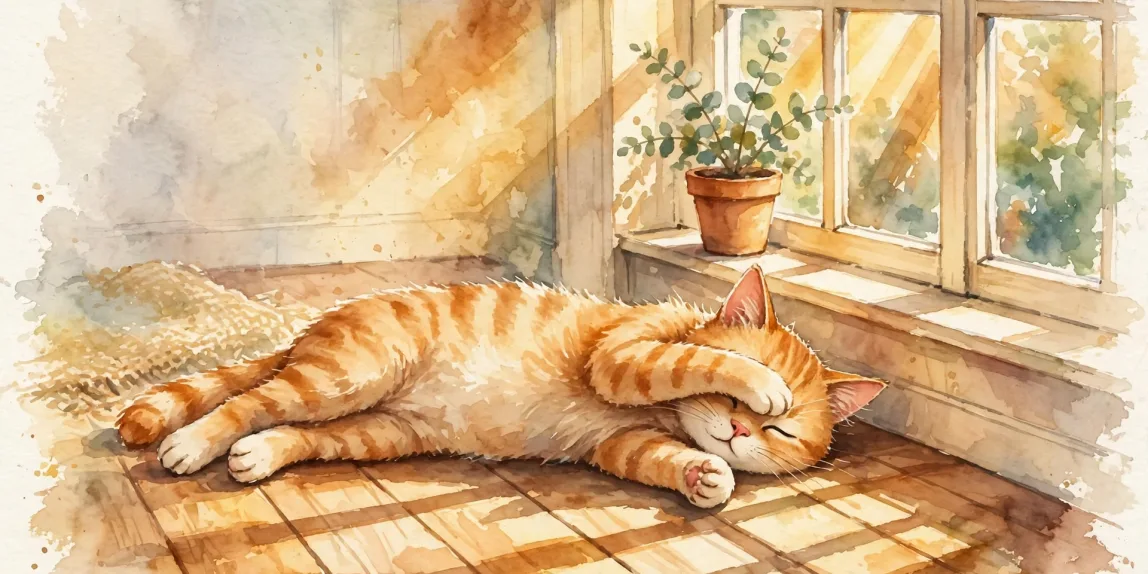
Your cat is not lazy for sleeping in the sunbeam. She is running a heating system older than the furnace, older than the house, older than the species that built both — and the sun works for free. -- YNOT!
Look at the evidence and it seems to make no sense. Your cat runs hotter inside than you do. She wears a fur coat she never takes off. And still she will walk past three good chairs to sleep on top of the warm refrigerator, in a patch of sunlight, on your laptop, in the laundry fresh from the dryer. Hotter, furrier, and forever hunting for more heat. It looks like a contradiction. It is a system — and once you understand it, half of what your cat does all day stops being a mystery and starts being arithmetic.
YOUR CAT RUNS HOTTER THAN YOU DO
Start with the thermometer, because the numbers surprise people. A healthy cat’s normal body temperature is 100.5 to 102.5 degrees Fahrenheit. Yours, on a good day, is 97 to 99. Your cat is idling a couple of degrees warmer than you are, all day, every day, in a body a tenth your size.
But here is the part the thermometer doesn’t tell you: running hotter does not mean feeling hotter. It means paying more. Every degree of body heat is manufactured out of food, and the higher the temperature, the more the furnace charges to hold it. Her whole relationship with warmth is not about comfort in our sense. It is about energy — what it costs to be a cat, and how little she intends to spend on anything she can get for free.
HER COMFORT ZONE IS NOT YOUR COMFORT ZONE
Scientists have a term for the air-temperature range where an animal spends almost no extra energy holding its own temperature: the thermoneutral zone. Inside that range, the furnace idles. Outside it, the animal starts paying — burning calories to warm up, or working to cool down. The veterinary behavior folks at the American Veterinary Society of Animal Behavior estimate the cat’s thermoneutral zone at roughly 86 to 101 degrees. Read that again. The air temperature at which she spends nothing at all to be comfortable starts at about eighty-six.
Now look at your thermostat. Seventy-two, if your house is like most houses — a number chosen by a species whose comfort zone sits far lower. To you, seventy-two is a pleasant room. To your cat, it is a room quietly charging her rent: not dangerous, not miserable — just a few degrees she must manufacture or go find. So she goes and finds it — the sun patch, the warm spot over the refrigerator motor, your lap. She is not spoiled, and she is not suffering. She is simply house-hunting, inside your house, for the climate she was built for — and filing a relocation claim about twice a day as the sun moves.
And before anyone reaches for the thermostat: nobody is prescribing an eighty-six-degree house. She does not need the whole building at her temperature — just one warm place in it, and the freedom to go there. The difference is your electric bill.
SHE COMES FROM DESERT PEOPLE
The domestic cat descends mainly from the African wildcat, an animal of the warm, dry country of North Africa and the Near East, and thousands of years of domestication have redecorated the cat without remodeling her. The desert is in the design. It is why she conserves water like a miser — another chapter takes that up at the water bowl. It is why her ancestors hunted at dawn and dusk and spent the blaze of midday motionless in the shade. It is why the legendary cat nap is not laziness but policy: in a country where food is scarce and heat is free, the winning strategy is to rest like it’s your job and let the sun carry the heating bill.
Her preference for warm resting places is not a quirk of your household. It is an heirloom. She was built by a climate, and she has been looking for that climate in every home since — including, at this moment, yours.
THE FUR IS A THERMOS, NOT A FURNACE
Which raises the obvious objection: if she loves heat so much, why the coat? Surely a fur coat in a warm room is like wearing a parka in July. It would be, if fur made heat. It doesn’t. Fur is insulation, and insulation is not a heater — it is a slow-down. A coat traps air against the body and slows heat moving in either direction, the way attic insulation does. In winter it keeps the cat’s own heat in. In summer it slows the outside heat getting in. The coat is not the furnace. The coat is the house the furnace lives in.
This is why shaving a healthy cat for the summer is generally a solution in search of a problem. You have not cooled the cat; you have stripped the insulation off the building and left the furnace exposed — and a shaved cat can have a harder time managing heat, not an easier one. The coat chapter covers the wardrobe in full; here it is enough to know the coat is climate equipment, grown on purpose, and smarter than it looks.
SUNBATHING IS JUST GOOD ACCOUNTING
So when you see your cat asleep in a patch of sunlight for three hours, know what you are looking at. She is not merely enjoying herself, though she is. She is letting the sun pay part of her heating bill. Every calorie she would have burned to stay warm is a calorie saved, and a cat is a biological energy-conservation machine — an animal engineered to spend as little as possible on anything except the hunt.
It is why the sun patch is occupied real estate, and why it moves across the floor all day, the cat following like a slow sundial with opinions. It is why she sleeps on the laptop and the cable box — warm electronics are small free furnaces. It is why the top of the refrigerator, where the motor’s heat rises, is prime territory. It is why the laundry basket, fresh from the dryer, must be sat in immediately, before the heat escapes. And it is at least part of why she sleeps on you. Whatever else you are to her — provider, servant, staff — you are also a ninety-eight-point-six-degree heated cushion that breathes. By cat accounting, you are the finest piece of furniture in the house.
HOW SHE RUNS HER OWN THERMOSTAT
The cat does not just find temperatures. She adjusts herself, and once you know the settings you can read them like dials. When she is cold, she makes herself small. The tight curl — nose to tail, everything tucked into a ball — is the minimum-surface position, the least amount of cat exposed to the room. The tail wraps around the outside like a scarf, sometimes right over the nose. The famous cat loaf, paws tucked underneath, is partly a heating position too: the paws are where the heat leaks, so she sits on them. In winter her coat thickens, and she goes looking for enclosed, elevated, insulated places — boxes, closets, the exact middle of your bed. Small, wrapped, and hidden is a cat turning her thermostat down to conservation.
When she is hot, she does the opposite of everything. She stretches out to her full ridiculous length on the cool tile, maximum cat exposed, dumping heat like a radiator laid flat. She seeks shade and goes still — the desert schedule. And she grooms, which is not vanity: moisture spread on the coat evaporates, and evaporation cools, making her tongue her one built-in swamp cooler. That is nearly the whole cooling department, because a cat barely sweats at all. What sweat glands she owns sit mostly in her paw pads — the damp little paw prints on the veterinarian’s steel table are about all her sweating you will ever see.
Which is why one sight gets no jokes in this book. A dog pants as a way of life; a cat does not. A cat may pant briefly after a hard play session and settle, and that is one thing. But a cat panting at rest — mouth open, breathing hard, doing nothing — is a cat in trouble: overheating, pain, or something worse, and it belongs on the first-aid chapter’s list of alarms. Her cooling system is too small for panting to be part of the plan. If she is panting, the plan has failed, and the veterinarian is the next step.
AND COLD IS NOT HER FRIEND EITHER
Warmth-loving is not the same as cold-proof, but she tolerates cool weather better than the folklore about delicate house cats suggests — especially a healthy adult acclimated to it, with shelter from wind and wet. Comfort, though, runs out before survival does. As rough guidelines — and they are only rough — prolonged exposure below about forty-five degrees gets increasingly risky, and below freezing the danger is real and named: hypothermia, and frostbite, which takes the ears, the tail, and the paws first. Age, health, wind, and wet all move the line — a soaked cat in a cold wind is in trouble at temperatures a dry, acclimated cat would shrug at. Kittens, seniors, and the sick have the least margin of all.
Breed moves the line too. A Maine Coon, a Siberian, a Norwegian Forest Cat is wearing expedition gear — built by cold countries, with the coats to prove it. A short-haired cat in the same weather is wearing a T-shirt. Same thermometer, different animals, and what decides who copes is not fairness. It is equipment.
THE FLORIDA CLAUSE
All of which makes Florida, most of the year, near the cat’s ancestral idea of a fair climate — a Florida cat lives nearer her comfort zone than a Minnesota cat ever gets. But Florida summer is the exception that tests the whole system, because Florida does not just send heat. It sends humidity. And humidity is the enemy of every cooling trick she owns: evaporation — the grooming, the modest paw-pad sweat — only works if the air has room for the moisture. In August air, the air is already full. Her swamp cooler is blowing into a swamp.
So the kind arrangement is not a house heated for the cat, nor one chilled for the people. It is a house with choices. The air conditioning running, yes — and also a sunny window for the morning bake. A shady corner. Cool tile. Fresh water out. Then step back and let her run her own thermostat by moving around the map — that is what the entire apparatus, desert ancestry to three-hour sunbath, is built to do. You do not set the temperature for a cat. You give the cat temperatures, and you trust the oldest climate-control system in the house to pick the right one.
Cats were doing passive solar heating, seasonal insulation, and zone climate control millions of years before anybody invented the thermostat. Your cat is not looking for the warm spot because she is spoiled. The warm spot is simply where a cat, correctly understood, lives. -- YNOT!