Think of it as Yoga for the brain, we are going to stretch a bit.
CUBA’S INFRASTRUCTURE IN THE 21ST CENTURY — HOW DID AN ENTIRE NATION FALL SO FAR BEHIND?
A nation’s progress is not measured by the grandeur of its promises, but by the reliability of its infrastructure. When the lights go out, the water stops flowing, and communication with the outside world becomes a privilege rather than a necessity, no amount of political rhetoric can illuminate the darkness. -- YNOT!
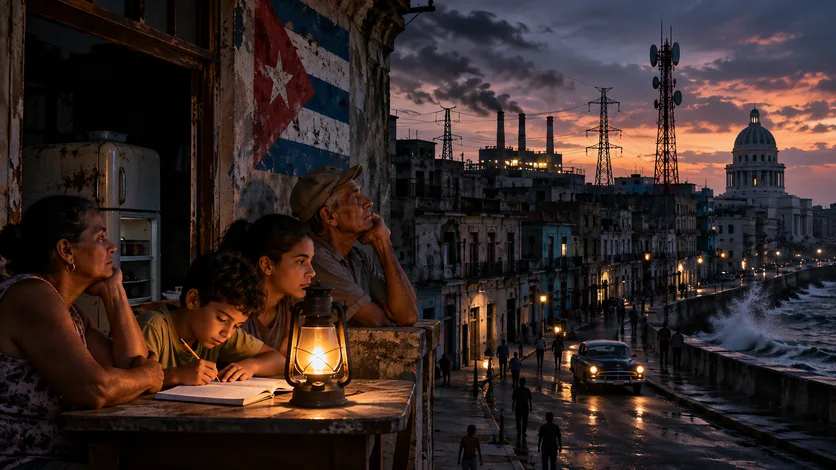
There was a time when the greatest technological challenge facing humanity was figuring out how to put a man on the moon. Today, in Cuba, one of the greatest technological challenges facing an ordinary family is figuring out when to plug in the refrigerator.
While much of the world is discussing artificial intelligence, fiber-optic networks, satellite communications, electric vehicles, robotics and the next generation of nuclear power plants, millions of Cubans are organizing their daily lives around the possibility that the electricity might come back on long enough to cook dinner.
Progress, it seems, has not been distributed equally.
Over the next several articles, I intend to examine Cuba’s infrastructure from a technical, economic and historical perspective. Who built it? Who owns it? Who maintains it? How does it operate? And how does it compare with the infrastructure of other countries in the 21st century?
Rather than relying exclusively on political speeches, ideological arguments or government promises, let us examine the machinery itself.
Machines, after all, are remarkably indifferent to political ideology. A turbine does not care what political party operates it. A transformer cannot be persuaded by a revolutionary speech, and a fiber-optic cable will not transmit information any faster because someone has declared it a national accomplishment.
Infrastructure either works or it doesn’t.
THE CARIBBEAN COMPARISON
Whenever Cuba’s economic and technological problems are discussed, someone inevitably objects to comparing Cuba with the United States.
That is understandable to a certain degree. The United States is an enormous country with substantially greater financial, industrial and technological resources.
So let us also compare Cuba with the Dominican Republic.
Both are Caribbean nations. Both have populations of approximately 11 million people. Both experience hurricanes, tropical weather, dependence on imported resources and the economic challenges associated with island geography.
Neither possesses the enormous domestic energy resources of the United States.
Yet their infrastructure has developed quite differently.
According to comparable World Bank figures for 2024, the percentage of the population using the internet was approximately:
Interestingly, the same World Bank statistics indicate that virtually everyone in Cuba, the Dominican Republic and the United States has access to electricity.
But there is a rather important distinction between having an electrical outlet in your house and having electricity coming out of it.
Statistics can tell us whether a house is connected to the electrical grid. They do not necessarily tell us whether the family living inside can keep its food refrigerated.
THE ELECTRICITY THAT NEVER ARRIVES
Cuba possesses a nationwide electrical network, large thermoelectric power stations, natural gas facilities, hydroelectric installations, solar farms and thousands of distributed generators.
Its problem is not that nobody ever thought of building power plants.
Many of Cuba’s major generating stations are decades old. Some were constructed with Soviet assistance and have undergone years of repairs, modifications and increasingly difficult maintenance.
A modern industrial economy requires more than constructing infrastructure. It must continuously maintain, modernize and eventually replace that infrastructure.
A power plant built forty years ago does not become a new power plant simply because somebody paints it.
Cuba has experienced repeated nationwide electrical grid collapses, prolonged regional blackouts, fuel shortages and mechanical failures at its largest generating stations.
In some communities, electricity has become something residents receive for a few hours between lengthy periods without it.
Consider the American experience.
According to the U.S. Energy Information Administration, American electricity customers experienced an average of approximately 11 hours of power interruptions throughout the entire year of 2024, including an exceptionally destructive hurricane season.
Approximately 80% of those interruptions were associated with major events.
There are Cuban families who experience that much disruption in a single day.
The Dominican Republic is certainly not immune to electrical problems. It continues to experience blackouts, aging distribution infrastructure, electricity theft, government subsidies and financial losses in its electrical sector.
The International Monetary Fund has repeatedly identified these as significant obstacles to Dominican economic development.
The Dominican Republic is not an electrical paradise. But its experience provides a useful comparison with Cuba, particularly regarding investment, private electricity generation and the modernization of infrastructure.
The difference is not that one country has problems and the other doesn’t.
The difference lies in the severity of those problems and the institutional and financial capacity to address them.
WHEN YOUR POWER PLANT SAILS AWAY
Beginning in 2019, Cuba contracted floating power plants from the Turkish company Karpowership.
These were essentially enormous electrical generating stations mounted on ships and barges, which could be connected directly to Cuba’s electrical grid.
At one point, these foreign-owned facilities reportedly supplied nearly a quarter of Cuba’s electricity generation.
There was, however, one unfortunate complication.
They belonged to somebody else.
And the people who owned them expected to be paid.
Cuban officials publicly acknowledged difficulties meeting their payment obligations because of shortages of foreign currency.
On November 2, 2026, the Turkish floating power station Erol Bey departed Havana Harbor.
The vessel had a generating capacity of 63 megawatts, although it had reportedly been inactive for months because of fuel shortages.
Its departure illustrates the limitations of depending on temporary foreign generating capacity without establishing a sustainable mechanism to finance and operate it.
Electricity cannot be purchased indefinitely with promises of future prosperity.
WHO ACTUALLY OWNS CUBA’S POWER PLANTS?
One of the more interesting discoveries in examining Cuba’s electrical infrastructure is how much foreign involvement there has been.
Cuba’s conventional electrical infrastructure is predominantly government-owned and operated through Unión Eléctrica.
However, other countries have contributed equipment, investment, technology and generating capacity.
Canada’s Sherritt International owns approximately one-third of Energas, a joint venture operating natural gas power plants in Cuba.
Turkey supplied privately owned floating power stations.
British investment participated in the development of biomass generation.
China has supplied financing, equipment and technical assistance for renewable energy projects.
Russia and the former Soviet Union have contributed conventional generating equipment, construction expertise, modernization assistance and fuel supplies.
Cuba’s electrical infrastructure is therefore not exclusively the product of Cuban engineering or Cuban investment.
It is an international collection of technologies, contracts and economic relationships, many of which require continuous access to foreign currency, replacement components and technical expertise.
The upcoming articles will examine these power plants individually, including their locations, generating capacity, ownership and operational challenges.
THE INTERNET WELCOME TO THE 21ST CENTURY – NOT
Electricity is only the beginning.
Let us examine the infrastructure that has arguably become the most important economic resource of the modern world: the internet.
Today, an ordinary American household might have access to multiple internet providers offering cable, fiber-optic broadband, cellular internet or satellite communications.
Depending on the location, an American can purchase a connection capable of transferring one billion bits of information every second.
In the Dominican Republic, residents can obtain internet services through competing telecommunications companies, including Claro and Altice. Fiber-optic broadband, mobile networks and satellite internet are also part of the country’s telecommunications landscape.
According to Ookla measurements published at the beginning of 2025, the Dominican Republic had median download speeds of approximately 40 Mbps for mobile internet and 44 Mbps for fixed broadband.
Cuba’s telecommunications environment is considerably different.
Virtually the entire civilian telecommunications network operates through one government-controlled company:
ETECSA — Empresa de Telecomunicaciones de Cuba.
ETECSA controls the mobile telephone network, residential internet services, public Wi-Fi infrastructure and the principal gateways connecting Cuba to the international internet.
For an ordinary Cuban dissatisfied with the performance, price or policies of ETECSA, switching to a competing mobile network is not an ordinary consumer option.
Imagine if every American internet provider, telephone company and cellular carrier were consolidated into one government-controlled telecommunications company.
Now imagine that the same government was responsible for regulating that company and determining what communications were permissible.
That gives you some idea of the institutional structure of Cuba’s telecommunications system.
HOW CUBA CONNECTS TO THE OUTSIDE WORLD
Contrary to what some people believe, Cuba is connected to the global internet through modern submarine fiber-optic cables.
Its two principal civilian cable systems are:
• ALBA-1, connecting Cuba with Venezuela and Jamaica.
• ARIMAO, connecting Cuba with Martinique, a French overseas territory.
In January 2025, ETECSA reported that Cuba’s international internet connection capacity had increased to approximately 380 gigabits per second.
That was three times the capacity reported for 2021.
It sounds impressive until one considers that this international bandwidth must help serve millions of people.
There are American universities, corporations and data centers that operate network connections measured in hundreds of gigabits or even terabits per second.
Cuba’s reported 380 Gbps international capacity is equivalent to the combined maximum bandwidth of 380 ordinary gigabit internet subscriptions.
That does not mean Cuba can only support 380 customers. Internet networks share bandwidth among users, and not all traffic travels internationally.
Nevertheless, it provides some perspective on the technological scale involved.
And unlike the Dominican Republic and many other Caribbean destinations, Cuba has limited diversity in its civilian international connections.
An additional cable connection involving an American-linked network was proposed, but U.S. authorities recommended rejecting the proposal in 2022, citing national security and surveillance concerns.
That is part of the story too. American restrictions have affected Cuba’s connectivity, and an examination of its infrastructure would be incomplete without acknowledging them.
INTERNET ACCESS IS NOT NECESSARILY INTERNET FREEDOM
Imagine purchasing an automobile and discovering that the company selling it could decide which roads you were permitted to drive on.
Now imagine that the company could deactivate your automobile whenever you attempted to visit somebody it considered undesirable.
That is one way of understanding the risks associated with centralized telecommunications control.
Cuba has documented instances of website blocking, social media restrictions, targeted internet disconnections and widespread network disruptions during political demonstrations.
Independent news organizations have had their websites blocked.
Human rights organizations have documented prison sentences associated with online political expression.
In 2025, Freedom House reported the case of a Cuban man sentenced to five years in prison following a Facebook post criticizing the government and encouraging a demonstration.
There are technological limitations to Cuba’s internet, but there are also political and legal limitations.
A fiber-optic cable can carry information in either direction. Whether people are permitted to exchange that information freely is another matter entirely.
THE COST OF BEING CONNECTED
In 2025, ETECSA introduced controversial changes to mobile internet pricing.
Ordinary domestic top-ups were restricted, while additional data packages became substantially more expensive.
Some additional mobile data packages cost more than an entire month’s minimum wage.
For Cuban families receiving financial assistance from relatives in Miami, Madrid, Toronto or elsewhere, international mobile top-ups can help alleviate the problem.
For families dependent exclusively on domestic wages, the situation is considerably more difficult.
Imagine paying your monthly salary for the privilege of downloading a few movies, attending online classes or communicating regularly with your family overseas.
The internet is not merely entertainment anymore.
It is how people apply for employment, conduct business, access educational materials, obtain technical information, communicate with customers and participate in the international economy.
When internet access becomes prohibitively expensive, economic opportunity becomes prohibitively expensive with it.
WHAT ABOUT STARLINK?
Satellite internet represents one of the most significant technological developments of recent years, particularly for geographically isolated communities.
A person living in a remote region can potentially obtain high-speed connectivity without waiting for a telecommunications company to install hundreds of miles of fiber-optic cable.
Starlink is available in the United States and the Dominican Republic.
Cuba, however, has not authorized ordinary consumer access to Starlink.
The technology exists. The satellites exist. The receivers exist.
But operating such equipment involves regulatory restrictions that prevent ordinary Cubans from freely adopting it.
Satellite internet would not solve all of Cuba’s telecommunications problems. It would still require electrical power, affordable equipment and authorized service.
Nevertheless, it offers an alternative architecture that illustrates the importance of technological competition and independent connectivity.
THE DOMINO EFFECT — WHEN EVERYTHING DEPENDS ON EVERYTHING ELSE
Modern infrastructure is not a collection of independent systems.
It is an interconnected network of systems that depend on one another.
Electricity powers telecommunications.
Telecommunications support banking, businesses and emergency services.
Electric pumps provide drinking water.
Refrigeration preserves food and medicine.
Transportation networks deliver fuel, replacement parts and agricultural products.
Hospitals depend on all of them.
When electricity fails, the mobile telephone towers eventually run out of backup power.
When the mobile telephone towers fail, businesses cannot communicate reliably.
When water pumps fail, households lose running water.
When refrigeration fails, food spoils and medicines may become unusable.
When transportation fails, the equipment necessary to repair the other systems may never arrive.
According to Cuban government infrastructure reporting, approximately half of the country’s mobile radio base stations lacked backup power around the beginning of 2025.
This means that even if Cuba possessed unlimited international internet bandwidth, millions of people could still lose connectivity when the electrical grid fails.
You cannot operate a digital economy with an unreliable electrical grid any more than you can operate a modern hospital with an unreliable water supply.
THE COMPARISON WITH HAITI
Haiti provides another important Caribbean comparison.
According to World Bank figures, approximately 54% of Haiti’s population had access to electricity in 2024, while approximately 48% used the internet.
Haiti faces enormous challenges involving political instability, violence, poverty, natural disasters and weak institutional capacity.
Cuba has historically achieved much broader electrical coverage and higher levels of internet adoption than Haiti.
That distinction deserves acknowledgment.
Cuba’s infrastructure crisis is not identical to Haiti’s.
Cuba’s challenge is largely the deterioration and inadequate modernization of an extensive infrastructure that was already established.
Haiti faces the additional challenge of providing essential infrastructure in communities that have historically lacked it altogether.
Both demonstrate that constructing infrastructure, financing it, protecting it and maintaining it require functioning institutions as well as technology.
IS EVERYTHING THE RESULT OF THE AMERICAN EMBARGO?
No serious examination of Cuba’s infrastructure can ignore the American embargo, financial restrictions, sanctions and their consequences for international commerce.
These policies can complicate access to financing, equipment, banking services, foreign suppliers and international investment.
They are legitimate factors to examine. But they are not the only factors.
An embargo does not explain a government’s choice to maintain a telecommunications monopoly.
It does not fully explain restrictions on independent community computer networks.
It does not explain criminal penalties for peaceful online criticism.
Nor does it eliminate the need for sustainable financial management, preventive maintenance, investment priorities and accountability.
Conversely, it would also be inaccurate to suggest that Cuba’s infrastructure problems have developed in complete isolation from international economic pressures.
A proper examination must consider both domestic policy and external restrictions, alongside the collapse of Soviet economic assistance, dependence on imported fuel, declining Venezuelan support, the pandemic, tourism disruptions and demographic changes.
The purpose of this series is to investigate how these factors interact, rather than pretending that a single explanation answers every question.
WHAT WE WILL EXAMINE NEXT
This series will examine the physical, technological and economic foundations of modern Cuba.
PART I — CUBA’S ELECTRICAL INFRASTRUCTURE
A detailed examination of the country’s land-based power stations, Turkish floating power plants, natural gas facilities, renewable energy projects, generating capacity, ownership and national electrical grid.
PART II — CUBA’S INTERNET AND TELECOMMUNICATIONS INFRASTRUCTURE
An examination of submarine fiber-optic cables, international bandwidth, cellular networks, internet pricing, government ownership, censorship, surveillance and satellite internet restrictions.
PART III — CUBA’S WATER AND SEWAGE INFRASTRUCTURE
Where drinking water comes from, how it is distributed, the condition of pipelines, wastewater treatment and the effects of electrical failures.
PART IV — CUBA’S TRANSPORTATION INFRASTRUCTURE
Roads, bridges, railroads, airports, seaports, public transportation and the country’s dependence on imported vehicles, fuel and replacement parts.
PART V — CUBA’S HEALTHCARE INFRASTRUCTURE
Not simply the number of doctors, but the physical condition of hospitals, medical equipment, pharmaceutical production, emergency services, sanitation and access to reliable electricity and water.
PART VI — CUBA’S AGRICULTURAL AND FOOD DISTRIBUTION INFRASTRUCTURE
Food production, agricultural equipment, irrigation, refrigeration, storage facilities, imports and distribution networks.
PART VII — WHAT WOULD IT TAKE TO REBUILD CUBA?
The economic, technological, financial and institutional requirements necessary to restore and modernize Cuba’s essential infrastructure.
THE REAL MEASURE OF A COUNTRY
A country’s infrastructure should not be measured exclusively by the number of power plants it has constructed, the number of hospitals it has opened or the number of citizens theoretically connected to the internet.
It should also be measured by how well those systems serve the people who depend on them.
Can a family keep its food refrigerated?
Can a child study at night?
Can a business communicate with its customers?
Can a hospital operate its medical equipment?
Can a household obtain clean drinking water?
Can an engineer purchase the equipment necessary to repair a broken machine?
Can an ordinary citizen communicate freely with the outside world?
These are not particularly extravagant expectations in the 21st century.
They are the basic foundations upon which modern civilization operates.
Cuba possesses educated people, experienced engineers, skilled technicians, valuable natural resources, strategic geography and considerable economic potential.
The Cuban people are not lacking in intelligence, ingenuity or the ability to improvise.
Indeed, their ingenuity is demonstrated daily by their ability to keep aging automobiles, machinery and equipment functioning under extraordinarily difficult circumstances.
But ingenuity should be something a society uses to advance itself, not something its citizens must constantly employ merely to survive.
A country should not have to rely indefinitely on the remarkable ability of its people to repair what should have been replaced decades ago.
Civilization is not maintained by revolutionary anniversaries, political speeches or impressive statistics.
It is maintained by investment, engineering, maintenance, productive institutions and the ability to acknowledge and correct mistakes.
The ultimate measure of progress is not what a government promises its people tomorrow.
It is what its people can depend on today.
———
Cuba’s Power Plants — Locations and Ownership
The map below identifies the major land-based power stations, the three Cuban-Canadian natural gas plants, selected renewable energy facilities and the historical locations of the Turkish floating power stations.
One particularly interesting discovery is that Turkey is not the only foreign country with a commercial interest in Cuba’s electricity generation. Canada also has a substantial investment through Sherritt International.
Interactive map
Thermal: Cuban government-owned conventional power plants.
Natural gas: Cuban-Canadian joint venture.
Floating: Turkish-owned power ships, including former deployment locations.
Renewable: Selected hydroelectric, wind and biomass facilities.
Máximo Gómez2.8•State-owned thermal
Otto Parellada5.0•State-owned thermalOpen
Ernesto Che Guevara4.3•State-owned thermal
Antonio Guiteras1.7•State-owned thermal
Carlos Manuel de CéspedesState-owned thermalClosed
10 de OctubreState-owned thermal
Lidio Ramón Pérez2.7•State-owned thermal
Moa Diesel Power Station3.0•State-owned thermal
Antonio Maceo3.6•State-owned thermal
Energas Boca de Jaruco3.9•Cuban-Canadian natural gas
Energas Puerto EscondidoCuban-Canadian natural gas
Some markers represent the municipality or harbor rather than the precise generating equipment location.
1. Land-based thermoelectric power plants
These form the backbone of Cuba’s traditional electrical grid. Most burn crude oil or heavy fuel oil, and several date back to the Soviet era.
Power plant
Location
Installed capacity*
Owner
10 de Octubre
Nuevitas, Camagüey
503 MW
Cuban government
Lidio Ramón Pérez (Felton)
Holguín
500 MW
Cuban government
Máximo Gómez
Mariel, Artemisa
450 MW
Cuban government
Antonio Maceo (Renté)
Santiago de Cuba
450 MW
Cuban government
Carlos Manuel de Céspedes
Cienfuegos
382 MW
Cuban government
Antonio Guiteras
Matanzas
330 MW
Cuban government
Ernesto Che Guevara
Santa Cruz del Norte
300 MW
Cuban government
Moa Diesel Power Station
Moa, Holguín
184 MW
Cuban government
Otto Parellada (Tallapiedra)
Havana
Historical plant
Cuban government
The principal owner and operator is Unión Eléctrica (UNE), under Cuba’s Ministry of Energy and Mines.
*These figures represent historical or nominal installed capacity, not necessarily current usable capacity. Infrastructure databases differ because of retired, damaged and unavailable generating units. openinframap.org
2. Canadian-Cuban natural gas power plants
These three plants are operated through Energas S.A., a joint venture involving Canadian and Cuban interests.
Power plant
Location
Capacity
Technology
Boca de Jaruco
Mayabeque
313 MW
Combined-cycle natural gas
Varadero
Matanzas
173 MW
Combined-cycle natural gas
Puerto Escondido
Mayabeque
20 MW
Natural gas turbine
Total
506 MW
Ownership of Energas S.A.
Shareholder
Country
Ownership
Sherritt International Corporation
🇨🇦 Canada
33.33%
Unión Eléctrica (UNE)
🇨🇺 Cuba
33.33%
Unión Cuba Petróleo (CUPET)
🇨🇺 Cuba
33.33%
Sherritt describes Energas as Cuba’s largest independent energy producer, representing approximately 10% of the country’s installed electrical generating capacity. The joint venture agreement was extended until March 2043.
CUPET supplies the natural gas, and UNE purchases the electricity generated. sherritt
3. Turkish floating power plants — Patanas
All eight historically contracted floating power plants were supplied by Karpowership, part of Turkey’s privately owned Karadeniz Holding.
Floating power plant
Historical location
Rated capacity
Owner
Suheyla Sultan
Havana – Tallapiedra
240 MW
🇹🇷 Karpowership
Esra Sultan
Mariel
235 MW
🇹🇷 Karpowership
Erin Sultan
Havana / Santiago
130 MW
🇹🇷 Karpowership
Irem Sultan
Santiago de Cuba
114 MW
🇹🇷 Karpowership
Ela Sultan
Mariel
80 MW
🇹🇷 Karpowership
Erol Bey
Havana – Regla
63 MW
🇹🇷 Karpowership
Baris Bey
Mariel
40 MW
🇹🇷 Karpowership
Belgin Sultan
Havana
15 MW
🇹🇷 Karpowership
Combined historical vessel ratings
917 MW
The combined vessel ratings should not be confused with the capacity actually contracted, connected or available simultaneously in Cuba. Ships were deployed and withdrawn at different times. foresightcuba.substack.com
As of November 2, 2026, seven of the eight contracted vessels had reportedly departed Cuba, including the Erol Bey pictured in your original post. Cubanos por el Mundo
4. Renewable energy power plants
Cuba also has numerous smaller renewable energy installations.
Power plant or project
Location
Capacity
Ownership or involvement
Hanabanilla
Central Cuba
43 MW
🇨🇺 Cuban government
Gibara wind farms
Holguín
Approximately 10 MW
🇨🇺 Cuban government
Ciro Redondo biomass plant
Ciego de Ávila
60 MW
🇨🇺 Cuba / 🇬🇧 United Kingdom
La Herradura wind project
Las Tunas
83 MW project
🇨🇺 Cuban state sector
National solar expansion program
Multiple provinces
Multiple projects
🇨🇺 Cuban state / 🇨🇳 Chinese support
Chinese involvement in the solar program should not automatically be interpreted as Chinese ownership. Financing, construction, equipment supply and ownership are different commercial arrangements. openinframap.org
Ciro Redondo biomass plant
This is another significant foreign investment in Cuban electricity generation.
Company
Country
Ownership
Zerus S.A. (AZCUBA)
🇨🇺 Cuba
51%
Havana Energy Ltd.
🇬🇧 United Kingdom
49%
Shanghai Electric of China provided technology and financing through a supplier credit agreement valued at approximately $186 million.
The plant was designed to burn sugarcane waste and other biomass, although it has struggled to maintain its anticipated electricity output. Gem Wiki
5. Who really owns Cuba’s electrical infrastructure?
Country
Organization
Role
🇨🇺 Cuba
Unión Eléctrica
Most conventional power plants, transmission and distribution
🇨🇺 Cuba
CUPET
Fuel production and natural gas generation investment
🇨🇺 Cuba
AZCUBA / Zerus
Biomass electricity generation
🇨🇦 Canada
Sherritt International
One-third ownership of Energas
🇹🇷 Turkey
Karpowership
Foreign-owned contracted floating power plants
🇬🇧 United Kingdom
Havana Energy
49% ownership of Biopower
🇨🇳 China
Shanghai Electric and other suppliers
Financing, construction and equipment
🇷🇺 Russia / former USSR
Various organizations
Historical construction, technology and modernization assistance
6. More detailed infrastructure maps
These resources provide additional locations, including smaller generating stations not individually marked on my map.
What I find particularly interesting about Cuba’s electrical system is how internationally dependent it has become.
Cuba’s conventional plants are largely state-owned and rely heavily on aging infrastructure, much of it originating during the Soviet era. Canada participates in natural gas generation. Turkey provided emergency floating power stations. British investment helped develop biomass generation. China is supporting renewable energy development.
Despite access to all this international technology, investment and expertise, Cuba continues to experience a severe electricity crisis.
The problem involves not just generating capacity, but also maintenance, fuel availability, foreign currency shortages, financing, sanctions, aging transmission infrastructure and the ability to meet commercial obligations.
Cuba’s electricity crisis is not simply a shortage of power plants. It is also a shortage of the resources necessary to keep those power plants running.
The map is an overview of major facilities rather than an exhaustive inventory of every diesel generator, solar park and small hydroelectric installation. It also distinguishes historical floating power plant locations from permanent land-based assets; it should not be interpreted as a live vessel-tracking or power-generation map.
Inside Cuba’s Internet: Infrastructure, Capacity and Government Control
Research overview — November 2026
Cuba is no longer an island without internet access. Millions of Cubans use smartphones, Facebook, WhatsApp, YouTube and other international services. Cuba also possesses international fiber-optic connections and a domestic telecommunications network.
However, having internet access and having unrestricted, reliable and affordable internet access are very different things.
The most significant characteristic of Cuba’s internet infrastructure is that virtually the entire civilian population depends on a single government-controlled telecommunications provider, ETECSA.
This creates a centralized system in which the government can exercise control over both domestic connectivity and access to the international internet.
1. Cuba’s internet infrastructure at a glance
Indicator
Cuba
Population
Approximately 10.9 million
Internet users
7.79 million
Internet penetration
71.3%
Mobile cellular connections
8.14 million
Reported international bandwidth, January 2025
380 Gbps
Principal civilian submarine cables
2
Major civilian internet providers
1
Average fixed broadband download speed, 2026
3.83 Mbps
Average mobile download speed, 2026
4.02 Mbps
IPv6 adoption
3%
Active autonomous systems
3
Popular websites available through local servers or caches
7%
Sources include Internet Society Pulse, DataReportal, GSMA Intelligence and statements from ETECSA. The statistics have different reporting dates; the speed measurements are sample-based estimates, and subscriber counts do not necessarily represent unique individuals. Internet Society Pulse
One particularly important statistic is the limited amount of international content hosted or cached inside Cuba. The Internet Society reports that only 7% of the 1,000 most-visited websites can be accessed through local infrastructure, compared with 70% across the Americas.
That places additional pressure on Cuba’s international connections. Internet Society Pulse
2. How Cuba connects to the outside world
Cuba has four international submarine fiber-optic cable systems landing on the island. However, only two serve the civilian Cuban telecommunications network.
Cable
International connection
Activated
Ownership
ALBA-1
Venezuela – Cuba – Jamaica
2013
Cuban-Venezuelan joint venture
ARIMAO
Cuba – Martinique
2023
ETECSA and Orange, France
GTMO-1
Florida – Guantánamo Bay
2016
U.S. government
GTMO-PR
Puerto Rico – Guantánamo Bay
2019
U.S. government
ARCOS-1 Cuba extension
Proposed connection to U.S.-linked network
Not operational
Proposed commercial connection
The two American military cables do not provide ordinary Cuban citizens with internet access. geocables.com
Map of international submarine cable connections
ALBA-1 Cuban landing stationCivilian fiber
ALBA-1 Venezuela3.7•Civilian fiberOpen
ALBA-1 Jamaica4.3•Civilian fiber
ARIMAO Cuban landing stationCivilian fiber
ARIMAO French Caribbean connection3.6•Civilian fiberOpen
U.S. military fiber landing3.5•Military fiberOpen
GTMO-1 Florida connection3.5•Military fiberOpen
GTMO-PR connection4.0•Military fiber
Proposed ARCOS-1 landing5.0•Not operational
The markers represent cable endpoints, not the precise underwater routes.
ALBA-1 — The Venezuelan connection
Before ALBA-1 became operational, Cuba depended heavily on international satellite connectivity, which was expensive, relatively slow and limited in capacity.
The ALBA-1 cable was installed through a joint venture called Telecomunicaciones Gran Caribe (TGC).
Shareholder
Ownership
Telecom Venezuela
60%
Cuban telecommunications company Transbit
40%
The cable system measures approximately 1,860 kilometers. It became Cuba’s first major civilian international fiber-optic connection. geocables.com
ARIMAO — The French connection
The ARIMAO cable connects Cienfuegos, Cuba, with Schœlcher, Martinique, a French overseas territory.
Specification
Details
Length
2,470 km
Operational year
2023
Cuban partner
ETECSA
French partner
Orange
Purpose
Additional international capacity and redundancy
Individual cable capacity
Not publicly verified
In January 2025, ETECSA executive president Tania Velázquez announced that expansions associated with ARIMAO had increased Cuba’s overall international connection capacity to 380 Gbps, approximately three times its 2021 capacity. submarinecablemap.com
Why isn’t Cuba connected directly to Miami?
Geographically, Cuba is extremely close to one of the largest telecommunications hubs in the Western Hemisphere.
A commercial connection was proposed through the existing ARCOS-1 Caribbean submarine cable system, with a new landing station in Cojímar, near Havana.
The proposed system would have provided:
Initial capacity of 100 Gbps.
Planned expanded capacity of 1.6 Tbps.
A more direct connection to international telecommunications infrastructure.
However, on November 30, 2022, the U.S. government’s Team Telecom recommended that the FCC deny the application.
The Justice Department cited national security concerns involving ETECSA’s control of the Cuban landing station, potential interception of American communications and Cuba’s intelligence relationships with Russia and China.
This is an important distinction: Cuba’s international connectivity is constrained both by its own domestic telecommunications policies and by U.S. national security and sanctions policies.submarinenetworks.com
3. How much international bandwidth does Cuba really have?
The most recent clearly documented aggregate capacity figure I located is 380 Gbps, announced in January 2025.
Measurement
Capacity
Reported national capacity in 2021
Approximately 127 Gbps
Reported national capacity in 2025
380 Gbps
Proposed ARCOS-1 expanded capacity
1,600 Gbps
The 2021 figure is inferred from ETECSA’s statement that capacity had tripled. I could not verify an updated aggregate capacity figure for November 2026. kpl.gov.la
To put 380 Gbps into perspective, it represents the equivalent of just 380 fully utilized gigabit residential internet connections.
Obviously, millions of people do not use their maximum bandwidth simultaneously, and domestic traffic does not necessarily travel internationally. Nevertheless, it illustrates the limitations of the country’s reported international capacity.
Dividing 380 Gbps among 7.79 million internet users would theoretically provide approximately 49 Kbps per user if everyone accessed international content simultaneously.
That is roughly equivalent to an old dial-up modem connection. This is a theoretical illustration, not a measurement of actual consumer speed.
4. Who owns and controls the Cuban internet?
The primary organization is ETECSA — Empresa de Telecomunicaciones de Cuba S.A.
Established in 1994, ETECSA operates virtually all of Cuba’s public telecommunications infrastructure.
Service
Provider or controlling organization
Landline telephone network
ETECSA
Mobile telephone network
Cubacel / ETECSA
Residential internet
Nauta Hogar / ETECSA
Public Wi-Fi
ETECSA
International internet gateways
ETECSA
Domestic telecommunications backbone
ETECSA
Commercial internet access
ETECSA
National internet exchange
ETECSA
Telecommunications regulation
Ministry of Communications (MINCOM)
Under Decree 124/2025, ETECSA’s telecommunications concession runs through December 31, 2036, with provisions allowing extensions.
Ordinary Cuban entrepreneurs cannot simply establish a competing public ISP, purchase international bandwidth and sell unrestricted internet access to their neighbors. Cuban regulations restrict private businesses from operating public telecommunications infrastructure and providing various telecommunications services. LatAm Thread
Simplified network architecture
            GLOBAL INTERNET
                    │
        International Transit Providers
                    │
         ┌──────────┴──────────┐
         │                     │
      ALBA-1                ARIMAO
      Venezuela             Martinique
      and Jamaica           France
         │                     │
         └──────────┬──────────┘
                    │
            ETECSA GATEWAYS
                    │
          Routing and Traffic Control
                    │
         National Fiber Backbone
                    │
       ┌────────┬───┴────┬──────────┐
       │        │        │          │
    Mobile    Nauta    Public    Government
    Towers    Hogar     Wi-Fi    Institutions
       │        │        │          │
       └────────┴────────┴──────────┘
                    │
              Cuban Citizens
This is a conceptual architecture, not a disclosed engineering diagram of ETECSA’s internal network.
The significant feature is the concentration of control at the network operator level. Cuba has multiple physical connections, but very little independent network competition.
Technical information for network administrators
ETECSA’s public BGP routing information includes:
Network parameter
Details
ASN
AS11960
Organization
ETECSA / IXP Cuba
ASN
AS27725
Organization
ETECSA / INFOCOM
Example IPv4 allocation
152.206.0.0/17
Example IPv6 allocation
2001:1358::/32
International upstream diversity
Poor, according to Internet Society
Public BGP observations show AS27725 connecting through AS11960, another ETECSA-controlled network.
You can examine the public routing information yourself:
These public routing tables illustrate network concentration but do not reveal every private interconnection or the government’s internal surveillance architecture. Hurricane Electric BGP Toolkit
5. Cuba’s domestic internet infrastructure
Cuban government figures covering 2024 and early 2025 identified the following infrastructure:
Infrastructure
Reported quantity
Mobile telephone lines
Approximately 8 million
Mobile radio base stations
5,600
Public Wi-Fi areas
1,171
Public internet browsing rooms
397
Nauta Hogar residential connections
Approximately 290,000
Installed landline connections
1.7 million
Residential landlines
1.26 million
Mobile devices supporting 4G
76%
Radio base stations without backup power
Approximately 50%
Average monthly mobile data consumption
9.9 GB
These are historical infrastructure figures, rather than a live inventory for November 2026. Urban Agenda Platform
Mobile internet
Mobile connectivity is the primary means through which ordinary Cubans access the internet.
Cuba only introduced broadly available mobile internet service in December 2018. Its networks include 2G, 3G and 4G LTE infrastructure.
Huawei and ZTE equipment has been reported in Cuba’s telecommunications sector. However, I could not establish a current breakdown of equipment manufacturers or their respective market shares.
Residential internet
ETECSA’s Nauta Hogar service historically relies on ADSL over existing telephone copper lines.
Unlike a typical American household with cable broadband or fiber-to-the-home service, Cuban households have traditionally faced limited connection speeds and monthly browsing allowances.
Historically advertised packages included speeds ranging from approximately 1 to 4 Mbps, with monthly allowances of 30 to 120 hours.
Residential fixed broadband remains far less widespread than mobile access. Freedom House
6. What does internet access cost an ordinary Cuban?
In May 2025, ETECSA introduced controversial changes to domestic mobile top-ups and data pricing.
The following are published consumer packages, expressed in Cuban pesos (CUP).
Standard mobile data packages
Data allowance
Price
2 GB
120 CUP
4 GB
240 CUP
4.5 GB
240 CUP
6 GB
360 CUP
Ordinary domestic top-ups are generally restricted to 360 CUP within a 30-day period under the policy introduced in 2025.
Customers may obtain additional data, but at substantially higher prices.
Additional data packages
Additional data
Price
Percentage of the historical 2,100 CUP minimum monthly wage
3 GB
3,360 CUP
160%
7 GB
6,720 CUP
320%
15 GB
11,760 CUP
560%
The wage comparison uses the 2,100 CUP minimum established in 2021, not a verified current wage for every Cuban worker.
Packages payable in U.S. dollars
Package
Price
4 GB
$10
8 GB
$20
16 GB
$35
International top-ups purchased by relatives living abroad offer another way for Cubans to obtain mobile data.
These arrangements create substantial differences between households receiving financial assistance from abroad and those dependent entirely on local peso incomes. help.fonoma.com
The Internet Society estimates that a basic mobile internet consumption basket costs approximately 30% of average income in Cuba. Internet Society Pulse
What can someone do with 6 GB?
Approximate data consumption varies by application and video quality.
Activity
Approximate usage
Basic email and messaging
Relatively low
One hour of web browsing
50–150 MB
One hour of video calling
200–800 MB
One hour of standard-definition YouTube
500–700 MB
One hour of HD YouTube
1–3 GB
Downloading a major computer software update
Potentially several GB
A Cuban relying on the standard 6 GB package could consume most of their monthly allowance in a few hours of high-definition video streaming.
7. What controls does the Cuban government impose?
Cuba exercises several distinct forms of internet control, ranging from technical restrictions to criminal penalties.
Control mechanism
Documented status
Government telecommunications monopoly
In place
Centralized international gateways
In place
Website blocking
Documented
IP address and traffic filtering
Documented
Deep packet inspection (DPI)
Reported evidence
Selective bandwidth throttling
Documented
Individual account disconnection
Documented
Regional internet shutdowns
Documented
Nationwide internet shutdowns
Documented
Blocking VPN services
Documented
Restrictions on independent ISPs
In place
Restrictions on satellite internet
In place
Monitoring online political activity
Documented
Criminal prosecution for online expression
Documented
Sources include Freedom House, the Open Observatory of Network Interference (OONI) and the U.S. State Department. State Department
Website blocking
Unlike North Korea, Cuba does not completely isolate its ordinary citizens from the international internet. Instead, it selectively restricts access to certain websites and services.
Website or service
Reported accessibility
Google Search
Generally accessible
YouTube
Generally accessible
Gmail
Generally accessible
Facebook
Generally accessible; periodically restricted
WhatsApp
Generally accessible; periodically restricted
Telegram
Periodically restricted
Signal
Periodically restricted
TikTok
Periodically restricted
CubaNet
Reported blocked
14ymedio
Reported blocked
Diario de Cuba
Reported blocked
Miami Herald
Historically reported blocked
BBC
Generally accessible
Granma
Accessible
Cubadebate
Accessible
VPN services
Some accessible, others blocked
This is not a live accessibility test of each website. Restrictions can change depending on political events, network conditions and government decisions. Freedom House
Deep packet inspection
Deep packet inspection, or DPI, allows telecommunications operators to examine network traffic characteristics beyond basic source and destination IP addresses.
Research cited by Freedom House suggests that Cuba has used filtering technology associated with Chinese equipment manufacturers.
Such technology can potentially identify:
VPN protocols.
Messaging application traffic.
Unencrypted communications.
Particular websites and internet destinations.
Traffic patterns associated with video streaming.
Attempts to circumvent censorship.
DPI does not automatically give the government the ability to decrypt properly implemented HTTPS or end-to-end encrypted communications. However, it can facilitate traffic identification, blocking and surveillance.
The full extent of Cuba’s current DPI deployment is not publicly documented. Freedom House
8. Can the government shut down the internet?
Yes. There are documented examples of both nationwide and individually targeted restrictions.
Date
Event
Reported restriction
November 2020
Political demonstrations
Social media restrictions
July 11, 2021
Nationwide demonstrations
National outage and messaging service blocks
September 2022
Protests following Hurricane Ian
Repeated overnight internet disruptions
May 2023
Caimanera protests
Mobile connectivity disruptions
March 17, 2024
Protests over electricity and food shortages
Traffic reductions lasting approximately five hours
During the July 2021 protests, OONI independently detected restrictions affecting Signal, WhatsApp, Telegram, Facebook and TikTok.
Authorities have also reportedly disconnected individual journalists and activists without necessarily disrupting service for everyone else. ecoi.net
From a network administration perspective, throttling can sometimes be more difficult for users to recognize than a complete shutdown. Basic text messages might continue functioning while uploading videos or livestreaming becomes practically impossible.
9. Can Cubans be punished for what they post online?
Yes. Cuba has enacted several laws and regulations governing online communications.
Legislation
Purpose and implications
Decree-Law 370, 2018
Regulates computerization and certain online publications
Decree-Law 35, 2021
Regulates telecommunications and imposes obligations on service providers
Establishes criminal penalties applicable to certain online activities
Social Communication Law
Regulates media and online communications; effective October 2024
Cuban authorities justify many of these measures on grounds of national security, public order, cybersecurity and protection against foreign interference.
Human rights organizations argue that the broad wording of these provisions allows authorities to punish peaceful political criticism and independent journalism. Freedom House
Documented examples
José Manuel Barreiro Rouco: In September 2024, he received a two-and-a-half-year prison sentence after sharing memes about Cuban leaders in a private WhatsApp group.
Félix Daniel Pérez Ruiz: In January 2025, he received a five-year prison sentence following a Facebook post criticizing the government and encouraging a demonstration.
These cases were documented in Freedom House’s 2025 internet freedom report. Freedom House
10. Can the Cuban government read private WhatsApp messages?
Not automatically. It is important to distinguish between network surveillance and access to encrypted message contents.
Information
Potential visibility to telecommunications operator
Subscriber identity
Yes
Subscriber telephone number
Yes
Cellular tower location
Yes
Connection timestamps
Generally yes
Data consumption
Yes
Destination IP addresses
Generally yes
Some website domain information
Potentially
Unencrypted HTTP content
Yes
Ordinary unencrypted SMS
Potentially yes
Properly encrypted HTTPS content
Not directly
End-to-end encrypted WhatsApp messages
Not directly
VPN connection activity
Often detectable
Content inside a properly encrypted VPN
Not directly
Authorities could potentially gain access to private messages through device confiscation, compromised accounts, spyware, access to unencrypted backups or access to an unlocked telephone.
Freedom House’s 2026 report cites allegations that ETECSA facilitated the compromise of communications accounts belonging to activists and independent journalists.
There is no publicly established evidence that the Cuban government can universally decrypt WhatsApp communications. Freedom House
11. Why can’t Cubans simply use Starlink?
This is one of the most interesting developments in 2026.
Technologically, satellite internet could substantially reduce dependence on Cuba’s terrestrial telecommunications monopoly. A satellite terminal could communicate directly with an orbiting satellite rather than obtaining its internet connection through an ETECSA access network.
However, Starlink is not officially offered as a consumer service in Cuba.
November 2026 development
On November 9, 2026, Cuba’s Ministry of Foreign Affairs reportedly circulated a diplomatic communication reminding foreign embassies and international organizations that importing and operating Starlink equipment in Cuba was not authorized.
According to 14ymedio, the restrictions already applied to Cuban citizens and domestic businesses and were being expressly reiterated to foreign diplomatic missions. 14ymedio.com
Technology
Ordinary civilian availability
Starlink
Not officially available; unauthorized use restricted
OneWeb
No verified ordinary consumer service
HughesNet
No verified ordinary consumer service
Independent VSAT terminals
Subject to authorization and equipment restrictions
Satellite phones
Subject to telecommunications and import regulations
Unauthorized satellite terminals have reportedly entered Cuba, but their use carries legal risks.
The presence of satellite coverage over Cuba does not necessarily mean a terminal can legally or reliably obtain service there.
12. Cuba’s electricity crisis is becoming an internet crisis
This connects directly to our earlier research into Cuba’s power plants.
Even if Cuba doubled its international fiber bandwidth tomorrow, ordinary people would still need functioning mobile towers, routers, switches, telephone exchanges and associated backhaul equipment.
In April 2026, EFE reported that nearly half of Cuba’s telecommunications antennas lost service when electricity was interrupted. EFE Noticias
On September 24, 2026, CubaNet reported statements from ETECSA acknowledging the following conditions during a major electrical grid collapse:
Impact
Reported figure
Mobile radio base stations that lost service
More than 80%
Internet traffic reduction
Up to 58%
ETECSA also acknowledged that continuing to expand telecommunications infrastructure was not viable without adequate electrical backup systems. Cubanet
The resulting chain of failures looks like this:
Power generation failure
           ↓
National electrical grid failure
           ↓
Telecommunications batteries discharge
           ↓
Mobile towers and network equipment fail
           ↓
Remaining towers become congested
           ↓
Internet and telephone service deteriorate
           ↓
Businesses and emergency communications suffer
A telecommunications outage in Cuba is therefore not necessarily evidence of deliberate government censorship. It can also be the result of electrical failures, equipment shortages or network congestion.
13. Cuba’s offline internet — El Paquete Semanal
Cubans have developed remarkably inventive alternatives to traditional internet access.
One of the best known is El Paquete Semanal, or the Weekly Package.
It is essentially a manually distributed collection of digital content, historically containing approximately one terabyte of material.
It can contain television shows, movies, music, magazines, software, educational materials, advertisements and downloaded web content.
Instead of downloading everything individually, distributors copy the material onto hard drives and USB devices, which are then physically circulated throughout the country.
Cuba has also had community computer networks, most notably Havana’s SNET (Street Network).
SNET connected thousands of computers through privately organized wireless and wired connections, allowing participants to play games, exchange files and communicate locally. Regulatory changes in 2019 effectively ended its operation as a large independent community network, with services transferred to state-controlled institutions. Freedom House
14. Historical development of the Cuban internet
Year
Development
1994
ETECSA established
1996
Cuba obtains its first full international internet connection
2008
Mobile telephone ownership becomes more broadly available
2011
ALBA-1 submarine cable installed
2013
ALBA-1 begins carrying internet traffic
2015
Public Wi-Fi access expands
2017
Nauta Hogar residential internet introduced
2018
Public mobile internet service introduced
2019
4G LTE deployment expands; independent community networks face restrictions
2021
Nationwide internet restrictions during demonstrations; Decree-Law 35
2022
U.S. authorities recommend rejection of proposed ARCOS-1 connection
2023
ARIMAO submarine cable becomes operational
2024
Social Communication Law takes effect
2025
International bandwidth reported at 380 Gbps; mobile data pricing restrictions introduced
2026
Electrical crisis severely disrupts connectivity; satellite internet restrictions reiterated
15. What would be necessary to modernize Cuba’s internet?
From a telecommunications engineering and economic perspective, Cuba faces several challenges simultaneously.
Area
Required improvement
International connectivity
Additional submarine cables and independent transit routes
Bandwidth
Expansion into multi-terabit international capacity
Domestic backbone
Fiber capacity upgrades
Residential access
Fiber-to-the-home deployment
Mobile networks
Expanded LTE and eventual 5G deployment
Electrical infrastructure
Batteries, generators and renewable backup systems
Local hosting
Data centers and content delivery networks
Market competition
Independent telecommunications providers
Affordability
Prices proportionate to local incomes
Network resilience
Multiple independent operators and routes
Privacy
Stronger protections and independent oversight
Satellite internet
Clear licensing and consumer access arrangements
Increasing international bandwidth alone would not resolve these issues.
16. Independent monitoring resources
These are particularly useful if you want to investigate Cuba’s internet infrastructure from a technical perspective.
Cuba’s internet problem consists of five interconnected factors:
Infrastructure: Limited international capacity and aging domestic equipment.
Electricity: Frequent power failures that disable telecommunications equipment.
Economics: High consumer prices, foreign currency shortages and insufficient investment.
International politics: U.S. restrictions and national security disputes affecting international connectivity.
Government control: A state telecommunications monopoly, censorship, surveillance, restrictions on independent providers and penalties for certain online expression.
Cuba is not disconnected from the world. Millions of its citizens have access to the international internet. What distinguishes its system is the extraordinary concentration of telecommunications infrastructure and regulatory authority under the state.
A new submarine cable can increase bandwidth. New cellular towers can improve coverage. Satellite technology can provide alternative connectivity. But none of these technological improvements, by themselves, guarantees freedom of communication.
The distinction is between providing citizens with access to the internet and allowing citizens to access the internet freely.
The principal research limitations are the absence of publicly verified November 2026 aggregate international bandwidth figures, detailed internal ETECSA network architecture, a live inventory of blocked websites and a comprehensive disclosure of surveillance equipment. Those details should not be treated as established facts where public evidence remains unavailable.
Research sources supporting the article
The following are useful references to accompany the entire infrastructure series.