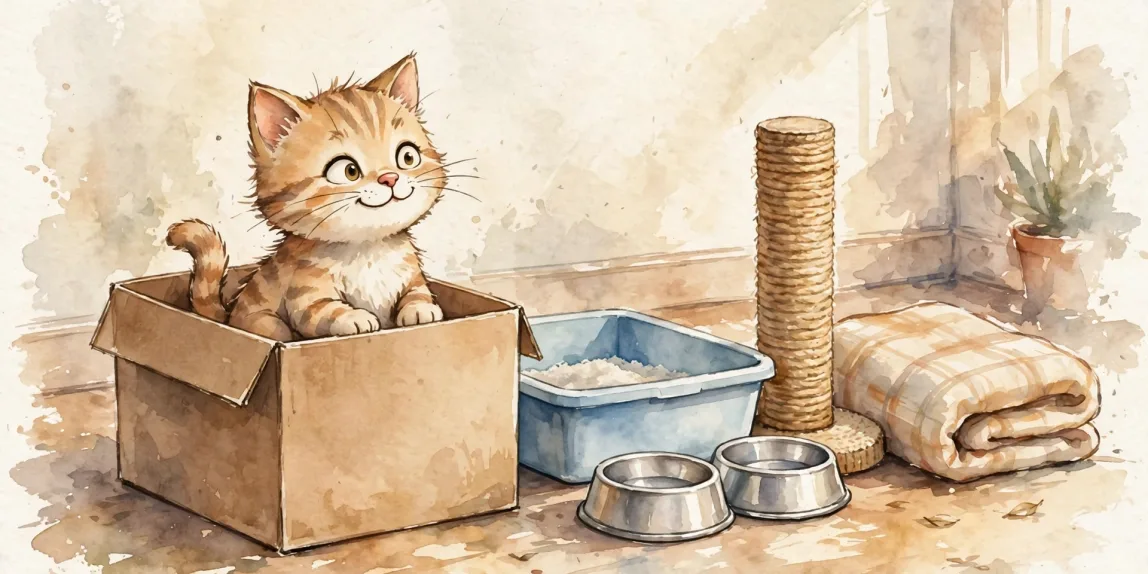
Think of it as Yoga for the brain, we are going to stretch a bit.
The Starter Kit — What to Buy Before the Cat Comes Home (and What Not To)
A pet store will sell you everything a cat might want, in advance, before the cat has expressed a single opinion. Consult the cat first and the list gets shorter: a box, a bowl, something to scratch, and you. The rest of the store is a museum of human worry. -- YNOT!
She stood in the pet store aisle the way generals stand before a map, which is to say the cart was already losing. First cat, from a rescue, coming home Saturday. A single mother, a budget with edges on it, and a memory she was determined not to repeat: she had overbought for her baby like a woman stocking a bunker for a seven-pound invasion. Half of it was never used. She had sworn the cat would be different. And yet here was the aisle, glowing, arranged to convert love into receipts.
Here is the good news: she was right to hesitate. A cat’s starter kit fits in a modest cart, with room left over for the cat. This chapter is that cart — what goes in it, what stays on the shelf, and the one expense on no shelf that matters more than everything in the store.
THE STORE IS NOT SELLING SUPPLIES. IT IS SELLING INSURANCE AGAINST GUILT.
Understand the business you are standing in. The pet industry does not sell to cats — cats are terrible customers, with no money and strong opinions. It sells to the feeling that arrives with a new animal: that somewhere in this building is the purchase that proves you are ready. That feeling is sincere and expensive, and the shelves are stocked in its honor.
The antidote is what the store will not volunteer: a cat’s needs were fixed thousands of years ago, in deserts and barns. Food. Water. A safe place to relieve herself. Something to scratch. Somewhere to hide. A way to get to the veterinarian without a wrestling match. And a person. Everything beyond that list is an upgrade, a convenience for the human, or a lottery ticket on a cat’s tastes — and you cannot know a cat’s tastes before the cat arrives to announce them. Buy for the species now; buy for the individual later, when she has filed her preferences.
THE LITTER BOX: SMELL IS A SCHEDULE, NOT A PRODUCT
Start with the box, because the box is where new owners spend the most money solving the wrong problem. The rule of thumb is one litter box per cat, plus one extra. What keeps a house from smelling like a cat lives in it is not a gadget, a fragrance, or a crystal. It is a schedule. Scoop daily. That is the whole secret, and it is cheap: a box scooped every day never becomes a story the neighbors tell.
Buy unscented litter. A cat’s nose is a far finer instrument than yours, and scented litter is perfume mixed into a toilet — a courtesy to the human, an assault on the cat. Put the box somewhere ventilated, and think twice about covered boxes and furniture enclosures: a lid traps the odor inside with the cat, and some cats take one sniff of that cave of smells and decline the whole arrangement — we have a whole chapter on the litter box rebellion, and a box the cat hates is how rebellions start. A plain open box in a decent spot beats a disguised one in a bad spot every time.
One upgrade is worth knowing about: a stainless steel litter box never soaks up odor the way scratched plastic does, and it scrubs clean like a pan, because it is one. But a plain plastic box is a fine start; the steel box is what you buy in year two, when you know this is forever. The cat cannot tell plastic from steel. She can only tell scooped from unscooped, and there she is a hanging judge.
BOWLS: STEEL OR CERAMIC, AND HERE IS WHY
For food and water, buy steel or ceramic and walk past the plastic. Plastic scratches, and scratches harbor bacteria that no washing fully evicts — and many veterinarians will tell you plastic bowls are a leading suspect in the chin acne that gives a cat the complexion of a teenager before prom. Steel and ceramic do not scratch, do not hold smells, go in the dishwasher, and will outlive the cat’s grandchildren. This is the cheapest quality in the store: the good version costs about what the bad version costs. Personally I use glass bowls, it is easier to see if their level and if they need cleaning. I have two cats, 5 bowls.
FOOD: WET BRINGS ITS OWN WATER, AND THE CAT VOTES
On food, the one principle worth carrying into the aisle is water. Cats descend from desert hunters who took most of their moisture from their prey, and the modern cat runs a lazy thirst drive — we have a whole chapter on the water bowl and what it reports. Wet food brings its water with it, built into the meal. Dry food is convenient, keeps well, and is fine as part of the picture. Many a cat thrives on a mixture of the two and a human who pays attention.
Expect to experiment, because the cat votes. The food she devoured at the rescue may be beneath her by Tuesday; the flavor you bought in bulk will be the flavor she retires from. Buy small until you know her. A cat’s palate is a legislature of one, and it is always in session. What she needs is not the perfect food, but a person who notices what she eats — not a warehouse of what she has rejected. For my cats, dry food with broth in the morning, dry food mixed with wet food early evening.
A CARRIER, A SCRATCHER, AND TOYS THAT COST LESS THAN LUNCH
Buy a sturdy carrier — the kind that opens from the top, if you can. A top-loading carrier turns the veterinarian’s visit from an extraction — you, shaking a front-loader like a piggy bank while a cat achieves the density of a star — into a lift. The carrier must work on the worst day, not the best one. Do not economize here; economize everywhere else.
Buy a scratcher the cat is allowed to love: a post wrapped in sisal rope, or honest corrugated cardboard. Scratching is not a vice; it is maintenance, exercise, and handwriting, and the only question is whether it happens on the furniture you provide or the furniture you treasure. Put it near where she sleeps — cats scratch on waking the way humans reach for coffee.
Toys: a handful, cheap. A wand with a feather. A few balls. The crinkly thing. Cats are moved by motion and novelty, not price, and five cheap toys in rotation beat a chest of fifty — a toy that vanishes for a week returns as a new toy. And the bed: buy it last and cheap, or not at all. The cat will sleep in the carrier, on your laundry, in the box the carrier came in. The expensive bed is a purchase for the owner’s feelings. Feelings are allowed. Just know which customer the bed is for. My cats favorite toy seems to be the empty Amazon box sitting in middle of living room.
THE CAT IS CHEAP. THE VET IS THE COST.
Now the money truth, the one this chapter leans on: the supplies are not the expense of a cat. The veterinarian is. The first year carries the founding costs — spaying or neutering, if the rescue has not done it, the vaccinations, and a microchip, that tiny piece of paperwork under the skin we devote a whole chapter to, because chipped cats come home from being lost at rates that make the chip the best money in this book. After that come the ordinary years, cheap right up until the evening they are not.
So here is the most unfashionable starter item on the list, available in no store: an envelope. A small emergency fund, started the week the cat comes home and fed a little at a time, will do more than every premium gadget in the building. The gadget is a guess about what might please her. The envelope is a promise about what will save her. If the budget forces a choice between the automatic anything and the envelope, choose the envelope and scoop the box yourself. The cat will not grade your equipment. She will grade whether somebody showed up with a plan on the bad day.
WHAT NOT TO BUY — AT LEAST, NOT YET
Walk past the automatic litter machine, a marvelous device for a problem you do not yet know you have, priced at about two envelopes. Walk past the drinking fountain for now; some cats adore running water and some regard it as plumbing, and a month of observation will tell you which cat you have. Walk past everything scented, made for your nose and against hers. Walk past the wardrobe of toys, the outfits, the furniture shaped like landmarks. And walk past anything sold as an ultrasonic trainer or fear gadget — we have a whole chapter on why scaring a cat is not training, and fright is not starter equipment.
The pattern in the skip list is timing, not virtue. Most of it is not foolish; it is premature. You are buying for a cat you met once, on her best behavior. Live with her a season. Learn that she drinks from the tap and sleeps only in rectangles. Then spend precisely, with intelligence reports instead of a gift card and a deadline. The store will still be there, counting on you either way; the only question is whether you arrive as its customer or its funding source.
ONE CAT, ONE HOME
One last piece of the kit is not for sale, and it concerns the small boy who travels between his mother’s house and his father’s, as children of two homes do. The question arises: should the cat travel too, so the boy is never without her? The answer is gentle and firm. No. The cat lives in one home — hers. Most cats are citizens of a place rather than followers of a schedule; their confidence is built of familiar rooms, their box in its corner and their sunbeam at its hour. Weekly shuttling between houses is, to a cat, not a visit. It is a small earthquake with a carrier.
And the boy loses less than the adults fear. A cat who stays is not an absence; she is home base. She will be exactly where he left her when he returns — in his chair, on his bed, running the establishment, ready to report that standards were maintained. Children understand headquarters. Let the boy commute, as he must. Let the cat be the place he commutes back to.
So here is the whole of it, the list on one line: a box, litter, and a scoop; steel bowls; food she will actually eat; a scratcher; a carrier that opens from the top; a handful of cheap toys; and a vet budget in an envelope. Nine things, and not one of them glows, beeps, or requires an app. The woman in the aisle can put the rest back. She was never going to fail this cat for lack of merchandise. Nobody fails a cat at the register.
The pet store sells anxiety in a bag and calls it preparation. A cat needs about nine things and one person who shows up. Buy the nine. Be the person. The cat will take it from there. -- YNOT!