Think of it as Yoga for the brain, we are going to stretch a bit.
NOTHING HAPPENS BY ACCIDENT… Not even Riots in Paris
France is burning, communists are organizing, China is watching, and somebody is paying the bills. --YNOT!
What do the Democratic Socialists of America, the Revolutionary Communists of America, Che Guevara, communist revolutionaries, radical Islamists, Iran, China, and a bunch of angry French teenagers have in common?
At first glance, absolutely nothing.
One group wants socialism. Another wants revolution. Another wants an Islamic theocracy. Another wants to replace the United States as the dominant superpower. And the French teenagers? Apparently, they would just like to attend a school where the teachers actually show up and the ceiling doesn’t fall on their heads.
Fair enough. But here’s where the story gets interesting.
These movements may have different objectives, different religions, different ideologies, and different visions of the perfect society.
Yet some of their organizations have discovered something remarkably useful.
You don’t have to agree about what the world should look like tomorrow if you agree about whose world you want to dismantle today.
And that brings me to something I’ve been saying for years.
Nothing happens by accident. Well, almost nothing.
A volcano erupts. An earthquake happens. A hurricane develops. Those are natural disasters.
But when thousands of people show up at the same location, at the same time, carrying similar signs, repeating similar slogans, following coordinated messaging, and sometimes arriving prepared for confrontations with police, I start asking questions.
Who organized them? Who communicated with them?
Who created the signs? Who arranged the transportation?
Who paid for the equipment? Who trained the organizers?
And perhaps most importantly: Who benefits?
Now, before somebody starts screaming that I’m suggesting every protester is a paid revolutionary, I’m not. Most protesters aren’t.
Many have legitimate complaints. Some are simply angry. Some are idealistic. Some genuinely want to change society for the better.
And some just want to skip school.
But there’s an enormous difference between an ordinary person expressing dissatisfaction and an organized political movement that knows how to take that dissatisfaction and turn it into an instrument of power.
And there are people who have made an entire career out of doing precisely that.
Welcome to the business of revolution.
FRANCE: WHERE REVOLUTION IS PRACTICALLY A NATIONAL SPORT
I love France. Beautiful country. Incredible history. Wonderful food.
And apparently, if the croissants go stale, somebody sets a government building on fire.
I’m exaggerating, of course.
But France certainly has a long and colorful relationship with revolution.
The French Revolution began in 1789. Then came the revolutions of 1830 and 1848, the Paris Commune of 1871, the student and worker uprisings of 1968, and plenty of political upheaval in between.
The French didn’t invent revolution, but they certainly helped turn it into an international political art form.
And now they’re at it again. In September 2026, students began protesting deteriorating conditions in French schools.
Missing teachers. Overcrowded classrooms. Deteriorating buildings. Educational systems struggling to deliver what taxpayers have already paid for. These are legitimate grievances.
If you’re a parent sending your child to school, you expect teachers, classrooms, and an education.
That isn’t some outrageous capitalist demand. That’s the bare minimum.
But what began as demonstrations over education expanded into a much broader confrontation with the French government.
Hundreds of schools were disrupted or closed. Thousands of students took to the streets.
Then came the fires. Burning vehicles. Destroyed property. Looted businesses. Attacks on public buildings. Clashes with police.
By October 17, France was experiencing some of its most serious civil unrest in years.
Hundreds of thousands demonstrated peacefully, but violent groups and opportunistic rioters created widespread destruction.
And who paid the price? The ordinary French citizen.
The shopkeeper whose windows were smashed. The restaurant owner whose business was vandalized. The worker whose car was burned.
The taxpayers who will eventually receive the bill for cleaning everything up.
You know, the people who weren’t responsible for the problems in the first place.
There’s a certain irony in claiming to fight for the working class while destroying the livelihoods of working-class people.
But apparently, revolution comes with collateral damage.
And somebody else always gets the invoice.
PROTESTING IS A RIGHT. DESTROYING SOMEBODY’S BUSINESS IS NOT.
Let’s establish something important. People have every right to protest.
They have every right to criticize their government.
They have every right to demand better schools, better services, and better leadership.
Those freedoms are among the greatest achievements of Western civilization.
But when protesters begin destroying businesses, attacking police officers, burning buildings, and terrorizing neighborhoods, we’ve crossed into something else.
That’s no longer peaceful political expression. That’s violence.
And I have very little sympathy for anybody who thinks burning down a family-owned business is a legitimate way to demand another mathematics teacher.
What exactly is the logic? My classroom is overcrowded, so I’m going to burn down a bakery?
Congratulations. Now the baker is unemployed, the insurance company is raising everybody’s premiums, and the local government has another mess to clean up.
Meanwhile, the education problem remains. And here’s where another uncomfortable question arises.
How much of this violence is spontaneous, and how much is being encouraged, organized, or exploited by groups with political objectives that have nothing to do with French schools?
That’s the question authorities should be asking.
And it’s a question that deserves an answer based on evidence, not merely political accusations.
RIOTS DON’T REQUIRE AN INVITATION. ORGANIZED MOVEMENTS REQUIRE INFRASTRUCTURE.
I’ve personally witnessed situations where pickup trucks arrived before a demonstration, unloaded supplies, and disappeared.
Hours later, the protesters arrived. Now, that doesn’t automatically mean something illegal was happening. Demonstrations require logistics. Water, food, signs, transportation, communications equipment, and medical supplies are perfectly normal parts of legitimate organizing.
But the experience made me think about something most people overlook.
Political mobilization is a skill. It requires organization. It requires communication.
It requires people who understand crowds, messaging, media, and public pressure.
Professional activists understand how to mobilize people.
They know how to create websites explaining what demonstrators should bring, how to communicate with organizers, what their legal rights are if arrested, and how to respond to police questioning.
They organize transportation. They arrange training. They create messaging campaigns.
They operate social media channels. They raise money.
They build relationships with other organizations.
Some have international networks and experienced organizers who travel between countries.
None of this is necessarily illegal. But it illustrates something extremely important.
A protest involving 20 people can happen because somebody gets angry and calls a few friends.
A coordinated national movement involving hundreds of thousands of people generally needs communications systems, organizing structures, and considerable resources.
Of course, social media can rapidly mobilize genuine grassroots anger without a central command.
And riots can erupt opportunistically without anybody supplying a master plan.
But once political organizations enter the picture, they can amplify, redirect, and exploit that anger.
Sometimes the original protesters discover that the movement they started no longer belongs to them.
They wanted teachers. Somebody else wants revolution.
And that’s a very different conversation.
THE RED-GREEN ALLIANCE: POLITICS MAKES STRANGE BEDFELLOWS
Let’s talk about one of the strangest relationships in modern politics.
The so-called Red-Green Alliance. Red represents revolutionary socialism and communism. Green, in this political context, refers to Islamist political movements.
Not ordinary Muslims. Not people practicing their religion.
I’m talking about political organizations seeking to impose systems of government based on their interpretation of religious authority.
Now, on paper, these two ideologies should hate each other.
Communism has historically been hostile to organized religion.
Islamist theocratic movements place religion at the center of government.
Many modern Western socialist movements support feminism, LGBTQ rights, secular government, and sexual freedom.
Hard-line Islamist organizations often oppose those very things.
So how do these groups end up marching under overlapping political banners?
Simple. Sometimes having a common enemy is more important than having a common philosophy.
And for certain revolutionary Marxist and Islamist movements, the common enemy is Western political and military power.
American influence. Western capitalism. Israel. NATO. Liberal democratic institutions.
Now, this doesn’t mean every socialist agrees with Islamist extremists, or that every pro-Palestinian demonstrator supports religious authoritarianism.
Obviously not. But there are documented examples of activists from otherwise incompatible ideological movements cooperating around shared political objectives.
Sometimes that cooperation is tactical. Sometimes it’s ideological. Sometimes it’s merely a temporary coalition. And sometimes the contradictions are so enormous that you wonder whether anybody has bothered reading the other side’s manifesto.
Imagine a revolutionary communist explaining to an Iranian cleric that the revolution will eventually abolish religion.
Or an Islamist revolutionary explaining to a Western feminist activist exactly what women’s rights would look like under his preferred theocracy.
I suspect that meeting would end rather abruptly.
But until those contradictions become unavoidable, both sides can benefit from cooperation. One provides activists. Another provides networks. Another provides publicity. Another provides ideological material.
And sometimes somebody provides the funding.
That’s where things become particularly interesting.
ENTER NEVILLE ROY SINGHAM: THE MILLIONAIRE REVOLUTIONARY
Now we arrive at a gentleman whose name deserves considerably more attention.
Neville Roy Singham. An American technology entrepreneur who founded ThoughtWorks, made a fortune, sold the company, and became a major financial supporter of left-wing political and activist organizations.
Nothing illegal about being wealthy. Nothing illegal about being a socialist.
Nothing illegal about donating to organizations that advocate political positions you believe in.
But Singham’s activities have raised serious questions about the relationship between American activist networks and the Chinese Communist Party.
And these questions aren’t coming exclusively from obscure websites or anonymous people on the internet. In August 2023, The New York Times published an extensive investigation into Singham’s international network. Its journalists traced financial relationships among nonprofit organizations, activist groups, media outlets, and political operations across multiple countries.
The investigation identified significant connections between Singham-supported organizations and China’s government media apparatus. Some organizations promoted narratives consistent with official Chinese positions. Some had relationships with Chinese media entities. Some operated internationally. And Singham himself was living in Shanghai.
Now, being in Shanghai doesn’t make someone a Chinese agent.
Plenty of Americans live in China.
But when an American millionaire finances organizations promoting positions remarkably favorable to the Chinese government, while maintaining relationships with Chinese state-linked media operations, it’s reasonable to ask questions.
Who is influencing whom?
Where is the money coming from?
What are the organizations being asked to promote?
And are the American people receiving political advocacy from independent domestic organizations or messaging shaped by foreign interests?
Those are legitimate national-security questions. And they’re no longer just questions from journalists. In 2026, federal investigators were examining Singham’s financial network, including possible violations of foreign-agent and tax laws.
Congressional committees have also investigated organizations associated with his network. An investigation isn’t a conviction, and allegations aren’t proof.
But neither should substantial financial and organizational relationships be dismissed simply because the organizations describe themselves as advocates for peace and justice.
Follow the money. Follow the messaging. Follow the relationships.
Then decide what the evidence actually establishes.
CODE PINK: PEACE, LOVE, AND SOME VERY INTERESTING FRIENDSHIPS
One organization closely associated with this controversy is Code Pink.
Founded in 2002, Code Pink became prominent for protesting the Iraq War.
Its message was simple. Stop the wars. Promote peace. Protect civilians.
Those aren’t inherently objectionable objectives.
Plenty of reasonable people opposed the Iraq War, including people on the political right.
But over time, Code Pink became increasingly outspoken in defending China against Western criticism.
One of its co-founders, Jodie Evans, married Neville Roy Singham in 2017.
The New York Times reported financial support flowing to Code Pink from entities associated with Singham’s network.
The organization has denied being directed or funded by the Chinese government.
And that distinction is important. Receiving funding from a wealthy American who maintains relationships with Chinese state-linked organizations isn’t automatically the same as receiving instructions from Beijing.
But when financial connections and political messaging repeatedly overlap, people are entitled to scrutinize those relationships.
Particularly when an organization calling itself an advocate for human rights appears considerably more enthusiastic about criticizing American policies than confronting human-rights abuses by authoritarian governments.
Consider China’s treatment of Uyghurs. Hong Kong’s loss of political freedoms. The suppression of dissent. Restrictions on independent journalism.
And the Chinese Communist Party’s refusal to permit meaningful electoral competition.
An organization advocating universal human rights should have no difficulty criticizing these things.
Human rights aren’t supposed to depend on whether the government violating them happens to oppose the United States.
Otherwise, you’re not defending universal human rights. You’re defending a political team. And that’s quite a different occupation.
THE CHINA-IRAN CONNECTION: NOW THE STORY GETS EVEN MORE INTERESTING
If you thought the relationship between communist organizations and Islamist movements was merely philosophical, consider the latest reporting.
In October 2026, Newsweek published an investigation into links between China-connected influence networks and an organization based in Iran.
At the center of the story were two organizations. Tricontinental: Institute for Social Research. And the House of Latin America, also known as HOLA.
Tricontinental is a research and advocacy organization associated with Singham, who has served as chairman of its advisory board and provided financial support.
HOLA is headquartered in Tehran and was established to develop relationships between Iran and Latin America.
According to Newsweek, HOLA and Tricontinental have an organizational partnership.
More interestingly, Newsweek reported that Tricontinental’s Persian-language Telegram channel published donation appeals directing funds to accounts at Iranian banks subject to sanctions.
One of those institutions was Bank Melli Iran. Another was Refah Kargaran Bank.
These banks have faced sanctions connected to Iran’s defense establishment and other activities.
Now, think about what that means. We have an organization connected to an American millionaire living in Shanghai. We have another organization operating out of Tehran.
We have cooperation between their networks. And we have donation appeals involving sanctioned Iranian financial institutions. That does not prove that the Chinese or Iranian governments financed riots in France. But it establishes something worth investigating.
Networks associated with very different authoritarian political environments can overlap through activist organizations, publications, fundraising appeals, and international political campaigns.
China is officially governed by a communist party. Iran is governed by an Islamist theocracy. Their domestic systems are fundamentally different. Yet their governments cooperate strategically because both have reasons to oppose American influence.
And now we’re seeing reported connections involving organizations that operate within the broader political ecosystems of both countries.
Does anybody seriously believe those relationships are uninteresting? I certainly don’t.
CHINA AND IRAN: THE ENEMY OF MY ENEMY
Here’s a lesson from history. Countries don’t have to like each other to cooperate.
They only have to believe cooperation serves their interests.
The United States and the Soviet Union cooperated against Nazi Germany.
That didn’t make Stalin a believer in American capitalism.
It meant both countries had a common enemy.
China and Iran have their own version of strategic cooperation.
China wants greater global influence, secure energy supplies, expanding commercial relationships, and reduced American military dominance in Asia.
Iran wants to survive international pressure, weaken American influence in the Middle East, and preserve its regional strategic position.
These objectives aren’t identical. But they overlap.
And when two governments share an interest in weakening American influence, cooperation becomes attractive.
Sometimes that cooperation is economic. Sometimes diplomatic. Sometimes military.
And sometimes it involves information, political messaging, or attempts to influence public opinion.
China understands the importance of narratives. So does Iran.
They understand that modern conflicts aren’t fought exclusively with soldiers, tanks, missiles, and aircraft.
They’re also fought through information. Through media. Through political influence.
Through the stories people believe. And through the ability to influence what millions of people become angry about.
You don’t necessarily have to convince people that your system is wonderful.
Sometimes it’s enough to convince them that their own system is hopelessly corrupt.
Then you stand back and let the divisions grow. That’s one reason foreign influence operations deserve scrutiny.
A country divided against itself is considerably less capable of confronting challenges from abroad.
And the beauty of this strategy, from an adversary’s perspective, is that legitimate domestic grievances already exist.
You don’t have to invent every complaint. You can amplify the ones that are already there.
THE BUSINESS OF POLITICAL INFLUENCE
People imagine propaganda as some government official sitting behind a desk writing slogans.
That may have worked a hundred years ago. Today, influence is a sophisticated business.
It can involve think tanks. Research institutes. News websites. Political organizations. Nonprofit foundations. Social media personalities. Student associations. Campaign strategists. International conferences. Training programs. Documentary producers. And, of course, money. Lots of money.
Not every organization in this ecosystem is dishonest or foreign-controlled.
But sophisticated influence campaigns can operate through organizations that appear independent.
The message doesn’t necessarily arrive with a label saying:
PAID FOR BY THE CHINESE COMMUNIST PARTY.
That would make life a little too easy. Instead, the message can appear as an article.
A documentary. A social media post. A conference presentation. A protest slogan.
Or an interview with somebody introduced as an independent expert.
The objective may be to shape what people believe without revealing the full chain of influence behind the message.
And sometimes the most effective messenger genuinely believes every word.
They don’t have to be paid to lie. They only have to be persuaded that they’re fighting for a righteous cause. There is an old expression for people who advance another power’s objectives without fully understanding the consequences.
Useful idiots. It’s a harsh expression. But history has provided plenty of examples.
And the internet has made their potential reach extraordinary.
BACK TO FRANCE: WHO BENEFITS FROM THE CHAOS?
Now let’s return to France. The students started with legitimate complaints about their education. By October, the movement had expanded into a national political crisis.
Radical-left organizations sought to capitalize on the demonstrations.
Other political factions attempted to exploit the unrest.
And violent individuals used the crowds as opportunities to loot, vandalize, and attack institutions.
The French government accused ultra-left extremists of contributing to the violence.
But here’s the distinction that matters. The existence of an international activist network does not automatically prove that the network organized a particular riot.
We need evidence. Financial transactions. Direct communications. Organizational instructions. Verified travel and coordination. Actual relationships between the organizers and violent participants. Not merely photographs of people carrying similar signs.
However, we should be equally careful not to ignore the possibility of political exploitation simply because the protests began organically.
A movement can begin spontaneously and later be influenced by organized political groups.
It can start with reasonable demands and develop extremist factions.
It can include thousands of peaceful demonstrators while a smaller group commits serious violence.
All of those things can happen simultaneously.
And in France, we have already seen a very real distinction between the students demanding better schools and the people responsible for destructive riots.
The government needs to identify those responsible for violence.
It also needs to investigate whether organized extremist groups deliberately encouraged or coordinated that violence.
And if evidence reveals foreign financing or direction, the French public deserves to know.
Because the question isn’t simply who threw the brick.
It’s whether anyone encouraged the violence for political purposes, and whether that encouragement was part of a larger organized effort.
MACRON HAS A PROBLEM, AND IT’S BIGGER THAN BAD SCHOOLS
Emmanuel Macron is approaching the end of his presidency.
France’s next presidential election is scheduled for 2027.
And his political movement faces an increasingly hostile environment.
Economic frustration. Public dissatisfaction. Political polarization. Declining confidence in government. And now nationwide unrest. The Cancer is taking hold.
On October 22, Macron announced tougher measures against violent demonstrations and blamed extremist groups for contributing to the chaos.
The French government has also acknowledged that students have legitimate grievances.
Both things can be true. France can have serious problems with its education system, and extremist organizations can simultaneously attempt to exploit the resulting anger.
But here’s the problem for Macron. You cannot solve a political crisis merely by sending riot police into the streets. Nor can you solve it by surrendering public order to violent groups.
You need both effective government and effective law enforcement.
Fix the schools. Address the legitimate complaints. Protect peaceful demonstrators. And arrest people who commit violence. That shouldn’t be particularly controversial. But this wont be the end, they will want something else.
But in today’s political environment, even the suggestion that somebody shouldn’t set fire to a police car seems capable of starting an argument.
Meanwhile, France’s political extremes have an opportunity to capitalize on the government’s failures. And Macron’s allies are left trying to convince voters that they can restore stability. Good luck with that.
AMERICA SHOULD BE PAYING ATTENTION
If you think this is exclusively a French problem, you’re missing the larger issue.
America has its own political divisions. Its own activist organizations. Its own legitimate grievances. And its own susceptibility to foreign influence operations.
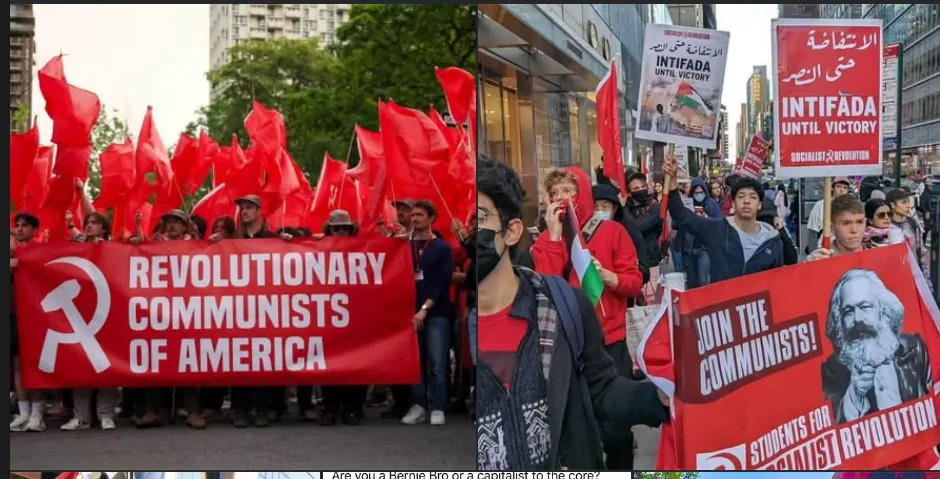
Consider the Democratic Socialists of America, the Revolutionary Communists of America, and other organizations operating on the revolutionary or socialist left.
These are distinct organizations with different ideologies, memberships, and political strategies. Membership in a socialist organization doesn’t establish involvement in violence or foreign influence.
But political organizations that advocate revolutionary change deserve the same scrutiny as any organization attempting to reshape our institutions.
Where does their funding come from?
Which international organizations do they collaborate with?
What relationships do they maintain with foreign political movements?
Do they support democratic institutions even when elections don’t produce their preferred outcomes?
And where do they draw the line between political activism and revolutionary confrontation?
The answers matter. The same questions should apply to organizations on the political right.
Foreign influence isn’t acceptable simply because the foreign government happens to support your political preferences. And this is where America needs to become considerably more sophisticated. A foreign government doesn’t necessarily need to create a political movement to benefit from it.
Sometimes all it needs to do is amplify existing divisions.
If Americans are already arguing about race, religion, immigration, capitalism, socialism, Israel, Palestine, or the economy, a foreign influence operation can selectively promote messages designed to intensify those disagreements.
One campaign tells Americans their country is irredeemably racist.
Another tells Americans their political opponents are determined to destroy their way of life. Another spreads distrust of elections. Another amplifies conspiracy theories. And another portrays authoritarian governments as attractive alternatives to Western democracy.
The objective isn’t necessarily to make everybody believe the same thing. Sometimes the objective is to make sure nobody believes anybody else. A society that cannot agree on basic facts becomes easier to manipulate. And a divided country becomes easier to challenge internationally.
CHE GUEVARA WOULD LOVE SOCIAL MEDIA
There’s something almost comical about modern revolutionaries. They worship Che Guevara. They romanticize Marx. They celebrate the overthrow of capitalism.
And they organize their revolutions on smartphones manufactured by multinational corporations. They use Instagram. They use TikTok. They use encrypted messaging applications. They collect donations electronically.
They coordinate international campaigns through the very technological and financial infrastructure created by the economic system they claim to despise.
Apparently, capitalism is terrible until you need an iPhone, a plane ticket, and a high-speed internet connection.
But beneath the hypocrisy is an important reality.
Modern technology has made political mobilization dramatically easier.
A demonstration that once required weeks of organizing can now attract enormous attention within hours.
Videos spread across national borders. Slogans become international. Political messaging can be translated into multiple languages almost instantly.
A protest in Paris can become inspiration for demonstrations in New York, London, Madrid, or São Paulo. And organizations with established networks can take advantage of that connectivity.
This is why political movements increasingly resemble international communications campaigns. They don’t necessarily need one central headquarters.
They need networks capable of distributing information, mobilizing supporters, and maintaining momentum.
And if an organization has access to substantial funding, professional organizers, media production capabilities, and international contacts, its influence can extend far beyond its actual membership.
A relatively small organization can appear much larger when its messages are repeatedly amplified by associated outlets and supporters.
That’s the new reality of political activism. It’s also the new reality of propaganda.
THE BIGGEST THREAT ISN’T ALWAYS THE PERSON THROWING THE BRICK
When people watch riots on television, they focus on the violence.
The burning cars. The smashed windows. The police confrontations. The looters running out of stores. But those are the visible symptoms.
The deeper question is what happens before the violence. Who shapes the political narrative? Who encourages confrontation? Who convinces otherwise reasonable people that destruction is justified? Who glorifies violence after it happens? Who turns criminals into political heroes?
And who uses the resulting chaos to advance objectives unrelated to the original grievance?
Sometimes the answer is a local extremist group. Sometimes it’s opportunistic criminals. Sometimes it’s an irresponsible political leader. Sometimes it’s a spontaneous escalation. And sometimes it may involve coordinated networks with broader political ambitions.
We shouldn’t pretend to know the answer before investigating.
But we certainly shouldn’t refuse to ask.
Because political violence has consequences that extend far beyond the immediate destruction. It erodes public trust. It encourages political polarization. It weakens confidence in institutions. It creates economic uncertainty.
And it often produces demands for more restrictive government powers.
There’s another irony.
Groups claiming to fight authoritarianism can, through their own violence, create public support for stronger authoritarian measures.
Destroy enough businesses, terrorize enough neighborhoods, and attack enough public institutions, and eventually ordinary citizens begin demanding that somebody restore order.
Sometimes at almost any cost. That’s a dangerous road for any democracy.
FOLLOW THE MONEY. THEN FOLLOW THE MESSAGE.
I keep returning to money because money is what allows political movements to develop professional infrastructure.
An organization needs resources to maintain offices, websites, publications, employees, events, travel, conferences, and media operations.
Some movements are financed through small individual donations. Some rely on unions.
Some depend on wealthy supporters. Some receive institutional grants.
And some have complicated international relationships that deserve closer examination.
The Singham network is particularly interesting because major investigative reporting has already identified extensive financial relationships involving organizations that promote narratives favorable to China’s government.
Congressional committees have issued subpoenas and demanded records.
Federal investigators have examined potential legal violations.
And the October 2026 Newsweek investigation adds another dimension by documenting organizational links involving Iran.
That’s not evidence that every associated protest is controlled from Beijing or Tehran.
But it is evidence that international political influence is not merely a theoretical concern.
We should demand transparency. If organizations are attempting to influence public policy, citizens deserve to understand who provides their funding.
If foreign governments are secretly directing political operations, authorities should investigate and enforce applicable laws.
If organizations are independent, they should be able to demonstrate that independence.
And if somebody is accused of wrongdoing, the evidence should be examined rather than assuming guilt through association.
The goal should be accountability. Not censorship. Not political persecution. Not criminalizing disagreement. Transparency is what allows citizens to distinguish genuine political advocacy from concealed foreign influence.
And democracies need that distinction.
THE FINAL QUESTION: WHO WINS WHEN WESTERN DEMOCRACIES LOSE?
China doesn’t need France to become communist to benefit from French instability.
Iran doesn’t need French students to become Islamists.
Neither government needs to control every protester.
From a strategic perspective, an adversary may benefit simply when Western countries become distracted, economically weakened, politically divided, or less capable of coordinating international policy.
That’s the larger concern. A weakened France creates problems for Europe. A divided Europe creates problems for NATO. A weakened NATO affects American strategic interests.
And a United States consumed by internal political conflict has fewer resources and less political unity available to confront international challenges.
Of course, that doesn’t mean foreign adversaries caused those problems.
Western governments are perfectly capable of creating crises through their own incompetence. We’ve demonstrated that repeatedly.
And blaming foreign conspiracies for domestic failures is one of the oldest political tricks in the book.
But ignoring genuine foreign influence is equally foolish. A serious country needs to recognize both threats. Internal failures create vulnerabilities. External actors can exploit them.
And ideological organizations can sometimes serve as the connection between the two.
That’s what makes the international relationships involving Singham, Tricontinental, Code Pink, and the newly reported Iranian connections worth investigating.
Not because every relationship proves a conspiracy.
But because money, ideology, information, and political influence increasingly operate across international borders.
And national security doesn’t end at the border anymore.
NOTHING HAPPENS BY ACCIDENT…
Perhaps the title of this article is a little provocative.
After all, accidents do happen. Spontaneous protests happen. Genuine political movements happen. Angry citizens sometimes take to the streets without receiving instructions from anybody.
But organized political influence doesn’t emerge from thin air. It requires effort. It requires communication. It requires institutions. It requires networks.
And frequently, it requires considerable money.
When you see thousands of people participating in a coordinated political movement, you should be interested in the organization behind it.
When you see media outlets promoting identical narratives, you should be curious about their relationships.
When you see wealthy individuals financing international ideological networks, you should ask what objectives they hope to achieve.
And when organizations connected to China and Iran begin appearing in the same financial and political ecosystem, you should certainly pay attention.
That’s not paranoia. That’s understanding how political influence works.
But remember something equally important.
A connection is not necessarily coordination. Coordination is not necessarily criminality. And an allegation is not proof.
If we’re going to expose propaganda, we cannot build our own arguments on speculation masquerading as certainty.
That’s precisely the kind of intellectual dishonesty we should be opposing.
France has real problems. Its students have real grievances. Its government has real responsibilities. And the people who destroy property and attack innocent citizens should be held accountable.
Meanwhile, governments should investigate credible evidence of organized political violence and foreign interference wherever that evidence leads.
Whether the trail leads to communists, Islamist extremists, wealthy political activists, foreign intelligence operations, or simply a collection of local troublemakers.
Because nobody gets a free pass.
Not the left. Not the right. Not China. Not Iran. Not anybody.
And here’s my final thought.
Revolutionaries throughout history have promised to create a better world by destroying the existing one.
Sometimes they have helped overthrow genuine tyranny.
Other times they’ve replaced imperfect societies with dictatorships considerably worse than the governments they destroyed.
History is filled with examples.
And the people celebrating revolution from comfortable offices, expensive homes, and international conferences rarely seem to be the ones paying the highest price.
It’s the shopkeeper. The teacher. The worker. The parent.
The ordinary citizen who just wants to live in peace.
The people who wake up the next morning and discover that their city has been turned into somebody else’s political battlefield.
So, before celebrating another revolution, perhaps we should ask one simple question.
Are we building something better, or are we simply helping somebody else destroy what we already have?
Because there’s a big difference. And the people who eventually pay for that difference usually aren’t the ones financing the revolution.
They’re the rest of us. Nothing happens by accident.
And when organized political interests become involved, there’s usually a reason.