Think of it as Yoga for the brain, we are going to stretch a bit.
The Big Six — The Illnesses That Visit Almost Every Cat
A cat will hide an illness the way it hides from the vacuum cleaner — thoroughly, silently, and in plain sight. Your job is not to find the disease. Your job is to notice the cat has started hiding something. -- YNOT!
There is a poster making the rounds that lists the six most common illnesses in cats, and for once the poster is not lying to you. Kidney disease. Diabetes. Hyperthyroidism. Heart disease. Asthma. And the upper respiratory infection, the common cold of the cat world. Between them, these six account for most of the veterinary medicine a cat will ever meet.
Four of the six are mostly diseases of the older cat, which is why this chapter keeps one eye on “Growing Old Together.” Two — the cold and the asthma — visit the young as well. But here is the mercy built into the list: nearly every one sends a letter before it arrives, delivered where you already look every day. The water bowl. The food bowl. The litter box. This chapter is about reading the mail.
THE FIRST THREE ALL KNOCK ON THE SAME DOOR
Start with a strange fact that organizes everything else in this chapter. The first three diseases on the list are different machinery broken in different rooms of the house — kidneys, pancreas, thyroid — and yet they announce themselves with almost the same handful of signs. Drinking more. Peeing more. Weight sliding off. Appetite wandering, up or down. The cat cannot tell you which system is failing. The cat can only change its habits at the bowls, and it does.
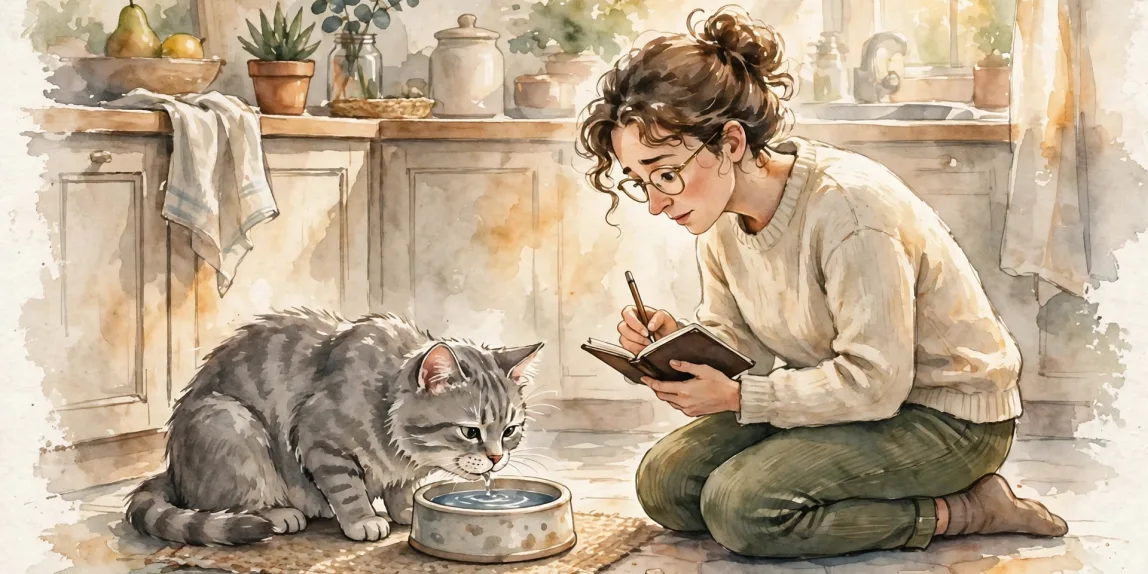
This is exactly why “The Water Bowl Is a Health Report” and “When the Bowl Comes Back Full” exist in this book. The bowl cannot name the disease; it was never meant to. Its whole job is to tell you something changed — and noticing the change is the whole of your job. Naming it is the veterinarian’s department, and the veterinarian names it mostly with bloodwork, because bloodwork is the net that catches the quiet diseases while they are still quiet. It is also why the senior chapter keeps nagging about twice-yearly exams for older cats: the net only works if somebody throws it.
NUMBER ONE: THE KIDNEYS SLOW DOWN
Chronic kidney disease is one of the most common serious diseases of the older cat, and it is a slow leak rather than a sudden flood. The kidneys are the cat’s waterworks: they filter the blood and decide how much water to keep. Healthy kidneys concentrate urine and hold the water in; worn ones lose the trick. The water runs through, the litter box fills faster, and the cat drinks more to keep up. Around that central fact the rest of the picture gathers: weight loss, an appetite that fades by degrees, a cat growing quieter than the cat you know.
There is no cure that hands the kidneys back, and this chapter will not pretend otherwise. But managed is not a hopeless word. Caught early, kidney disease is managed — with fluids, with a special diet, with care for the blood pressure that so often climbs alongside it — and cats live well for years that way. The difference between early and late in this disease is not a detail; it is most of the story. And the diagnosis cannot be made from the couch: it takes bloodwork and urine tests — which is to say, the appointment you make because the water bowl started talking.
NUMBER TWO: THE SUGAR FLOOD
Diabetes is the body’s sugar management failing. Sugar that belongs in the cells piles up in the blood, spills into the urine, and — here is the engine of the whole disease — drags water out with it as it goes. So the diabetic cat drinks more and pees more to match, same as the kidney cat, which is why nobody should be diagnosing from the kitchen. But diabetes adds one sign that ought to stop any owner mid-pour: the cat is losing weight while eating more. The fuel arrives and passes through unused, so the body burns its own stores while the cat begs for seconds. A robbery where the pantry is full.
The risk leans a particular way — toward the overweight cat, the older cat, and most of all the neutered gentleman of a certain age and girth, which describes half the beloved cats in America, so no smugness is available here. Treatment is insulin and diet, a routine owners manage fine once the first week’s nerves wear off. And diabetes carries the best footnote on this entire list: some cats, caught early and managed well, go into remission — the disease quiets down and the insulin can be withdrawn under the veterinarian’s eye. Print that at its proper strength. Remission is a real hope. It is not a promise, and anyone who promises it is selling something.
NUMBER THREE: THE THYROID WITH ITS FOOT ON THE GAS
Hyperthyroidism is a disease of older cats in which the thyroid gland — the body’s throttle — gets stuck partway open. The engine revs at idle. Everything speeds up, and the signs follow the metaphor with embarrassing loyalty. The cat eats more, sometimes frantically more, and loses weight anyway, because the furnace is burning the fuel as fast as it lands. The cat is restless. The cat yowls at night, holding forth at three in the morning like a town crier. The coat, on a fastidious animal, goes ratty. If the kidney cat is a slow leak, the thyroid cat is a house with every light on and the radio blaring, consuming itself at high speed.
A blood test confirms it, and here the news is genuinely good: this is one of the most treatable diseases on the list. There is daily medication that holds the throttle down. There is a radioactive-iodine treatment that is actually curative. There is a prescription diet, and there is surgery. Four doors, and the veterinarian will tell you which ones fit your cat. What the owner supplies is the observation that the cat is eating like a lumberjack and shrinking like a wool sweater — reported early instead of marveled at for six months.
NUMBER FOUR: THE ONE THAT DOESN’T KNOCK
Heart disease is the honest exception on this list, and it deserves a plainer paragraph than the others. The commonest form is a thickening of the heart muscle itself — hypertrophic cardiomyopathy — in which the pump’s walls grow stiff and the chambers shrink. And the hard truth is that many cats with it show nothing: no change at the bowls, no letter in the mail. The first visible sign may be the terrible one, a cat suddenly struggling to breathe. “Minutes Count” covers that moment, and it is a drive-now moment, not a watch-and-wait one. This chapter’s job is the time before it.
You have two tools, and neither is dramatic. The first is the veterinarian’s stethoscope: a murmur or an odd rhythm heard at an ordinary checkup is very often the first catch this disease ever makes — one more reason the boring annual visit is not boring. The second tool is yours, the only home measurement in this chapter worth the name. Count your sleeping cat’s breaths, watching the chest rise and fall while the cat is genuinely asleep, not dozing with one ear on the kitchen. A resting cat normally breathes under about thirty times a minute. A cat whose sleeping rate has crept up and stayed up — or any cat breathing with its mouth open, or working visibly for air — is a cat for the veterinarian now, not next month. Thirty seconds, a few times a year, written down. That is the whole instrument, and it is a real one.
NUMBER FIVE: THE COUGH THAT ISN’T A HAIRBALL
Asthma contains the best trap on the list, because it disguises itself as the most ordinary event in a cat house. The cat crouches low, neck stretched out, shoulders hunched, and coughs — cough, cough, cough — and the owner says what owners have said for fifty years: hairball coming. Except no hairball ever arrives, because nothing was ever coming up. A coughing cat is not a hairball cat. Hairballs travel from the stomach; a cough comes from the chest, and a cat down in that crouch, wheezing, breathing harder after play, is telling you its airways are inflamed and narrowed. Cats get asthma the way people do, and the crouch-and-cough is its signature.
It is a long-term condition, managed rather than cured: anti-inflammatory medicine to keep the airways calm — often delivered by an inhaler, the same arrangement as a person with asthma, mask and all — and a household audit for triggers. Dusty litter, cigarette smoke, scented sprays: the asthma cat’s enemies are airborne and mostly optional. Switch the litter, lose the smoke, and the cat breathes easier in the most literal sense available. The chapter’s whole assignment here is one sentence long. The next time your cat crouches and coughs and produces nothing, do not wait for the hairball. It was never a hairball.
NUMBER SIX: THE COMMON COLD, CAT EDITION
The upper respiratory infection — cat flu, in the everyday name — is the cold your cat catches, and it behaves like yours. Sneezing. A runny nose. Watery or goopy eyes. A mild, tired cat who wants the warm spot and the quiet. It is usually viral, which means no pill ends it; most cases improve the way your cold improves, with rest, warmth, and time. The first-aid chapter’s sticky-eyes material lives in this neighborhood, and the home care is mostly nursing: keep the cat warm, the eyes and nose gently clean, and attend to the one problem that matters — food.
A cat that cannot smell will not eat, and a stuffed-up nose is a nose on strike. So the cold remedy with actual power in it is smell: warm the wet food a few seconds so it announces itself through the congestion, and offer the strong-smelling stuff you would normally call too much. You are not spoiling the cat. You are shouting dinner through a blocked door. The lines that send this from the couch to the clinic are clear ones: a kitten, whose small reserves forgive nothing; an eye that clouds over or will not open; a cat that stops eating altogether; or any difficulty breathing at all. Inside those lines, it is a cold. Across them, it is an appointment.
THE RULE OF THE HOUSE
Six diseases, and notice what the list never once asked of you. It never asked you to diagnose, to medicate, to dose, or to tell a kidney from a thyroid at the kitchen counter — a task that defeats people with diplomas when they try it without bloodwork. The owner’s job is smaller and, done faithfully, worth more: notice early, and write it down. The date the bowl started emptying faster. The month the spine started feeling sharper under your hand. The night the yowling began. Memory is a storyteller and it edits; a note on the refrigerator does not. Bring the vet the dates, and you have done the one thing no test in the building can do — told them when it started.
Every illness in this chapter is a better story caught in chapter one than in chapter ten. The kidney cat managed for years instead of crashing. The diabetic with a shot at remission instead of a crisis. The thyroid cat treated before the engine burns the house down. None of those endings begin at the clinic. They begin at the water bowl, on an ordinary morning, with an owner who glanced down and thought: that is different. That glance is the cheapest medicine in this book, and the one only you can administer.
You cannot diagnose from the couch, and you do not have to. Notice early, write it down, and let the veterinarian name it — a cat's diseases are all cheaper, kinder, and shorter in the first chapter than in the last. -- YNOT!