Think of it as Yoga for the brain, we are going to stretch a bit.
Buying One Today: What to Check Before You Pay
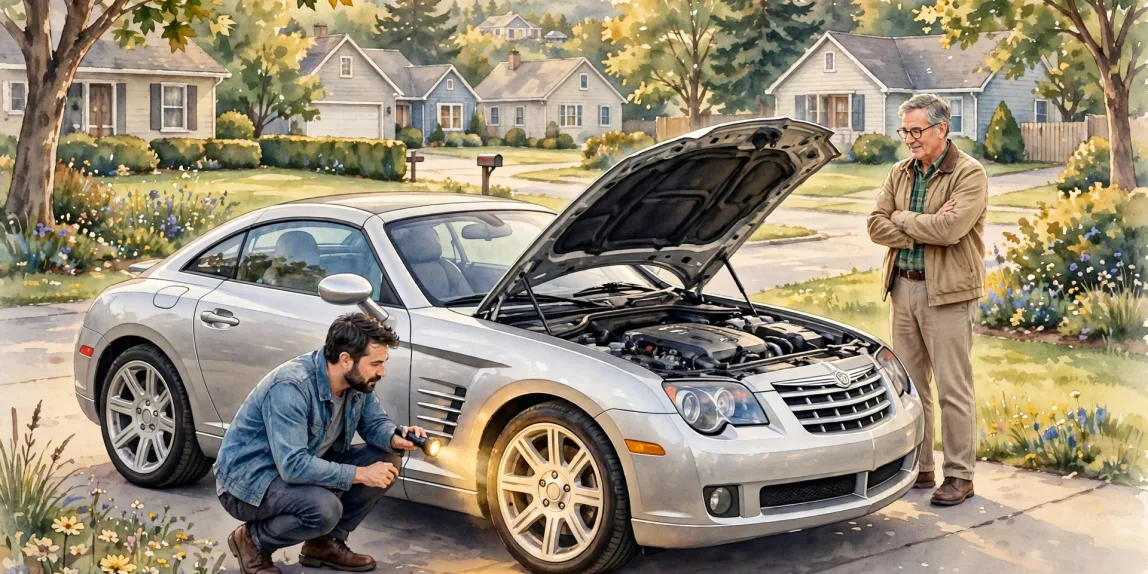
Buying a Crossfire is not like buying a Camry of the same age. The car is a Mercedes R170 underneath, built in Germany, and out of production since 2008 — which means the usual used-car checklist misses the things that actually cost money on this one. The engine is the least of your worries; these V6s are stout. What separates a bargain from a money pit is a short list of Crossfire-specific items: keys, starting behavior, the top, the tires, and water. This chapter is that list, in the order you should check it.
Why the Checklist Is Different for This Car
Most twenty-year-old cars fail in twenty-year-old ways — rust, worn suspension, tired transmissions. The Crossfire can do all of that too, but its expensive failures are electrical and specific. The parts that strand people are modules and keys, not pistons and rings, and several of them are no longer on any dealer’s shelf. A car that looks identical to another can be worth thousands less because of what is missing from its key ring or its service history. So the inspection below starts with the items you cannot fix cheaply, and works down to the ones you can.
Keys First
Count the keys before you look at anything else. Two working keys is the healthy state, and the reason is the car’s famous saga: the SKREEM anti-theft module and its matched keys, covered in full in the chapter Everything About Keys and Fobs. A replacement key is not a hardware-store errand on this car, and a car with one key is one lost key away from being a lawn ornament. If the car has only one key, price it like one — the discount should reflect a problem you may never fully solve. Test both keys if two exist: each one should start the car, not just unlock it.
The Starting Ritual
Start the car cold, and start it more than once. Intermittent no-starts are the Crossfire’s signature complaint, and they trace most often to the Relay Control Module and to the crank sensor — the full method is in How to Diagnose No Starts and Turn the Key and Nothing Happens. Ask directly whether the Relay Control Module has been replaced, and whether a spare comes with the car; the chapter Do You Have a Spare RCM? explains why owners hoard them. A seller who knows what an RCM is has probably maintained the car. A long crank, a start-and-stall, or a seller who says it only does it sometimes is the car telling you its price is wrong.
Then drive it, park it, and start it again hot. Some of these faults are shy: the car behaves for the first start of the day and acts up on the third. A seller who is happy to let you run the full ritual is telling you something good about the car. A seller who rushes you past the restarts is telling you something too. Believe both of them.
Work the Top Twice
On a roadster, cycle the top — down and back up — and watch like an inspector, not a fan. Look at the rear window’s bond line for separation, listen for the hydraulics straining or whining, and check around the cylinders and the trunk for fluid leaks. One caution protects you and the seller both: the car has factory thermo protection, and if the top stops after several cycles in the seller’s driveway, a 30-minute rest may be all it needs. But agree before the money moves on who pays if it does not come back after the rest. A top that works once, cold, in front of you, is worth more than three promises. Coupe buyers can skip this section and spend the time on the headliner instead.
Tires: The Four-Figure Surprise
Look at the tires, and then look at their date codes. The factory sizes are staggered — 225/40ZR18 in front, 255/35ZR19 in back, per the chapter Alignment, Brakes, Tires & Wheels — so a set is not four matching tires you can catch on sale. Owners in the groups report roughly $400 to $450 per tire in late 2026, which makes a full set a four-figure errand before mounting. Worse, a low-mileage car can be sitting on ancient rubber: the tread looks new because nobody drove on it, while the sidewalls are a decade old. Read the four-digit date code on every tire and do the math out loud in front of the seller.
Water and Smells
Get your head into the footwells. Water finds its way into the passenger footwell on these cars, and what lives under that carpet makes it matter: the amplifier sits down there, which is why this check pairs with the sound test below. Damp carpet, a musty smell, or silt lines are not cosmetic issues — they are a leak to find and possibly an amplifier already dying. While you are inside, look up: the headliner sags on these cars as the foam backing gives up, and a drooping headliner is a real repair bill, not a detail. None of this kills a deal by itself, but all of it belongs in the price.
The Sound Test
Turn the radio on and confirm there is actual sound. A Crossfire radio that lights up and plays silently is a known failure, and the story — including why the amplifier’s home in the passenger footwell matters — is in Radio On, No Sound — The Amplifier. Silence is not a fuse until you have proven it is a fuse. While you are in the seat, ask when the battery was last replaced and whether the car sits for weeks at a time. A Crossfire that sits is a Crossfire that drains, and Why Your Battery Drains explains the appetite these cars have at rest.
What They Actually Sell For
Prices here are asking prices seen in the owner groups in late 2026 — what sellers asked, not verified sale prices, and asking prices are wishes. One owner asked about $6,000 for a 2006 car under 70,000 miles that needed a jump after a few starts and had a detached rear window in its top. At the other end, a 28,000-mile 2005 roadster was offered at about $14,500, and a 40,000-mile 6-speed at about $15,000. Read those three numbers together and the pattern shows itself. Miles, top condition, and keys move the price more than the model year does.
Use the checklist as the negotiation, because it is an honest one. Every fault you find with this chapter in hand is a priced item, not a vague feeling that the car should be cheaper. A one-key car, a car on decade-old tires, a car with a lifting rear window — each has a number attached, and the seller knows it once you have shown your work. The cars that hold their money are the ones with two keys, fresh rubber, and a top that works twice in a row. Pay for those things when they are present, and deduct for them when they are not.
The Verdict
A good Crossfire is not hard to find; a good Crossfire at the right price takes one careful hour. Count the keys, start it cold twice, work the top, read the tire dates, and put your hand on the footwell carpet. Every item on that list is cheap to check and expensive to skip. Buy the car whose problems are the ones you already know about.