Think of it as Yoga for the brain, we are going to stretch a bit.
A Stereo From This Century: Head Units and Speakers
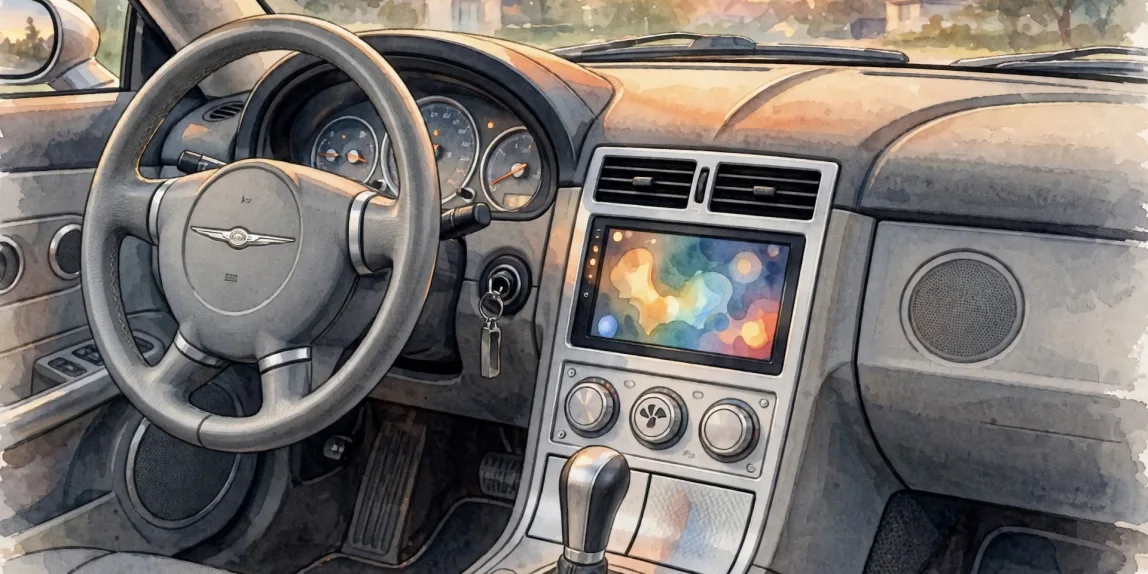
The Crossfire’s cabin was designed at the turn of the century, and its stereo tells the story: a CD-era head unit, speakers chosen when the car was new, and not a touchscreen, a phone connection, or a backup camera in sight. Owners love these cars and drive them daily, so the stereo is where the car’s age is felt most. The good news is that this is the most upgradeable system on the car, and the owner community has walked every path through it.
What the Factory Gave You
Know what you are starting from. The factory system is a Chrysler head unit in the dash feeding a separate amplifier, and that amplifier lives in the passenger footwell, as covered in Radio On, No Sound — The Amplifier. The head unit is the part you see and touch, but it is not the part that powers the speakers. That split personality — Chrysler face, separate amp, speakers downstream — is what makes the upgrade decisions interesting.
Factory diagnostics name door speakers and rear speakers, and the rears sit behind the seats. Those rear speakers live a hard life in a small cabin, inches from the rear glass and the sun that comes through it. When owners describe the factory sound as tired, thin, or rattly, it is very often those aged speakers talking, not the electronics. Keep that in mind before you spend money: the weakest part of the system may be the cheapest part of it.
One piece of factory kindness deserves mention before any tools come out. The factory radio comes out with radio removal keys — the factory special tool is listed as Radio Removal Tool 9241 — which slide in and release the unit so it pulls straight out of the dash. No dash surgery is needed for the head unit itself. Whatever else your upgrade involves, getting the old radio out is not the hard part.
The Head Unit Swap
The single most popular upgrade in the owner groups is a modern touchscreen, and the community has settled the question of whether one fits. Double DIN dash kits exist — an owner-designed kit circulates in the community — and owners have fitted Sony and Pioneer units running Apple CarPlay and Android Auto. The result transforms the cabin more than any other single change: modern navigation, phone integration, and a screen the car was never designed for, sitting where it looks like it belongs.
Owners who do not want to cut or convert the dash take the other well-trodden road. Single-DIN units with retractable screens fit the factory opening, fold their displays away when not wanted, and also add a rear-camera option — no small thing on a car with the Crossfire’s rear visibility. Both routes are proven. The choice is between a permanent modern dash and a reversible one, and honest owners exist in both camps.
Whichever unit you choose, buy the wiring adapter with it. The car’s harness and the new head unit speak different connector languages, and the adapter harness is what lets the swap happen without cutting factory wires. A Crossfire whose harness survives its stereo upgrade is worth more to the next owner, and the next owner may be you, putting it back.
Speakers: The Ones Behind the Seats
Ask the owner groups one audio question and it will be this one: what are you using for replacement speakers behind the seats? It is the running question of the community, because the factory rear speakers age out — cones and surrounds were never meant to see twenty summers — and the space behind the seats is shallow and specific about what fits. Owners have found that modern shallow speakers fit the spot and wake the system up out of proportion to their cost.
The door speakers deserve the same audit. They are the speakers you actually hear most, and they age on the same schedule as the rears. Owners replacing speakers generally do the rears first because that is where the failure is audible, then discover the doors were nearly as tired. If the car is apart and the budget allows, speakers are a set, not a single.
Set expectations the way experienced owners do. New speakers in a small, stiff, glassy cabin will sound clearer and stronger, but the Crossfire will never be a concert hall, and it does not need to be. The goal is a system that sounds alive at highway speed with the top down or the windows open. Modern speakers reach that goal easily, which is why this modest job is the community’s favorite.
Keep the Amp or Bypass It
Here is the decision to make before you buy anything, because it changes the shopping list. The factory amplifier sits between any head unit and the speakers, and a new head unit has to reckon with it. Owners split into two camps, and both routes are well-trodden. Neither is wrong; they are different amounts of work for different goals.
Keep the factory amplifier. Many owners feed it through an adapter harness and let it go on powering the speakers. This is the shorter job, it preserves the factory wiring, and a healthy amp sounds perfectly respectable behind a modern head unit.
Bypass the amplifier. Other owners run the speakers from the new head unit’s own power, or install a fresh amplifier, and leave the factory amp out of the chain. More work, more wire, but every component in the system is then new and known.
One warning belongs in this chapter, and it may save you the whole budget. A dead-sounding system on a car you are fixing should be diagnosed before it is upgraded. If the silence is the factory amplifier’s known failure — the subject of Radio On, No Sound — The Amplifier — then sometimes the “upgrade” your car needs is just a working amp, and the touchscreen can wait for a car that already makes sound. Upgrade a working system because you want more from it. Do not upgrade a broken one hoping the new parts will route around the corpse.
The Bottom Line
The factory gave you a split system — Chrysler head unit, separate footwell amplifier, door speakers and rears behind the seats — and every part of it can be improved without heroics. The head unit slides out on removal keys, modern touchscreens fit with the community’s Double DIN kits or as retractable single-DIN units, and the tired rear speakers are the community’s favorite first fix. Decide the amplifier question before you shop, diagnose silence before you upgrade it, and the Crossfire’s cabin can join this century in a weekend.