Think of it as Yoga for the brain, we are going to stretch a bit.
The Last Door — Saying Goodbye to a Cat
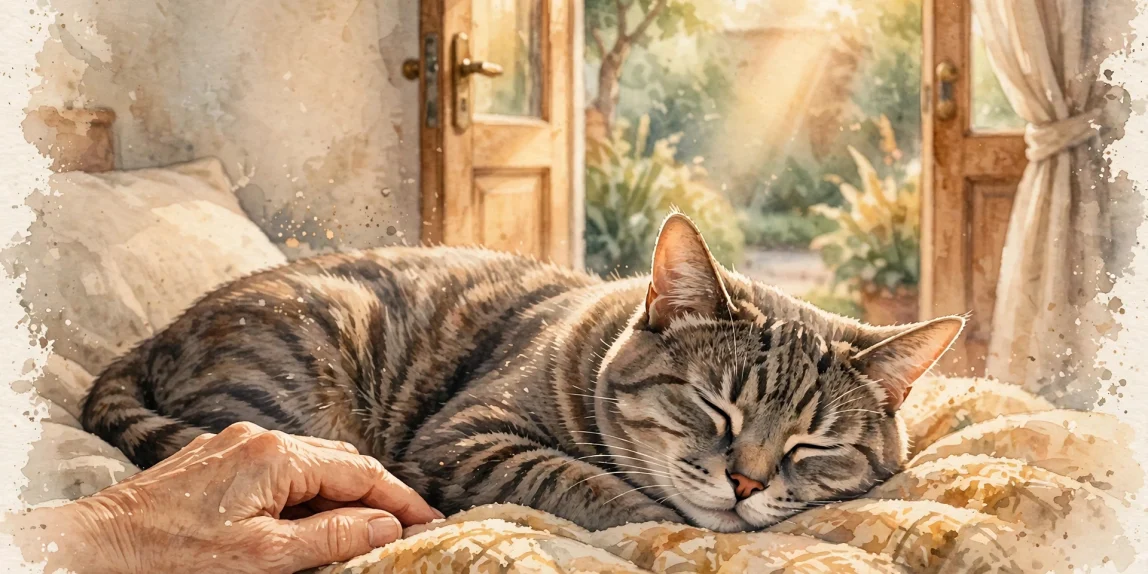
Every cat comes with a first day and a last one, and everything in between is just us keeping the promises we made on the first day. This is the promise nobody wants to talk about. It is still a promise. — YNOT!
The capstone of this book, “How to Be a Good Cat Parent,” put the whole job on one page: feed the carnivore, keep the vet appointments, make the house safe, play, scoop, learn the language, go gently, be patient. A good list. But it left one item off, the way we all leave it off — not because it is not part of the job, but because it is the part nobody puts on a poster.
This chapter is that item. A cat’s life ends in our hands as surely as it began in them.
The kitten chapters — the naming, the hissing phase, the first wild months — were written in the grammar of beginnings. This one is written in the grammar of endings, and it belongs in the same book, because it is the same love at the other end of it.
THE DEAL WE MADE ON THE FIRST DAY
Nobody says it out loud at the shelter, but the bargain is struck the moment the kitten comes home: this animal will almost certainly die on our watch, and we will almost certainly be the ones to decide how. Cats live fifteen, eighteen, sometimes twenty years — a good long while, and still, on the human calendar, a short story. We agree to outlive them. We agree to be there at the end. That was always the deal — and knowing it early is how the middle years get lived on purpose.
HOW DO YOU KNOW
The hardest question in all of cat keeping is the shortest one: is it time? There is no alarm. Cats hide decline the way poker players hide cards — an old cat does not complain, she withdraws, a little at a time, so gradually that the person who loves her most is the worst positioned to see it.
Which is why a veterinarian named Alice Villalobos, a cancer specialist for animals, built a counting tool. It is called the HHHHHMM scale, and it asks you to score seven things, honestly, from 0 to 10. Hurt: is her pain controlled, and can she breathe easily — breathing trouble outweighs everything else on the list. Hunger: is she eating enough, willingly. Hydration: is she drinking. Hygiene: can she keep herself clean, and move away from her own mess. Happiness: does she still take an interest — in you, in the sunbeam, in anything. Mobility: can she get up, get to her box, get to her bowl. And the last one, which sums the rest: More good days than bad.
Add the seven scores. Out of 70, vets who use the scale generally say that above 35 there is still enough good in the week to work with — room to adjust the medicine, try hospice, keep going. Below it, the conversation changes. But hear this: the number is not a verdict and not a permission slip. It is a way of counting honestly on an ordinary day, instead of deciding in a panic on the worst one. Score it more than once, with your vet. Its real gift is that it makes you look at the week your cat is actually having, rather than the cat you remember from three years ago.
And then there is the saying you will hear, sooner or later, from vets and from people who have stood where you are standing: better a week too early than a day too late. It is not a rule, and it is not meant to rush anybody. It is the hard kindness of experience talking. A cat does not know about next month. A cat knows today — whether today hurts, whether it holds anything she still wants. When the good days have quietly become the rare ones, choosing a gentle end before the crisis is not giving up on her. It is the last thing on the list, done on time.
YOU DO NOT HAVE TO DECIDE ALONE
This decision belongs to two parties: you, who know the cat, and your vet, who knows the disease. Neither half is enough by itself. If you are not sure you are hearing the whole story, a second opinion is not a betrayal — good vets expect the question and respect it. Ask what the medicine can still do. Ask what the next month honestly looks like.
And know that “nothing more can be done” is rarely the whole truth. There is a middle country between treatment and the end: hospice and palliative care for cats — pain control, fluids, appetite support, a comfortable bed near the family’s life — is a real and growing field, with its own veterinary guidelines and vets who do nothing else. Sometimes it buys weeks of genuinely good days. Sometimes it is simply how a cat spends her last days at home. Either way, it exists, and asking about it is allowed.
WHAT ACTUALLY HAPPENS
Most of the dread is in the not knowing, so here it is, plainly.
First comes sedation. In modern practice — and the feline vets’ own guidance prefers it — the cat is given a sedative or light anesthetic first, a small injection, and over a few minutes she simply goes to sleep: a real sleep, deep and untroubled, in your arms or on her own blanket. Whatever happens after that happens to a cat who is already asleep and feels none of it. Then, when you are ready, the vet gives the final injection — essentially a strong anesthetic, given as an overdose — usually into a vein in a front leg. The breathing slows and stops, and the heart stops after it, usually within a minute or so. There is no moment of fear in it. The cat’s experience of her own death is: she fell asleep near her person, and the pain was off.
A few things about the body afterward, so nothing startles you. The eyes usually stay open; that is normal — only sleep’s face without the closing. There may be a last deep breath or two, or a small muscle twitch, after the heart has stopped — reflexes of a body shutting down, not signs of feeling; the veterinary guidelines are clear that once consciousness is gone, they are not perceived. The bladder or bowels may let go as the muscles relax. None of it means she suffered. All of it means you were told in advance, which is the difference between a shock and a sorrow.
Should you stay in the room? That is your choice and only yours, and no guilt is owed in either direction — the cat is asleep before anything that matters happens, and she will not be frightened either way. But if you can stay, stay. Your voice is the most familiar sound in her world; cats know their person’s voice the way you know a song. Let it be the last one she hears, going under.
AT HOME, OR AT THE CLINIC
Both are honorable places for it. The clinic has everything at hand and a staff that has done this a thousand times with tenderness. Home has the cat’s own territory — her smells, her sunbeam, no car ride — and in many areas there are now veterinarians who do nothing but come to the house for exactly this. Ask your vet about it early, before the crisis day, so the name and number are already in your phone. The right place is the one where she is calm and you can be present. That is the whole test.
THE PAPERWORK OF THE HEART
There are practical matters, and they are kinder settled before the day than during it. Afterward, most cats are cremated — privately, with the ashes returned, or communally — or buried. Home burial is legal in many places and restricted in others, under local rules about depth and distance from water; check before, not after. There are costs to all of it, and no shame in asking what they are ahead of time — clinics answer these questions every week. Planning the paperwork early is not cold. It is how you buy yourself a last day that contains nothing but the cat.
GRIEF IS NOT A SMALLER THING
Afterward, people will sometimes say, kindly and stupidly, that it was only a cat. You will know better. The grief for an animal who shared your house, your schedule, and your lap for fifteen years is real grief — the same weather system as any other bereavement — and it needs no apology and no smaller name.
Two companions in it deserve a word. The first is guilt, which arrives for nearly everybody, whatever they decided: too early, too late, should have seen it sooner, should have tried the other medicine. Guilt here is just the tax love charges for having been the one who had to decide, and everyone who ever loved a cat has paid it. It is not evidence. The replaying is just the heart checking its work.
The second is the rest of the household. Children should be told the truth in plain words — not “went to sleep,” which can make a child afraid of bedtime, and not a story about a farm. A child who is allowed to say goodbye, and to grieve out loud, learns the lesson this whole chapter teaches: love includes the ending, and endings can be faced. And the other cats may grieve in their own way — searching the house, waiting by doors, calling, going quiet. Vets commonly suggest letting a housemate cat see and sniff the body if she wishes; nobody can prove what a cat understands of it, but the searching, in many houses, settles sooner when she has been allowed to look. At honest strength: it costs nothing, it often seems to help, and the cat will tell you herself whether she wants to.
THE QUIET HOUSE, AND THE NEXT CAT
The house will be quiet in a way that has a texture. The bowl stays down a day too long. You will hear a step that is not there. This is normal, it is not an emergency, and it does not need to be fixed on any schedule.
When — if — another cat comes, it will not be a replacement, because cats are not furniture and one does not replace a person. It will be a successor: a new animal, a new bargain, struck with full knowledge of how it ends — the only honest way any of us strike it. Some people are ready in a month, some in a year. Some keep the last cat as the last cat, and that is a complete sentence too. The cat you lost does not grade this. She had her whole life, and you were it.
On the first day, we promise them a whole life. On the last day, we find out the promise included this — and we keep it anyway, gently, in person, on time. That is not the sad part of having a cat. That is the proof of the rest of it. — YNOT!