Think of it as Yoga for the brain, we are going to stretch a bit.
Gone — What to Do When Your Cat Gets Out
A lost dog goes out to meet the world. A lost cat goes in to hide from it — and most of the time, the hiding place is close enough to hear you calling. — YNOT!
It happens in a second. A screen gives, a door stands open for the groceries, a carrier latch fails in a parking lot — and the cat who was asleep on your laundry is outside, gone. This chapter is built like a fire extinguisher: half of it is the ten minutes of prevention that make the night unlikely, and half is a checklist you can run at midnight with a flashlight in your teeth. And the research says the opposite of what panic says. Panic says far and fast. The facts say close and quiet.
THE BEST SEARCH IS THE ONE YOU NEVER HAVE TO RUN
Start with the microchip. A chip is not a GPS. It has no battery, it cannot be tracked, and it does not know where your cat is. It is a sliver the size of a grain of rice that sits silent under the skin until a shelter or a veterinarian waves a scanner over it — and then it speaks exactly one word: a number. The number points to a registry, and the registry points to you — if the phone number is current. In a study of more than seven thousand animals entering shelters, microchipped cats went home about thirty-eight percent of the time; cats without chips, under two percent. The chipped cats who didn’t get home mostly failed on paperwork: an old number, an address two moves back. A chip with a stale registration is a lottery ticket with no address on it. Register it, update it when you move, and at the yearly vet visit ask them to wave the wand over the cat: chips occasionally migrate from between the shoulder blades, and a two-second scan confirms the ticket still reads.
The collar is the chip’s fast-talking partner. Get the breakaway kind, which parts under strain so a snag can’t become a strangling, and put a tag on it with your number. Cats are the least-identified pets in the country; the fastest reunion there is, is a neighbor reading a number off a tag. Then, household discipline: know where the cat is before a door stands open, check your window screens like you’d check a boat for leaks, and never transport a cat loose. A cat rides in a carrier, because a cat loose in a car, or bolting across a strange parking lot, is a lost cat in foreign country. The Home Alone chapter told you to leave the sitter the cat’s hiding places. This chapter is why.
FIRST, SEARCH THE HOUSE YOU ARE STANDING IN
Before the street, search the house — thoroughly, even if you are sure, especially if you are sure. In the University of Queensland study of missing cats, about four percent of the “lost” cats were found inside their own homes. Cats fold themselves into places that look physically rude: the drawer that was open for an hour, the chimney, behind the washer and the water heater, inside the recliner’s machinery, up inside the box spring. Work room by room with the treat jar shaken softly, then stand still and listen. Certainty is cheap, but so is looking, and only one of them finds cats.
THE CAT IS CLOSE, AND THE CAT IS SILENT
Here is the single most important fact in this chapter, and it comes from that Queensland work — researchers working with Kat Albrecht, who built lost-pet recovery into a profession, surveyed the owners of 1,210 missing cats. For indoor-only cats found alive, the median distance from the point of escape was thirty-nine meters. About forty yards. Two or three gardens. Three quarters of them were found within roughly a hundred and fifty yards; across cats of every kind, three quarters were within a third of a mile. Your cat is almost certainly not across town. Your cat is under something.
And your cat will not answer you. Albrecht calls it the Silence Factor: a frightened cat’s oldest survival program is to hide and shut up, because in the wild, sound is how predators take attendance. The cat who answers your call every morning of its life will lie mute ten feet from your shoe. Ninety-three percent of owners in the study called their cat’s name while searching. The cats, by and large, did not reply. Silence is not distance. The absence of meowing is exactly the sound a scared cat makes. One exception: a cat allowed outdoors ranges like it means it — the median for those cats was three hundred meters, and a quarter went past a mile. Different cat, wider net. But the escaped house cat is a forty-yard problem until you have proven otherwise.
THE MIDNIGHT SEARCH: FLASHLIGHT, KNEES, AND PERMISSION
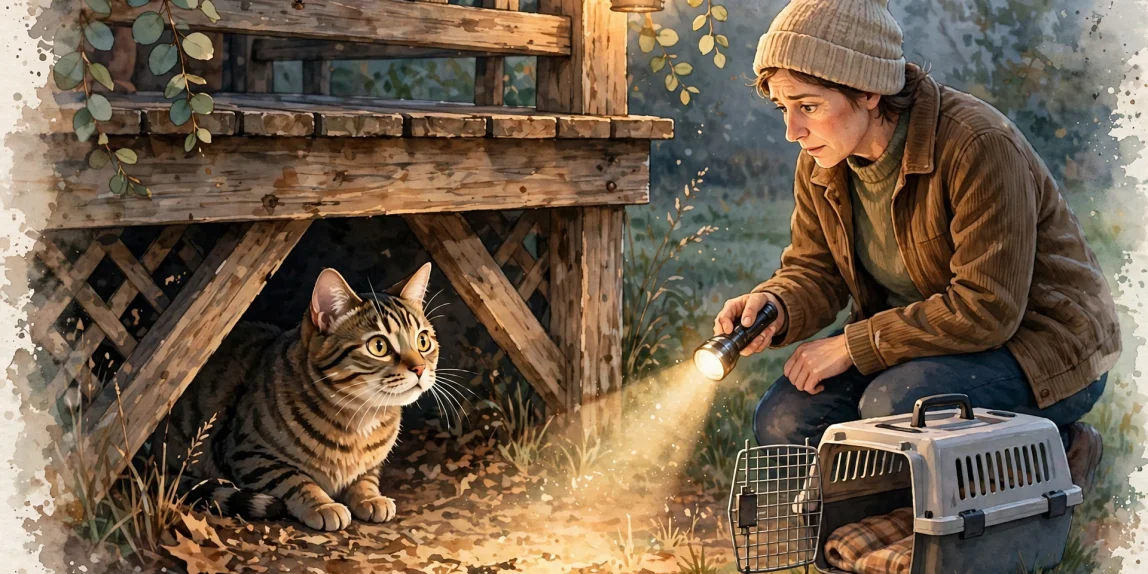
Search at night. The world quiets down, a hiding cat is likelier to stir, and a flashlight beam does the one thing your eyes can’t: it lights up eyeshine in the dark under a deck. Carry the light low and sweep it into every gap — under porches, decks, and sheds, into woodpiles and crawl spaces, up into the engine bay the Knock chapter warned you about. Get down on your knees. You are not looking for a cat standing in the open being a cat. You are looking for a cat-shaped silence at cat height.
Then knock on doors — your neighbors’, this time. Ask them to open their garages and sheds, or let you look inside: cats slip into an open garage and get shut in by supper, and in the study about one cat in ten found outside turned up inside somebody else’s house or garage. And search your own ground more than once — the cat you walked past at noon may shift six feet by midnight. It is about covering the same close ground like you mean it.
BAIT, HONEST AND OTHERWISE
Now the lures, at honest strength. Put out the things that smell like home — your worn shirt, the cat’s own bedding — by the door it went out of. Scent is the ink your cat’s map of the world is drawn in, and your smell is its biggest landmark. Set strong-smelling food near the escape point at dusk, watch from a distance, and bring what’s left in before deep night so you are not catering raccoons. Use familiar sounds: the treat jar, the can opener, and above all your ordinary voice, talking the way you talk on a Tuesday. A voice full of panic is a stranger’s voice. A calm one is home, broadcasting.
And the famous tip — set the dirty litter box outside, because a cat can smell it a mile away. The mile is fiction; no study supports it. Worse, the people who recover lost cats for a living, the Missing Animal Response network among them, mostly advise against the dirty box: used litter is an advertisement read by every animal in range, including territorial toms who will patrol your porch to answer it, and, in coyote country, predators who read cat scent as a dinner bell. Some owners swear the box worked, and it may have, because the cat was already twenty feet away and coming home regardless. The verdict of this book: your laundry carries the same message to your cat without mailing it to the whole neighborhood. Use the shirt. Leave the box inside, where the Litter Box Rebellion chapter left it.
THE PAPER WAR
While your knees do the close work, paper does the wide work. Flyers first: one big photograph, the word LOST in letters readable from a car, your phone number, not much else — posted within a few blocks in every direction, because that is where the cat is. Put them where people slow down: intersections, mailboxes, the veterinarian’s door. Then visit the shelters in person, every few days. Do not trust the phone: “grey tabby, female” describes a hundred cats, and no voice on a shelter line can scan a room the way your eyes can — in one study, finders trying to reunite cats through shelters and newspaper ads succeeded only about three times in a hundred. File the lost report, then go be your own search party in the stray ward. Call the microchip company too: they can flag the record, and some send out alerts. Post to the neighborhood pages and lost-pet registries. Paper multiplies eyes. It does not replace yours.
Here is what the odds look like, because at midnight you will want them. In the ASPCA’s national survey, about three quarters of lost cats were recovered. The largest group of the recovered — nearly six in ten — came home on their own; searching the neighborhood was the next biggest route home. And in the Queensland study, owners who physically searched found their cats alive fifty-nine percent of the time. Timing cuts both ways: a third of cats were found within a week, about half within a month — so start tonight, not this weekend, but a search is still worth running at week three. This is a winnable war. Most of them come home. Your job is to be looking when yours decides to.
DO NOT CHASE: SIT DOWN AND LET THE CAT COME TO YOU
If you see the cat, everything in you will want to run at it. Don’t. A chased cat runs, and a running cat leaves the forty-yard circle and becomes a mile-wide problem. Sit down instead. Get small, get boring, talk in your kitchen voice, and let the cat close the last ten feet at cat speed. It may take an hour of you sitting in a neighbor’s yard having a one-sided conversation with a shrub. That hour is the job.
For the cat who eats at the feeding station at 2 a.m. but will not come to any voice — and there are many, because fear temporarily rewires a house cat into something wild — borrow a humane box trap from a shelter or rescue group. Bait it with the good stuff, set it where the food has been disappearing, check it often, keep it quiet and covered. This is not a last resort; it is standard practice, and many a cat who fled every human for a week has walked into a trap before dawn and been a house cat again by breakfast, outraged and fine. And don’t grab at a trapped or cornered cat with bare hands. Fear bites. Towel, carrier, calm voice, home.
THE PORCH LIGHT STAYS ON
Last, the part nobody prints. Sometimes the search ends with bad news — a road, a shelter call you didn’t want. If it might have, go and check anyway: the shelters, the chip registry, the animal-control log. Certainty is a hard gift, but it is a gift; it ends the searching, and a chipped cat gets identified even then. Not knowing is the only outcome that never lets you put the flashlight down.
And the other truth, which is just as true: cats have come home after weeks, and after months — thin, dignified, and acting as if you were the one who was lost. The Queensland numbers thin out after ninety days, but they do not reach zero. So keep a flyer up a while. Keep the shirt by the door. Keep the porch light on. Hope is not a search method. But it is what keeps the searcher searching, and on the evidence, searching works.
Leave the porch light on and your voice calm and your knees dirty. The cat is not gone the way ships are gone. The cat is near, and silent, and waiting for the world to feel safe again — and nobody in that world is safer than you, sitting still, letting it come home the last ten feet by itself. — YNOT!