Think of it as Yoga for the brain, we are going to stretch a bit.
When the Storm Comes — Your Cat in a Hurricane
Every hurricane plan has a hole in it exactly the size of a cat — unless you put the cat in the plan first. -- YNOT!
Down here in Florida, the year has two seasons: hurricane season, and getting ready for it. The first runs June 1 through November 30, and most years a cone appears on TV with our name in it. The cat does not watch the cone. The cat watches you — and when the shutters start going up, the cat understands something is coming.
This is the plan for making sure whatever happens includes the cat — a checklist: do the work in June, and if the cone points at your house, just follow it.
THE ONLY RULE THAT OUTRANKS THE WEATHER
If you go, the cat goes. That is the whole doctrine; the rest is machinery for obeying it. Not “if there’s room.” Not “if the shelter allows it.” If you would not spend the storm in that house yourself, the cat does not spend it there either — the cat cannot evacuate itself.
The country learned this rule the expensive way. After Katrina in 2005 came the pictures from New Orleans: people who refused to leave because they could not take their animals, and animals left behind in houses that stood — and died in them anyway, of thirst, hunger, heat, and floodwater. Congress actually listened. In 2006 the PETS Act — the Pets Evacuation and Transportation Standards Act — became federal law: it requires state and local emergency plans to make room for people with household pets, and lets FEMA fund pet rescue and sheltering. There is a law about your cat in a hurricane.
Understand the trap in “I’ll only be gone a day or two.” After a real storm, you go back when the county says you go back. People have been kept out for a week and more. A cat left with “plenty of food” is a cat alone in a dark, hot house with water you would not drink. Tomorrow is a promise the storm never signed.
DO IT IN JUNE, WHILE THE SKY IS STILL POLITE
First, the carrier. Your cat should already think of the carrier as furniture with a door — that is a whole earlier chapter of this book, and hurricane season is where it pays off. A carrier that appears only on vet day is a trap with a handle; in an evacuation, you need the cat to walk into the box, not be wrestled in.
Second, the microchip. If your cat is not chipped, June is when it happens — and if it is, June is when you confirm the registry has your current number, because a chip that dials your old number is a message in a bottle. The Lost Cat chapter preaches this sermon; in a storm it doubles. A collar with an ID tag rides along — collars slip off in a panic; the chip cannot fall off.
Third, pictures: a recent photo of the cat on your phone, and one of you with the cat — the first for a lost poster, the second to prove in a shelter line that the cat is yours.
Fourth, the records. Vaccination records — rabies above all — go in a waterproof folder, and then you photograph every page, so the folder can drown and the records survive. Shortly you’ll see why that folder matters more than the food.
THE CAT’S SUITCASE
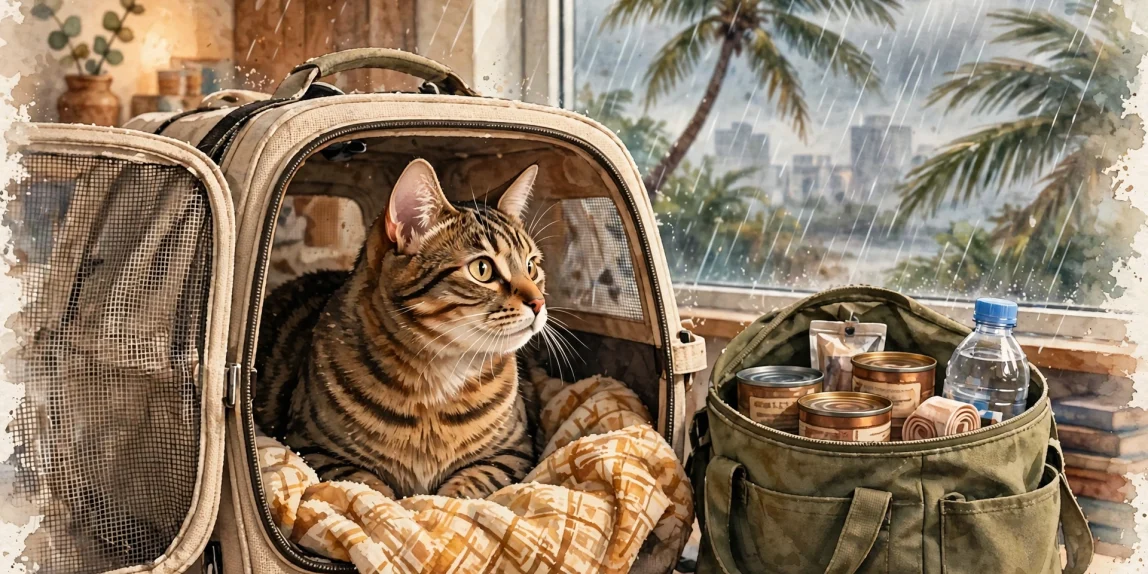
Every cat in a hurricane zone needs a go-bag, packed in June, kept near the door where everybody knows it lives. The list agrees, item for item, with what the FDA, the CDC, and the ASPCA tell pet owners to pack.
Food: at least a week’s worth in an airtight, waterproof container — two weeks if you have the shelf. Rotate it so it never expires in the bag. If the cans are not pop-tops, a manual can opener goes in; the electric one will be a paperweight.
Water: bottled water for the cat, a week’s worth, separate from the family’s supply. After a storm, tap water may be under a boil notice or worse.
Medicine: a two-week supply. Pharmacies close, roads close, vets close — two weeks is the cushion the federal lists recommend.
Litter and a pan: a bag of litter and disposable pans — the cheap aluminum roasting pans are perfect, because nobody washes a litter box in a shelter.
Handling gear: a harness and leash, and a spare collar with ID. In any evacuation the cat comes out of the carrier sometime — a vet check, a strange room — and a frightened cat in bare arms is one loud noise from gone.
The blanket that smells like home: one piece of bedding the cat sleeps on, unwashed, funk and all. The cat’s world is drawn in scent, as this book’s map chapter explains, and a shelter smells like bleach and strangers’ animals. That blanket is a piece of the map you can carry — one square yard that still says home.
And the janitor supplies: paper towels, plastic bags, disinfectant. A stressed cat in a strange place will produce a mess. Plan on cleaning it without complaint. You are staff.
KNOW YOUR EXITS BEFORE THE CONE POINTS AT YOU
In June, decide where you would go. You want three doors. Door one: family or friends inland, outside the evacuation zones, who have agreed — out loud, in advance — that the cat comes too. Door two: pet-friendly hotels inland — call in June, note which take cats, and ask again during an evacuation; never assume. Door three is the county’s backstop.
Most County’s Animal Services runs pet-friendly evacuation centers for residents of evacuation zones, unsafe structures, and mobile homes. Which centers open is announced as each storm approaches — check for example miamidade.gov or call 311. Pre-registration is not required, the county says, but admission has rules — hence the records folder: proof you live in the zone — a photo ID and a recent utility bill — and the cat’s medical and current vaccination records, with a current rabies vaccination, which county cats must have anyway. You bring your own supplies. The limit is four pets per household, a family member stays at the center with the animals, and a veterinarian examines every pet at the door — a shelter you stay in with your cat, not a kennel: Animal Services does not board animals.
And plainly: most ordinary public shelters still do not accept pets at all. Never drive to one assuming yours is the exception — June is when you learn a shelter’s pet policy, not landfall. And if you’re ordered out, leave early: everything takes longer with a cat.
RIDING IT OUT — ONLY IF NOBODY TOLD YOU TO LEAVE
If your zone is ordered out, skip this section and go back to the rule — this is for houses outside the zones, built to stay.
Choose one interior room — a bathroom, a closet, the room with the fewest windows — and make it the safe room before the weather arrives: litter box in the corner, water down, carrier standing open with the home blanket inside — a cave within the room.
Get the cat into that room early, while the sky is still merely rude. Cats read a falling barometer and a nervous household the way you read this page, and a hiding cat picks the one spot you cannot reach — under a bed, up inside the recliner — and stays there through the worst of it. You do not want to negotiate with a terrified animal under furniture by flashlight at landfall.
During the storm, doors and windows stay disciplined — nobody opens an outside door “for one second.” If the cat must move, it moves in the carrier, closed. And in a car, the cat rides in the carrier, never loose: a loose, terrified cat goes for the darkest hole it can find, and the darkest hole in a car is under the pedals. Keep the routine boring, feed at the usual times — to the cat, you are the weather it actually lives in; be a calm front.
IF YOUR HOME HAS AN ELEVATOR
A short word for renters and high-rise floors: a tower has its own storm. Ask management in June what the plan is — some buildings have rules about animals in hallways and stairwells, and June is when you find out, not the stairwell at midnight.
Elevators die with the power. If you might carry the cat down fifteen flights of dark stairs, the carrier must be one you can manage one-handed, flashlight in the other — so carry it down once on a calm day, as a rehearsal. Feeling foolish is the correct uniform for disaster preparation. Keep carrier and go-bag in your unit, by your door — not in a storage cage across the complex.
0THE STORM AFTER THE STORM
The wind stops. The rain stops. The dangers clock in for the second shift.
Keep the cat inside. Full stop. The house smells wrong — the cat’s scent map has been rained on and rearranged — and the yard is a new country full of hazards.
Walk the property first, cat-free. Downed power lines. Broken glass and nails. Fences down, gates hanging open. Standing water everywhere — and the cat never drinks it: floodwater is a soup of fuel, chemicals, sewage, and worse, so the cat’s water comes from your bottled supply. Displaced wildlife, too — snakes ride floodwater and shelter in debris piles, where a curious cat goes to supervise.
Then make doors a discipline for a week. The days after a storm are when the lost-cat posters bloom, because a recovering house is a building site, doors opening and closing all day. The cat keeps the safe room while the house is a thoroughfare. The Lost Cat chapter is full of cats who got out through a door somebody “only opened for a second.” After a storm, every door is that door.
THE QUIET KILLERS MOVE IN AFTERWARD
The first is carbon monoxide. When the power dies, out comes the generator — and the CDC’s rule has no exceptions: never run one inside the house or the garage, not even with the garage door standing open. Outside only, at least twenty feet from the house, exhaust pointed away. Carbon monoxide is colorless and odorless; it fills a closed space and poisons people and animals alike, and the cat, small and low to the floor, gives no warning in time. Every season, families survive the hurricane and die of the generator. Do not be a statistic with a cat in it.
The second is heat. A home without power after a storm is an oven with furniture in it — the hot-car problem from an earlier chapter, rebuilt at building scale. A sealed house cooks slower than a parked car, but it cooks — and the cat wears a fur coat it cannot take off. If the house climbs into real heat, the cat goes where you go — into the car with the air conditioning running and you in it (never the cat alone in a car) — or anywhere shady with moving air. Know the signs cold: a cat panting with its mouth open — something a healthy cat almost never does — drooling, wobbling, vomiting, gums gone brick-red. That is not a wait-and-see. That is a veterinarian, fast.
The time to save the cat is June, when the sun is shining and the carrier is just furniture. In October, you only find out whether you did. — YNOT!