Think of it as Yoga for the brain, we are going to stretch a bit.
Let Sleeping Kittens Lie — Why Keeping Her Awake All Day Backfires
Every new kitten owner eventually asks the same desperate question at 3 a.m.: can I just keep her awake all day, so she sleeps at night? No. And the reason is the best news in this book: a kitten is not being difficult. A kitten is under construction, and sleep is when the building happens. -- YNOT!
The case that started this chapter arrived with a soundtrack. A woman had brought home a kitten — black, small, and fitted with a collar bell — and the kitten had spent the entire night doing what kittens do: playing, at full volume, with a bell on. All night. Ringing. By morning the owner was asking the internet, in the tone of a woman negotiating with a tiny terrorist, whether she should treat the kitten like a baby on a sleep schedule: keep her awake all day, so she would crash at night like a toddler who skipped his nap.
One hundred and fifty-three people answered. It is a measure of how universal the 3 a.m. despair is that most of them were kind, many of them were funny, and nearly all of them landed on the same two pieces of advice. But buried in the thread is a genuine question that deserves a real answer, because the plan sounds so reasonable. It isn’t. Here is why — and what actually works instead.
A KITTEN SLEEPS LIKE IT’S HER JOB, BECAUSE IT IS
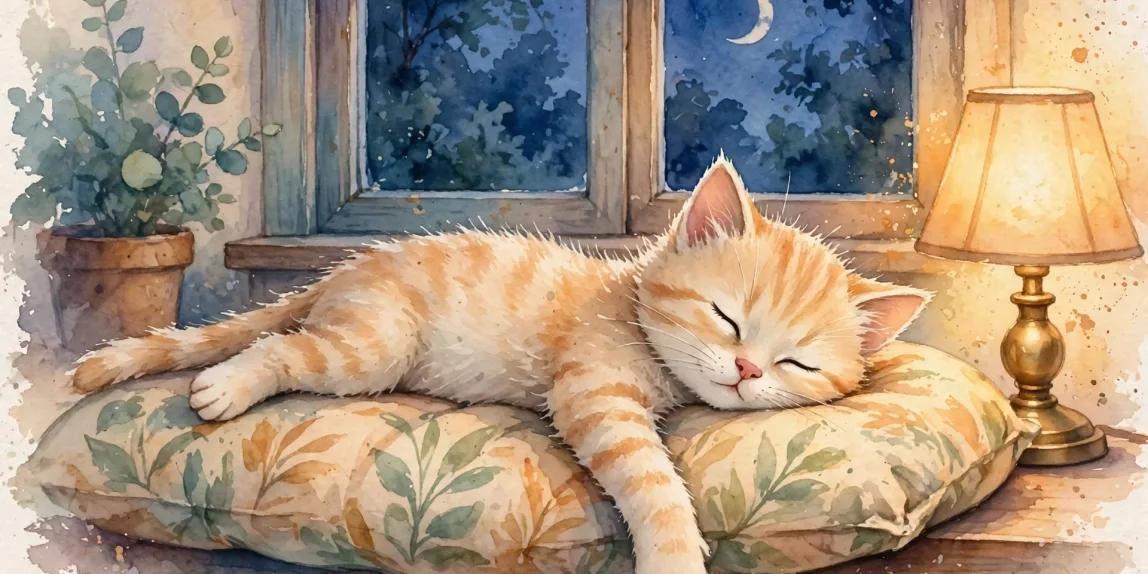
Start with the numbers, because they reframe everything. A young kitten sleeps somewhere between eighteen and twenty-two hours a day. Newborns sleep more than that — close to ninety percent of their lives. An adult cat gets by on twelve to sixteen. The kitten is not lazy, and she is not broken, and she is certainly not storing up energy out of spite. She is growing at the fastest rate of her entire life, and growth is not something that happens while she is awake and gets paused for naps. It is close to the opposite. The deep work of building a cat — the growth hormone release, the brain wiring itself, the immune system learning its trade — happens disproportionately during sleep. A sleeping kitten is not a kitten with the power off. She is a construction site with the crew on shift.
This is why “keep her awake all day” fails even as pure logic. You cannot bank a kitten’s sleep the way you bank your own exhaustion, because you are not dealing with a battery. You are dealing with a building schedule. Interrupt it all day and you do not get a kitten who sleeps gratefully through the night. You get an overtired kitten — and anyone who has ever met an overtired toddler knows exactly what overtired means. Not sleepy. Wired. Frayed, frantic, and faster than before. Sleep-deprived kittens do not wind down. They wind up.
SHE ISN’T NOCTURNAL. SHE’S A SHIFT WORKER.
There is a whole chapter earlier in this book about cat time — the crepuscular rhythm that makes cats creatures of dawn and dusk rather than true night owls. It matters here because it changes what “sleeping through the night” can even mean. Your kitten’s ancestors hunted at first light and last light, and the kitten has inherited the shift pattern along with the whiskers. She will probably never sleep a human eight hours in a single block, and asking her to is asking her to be a different species.
But here is the hopeful part, and every long-term owner in that thread confirmed it: cats are also creatures of routine, and routines can be negotiated. A cat in a household slowly anchors her active hours to the household’s — not because she has been trained like a dog, but because the interesting events of her day (food, play, company) happen on your schedule, and a cat’s clock is set by interesting events. The goal is not a kitten who sleeps when you sleep. The goal is a kitten whose two loud shifts happen at breakfast and in the early evening, instead of one of them happening on your pillow at 3 a.m. That goal is reachable. You reach it by moving the play, not by stealing the sleep.
THE ACTUAL FIX: RUN THE HUNT BEFORE BED
The thread’s most useful advice, repeated by owner after owner, was some version of this: wear her out in the last hour before bed. It works, and it works even better when you run it the way this book keeps recommending — as the full ancient sequence. Hunt, catch, eat, groom, sleep.
So, an hour or so before your bedtime, get the wand toy out and give her a real hunt: stalking, chasing, and — this part matters — catching. A play session where the prey never gets caught is frustration wearing a feather. Let her win, repeatedly, and then end the evening the way a hunt ends in the wild: with a small meal. A kitten who has hunted, caught, and eaten has a groom and a crash scheduled by several million years of wiring. You are not tiring her out. You are completing her day in the correct order, and a completed day ends in sleep.
Then keep the boring parts boring. Same lights-out routine, same quiet house. When she starts the warm-up laps at dawn — and she will, because dawn is one of her shifts — the discipline is yours, not hers: do not feed her, do not play with her, do not stage an interesting argument about it. Attention at 5 a.m. is a paycheck. The owners who survive the dawn shift park a few solo toys outside the bedroom and let the kitten entertain herself until a civilized hour. A closed bedroom door is also allowed. It feels like a crime. It is not. She has food, water, a box, and toys; what she is missing is an audience, and audiences are a daytime amenity.
AND ABOUT THAT BELL
Nearly a third of the thread said some version of the same sentence: take the bell off. They were right, and it is worth understanding why the bell was on her in the first place. A bell on a collar is a hunting handicap — it warns birds and other prey that a cat is coming, which is a genuinely useful thing for an outdoor cat whose owner would like fewer feathers on the doorstep. That is the bell’s whole job. Indoors, at night, it warns nobody of anything. It just narrates.
And consider whose ears it narrates to. A cat’s hearing is far more sensitive than yours and reaches pitches you will never hear in your life. The bell rings inches from those ears with every step, every scratch, every midnight lap of the hallway, all day and all night, and the cat cannot take it off. Nobody has proven a collar bell damages a cat’s hearing, and this book is not going to claim it. But a noise you would find maddening hung around your own neck deserves at least a raised eyebrow when it is hung around the neck of an animal who hears better than you do and never volunteered. If she goes outdoors, keep the bell for the birds’ sake — on a breakaway collar, always, so a snagged collar releases instead of strangling. If she is an indoor kitten, retire the bell and enjoy the silence. Half the problem in that thread was never the kitten. It was the soundtrack.
THE GOOD NEWS AT THE END OF THE NIGHT
Every veteran in that thread said the same last thing, and for once the internet’s most repeated claim is simply true: it gets better. The kitten who cannot be contained at ten weeks is, by five or six months, usually sleeping most of the night — not because she was scheduled into it, but because she grew, and because her active hours quietly anchored to yours. The night shift is a season, not a sentence.
So no — do not keep her awake all day. Let her sleep her enormous, necessary sleep, and spend your authority where it actually works: a hunt before bed, a meal to close it, a quiet house, a retired bell, and the patience to ignore the dawn encore until it moves to a better hour. You are not losing this negotiation. You are just negotiating with a creature whose clock runs on hunts and meals instead of hours — and now you know where the controls are.
You cannot schedule a kitten. But you can schedule the hunt, the meal, and the quiet — and the kitten’s sleep will arrange itself around them like water finding its level. — YNOT!