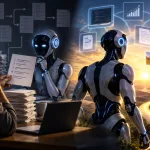
We have spent the last few years talking about AI assistants.
That description is already becoming obsolete.
The next generation of AI will not simply sit inside a chat window waiting for you to ask a question.
It will have a job. It will have responsibilities. It will have tools. It will have a computer.
And it will keep working after you close your laptop. That is what makes Grok Bot interesting.
xAI is moving Grok beyond the traditional chatbot model and toward something much closer to a persistent digital employee.
The distinction is enormous. A chatbot says: “Here is how you can do it.”
An AI agent says: “I did it.”
FROM CHATBOT TO WORKER
Imagine creating several AI workers inside your company:
Research Bot
Research competitors, products, customers, industries, regulations and opportunities.
IT Bot
Check servers, review logs, verify backups, monitor storage and investigate failures.
Accounting Bot
Review invoices, reconcile information and prepare reports.
Marketing Bot
Research trends, prepare campaigns, analyze competitors and organize content.
Executive Assistant Bot
Review information, prepare summaries, coordinate work and delegate assignments.
These are not simply different chat windows.
The important idea is that the agents can have persistent roles, workflows, memory and access to tools.
They begin looking much less like software features and much more like members of an organization.
THE COMPUTER CHANGES EVERYTHING
One of the most important parts of Grok Bot is that the agent can operate a computer.
That means it can potentially use:
- A browser
- Websites
- SaaS applications
- Files
- A terminal
- Command-line utilities
- Connected services
- APIs
- Internal business systems
This solves one of the biggest problems in automation.
For decades, we have built automation around APIs. If the application had an API, automation was possible.
If it didn’t, things became much more difficult. AI computer control changes that.
An AI worker can potentially interact with software the same way a human employee does:
look at the screen, understand what is happening, click something, type something, read the result and decide what to do next.
Suddenly millions of applications that were never designed for automation become candidates for automation.
That is a profound change.
AI IS BECOMING THE NEW RPA
For years corporations spent enormous amounts of money on Robotic Process Automation — RPA.
RPA systems automated repetitive office work.
Open this screen. Click this button. Copy this value. Paste it here. Download this file. Rename it. Upload it somewhere else.
The problem was that traditional RPA was brittle.
Move a button. Change a webpage. Rename a field. The automation would break.
AI introduces reasoning into the process.
Instead of programming: Click coordinate X=428, Y=176.
You can increasingly describe the intent:
Open the customer’s account, download the latest invoice and place it in the accounting folder.
The AI figures out how.
That is a completely different automation paradigm.
TEACH THE AI LIKE AN EMPLOYEE
Perhaps the most fascinating idea is teaching workflows by demonstration.
Think about how companies train employees today.
You sit beside someone and say:“Watch what I do.”
You open the accounting system. You find the invoice. You check the purchase order.
You compare the numbers. You enter the information. You save the record.
Then you tell the employee: “That’s how we do it.”
AI agents are beginning to learn workflows in essentially the same way.
Demonstrate the procedure.
The system converts the demonstration into a repeatable skill.
That skill can then become part of the organization’s operational knowledge.
This is important because enormous amounts of business knowledge have never been formally documented.
They exist inside people’s heads.
“Ask Maria. She knows how to do that.”
“John handles those.”
“Tony knows where that information is.”
AI agents may finally provide a practical mechanism for converting that undocumented tribal knowledge into executable organizational knowledge.
SKILLS + ROUTINES = DIGITAL EMPLOYEES
The architecture becomes especially powerful when you separate skills from routines.
A skill might be:
Check Production Servers
- Verify uptime.
- Check disk capacity.
- Check CPU and memory.
- Check database status.
- Check critical services.
- Review recent errors.
- Produce a health report.
Then you attach a routine:
Every weekday at 7:00 AM:
Run the production server health check.
The AI no longer waits for someone to remember to ask.
It performs the responsibility automatically. That is the moment AI crosses an important line.
It stops being merely responsive. It becomes operational.
THE AI ORGANIZATION
Now take the concept one step further.
Imagine an organization structured like this:
                    HUMAN
                      │
               AI CHIEF OF STAFF
                      │
          ┌───────────┼───────────┐
          │           │           │
       RESEARCH      IT        FINANCE
          │           │           │
          │        SECURITY     ACCOUNTING
          │
       MARKETING
Instead of one enormous AI trying to do everything, specialized agents handle specialized responsibilities.
The Chief of Staff agent receives a task.
It delegates research to one agent. Analysis to another.
Infrastructure work to another. The agents return their results.
The coordinating agent assembles the final product.
That begins to resemble a company organizational chart.
Except some of the boxes on the chart are software.
BUT THERE IS A VERY BIG SECURITY PROBLEM
Giving AI agents computers also creates an entirely new security problem.
A chatbot that gives bad advice is inconvenient.
An autonomous agent with access to:
- Banking
- Production servers
- Customer databases
- Source code
- Payroll
- Accounting
- Administrative credentials
can cause real damage.
That means the future of autonomous AI will require something similar to the permission systems we already use for employees.
The accounting AI should not automatically have access to production servers.
The marketing AI should not have access to payroll.
The research AI should not be able to delete customer records.
The IT AI should not automatically be allowed to transfer money.
AI agents will need: Identity Roles Permissions Audit trails Approval requirements Credential isolation Execution boundaries
In other words, AI employees will eventually require something very similar to HR + cybersecurity + identity management combined.
THE BIGGER STORY
The biggest mistake people can make right now is evaluating AI only by asking:
“Which chatbot gives the best answers?”
That may soon become one of the least interesting questions in AI.
The much more important question is: What can the AI actually do?
Can it operate systems?
Can it use tools?
Can it remember procedures?
Can it execute workflows?
Can it collaborate with other agents?
Can it run on a schedule?
Can it react to events?
Can it ask a human for approval when necessary?
Can it continue working without someone constantly prompting it?
Those are the capabilities that turn artificial intelligence into artificial labor.
THE NEXT SOFTWARE REVOLUTION
Traditional software gave humans tools.
AI assistants helped humans use those tools.
AI agents are beginning to use the tools themselves.
That may turn out to be a much larger economic transformation than the chatbot revolution that introduced the public to generative AI.
The computer industry spent decades asking: How do we make software easier for humans to operate?
The next decade may increasingly ask:
Why does a human have to operate it at all?
Grok Bot is one early glimpse of that future.
Not a chatbot. Not simply an assistant.
But the beginning of something much more significant:
The AI employee.
And eventually, perhaps, the 100 % AI company.
© 2026 insearchofyourpassions.com - Some Rights Reserve - This website and its content are the property of YNOT. This work is licensed under a Creative Commons Attribution 4.0 International License. You are free to share and adapt the material for any purpose, even commercially, as long as you give appropriate credit, provide a link to the license, and indicate if changes were made.
Related Posts: