Think of it as Yoga for the brain, we are going to stretch a bit.
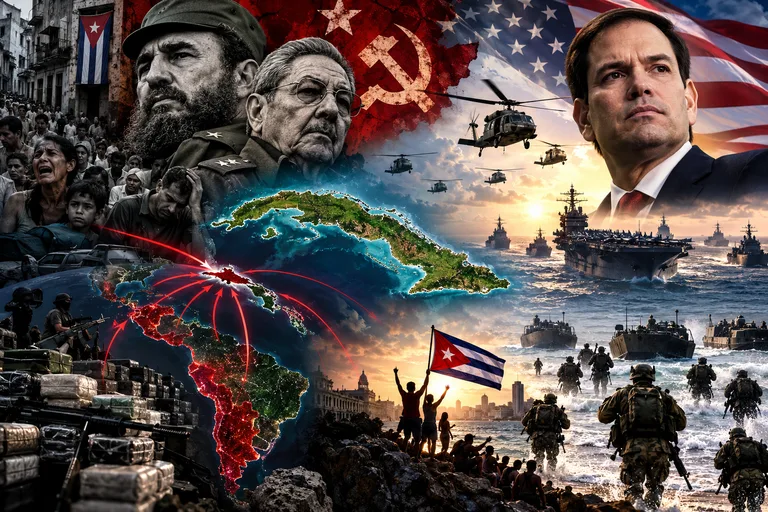
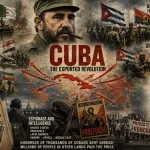
CUBA: THE LAST DAYS OF THE CASTRO DICTATORSHIP are here
70 Years of Communism, Repression, Murder, and Exporting Revolution and America Finally Preparing to End It. I can’t wait! — YNOT!
Let’s sharpen this conversation with a little truth, because we’ve spent nearly 70 years pretending Cuba is something it isn’t.
Cuba isn’t some innocent little Caribbean island that just happened to get bullied by the United States.
Cuba is an EVIL communist dictatorship.
A brutal, repressive, economically bankrupt dictatorship that has spent nearly seven decades destroying its own country, imprisoning political opponents, suppressing dissent, and exporting its poisonous political ideology throughout the Western Hemisphere.
Cuba has basically again proven that Communism, Socialism, Marxism, whatever you call it does not work. It has committed genocide on its own people for 70 years.
And here’s the truly remarkable part.
After nearly 70 years, Cuba still hasn’t figured out how to feed its own people, provide reliable electricity, or build an economy that functions without someone else paying the bills.
Seventy years! Think about that.
In less time, South Korea went from being one of the poorest countries on Earth to an industrial and technological powerhouse. Singapore became one of the wealthiest countries in the world. China transformed itself into an economic superpower by abandoning much of its orthodox communist economic system.
And Cuba?
Cuba is still begging for somebody to send it oil for Free!
That’s the magnificent achievement of the Castro revolution.
They promised paradise, delivered poverty, and then blamed everyone else for the results.
And before somebody starts telling me that Cuba’s problems are entirely the result of American sanctions, let’s remember something.
Cuba has traded with countries throughout the world. It has received enormous subsidies from the Soviet Union, preferential oil shipments from Venezuela, financial support, investment, and assistance from numerous foreign governments.
American sanctions have certainly damaged Cuba’s economy. Sanctions didn’t force Cuba to outlaw meaningful political competition, imprison dissidents, restrict private enterprise, or build an economic system in which the government controls almost everything.
Those were decisions made in Havana.
At some point, after seven decades, you have to stop blaming the neighbor and start questioning the people running the house.
THE CASTROS DIDN’T JUST DESTROY CUBA. THEY EXPORTED THEIR REVOLUTION.
This is the part of Cuban history that too many people conveniently forget.
The Castro government wasn’t satisfied with transforming Cuba into a Marxist-Leninist state. It wanted to spread revolution and chaos. Throughout Latin America. Throughout Africa.
And wherever else it believed revolutionary movements could undermine governments and expand Soviet-aligned influence.
Cuba supported revolutionary movements and armed organizations across the hemisphere, including the Sandinistas in Nicaragua and leftist insurgencies in Colombia.
Cuban military forces were deployed to Angola and Ethiopia during the Cold War, fighting in conflicts thousands of miles from Havana.
The Cuban government developed an extensive intelligence apparatus and cultivated relationships with political movements throughout Latin America.
Its influence has extended into Venezuela, Nicaragua, Bolivia, and other countries where political leaders adopted elements of the Castro revolutionary model.
Cuba tried to make puppets out of Brazil, Colombia, Mexico, and Bolivia. Havana spent decades attempting to influence political developments across the region is simply ignoring history.
And Venezuela deserves particular attention. The relationship between Cuba and Hugo Chávez, followed by Nicolás Maduro, became one of the most important political alliances in the hemisphere. Venezuela provided oil and economic support. Cuba provided medical personnel, advisers, intelligence cooperation, and political support.
Cuba sucked Venezuela dry and when Venezuela descended into economic catastrophe, millions of Venezuelans fled their homeland. Sound familiar?
Cuba built a political model so successful that millions of people have spent decades risking their lives to escape it. That’s not a ringing endorsement of communism.
That’s a verdict.
And let’s not forget Cuba’s darker history: allegations and documented cases involving drug trafficking networks, Cuban officials, clandestine operations, political violence, and revolutionary movements. The Castro government’s record is not some romantic Hollywood movie about heroic revolutionaries smoking cigars and liberating peasants.
It is a history filled with executions, political imprisonment, repression, failed economic experiments, and the systematic elimination of political freedom.
Che Guevara, that handsome face on millions of fashionable T-shirts, participated in and oversaw revolutionary executions. Called the Butcher of the Cabana – The exact number of deaths for which he was personally responsible is disputed, in the thousands but his involvement in revolutionary tribunals and executions is not.
Somehow, we transformed revolutionary violence into a fashion accessory. Imagine putting the face of an executioner on a T-shirt and calling it liberation.
The Cuban Revolution didn’t free the Cuban people from dictatorship. It replaced one dictatorship with another that lasted generations. And the Cuban people have paid for it ever since.
COMMUNISM HAS HAD SEVEN DECADES TO PROVE ITSELF IN CUBA.
Here’s another uncomfortable truth.
There aren’t many countries left operating under one-party communist political systems.
Cuba, North Korea, Vietnam, Laos, and China remain the principal examples.
But these countries aren’t economically identical.
China embraced private enterprise, foreign investment, manufacturing competition, and market mechanisms on a massive scale. Vietnam followed a similar economic reform path. Neither abandoned communist one-party political control, but both recognized that rigid central planning could not deliver the economic development their populations needed.
Cuba has permitted limited private enterprise while retaining extensive state control and political repression.
North Korea remains another extreme example of authoritarian isolation.
So when people tell me that Marxism simply hasn’t been implemented correctly, I have a question.
How many decades, how many failed economies, and how many generations of suffering are required before we’re allowed to question the experiment?
Cuba isn’t failing because it hasn’t had enough time. It isn’t failing because the Castro brothers weren’t sufficiently committed. It isn’t failing because nobody explained Marxism properly. The Castro government had decades to demonstrate that its economic and political system could produce prosperity, freedom, and opportunity.
Instead, Cuba has experienced chronic shortages, deteriorating infrastructure, mass emigration, and repeated economic crises.
You can acknowledge Cuba’s achievements in literacy and medical training without pretending those accomplishments excuse political repression or economic collapse.
And here’s something else. The Cuban people aren’t the enemy. They are the victims.
The fishermen, teachers, doctors, mechanics, farmers, shopkeepers, and millions of ordinary Cubans trying to build decent lives aren’t responsible for the political system imposed upon them.
My argument is against the dictatorship, not against Cuba or its people.
In fact, my hope is that Cuba eventually becomes one of the most prosperous countries in the Caribbean.
It has the geography, natural beauty, human talent, cultural richness, and proximity to North America to become an extraordinary economic success.
Imagine what Cuba could become with genuine political freedom, private investment, enforceable property rights, functioning institutions, and access to international capital.
An island 90 miles from Florida should be an economic powerhouse.
Instead, after nearly seven decades of communist rule, it has become a symbol of squandered opportunity.
AND NOW, FOR THE FIRST TIME IN DECADES, THE GEOPOLITICAL EQUATION IS CHANGING.
This is where things get interesting. For most of its existence, communist Cuba survived because someone more powerful was willing to keep it alive.
First, the Soviet Union. Then, following the collapse of the USSR, Venezuela became an enormously important economic lifeline.
China and Russia have continued providing varying degrees of political and economic support.
But the world is changing. And Cuba’s position is becoming increasingly precarious.
The Soviet Union is gone. Venezuela’s political leadership has been transformed following the removal of Nicolás Maduro.
Russia has its own military, economic, and geopolitical problems.
And China, while continuing to support Cuba, has enormous economic interests that extend far beyond preserving a failing communist government in the Caribbean.
For the first time in generations, Cuba may be approaching a political crisis without a reliable superpower willing to rescue it at any cost.
And President Trump knows it. Marco Rubio knows it. The Cuban government knows it.
The question is what happens next.
TRUMP IS REASSERTING AMERICAN POWER IN OUR OWN HEMISPHERE.
People need to understand something about geopolitics.
The world has always operated, at least partly, through spheres of influence.
Great powers have strategic interests. They have economic interests.
They have security interests.
And they generally don’t appreciate hostile governments cooperating with rival military powers in their immediate neighborhoods.
This isn’t something Donald Trump invented.
America has operated under variations of this principle since the Monroe Doctrine of 1823.
The United States has historically considered the Western Hemisphere strategically important to its national security.
What we’re witnessing now looks increasingly like an effort to reassert that position.
China has become the dominant economic and military competitor in East Asia.
Russia continues attempting to preserve influence over its neighboring countries.
Europe is struggling to define its own security and geopolitical future.
And the United States is increasingly focused on ensuring that rival powers cannot freely establish military, intelligence, and strategic footholds throughout the Americas.
Look at the attention being paid to Venezuela.
Look at the renewed strategic importance of Greenland, where Washington has secured expanded security cooperation without acquiring sovereignty over the territory.
Look at Panama, the Caribbean, Mexico, and the changing relationships throughout Latin America.
These developments aren’t necessarily part of one coordinated master plan.
But they point toward a broader strategic realignment.
America appears increasingly determined to become the decisive strategic power in its own hemisphere.
And Cuba presents a particularly interesting problem. Here is a communist government approximately 90 miles from Florida, with a long history of cooperation with America’s geopolitical adversaries.
A government that has maintained intelligence relationships with hostile powers.
A government that has spent decades openly opposing American political and economic influence.
And a government whose economic survival has repeatedly depended on foreign patrons.
From a strategic perspective, Washington has obvious reasons to care about what happens in Cuba.
That doesn’t automatically justify an invasion, and the Cuban people must ultimately have the right to determine their own government.
But I don’t believe the United States should simply ignore the security implications of an entrenched hostile dictatorship sitting on its doorstep.
You don’t need to occupy a country to prevent it from becoming a strategic outpost for your adversaries.
And I suspect the Trump administration understands that distinction.
THE MILITARY PREPARATIONS ARE WHAT REALLY CAUGHT MY ATTENTION.
Now we’re getting to something much more interesting.
On September 25, 2026, reports emerged that the U.S. Army Reserve had been assessing its ability to provide support units for a potential military operation involving Cuba.
Not just infantry. We’re talking about the logistical infrastructure required to sustain a substantial military operation. Medical brigades. Forward surgical units. Military police.
Engineering formations. Transportation and sustainment support.
And the particularly interesting detail? A readiness window of approximately 90 to 120 days.
Now, understand what that means. It doesn’t mean an invasion has been ordered.
It doesn’t mean American soldiers have been given deployment dates.
And it certainly doesn’t prove that an invasion is inevitable.
Military organizations develop contingency plans constantly.
But it does mean that the military has reportedly been evaluating whether the supporting infrastructure for a potential operation could be made available within a relatively specific period.
And that’s significant. Because moving military forces is only one part of an operation.
Keeping those forces supplied, fueled, transported, maintained, and medically supported is an entirely different challenge.
Military operations are ultimately logistical undertakings.
You can have the most technologically sophisticated military in the world, but if you can’t support it, you can’t sustain an operation.
So when I see reports about reserve medical units, engineers, military police, and sustainment commands being evaluated for availability, I pay attention.
That’s the kind of preparation that makes an operation possible.
Again, not proof of an invasion. But preparation creates options. And options create leverage.
And here’s what makes this particularly interesting. That report appeared roughly three weeks ago. The 90-to-120-day timeline would put potential readiness somewhere around late December 2026 through January 2027.
Tick. Tick. Tick. Tok.
Now, am I predicting that American troops are definitely going to invade Cuba in January? No.
But am I suggesting that the administration may be deliberately building the capability to apply increasingly credible military pressure? Absolutely.
And there is a considerable difference between threatening a government when you have no realistic intention of acting and threatening a government when you have prepared the means to act.
One is rhetoric. The other is leverage.
The Army Reserve assessment was reported on September 25, and officials emphasized that it was not a deployment order or a final decision to use force. AA News
THEN THERE’S VENEZUELA. AND WHAT HAPPENED TO MADURO.
The removal of Nicolás Maduro changed the political conversation throughout Latin America.
Whether you agree with the operation or not, the Trump administration demonstrated that it was willing to use American power in ways previous administrations had generally avoided.
And it demonstrated something else. A government that considers itself secure because it controls the military, intelligence agencies, police, and political institutions may discover that its position is considerably less secure than it imagined.
Maduro had surrounded himself with an elaborate security apparatus. He had political allies. He had military forces. He had foreign relationships.
And yet he was removed.
The resulting political transition in Venezuela remains complicated, and nobody should confuse removing a dictator with automatically establishing a functioning democracy.
But the psychological impact of that operation must have been enormous throughout the region.
And I can only imagine the conversations taking place behind closed doors in Havana.
Because what happened in Venezuela raises an obvious question.
If the United States was willing and able to remove Maduro, what does that mean for Cuba?
There are important differences. Cuba has a deeply entrenched military and intelligence structure. Its political institutions have developed over decades.
Its leadership is not organized around one man in exactly the same way.
And removing a leader is not equivalent to dismantling a political system.
But the fundamental question remains.
How secure is the Cuban dictatorship if the United States decides it no longer intends to tolerate the existing strategic relationship?
And what happens if the people surrounding Cuba’s leadership begin calculating that preserving the current system is no longer in their interests?
That, to me, may be the most interesting possibility.
The threat of military force might ultimately accomplish more than military force itself.
Because dictatorships often survive by convincing their supporters that the regime will last forever.
Once that assumption disappears, everything changes.
AND NOW FLORIDA HAS ISSUED AN ARREST WARRANT FOR RAÚL CASTRO.
This is where today’s news becomes particularly significant.
On October 19, 2026, Florida Attorney General James Uthmeier announced that the state had secured an arrest warrant for former Cuban leader Raúl Castro.
The charge? Conspiracy to commit first-degree murder.
The warrant was issued without bond. And it concerns one of the most disgraceful incidents in the history of U.S.-Cuban relations.
The February 24, 1996, shootdown of two civilian aircraft operated by Brothers to the Rescue.
For those unfamiliar with the story, here’s what happened.
Brothers to the Rescue was a Miami-based Cuban exile organization that conducted humanitarian search missions looking for Cuban refugees attempting to escape the island by sea.
These were people fleeing communist Cuba.
People who were so desperate to escape that they were willing to climb onto makeshift rafts and risk drowning in the Florida Straits.
And volunteers from Florida were flying aircraft to help locate them.
On February 24, 1996, three unarmed civilian Cessna aircraft departed Opa-locka Airport.
Cuban fighter jets intercepted the aircraft. Two were shot down. Four men were killed.
Their names deserve to be remembered: Carlos Costa, Pablo Morales, Mario de la Peña, Armando Alejandre Jr.
Three were American citizens, and one was a lawful permanent resident.
The International Civil Aviation Organization subsequently concluded that the aircraft were shot down over international waters.
Let that sink in. Unarmed civilian aircraft. Outside Cuban sovereign airspace.
Destroyed by military fighter jets. Four men killed.
And thirty years later, their families are still fighting for justice.
Cuba maintained that it was defending its airspace, but the international aviation investigation supported the American account.
This wasn’t some obscure ideological disagreement.
Four human beings were killed. And the alleged responsibility of the Cuban leadership has never been satisfactorily resolved through a criminal trial.
Now Florida is taking another step. According to the state’s charging documents, Raúl Castro was part of the command structure that authorized the attack.
At the time, Castro was Cuba’s defense minister.
Florida alleges that Cuban intelligence agents operating in South Florida infiltrated Brothers to the Rescue, gathered intelligence about its flights, and provided information that contributed to the operation.
The case also has a federal dimension.
In May 2026, federal prosecutors indicted Castro and several others in connection with the incident.
And now Florida has pursued its own state criminal charge. That matters.
Because this is no longer merely an argument about foreign policy.
It’s a criminal accusation concerning the deaths of four people connected to Florida.
The Florida Department of Law Enforcement’s October 19 announcement confirms the warrant, its no-bond status, and the alleged involvement of Cuban intelligence operatives in Miami-Dade and Monroe counties. Castro has been charged, not convicted. Florida Department of Law Enforcement
WHY CHARGE A 95-YEAR-OLD RAÚL CASTRO?
That’s a legitimate question. Raúl Castro is 95 years old. He’s no longer Cuba’s president.
He’s not traveling around the world commanding military operations.
The likelihood of Florida officers simply flying to Havana and arresting him is extraordinarily remote.
So what’s the point? There are several.
First, there’s accountability. The passage of thirty years doesn’t erase the deaths of four men.
It doesn’t erase the suffering of their families. And it doesn’t make criminal responsibility disappear.
Second, there’s legal significance. A state criminal proceeding exists separately from a federal prosecution.
Third, there’s international significance. An outstanding criminal warrant can complicate foreign travel and diplomatic relationships.
But I think there’s another dimension. Raúl Castro is not merely a former politician. He is one of the last living symbols of the Cuban Revolution.
He helped build the political system that has controlled Cuba since 1959.
He served as its defense minister for decades. He succeeded Fidel Castro as president.
And he remained influential after formally retiring from political leadership.
For generations, the Castro name represented the revolutionary government itself.
So imagine the symbolism of the former leader of the Cuban Revolution facing criminal prosecution in Florida for the deaths of men who were helping Cubans escape that revolution.
That is extraordinary. And the fact that this is happening while American military planners are reportedly evaluating potential Cuba-related contingencies makes the timing impossible to ignore.
Does that establish a coordinated invasion plan? No.
But it certainly contributes to the growing political and legal pressure surrounding the Cuban government.
The Castro name, once considered politically untouchable, is now appearing on American criminal arrest warrants.
That alone tells you something about how dramatically the relationship has changed.
MARCO RUBIO MAY BE ONE OF THE MOST IMPORTANT PEOPLE IN THIS ENTIRE STORY.
Marco Rubio understands the political history of Cuba in a way few American officials can claim.
He is the American-born son of Cuban immigrants. His family’s story is part of the larger Cuban-American experience that shaped South Florida.
And the Cuban-American community has spent generations living with the consequences of the Castro Revolution.
Families separated. Property confiscated. Political prisoners. People fleeing by boat.
Parents who never saw their children again. Businesses destroyed. Lives uprooted.
Rubio’s opposition to the Cuban communist government is neither new nor particularly subtle.
And now he occupies one of the most influential positions in American foreign policy.
Think about that.
A Cuban-American secretary of state is helping shape U.S. policy at a moment when the Cuban government is facing extraordinary economic and geopolitical pressure.
That’s historically significant.
The State Department has also been publicly documenting allegations concerning Cuban intelligence operations, foreign interference, support for revolutionary movements, and military cooperation with America’s adversaries.
It has announced additional sanctions against Cuban military and economic entities.
And the administration is making a public argument that the Cuban government’s conduct is not merely a domestic human rights issue.
It is also a national security issue.
In June and August 2026, the State Department issued statements identifying Cuban entities and individuals it accused of supporting foreign subversion, intelligence activities, and repression. Now, there’s an important distinction here.
Documenting Cuba’s historical conduct doesn’t by itself establish a legal justification for invading the country.
But it does help explain why the administration appears increasingly determined to confront Havana.
And it contributes to something I think we’re going to hear much more about.
The argument that communist Cuba is not simply a failed economic model.
It is a strategically hostile government whose survival has long been supported by powers opposed to American interests.
That argument has enormous significance for U.S. foreign policy.
BUT THERE’S ONE BIG DIFFERENCE BETWEEN TODAY AND THE BAY OF PIGS.
History matters. In 1961, President John F. Kennedy authorized the Bay of Pigs invasion.
The operation failed disastrously. The Cuban exile force was defeated. The CIA suffered a historic humiliation.
And Fidel Castro emerged politically stronger.
The following year brought the Cuban Missile Crisis, when Soviet nuclear missiles stationed in Cuba pushed the United States and the Soviet Union dangerously close to nuclear war.
That’s the historical context people need to remember.
Cuba wasn’t simply protected by its own military. It had the Soviet Union behind it.
And Moscow was willing to risk an extraordinary confrontation with the United States over the island.
That fundamentally changed America’s strategic calculations.
But today’s Cuba is not the Cuba of 1962. There is no Soviet Union. There is no Nikita Khrushchev.
There is no comparable communist superpower committed to protecting Havana under the same Cold War arrangements.
China and Russia continue their relationships with Cuba, but neither has demonstrated a willingness to risk a direct military confrontation with the United States to preserve the current Cuban government.
That’s an enormous difference. And here’s another.
The American military of 2026 possesses capabilities that would have been unimaginable in 1961. Intelligence gathering. Satellite surveillance. Precision weapons. Electronic Warfare. Cyber capabilities. Advanced logistics. Integrated command systems.
But here’s where I disagree with the idea that the United States could simply topple the government in an afternoon and everything would be finished.
Destroying military targets is one thing. Removing a political leadership is another.
And establishing a stable, functioning government is something else entirely.
History is filled with examples of powerful militaries winning the opening battle and struggling with everything that followed. Iraq. Afghanistan. Libya.
Military superiority doesn’t automatically produce political stability.
So if Washington is seriously considering military action against Cuba, I hope its planners understand that the most important question isn’t how quickly they can defeat the Cuban military.
It’s what Cuba looks like the following morning. And the following month. And the following year.
Because the objective should never be simply changing the men sitting in Havana’s government buildings.
The objective should be giving the Cuban people the opportunity to build a country that doesn’t require another revolution thirty years later.
SO WHAT DO I THINK HAPPENS NEXT?
Here’s my prediction. And I want to be very clear that this is my analysis, not a claim that I’ve seen a secret military plan.
I believe the Trump administration is deliberately increasing pressure on Cuba.
Economic pressure. Diplomatic pressure. Legal pressure. Intelligence pressure. And potentially military pressure.
The strategy may be to convince the Cuban government, its military leadership, and its remaining foreign supporters that maintaining the current arrangement is becoming increasingly expensive and dangerous.
The goal may not necessarily be an American invasion.
It may be to create conditions in which Cuba’s leadership concludes that political transformation is preferable to confrontation.
But I wouldn’t rule out a military operation. Not after Venezuela.
Not after the reported Army Reserve readiness assessments.
And not after the administration’s increasingly aggressive public posture toward Havana.
If tensions with Iran ease, that could eventually free American military assets for deployment elsewhere.
But the idea that aircraft carriers will immediately leave the Persian Gulf, surround Cuba, and topple the government remains speculation.
And I don’t need to pretend otherwise to make my point.
The important thing isn’t whether American aircraft carriers arrive off Cuba tomorrow. It’s whether Havana increasingly believes they could.
That’s the nature of strategic deterrence and coercive diplomacy.
The ability to act can sometimes be more powerful than actually acting.
And that may be exactly what we’re witnessing.
THE END OF CUBAN COMMUNISM WOULD BE ONE OF THE MOST IMPORTANT EVENTS IN MODERN HEMISPHERIC HISTORY.
Imagine it. A Cuba without political prisoners. A Cuba with genuine elections.
A Cuba where newspapers can criticize the government without their editors being threatened. A Cuba where entrepreneurs can establish businesses without obtaining political permission from a ruling communist bureaucracy.
A Cuba where people can own property, build wealth, invest, and pass what they’ve earned to their children.
A Cuba where young people dream about building their futures on the island instead of escaping it.
Imagine American and Cuban businesses working together. Imagine tourism flourishing.
Imagine modern ports, airports, hotels, telecommunications, technology companies, manufacturing facilities, and agricultural operations.
Imagine the Cuban diaspora bringing decades of business experience and investment back to the island.
Imagine a country where the government fears the voters instead of the voters fearing the government.
That would be a revolution worth celebrating.
And no, I don’t believe America should simply replace Havana’s communist government with an American-controlled administration.
Cuba should belong to Cubans. Its sovereignty matters.
Its people deserve the right to choose their own political future.
Freedom imposed at gunpoint by a foreign military can quickly become another form of domination.
But Cuba’s present dictatorship shouldn’t be allowed to use sovereignty as an excuse to deny its own citizens basic political rights indefinitely.
The purpose of liberation must be freedom. Not another dictatorship with a different flag.
Not another government that imprisons political opponents. Not another generation of Cubans fleeing across the Florida Straits. A genuinely free Cuba means Cubans controlling their own destiny.
And that is something worth supporting.
MY FINAL THOUGHT.
For almost seventy years, the Castro government has portrayed itself as the heroic defender of a small nation standing against American imperialism.
That’s been its favorite explanation for practically everything.
The economy fails? Blame America.
The electricity doesn’t work? Blame America.
The shelves are empty? Blame America.
People flee? Blame America.
Political opponents are arrested? Somehow, that’s America’s fault too.
At some point, the excuses become more absurd than the failures.
A successful government doesn’t need to prevent political competition.
A successful economic system doesn’t need seventy years of excuses.
And a government that truly enjoys the support of its people shouldn’t be terrified of allowing them to vote it out of office.
The Castro Revolution promised to liberate Cuba.
Instead, it created a political system that has outlived its original leaders, consumed generations of opportunity, and produced an enormous exile community.
The real tragedy of Cuba isn’t what communism did to America’s interests.
It’s what communism did to the Cuban people. And that’s why I believe the current moment matters.
The dictatorship is economically vulnerable. Its old alliances have weakened.
Its international position has become more precarious.
The United States is taking a much more confrontational approach.
And the possibility of fundamental political change looks more realistic than it has in decades.
Will it happen in ninety days? A year? Five years? Nobody knows.
Will America invade? I wouldn’t rule it out, but I certainly wouldn’t call it inevitable.
Could the government collapse internally? Absolutely possible.
Could negotiations lead to some form of transition? Also possible.
And could the regime survive despite all this pressure? Unfortunately, yes. Dictatorships have a remarkable ability to survive economic conditions that would destroy ordinary democratic governments.
But here’s what I believe. Cuban communism is not the future of Cuba.
It is the past desperately trying to hold on to the present. And sooner or later, that grip will loosen.
The Castro brothers promised Cuba a communist paradise. Seventy years later, their revolution has become a monument to political repression and economic failure.
The Cuban people deserve better. They deserved better in 1959. They deserved better in 1996. And they deserve better in 2026.
I want to see a free Cuba. A prosperous Cuba. A democratic Cuba.
A Cuba where nobody has to build a raft to find freedom.
A Cuba where nobody goes to prison for criticizing the government.
A Cuba where the government serves its citizens instead of demanding that citizens serve the revolution.
And when that day finally comes, I hope we remember the people who spent their lives fighting for it.
Including the four men murdered over the Florida Straits thirty years ago.
Carlos Costa. Pablo Morales. Mario de la Peña. Armando Alejandre Jr.
They deserve justice.
And the Cuban people deserve freedom. The Castro era has lasted long enough.