Think of it as Yoga for the brain, we are going to stretch a bit.
The Secret Language of Cats: Why their colors, stripes, and genetics tell an amazing story
Why are Orange Cats Are Usually Male, Black Cats Have Hidden Stripes, Calicos Are Almost Always Female, and How One Mother Can Have Kittens from Several Fathers at the same time - Because they are amazing -- YNOT!
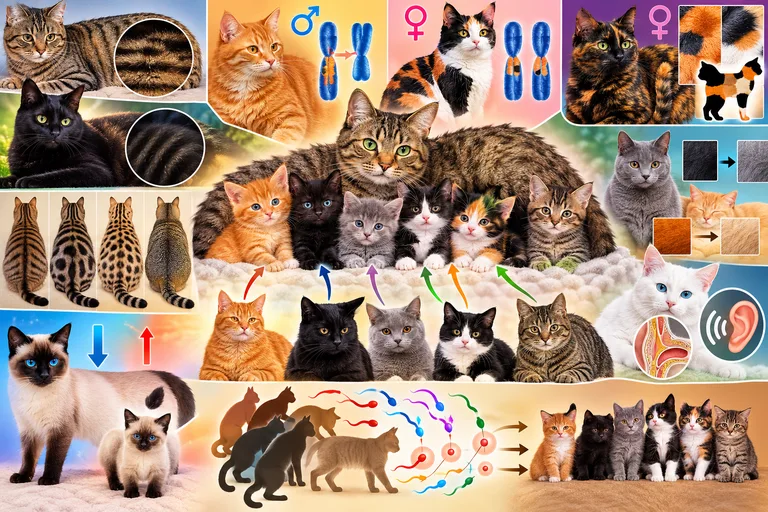
Have you ever looked at a litter of kittens and wondered how on earth they could all come from the same mother?
One kitten is completely black. Another is orange with stripes. A third is gray. Another is black and white. And then there’s one that looks like somebody spilled three different colors of paint all over it.
Same mother. Same litter. Completely different appearances.
And here’s something even more interesting: those kittens might not even have the same father.
Welcome to the fascinating world of cat genetics, where almost nothing is as simple as it appears.
Most people think cats come in different colors because, well, that’s just how nature made them. But beneath every cat’s coat is an extraordinary genetic system controlling pigment, stripes, spots, patches, and even whether a kitten is likely to be male or female.
Some of these genetic mysteries have been understood for decades. Others have only recently been solved.
And one of the biggest surprises is that virtually every domestic cat has the genetic blueprint for a tabby pattern, even when you can’t see it.
Let’s explore what your cat’s color is actually telling you.
THE BIG SECRET: ALMOST EVERY CAT HAS STRIPES
Here’s something that surprises many cat owners.
That solid black cat sitting on your couch? It has the genetic instructions for a tabby pattern.
That beautiful gray cat that appears to be one uniform color? Same thing.
Even cats that look completely solid can have the genetic blueprint for stripes, swirls, spots, or other tabby markings.
The ancestral domestic cat was a tabby, and the genes responsible for those patterns remain part of modern domestic cat genetics.
But whether those patterns are visible is another matter entirely.
Scientists have identified a gene called ASIP, commonly associated with the agouti trait, that helps determine whether the tabby pattern becomes visible.
Think of it as a genetic switch.
When the agouti system allows alternating pigment bands to develop in individual hairs, the contrast between the lighter background and darker markings becomes visible.
When a cat inherits two copies of a particular recessive non-agouti variant, the hairs become more uniformly pigmented, effectively concealing the underlying pattern.
The cat still carries genetic instructions associated with a tabby design, but the coat looks solid.
This is why a black cat can have a hidden tabby pattern without looking like a striped cat.
And sometimes nature lets us see what is underneath.
Look closely at a black kitten in bright sunlight. You may notice faint stripes running along its body, legs, or tail.
These are called ghost stripes or ghost tabby markings.
They’re particularly noticeable in young kittens, although some adult cats retain them.
Scientists at the University of California, Davis, have documented how non-agouti genetics suppress the visible tabby pattern without necessarily eliminating the genetic instructions for that pattern. Veterinary Genetics Laboratory
So the next time somebody shows you a completely black cat and says it has no stripes, tell them to take another look.
The stripes may be hiding in plain sight.
WHY BLACK CATS SOMETIMES LOOK BROWN IN THE SUN
Black cats are particularly interesting because their coloring involves a pigment called eumelanin.
This is the pigment responsible for black and brown coloration in mammals.
A solid black cat produces enough dark pigment to make its coat appear uniformly black.
But black fur isn’t always perfectly black under every lighting condition.
In bright sunlight, some black cats develop a brownish or reddish appearance.
There are several possible explanations.
Sunlight can alter the pigments in hair over time, making black fur appear rusty or faded. Normal genetic variations can also affect how dark or brownish the coat looks.
And then there’s the hidden tabby pattern.
A black cat with ghost markings may show subtle differences in color or sheen across its coat, revealing stripes that are practically invisible indoors.
Here’s an experiment.
Take a black cat outside into bright, indirect sunlight and examine the fur along its sides and tail.
You might discover that your supposedly solid-colored cat has been wearing an invisible tiger costume all along.
However, not every black cat will display recognizable ghost stripes, and a brownish coat does not automatically mean hidden tabby markings.
WHY ARE MOST ORANGE CATS MALE?
Now we get to one of the most fascinating examples of genetics in the animal kingdom.
Most orange cats are male.
The commonly quoted estimate is that approximately 80% of orange cats are male and 20% are female, although the precise percentage can vary between populations.
Why?
Because the gene responsible for ordinary orange coloration is located on the X chromosome, one of the chromosomes involved in determining biological sex.
Male cats normally have one X chromosome and one Y chromosome.
Female cats normally have two X chromosomes.
A male cat only needs to inherit one X chromosome carrying the orange variant to become orange.
A female cat ordinarily needs to inherit the orange variant on both of her X chromosomes to have an entirely orange coat.
That makes solid orange females less common.
A male orange kitten generally receives his orange-coloring X chromosome from his mother.
A female orange kitten needs an orange-coloring X chromosome from both her mother and father.
This is also why orange mothers can pass their orange coloring to all their male kittens, regardless of the father’s color.
And here’s a remarkable scientific development.
In 2025, two research groups independently identified the genetic mechanism responsible for orange cats.
The research revealed that a small deletion in DNA associated with a gene called ARHGAP36 changes pigment production in the cat’s hair follicles.
For decades, scientists understood that orange coloration was linked to the X chromosome, but the precise genetic mechanism remained a mystery.
Now we know much more about how it works.
It’s a remarkable example of modern genetics solving a mystery that generations of cat owners had observed without understanding. PubMed
WHY ORANGE CATS ALMOST ALWAYS HAVE VISIBLE STRIPES
Orange cats have another unusual characteristic.
Unlike black cats, whose tabby markings can become invisible, orange cats generally display their tabby patterns.
Look at almost any orange cat.
You’ll probably find stripes along its legs, rings around its tail, markings around its face, or swirls along its body.
Even orange cats that appear nearly solid usually have some visible pattern.
Why?
Because the orange-coloring mechanism affects how the cat produces pigment, and the ordinary non-agouti system does not fully conceal orange tabby markings the way it can conceal markings in black cats.
The result is that orange cats typically display some variation of the tabby pattern.
Some have narrow, parallel stripes.
Others have large swirling patterns.
Some have spots.
And others have markings so faint you must look carefully to find them.
That brings us to another distinction.
Tabby is not a breed. It’s a coat pattern.
A Maine Coon can be a tabby.
An American Shorthair can be a tabby.
A mixed-breed alley cat can be a tabby.
The same basic coat-pattern genetics can appear in many completely different breeds.
THERE ARE DIFFERENT KINDS OF TABBY CATS
People often think tabby means a cat with tiger stripes.
But tabby markings come in several distinct designs.
Mackerel tabby: This is the classic striped cat. Narrow stripes run down its sides, often resembling a fish skeleton. It’s the pattern most people associate with a little household tiger.
Classic tabby: Instead of narrow stripes, these cats have broad swirling patterns. Some have markings resembling a bull’s-eye along their sides.
Spotted tabby: These cats have dark spots rather than continuous stripes. In some cats, genetic modifiers interrupt ordinary stripes, creating spots.
Ticked tabby: These cats may look almost solid from a distance. Individual hairs contain alternating bands of pigment, creating a finely speckled appearance. Strong body stripes are often absent or greatly reduced.
Many tabbies also have an M-shaped marking on their forehead.
You’ll find that distinctive M on countless domestic cats.
It isn’t the sign of a particular breed, a special bloodline, or an ancient mystical inheritance.
It’s a common part of feline tabby markings.
Still, it’s a wonderful identifying feature.
Look at your cat’s forehead.
You might discover that nature has written its own little signature there.
WHY ARE CALICO CATS ALMOST ALWAYS FEMALE?
Now consider a cat with patches of black, orange, and white.
We call that a calico.
Calicos are especially fascinating because their coloring is directly connected to their sex chromosomes.
Remember that the orange-coloring variant is located on the X chromosome.
A typical female cat has two X chromosomes.
One can carry the orange variant, while the other carries the non-orange version.
But nature has an interesting system for dealing with those two chromosomes.
Early in development, one X chromosome becomes largely inactive in each cell.
In some groups of pigment-producing cells, the orange version remains active.
In other groups, the non-orange version remains active.
As those cell populations multiply during development, they produce patches of different-colored fur.
The resulting cat can have orange patches alongside black patches.
Add the independent genetic system responsible for white spotting, and you can get the familiar three-color calico.
This is known as X-chromosome inactivation.
It’s one of the most visually striking examples of genetics at work.
And because ordinary male cats have only one X chromosome, they generally cannot develop this same black-and-orange patchwork.
However, male calicos do exist.
They are rare and can arise through unusual genetic circumstances, including an XXY chromosome complement or other developmental variations.
Some of these males are infertile, particularly those with XXY chromosomes.
So if you find a male calico, you’re looking at a genuine genetic rarity.
WHAT ABOUT TORTOISESHELL CATS?
Tortoiseshell cats are close relatives of calicos in genetic terms.
Instead of large, clearly separated black, orange, and white patches, they usually display a mixture of black and orange, sometimes blended together in intricate patterns.
Their coats can look like polished tortoiseshell, with orange and black colors woven together.
The same X-chromosome mechanism explains their coloring.
Like calicos, tortoiseshell cats are overwhelmingly female.
The major difference is that a calico typically has noticeable white spotting, while a traditional tortoiseshell does not.
And here’s another interesting point.
Two tortoiseshell cats can have completely different patterns.
The arrangement of patches develops through biological processes during embryonic growth.
That means even cats with similar inherited color genes can look dramatically different.
Nature doesn’t simply print the same coat design over and over.
It creates something closer to an individual work of art.
HOW CAN ONE MOTHER HAVE FIVE KITTENS WITH FIVE DIFFERENT COLORS?
Imagine a female tabby cat gives birth to six kittens.
One is orange. One is black. One is gray. One is black and white. One is striped. And one is a calico.
How could this happen?
There are actually two explanations.
The first is ordinary genetic inheritance.
Every kitten receives a combination of genes from its mother and father.
Some color traits are dominant, meaning a single inherited copy can produce a visible characteristic.
Others are recessive, meaning a kitten generally needs two copies to display the trait.
Parents can carry genes that are not visible in their own coats.
For example, a black cat may carry a recessive dilution variant associated with gray coloration.
When that cat mates with another cat carrying the same variant, some kittens may inherit two copies.
Those kittens can be gray even though neither parent appears gray.
Likewise, tabby parents carrying recessive non-agouti variants can produce solid-colored kittens.
White spotting adds another layer of variety.
And sex-linked orange inheritance can create additional differences between sons and daughters.
Combine all these variables and you can get an extraordinary assortment of kittens from the same two parents.
But the second explanation is even more surprising.
ONE LITTER OF KITTENS CAN HAVE MULTIPLE FATHERS
Yes, it’s absolutely true.
A mother cat can give birth to kittens fathered by different males in the same litter.
The biological term is heteropaternal superfecundation.
Here’s how it works.
When a female cat is in heat, she may mate with several males during the same reproductive period.
Cats are generally induced ovulators, meaning mating helps trigger the release of eggs.
A female can release several eggs that can be fertilized.
If she mates with multiple males while those eggs are available, sperm from different males may fertilize different eggs.
The result?
One kitten might have a black father.
Another might have an orange father.
A third might have a striped father.
All could be born together, from the same mother, during the same delivery.
And they are all part of the same litter.
Cats Protection, a major feline welfare organization, confirms that kittens in a single litter can have different fathers. Cats Protection
This doesn’t mean that every colorful litter has multiple fathers.
A single pair of parents can produce plenty of color variation.
But when a female cat has access to several males during her fertile period, multiple paternity is entirely possible.
DNA testing is the reliable way to establish which male fathered each kitten.
So the next time you see six kittens that look nothing alike, remember: they might share a mother but have completely different family trees on their father’s side.
WHY ARE SOME CATS GRAY INSTEAD OF BLACK?
Gray cats aren’t necessarily a separate genetic color family.
In many cases, they are genetically black cats whose pigmentation has been modified by another gene.
The modification is called dilution.
The dilution system changes the distribution of pigment granules inside individual hairs.
Instead of appearing densely black, the fur looks gray.
In official cat-breeding terminology, this gray coloration is commonly called blue.
That’s why you’ll hear people describe a Russian Blue or a blue British Shorthair.
The cats aren’t literally blue.
They’re gray.
But in feline coat terminology, blue is the traditional name for diluted black.
The same dilution mechanism can affect orange cats.
Orange becomes cream.
Chocolate can become lilac.
Cinnamon can become fawn.
A genetic modification affecting pigment distribution creates an entirely different-looking animal.
And because dilution is generally recessive, two parents that do not visibly display diluted coats can still produce diluted kittens if both carry the appropriate variant.
That’s another reason a litter can contain such different colors.
WHY ARE SOME CATS WHITE?
White cats introduce another interesting genetic mystery.
A completely white cat is not necessarily a cat that lacks the genetic ability to produce other colors.
In many cases, its underlying genetic color is simply hidden.
One mechanism is called dominant white.
This genetic variation can prevent pigment-producing cells from populating the fur normally.
The result is a white coat that conceals whatever other coat-color genes the cat carries.
Think of it as a white covering placed over the cat’s underlying genetic design.
Another mechanism is white spotting.
Instead of producing an entirely white cat, it creates white areas on an otherwise colored animal.
That’s how you get tuxedo cats, cats with white feet, cats with white chests, and cats with enormous white patches.
There are also rare forms of feline albinism, caused by other genetic mechanisms.
But most ordinary white cats are not albinos.
A white cat with blue eyes is not automatically albino either.
And there’s an important medical connection.
Some genes associated with white coats, particularly dominant white, are also associated with congenital deafness.
White cats with blue eyes have a higher risk of deafness than many other cats, although plenty hear perfectly well.
The relationship exists because certain pigment-producing cells are also involved in normal inner-ear development.
That’s a remarkable example of one genetic variation influencing two seemingly unrelated characteristics.
The University of California, Davis, recognizes this connection in its veterinary genetics resources. Veterinary Genetics Laboratory
WHY DO SIAMESE CATS HAVE DARK FACES, EARS, PAWS, AND TAILS?
Siamese cats demonstrate one of the strangest coat-color systems of all.
Their coloring is influenced by temperature.
Yes, temperature.
The familiar Siamese color-point pattern comes from a temperature-sensitive variation affecting an enzyme involved in pigment production.
The enzyme works better in cooler parts of the body.
That means the ears, face, feet, and tail tend to develop darker coloring.
Warmer areas of the body remain lighter.
And here’s the extraordinary part.
Siamese kittens are generally born very pale because they develop inside the relatively warm environment of their mother’s uterus.
After birth, the cooler parts of their bodies gradually become darker.
A cat’s coloring can continue to change as it matures.
Some pointed cats also become darker overall as they age, particularly when exposed to cooler environments.
Imagine having hair color that changes depending on which part of your body is coldest.
For Siamese cats, that’s essentially what happens.
WHY DO SOME CATS HAVE WHITE SOCKS?
Everybody has seen a cat that looks as though it stepped into a bucket of white paint.
Maybe it has four white paws.
Maybe it has two.
Maybe it has a white chest and a white stripe down its nose.
These patterns result from genetic processes affecting the distribution of pigment-producing cells during development.
White spotting can prevent these cells from reaching or populating certain areas of the skin.
When pigment-producing cells are absent, the hair growing from those areas is white.
The final appearance depends on how those cells spread and develop in the growing embryo.
That’s why one cat can have a tiny white patch while another is nearly all white.
And it explains the endless variety of tuxedo cats.
A tuxedo cat isn’t a breed.
It’s simply a cat whose black-and-white markings resemble formal clothing.
Some look as if they’re wearing jackets.
Others appear to have white shirts.
A few even have little markings that look like mustaches.
Nature apparently has a sense of fashion.
DOES A CAT’S COLOR TELL YOU ANYTHING ABOUT ITS PERSONALITY?
This is where science and folklore start to collide.
Ask enough cat owners and you’ll hear plenty of theories.
Orange cats are supposedly friendly, goofy, and mischievous.
Tortoiseshell cats supposedly have strong personalities, often described as tortitude.
Black cats are said to be mysterious.
Gray cats are considered calm.
Calicos supposedly have attitudes.
But here’s the scientific reality.
Coat color alone is not a reliable way to predict an individual cat’s personality.
A cat’s behavior develops through a combination of genetics, early socialization, environment, learning, and individual temperament.
Some studies have explored associations between coat color and reported behavior, but those findings do not establish that a particular color causes a particular personality.
Owner expectations can also influence how behavior is interpreted.
An orange cat knocking a glass off a table might be described as a lovable troublemaker.
A black cat doing exactly the same thing might be described as mischievous or sneaky.
The behavior is identical.
The interpretation is different.
Of course, anyone who has lived with several cats knows that they can have dramatically different personalities.
Some are affectionate.
Some are independent.
Some are fearless.
Some are shy.
And some seem absolutely determined to reorganize your entire household at three in the morning.
But you cannot reliably determine which personality you’re getting simply by looking at the fur.
WHY ARE BLACK CATS ASSOCIATED WITH BAD LUCK?
Black cats have suffered from centuries of human superstition.
In parts of European history, black cats became associated with witches, witchcraft, and bad luck.
Those beliefs were cultural creations, not biological realities.
Other cultures have viewed black cats as symbols of prosperity or good fortune.
The same animal could supposedly bring disaster in one country and good luck in another.
Which tells us something important.
The cat didn’t change.
The human imagination did.
Black cats are genetically ordinary domestic cats with a particular combination of pigmentation genes.
They are no more supernatural than orange, gray, or white cats.
And their coloring has absolutely nothing to do with their ability to bring good or bad fortune.
Although if a black cat walks across your keyboard while you’re working, it can certainly create a little temporary disaster.
CAN TWO BLACK CATS PRODUCE AN ORANGE KITTEN?
Here’s a question that demonstrates why understanding genetics matters.
If both parents are genuinely solid black cats, can they produce an orange kitten?
Under ordinary feline coat-color inheritance, no.
The reason is that ordinary orange coloration is X-linked.
A black mother does not carry the orange variant on either X chromosome.
A black father also lacks the orange variant on his X chromosome.
Neither parent can ordinarily transmit the necessary orange allele.
However, a black-and-orange tortoiseshell mother is a different story.
Even if she appears predominantly black, she can carry the orange variant and pass it to her offspring.
Likewise, unusual genetic events and mistaken parentage can produce surprising observations.
But the basic principle is clear.
Not every color combination is possible from every pair of parents.
The genetics place real limits on what kittens can inherit.
And this is another reason DNA testing can be useful when parentage is uncertain.
CAN AN ORANGE MOTHER HAVE BLACK KITTENS?
Yes, but there’s an interesting rule.
A genetically orange mother ordinarily carries the orange variant on both X chromosomes.
All her sons receive their single X chromosome from her.
That means her male kittens will inherit orange coloration.
Her daughters receive one X chromosome from her and another from their father.
If the father contributes a non-orange X chromosome, the daughters can develop black-and-orange tortoiseshell or calico coloring.
If the father contributes an orange X chromosome, the daughters can be orange.
Additional genes can modify the results with white patches, dilute colors, and other patterns.
The central point remains that a completely orange mother passes the orange variant to all her sons.
It’s a fascinating example of how genetics can make certain predictions about a litter before the kittens are even born.
WHY DO SOME CATS CHANGE COLOR AS THEY GET OLDER?
A kitten’s coat does not always represent its final adult appearance.
Some kittens are born with ghost markings that fade as their adult coats develop.
Others gradually darken.
Pointed cats, such as Siamese, commonly develop darker extremities as they mature.
Some black cats become rusty-looking with sun exposure.
And certain breeds have genetic variations that cause substantial changes in pigmentation during growth.
Age, environment, temperature, and health can all influence the appearance of a cat’s coat.
Not every change is purely genetic.
Poor nutrition, excessive sun exposure, and certain medical conditions can also affect fur quality or color.
A sudden or unusual coat change, particularly one accompanied by hair loss or other symptoms, deserves veterinary attention.
But gradual changes can simply be part of a cat’s natural development.
WHY CAN TWO KITTENS WITH THE SAME PARENTS LOOK COMPLETELY DIFFERENT?
One of the most important concepts in genetics is that every kitten receives its own combination of inherited genetic material.
Full siblings are not genetically identical.
Each receives half its nuclear DNA from its mother and half from its father, but not necessarily the same half as its brothers and sisters.
During the production of eggs and sperm, chromosomes are shuffled and recombined.
This process creates enormous genetic variation.
Some kittens may inherit visible traits from their mother.
Others may resemble their father.
Some may express characteristics that were hidden in both parents.
And others may combine several features into an appearance that resembles neither parent closely.
It’s similar to what happens in human families.
Two brothers can look remarkably different even though they share the same parents.
Cats simply make those differences especially obvious because coat color and pattern are so visually dramatic.
One litter can look like an entire neighborhood of unrelated cats.
And sometimes, because of multiple paternity, some of those kittens really are only maternal half-siblings.
THE CAT’S COAT IS A GENETIC HISTORY BOOK
There’s something remarkable about the domestic cat.
Inside that small animal sleeping on your couch is a genetic story stretching back thousands of years.
The striped patterns reflect an ancestral camouflage system.
The black coat demonstrates how a recessive genetic variation can conceal an inherited pattern.
The orange coat illustrates the unusual relationship between pigmentation and sex chromosomes.
The calico demonstrates how X-chromosome inactivation creates patches of different colors during embryonic development.
The Siamese shows how a temperature-sensitive enzyme can create a striking pattern.
The white cat reveals how pigmentation genes can also influence hearing.
And the litter of kittens with wildly different appearances demonstrates the extraordinary genetic diversity produced through reproduction.
All of this is happening naturally.
No designer is selecting the colors.
No artist is painting the patterns.
No computer is deciding where the stripes should go.
It’s the result of genes interacting with one another, with development, and with the environment.
And science is still uncovering the details.
As recently as 2025, researchers finally identified the genetic mechanism responsible for the familiar orange cat.
Think about that.
We’ve lived alongside domestic cats for thousands of years, yet we are still discovering how their most recognizable physical features work.
THE NEXT TIME YOU LOOK AT YOUR CAT, LOOK A LITTLE CLOSER
If you have a black cat, look for the hidden tabby pattern in sunlight.
If you have an orange cat, examine its stripes and remember that its coloring is linked to the X chromosome.
If you have a calico or tortoiseshell, consider the remarkable cellular process that created its patches of color.
If you have a gray cat, remember that its coloring may be a diluted form of black.
If you have a white cat, understand that its visible color may be concealing an entirely different genetic coat underneath.
And if you ever see a litter of kittens with every color imaginable, don’t automatically assume something unusual happened.
It may simply be ordinary genetics producing extraordinary results.
Or perhaps several neighborhood tomcats contributed to the family.
Either way, nature has created an astonishing variety of colors, patterns, and combinations from a relatively small collection of interacting genetic systems.
The most fascinating thing about cats isn’t that they come in so many different colors.
It’s that the colors we see are only the surface of a much more complicated genetic story.
Every stripe has a biological explanation.
Every patch has a developmental history.
Every kitten inherits its own genetic combination.
And even that completely black cat sitting quietly in the corner may be hiding the markings of a little tiger.
That’s the remarkable science of cats.
One final thought: We often judge animals by what we see on the outside. But whether a cat is black, orange, gray, striped, spotted, or covered in patches, underneath that colorful coat is essentially the same remarkable little predator — one that has managed to convince millions of human beings to provide it with free housing, food, medical care, and a comfortable place to sleep.
And perhaps that’s the greatest evolutionary achievement of all.