Think of it as Yoga for the brain, we are going to stretch a bit.
Something wicked this way comes… and it is not me saying it.
Civilization is a marvelous thing, but I wouldn’t trust it so completely that I forgot to buy a manual can opener. -- YNOT!
There are certain things you do not expect a modern government to tell you.
“Keep some cash in the house.”
“Store drinking water.”
“Have food you can eat without electricity.”
“Buy a radio that works when everything else doesn’t.”
Those sound like instructions from your grandmother—the woman who saved aluminum foil, kept a pantry, and considered an empty cupboard a character defect.
But now governments are delivering them.
Britain’s Be Ready campaign tells households to prepare for three days of disruption. Its checklist includes water, food, essential medicines, flashlights, a battery or windup radio, important documents, and cash in case electronic payments fail. France, Ireland, and the Netherlands use similar three-day preparedness advice.
Germany recommends being able to support yourself for ten days, while emphasizing that even three days is a useful beginning. The European Commission’s preparedness strategy calls for guidelines supporting at least 72 hours of household self-sufficiency.
Now, Sweden dusted off its old Cold War pamphlet about six months ago, and they wrote it, rewrote it for today, and it reminds citizens that in a war, the these are their words, not mine. Reminder, this is from the Cold War, and they’ve updated it. In a war, you have a duty to help.
The Swiss also have done exactly the same thing. They’ve been doing this for decades, but they got they stopped after the Cold War, and they’ve gotten serious about it again. The European Union has asked all 450 million of its people to do the same. Prepare.
Now, why?
Apparently, Grandma has been promoted to European strategic adviser.
And I think we ought to listen. Not because a government checklist proves that war starts Thursday. It doesn’t. Because a government reminding you how to survive without the services you depend on deserves more attention than another celebrity announcing a skincare line.
The warning is real. The exact disaster is optional.
A hurricane can turn off your lights. A cyberattack can interrupt a payment system. A broken water main can make your faucet useless. A regional emergency can leave thousands of people needing help at the same time.
Why is everyone talking about this… That’s because they believe there could be some sort of digital disruption. Perhaps Iran causes it, perhaps Russia, may be someone else.
Okay. Now, come home to the United States. September 30th, Secretary of War signed a memo creating something called Fortress. I don’t know if you heard about it, but under Fortress, every major military base in the continental US must be able to run for 90 days without any outside help. It’s requiring now to have their own power, its own water, its own fuel, its own food, and be able to close those gates and run for 90 days. its own communications, everything.
Some bases are going to get their own small nuclear reactors.
That’s now the standard in the United States. It was just announced. The Pentagon’s chief spokesman said, and I’m quoting, “In the next major war, global supply chains will break.” Do you remember what happened during COVID? If you think that’s bad, imagine war.
Then there is also the RF the RAF base in Fairford. This is the base in England where the American B1 bombers where we fly our bombers to strike on Iran.
Early hours of September 27th, neighbors called the police about white vans and masked men near the fence. And what did the prime minister over there say? Well, it’s nothing. They were just crazy. It was just They’re having a picnic in the middle of the night. Remember? Five men were arrested on suspicion of preparing a terrorist act. Then our American bombers were pulled out because we I my guess is we didn’t think that they were taking this seriously.
Yesterday, Great Britain arrested two 24year-old British men charged under uh Britain’s National Security Act. Both have unpronouncable names. Either Muhammad or Abdul is their first. One is accused of assisting a foreign intelligence service. Now Britain’s top counterterror cop named that country Iran.
The prime minister says the plot was almost certain, quoting, almost certainly directed by the Revolutionary Guard and that more than 50 people have been arrested over Iran linked plots in Great Britain just in the last few months. Don’t know if you saw this piece of news in Palm Beach.
The army has now put the adventure air defense system on a barge in the inter coastal waterway outside of Mara Lago.
It is in plain view now of anyone driving down the southern boulevard. Who confirmed it and who is running it? NORAD.
NORAD has put it in and is running it at the request of the Secret Service. same day, the director of national intelligence warned the secretary of state that Iran has substantially increased its efforts to target plain old everyday Americans and some of those advanced plots have reached advanced stages.
A government asking you to keep three days of water is asking you to do what your grandmother did without being told.
You know, she would can our our grandparents knew every time I would say, you know, they would talk about the depression. I’d be like, “Grandma and grandpa, it’s not going to happen again. It can’t happen again.” They were like, my grandfather would turn to me and he would look at me like death in his eyes and he’d go, “Don’t ever think that way. You have no idea how fast this can collapse.” They live through it.
You do not need all four horsemen riding down Main Street.
One fallen utility pole can ruin a perfectly good Tuesday.
We have become remarkably comfortable living inside systems we barely understand, operated by people we will never meet, connected through networks we assume will always work.
Food arrives. Water flows. Cards swipe. Phones connect. Until something breaks.
Then we discover that “the cloud” is a collection of somebody else’s computers, delivery requires passable roads, and a smartphone with a dead battery is an expensive little mirror.
Civilization is an impressive achievement. It still needs electricity.
People who are running the West know things are breaking down.
They see the same numbers we do. We see economies that have stopped growing all over Europe. They have sabotaged their own refineries. They have sabotaged their own ability to make electricity. They have not paid for their own military. They have societies that are unwilling or unable to fight for itself.
You have a Europe with absolutely no plan to grow again. It has all been managed decline. You open the borders to millions of people without asking the people who already live there and then without asking those millions of people who the hell are you?
They also have no will to ask newcomers to embrace the culture that took them in. And so what do you have? You have Islamist organizing in the open telling you what they’re going to do. You have Marxists and communists now no longer bothering to hide what they want or who they are. They are telling you that they are going to overthrow the West and the United States of America. There are more communists in the US than China right now.
The cash recommendation ought to get your attention. We have spent years making money invisible.
Your paycheck is a notification. Your savings are numbers on a screen. Your credit card is stored inside your phone. You can buy lunch without touching anything your grandfather would recognize as money.
Convenient? Absolutely.
But convenience becomes a problem when it is your only option.
If the payment terminal cannot connect, standing there explaining your excellent credit score will not purchase the groceries.
Keep a reasonable amount of cash for essentials, preferably in useful denominations. Enough to give yourself options during an interruption.
A hundred-dollar bill may impress someone. A handful of smaller bills may actually buy breakfast.
And let us understand what 72 hours means. It is a preparedness target.
It is not a promise that a government truck will arrive at your driveway precisely three days after the lights go out.
Nor is it a magical deadline after which every neighbor becomes a highwayman.
Emergencies do not consult the brochure.
Some problems are fixed in hours. Others last much longer. Your circumstances, your location, and the scale of the damage matter.
Three days is a place to start. Personally, I would rather work toward a couple of weeks of ordinary household essentials, as space and money allow.
I would prefer my emergency plan to have a little room for the emergency.
Our grandparents understood something we have spent decades trying to forget.
They knew stability could disappear.
People who lived through the Depression did not keep supplies because they misunderstood prosperity. They kept supplies because they understood its limitations.
You could tell them, “That can’t happen again.”
They would look at you with the expression reserved for a child explaining that the stove probably wasn’t hot anymore.
They had already met “can’t happen.”
It had taken their job.
We have better technology now. We also depend on more technology now. Both facts deserve a seat at the table.
There is a political argument here, too.
A government should be judged partly by whether the basics work: reliable infrastructure, competent emergency services, secure systems, and the capacity to respond when events outrun the plan.
A preparedness pamphlet is useful. It does not repair a substation.
Telling citizens to be resilient is sensible. It does not excuse officials from doing their jobs.
I want households with supplies and governments with functioning systems. I am old-fashioned enough to believe we should be able to expect both.
When officials issue these warnings, ask concrete questions.
What risks are they preparing for? What has been tested? Where are the weak points? What happens when communications fail? How will people who need extra assistance get it?
We deserve answers with more substance than a photograph of somebody wearing a hard hat.
Still, you do not have to settle every argument about national security, immigration, energy policy, or government competence before putting water in your house.
The water will remain useful regardless of who wins the debate.
Here is how I prepare. It is terribly unglamorous.
I go to Aldi. Yes, Aldi. I am cheap, and I like the food. Those positions have coexisted peacefully for years. When I need a can of tuna, I buy two. A few extra cans of lentil soup. Some sardines. Beans. Whatever I actually eat.
Food, not a collection of mysterious survival products that require an instructional video and a strong stomach. I build the supply a little at a time. Then I use the older items and replace them.
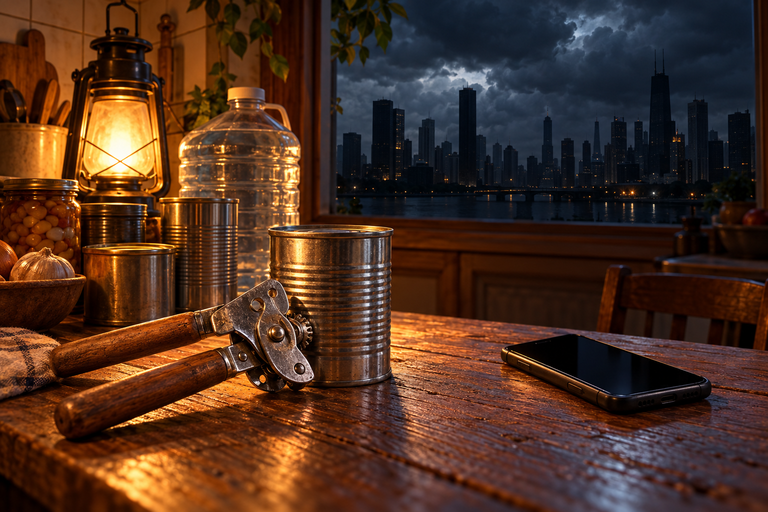
My emergency pantry should feed me during a disruption. It should also be edible on an ordinary Wednesday. And I keep a manual can opener.
There is something magnificently modern about owning three voice assistants and being defeated by a can of beans.
I also keep water jugs in the freezer, leaving room for the water to expand. They provide stored water and extra frozen mass that can help the freezer stay cold during an outage.
Those jugs are part of the supply. They are not the entire household water plan.
Water has to cover actual people and actual needs. Pets, too. The dog is unlikely to accept an explanation about supply-chain challenges.
Medicines deserve the same attention. I try to avoid reaching the last pill before arranging the next refill. Where prescriptions, insurance, and my clinician allow, I prefer a sensible reserve. Keep a written medication list. Know the doses. Know what requires refrigeration or electricity.
Keep important phone numbers somewhere besides the phone that may be dead.
And organize the paperwork. Identification. Insurance information. Emergency contacts. Documents you would need if you had to leave quickly. Put them somewhere you can find them under stress.
“I know it’s around here somewhere” is a filing system that performs poorly during an evacuation.
Think about the people around you. Who checks on the older neighbor?
Who has a medical device that needs power?
Who picks up the children if the usual arrangement falls apart?
Where does the family meet if calls will not connect?
A plan can be a five-minute conversation. Have it while everyone is calm.
Most of us know somebody who cannot easily buy extra supplies, carry water, or prepare alone. Helping that person is practical preparedness, too.
A functioning neighborhood is a valuable thing to have when the official systems are stretched.
The same common sense applies to money. I like having more than one way to pay, access to important account information, and some cash for immediate needs.
I also dislike making my entire future depend on one company, one investment, or one brilliant prediction. There is enough uncertainty in life without volunteering for additional concentration. You do not have to become a financial prophet. Having a few options will do. What I will not give you is a date for disaster.
Nobody can look at an emergency checklist and honestly announce when the lights will fail. There is no reliable calendar telling us we are “due.” Trouble has never demonstrated that level of administrative discipline.
But uncertainty is a poor excuse for doing nothing.
You buy insurance without knowing the date of the accident. You keep a spare tire without scheduling the nail.
A little food, water, cash, medicine, and organization follow the same logic.
And please, prepare within your means. An extra can of food counts. A copied document counts. Charging a power bank counts. Checking on someone counts.
Surviving isn’t about having a bunker it is about doing the simple things like keeping you paperwork organized in case you have to leave and a spare can opener like your gran mother had.. Keep your money diversified, split your investment, not all in one company, not all in stocks or gold, have some cash. Common sense stuff.
The British guidance itself encourages households to build readiness gradually, picking up an extra item or two during ordinary shopping. Even the government is suggesting that preparedness can begin without a shopping cart full of panic.
We are not immune. How many Americans will hear this warning and write it off? Please don’t. The radicals are already inside our house. They are all over the West. And that includes here. And in six days, we vote. Our vote is not going to stop this from happening, but it may slow it down. And I warn you, if that this election goes poorly, this is not about scaring you into voting. This is about telling you the truth.
Expect the radicals who have already told you what they want to abolish the Senate, abolish ICE, erase the border, to treat the gavel as permission.
That’s what they’re telling you. take them at their word or you’re suicidal.
Keep living your life. Make your holiday plans. Visit your relatives. Argue about football. Enjoy dinner.
Figure out what it takes for you and your family to live for 2 weeks and just store it, just in case. If nothing happens no big deal. Just brace for impact. On your next grocery trip, pick up a few things that would make a difficult week easier. Something wicked may come this way. Something merely inconvenient is quite capable of arriving first.
Governments are telling people to prepare. For once, I suggest we take the useful advice.
Grandma already left us the instructions. We were just too busy ordering dinner through an app to read them.
Again this not about the end of the worlds or a nuclear war. This is about a storm, a hurricane, a civil unrest that will prevent you from going to a store, a power outage, a hacked bank network. All things you can survive easier if you plan for it a little bit. If it never happens great. In my experience shit happens every 20 years... We are due.