Think of it as Yoga for the brain, we are going to stretch a bit.
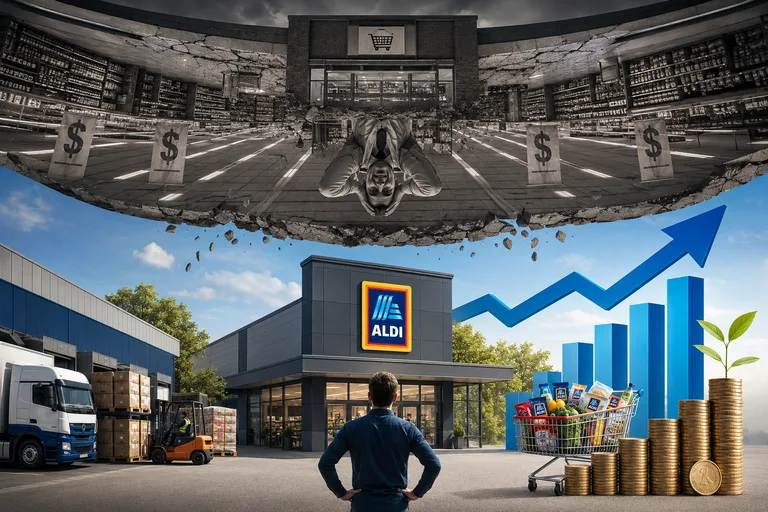
How ALDI Turned a Hundred-Year-Old Industry Upside Down
ALDI skips all the games and concentrates it efforts on quality, price and customer service. Nothing else, what a concept --YNOT!
The company that discovered the best way to compete was to stop copying its competitors
The grocery business is one of the oldest, largest, and most brutally competitive industries in the world.
For more than a century, supermarkets have competed using roughly the same formula:
Build bigger stores. Carry more products. Add more departments. Offer more brands. Run more promotions. Issue more coupons. Collect more customer information. Stay open longer. Provide more services. Give shoppers more choices.
Every generation of supermarket executives added another layer to the model.
The neighborhood grocery store became the supermarket. The supermarket became the superstore. The superstore added a bakery, butcher counter, pharmacy, florist, bank, coffee shop, deli, prepared-food department, loyalty program, mobile app, delivery service, and tens of thousands of products.
The industry assumed that more was always better.
ALDI looked at the same industry and reached the opposite conclusion.
It decided that most of what supermarkets considered essential was not essential at all.
The result was not simply a cheaper grocery store. ALDI created an entirely different operating system for selling food.
Its competitive advantage did not come from doing everything better than the traditional supermarkets.
It came from refusing to do most of what they did.
A Grocery Store Built Around Subtraction
ALDI’s story began in Essen, Germany, in 1913, when the Albrecht family established a small food business. Karl and Theo Albrecht later expanded the operation after World War II, building a chain around a limited assortment, low prices, minimal decoration, and strict cost control.
The name ALDI came from Albrecht Diskont—Albrecht Discount. The business was divided into ALDI Nord and ALDI Süd in 1961, and ALDI Süd opened its first American store in Iowa in 1976. (ALDI Careers)
The brothers understood something that many executives never learn:
Every feature a company adds eventually becomes a cost the customer must pay for.
More inventory requires more warehouse space.
More departments require more employees.
More employees require more managers.
More suppliers require more contracts, invoices, deliveries, inspections, and negotiations.
More promotions require more advertising, software, signs, coupons, and administrative support.
More choices require larger buildings and make the shopping experience slower and more confusing.
ALDI began removing those costs one by one.
It did not ask, “How can we operate a supermarket more cheaply?”
It asked a much more disruptive question:
“What would a grocery store look like if we eliminated everything that did not directly help the customer buy good food at a low price?”
That question changed the economics of the business.
Ingredient One: Radical Simplicity
A conventional supermarket can carry tens of thousands of individual products. In many categories, shoppers face an entire wall of nearly identical options.
There may be dozens of varieties of ketchup, cereal, coffee, salad dressing, detergent, pasta sauce, and bottled water.
Supermarkets call this selection.
But selection creates enormous operational complexity.
Every additional product must be ordered, transported, received, stored, priced, stocked, tracked, promoted, and eventually discounted or discarded if it does not sell.
ALDI deliberately offers a much smaller, carefully selected assortment.
Instead of giving customers thirty versions of the same basic item, it attempts to offer one or two good versions at an attractive price.
The source material describes this as limiting the store to roughly 1,400 items, compared with tens of thousands in a conventional supermarket. It also connects that limited assortment to supplier volume, simpler staffing, faster shopping, and less decision fatigue.
Whether the exact number changes by location and over time, the strategic principle remains the same:
ALDI does not attempt to satisfy every possible preference. It attempts to satisfy the most important preferences extremely efficiently.
That is a lesson many companies resist.
Executives often believe growth requires adding more products, features, services, and customer segments. But every addition dilutes attention and introduces another opportunity for waste.
ALDI proves that disciplined exclusion can be more powerful than endless expansion.
It wins partly because it knows what not to sell.
Ingredient Two: Control the Product, Not Just the Shelf
Traditional supermarkets depend heavily on national brands.
Those brands spend billions of dollars persuading customers to ask for them by name. That gives the manufacturers tremendous negotiating power.
A supermarket may dislike the price demanded by a major food company, but it cannot easily remove a famous cereal, beverage, detergent, or snack brand without angering customers.
ALDI escaped that trap through private-label products.
Approximately 90 percent of the products found in ALDI stores are exclusive or private-label brands. ALDI says these products can cost up to 50 percent less than national-brand equivalents. (ALDI)
This changes the power structure of the business.
In a conventional supermarket, the manufacturer owns the customer relationship. The shopper enters the store looking for the manufacturer’s brand.
At ALDI, the retailer owns the relationship.
Customers gradually learn that they are not buying an unknown product from an unknown company. They are buying an ALDI-selected product backed by the store’s reputation.
That allows ALDI to negotiate directly with manufacturers, consolidate enormous volume around fewer products, and replace a supplier when quality, price, or performance no longer meets expectations.
The original material describes suppliers competing for large ALDI contracts and being held to demanding quality comparisons against national brands. It argues that private labeling removes advertising expenses, brand premiums, and traditional shelf-placement economics from the final retail price.
This is not merely a purchasing tactic.
It is vertical control over the customer experience.
ALDI may not manufacture every product itself, but it controls what appears on the shelf, how it is positioned, what quality standard it must meet, and what value it must deliver.
That is a far stronger position than renting shelf space to someone else’s brand.
Ingredient Three: Design Labor Out of the System
ALDI did not merely reduce the cost of products. It redesigned the physical work involved in operating a store.
Consider the shopping cart.
Traditional supermarkets pay employees to retrieve carts from parking lots. They also absorb the cost of missing carts, damaged vehicles, injuries, and the time managers spend dealing with the problem.
ALDI requires customers to insert a quarter to release a cart. The quarter is returned when the cart is brought back.
The amount is financially insignificant, but psychologically effective.
The customer performs the cart-retrieval work voluntarily because the system provides a small and immediate incentive. ALDI confirms that the quarter-cart system is one of the intentional methods it uses to control operating costs. (ALDI)
The same principle appears throughout the store.
Customers bag their own groceries.
Products are frequently displayed in shipping cartons rather than individually arranged on elaborate shelves.
Stores are smaller and easier to navigate.
There are fewer specialized departments.
The product assortment is easier to replenish.
Employees are expected to perform multiple functions rather than remain confined to one narrow job.
The supplied material describes a cross-trained workforce in which employees move between stocking, checkout, and other store responsibilities as demand changes.
This flexibility is crucial.
A traditional supermarket may employ separate cashiers, stock clerks, cart attendants, deli workers, bakers, butchers, floral employees, department supervisors, customer-service representatives, and managers.
ALDI compresses many of those functions into a much smaller operating team.
That does not necessarily mean the work is easier. In many cases, it requires employees to move faster, learn more tasks, and accept greater responsibility.
But from the company’s perspective, the economics are powerful.
ALDI is not simply paying fewer people to perform the same system.
It has created a system that requires fewer labor hours to operate.
That distinction matters.
Cutting employees from a badly designed system usually damages service.
Redesigning the system so the work is no longer necessary creates permanent efficiency.
Ingredient Four: Stop Selling the Illusion of a Bargain
Traditional grocery pricing can be deliberately complicated.
A product may have:
A regular price.
A weekly sale price.
A loyalty-card price.
A digital-coupon price.
A buy-one-get-one price.
A manufacturer’s coupon.
A regional price.
A personalized promotional price.
Customers are trained to believe they are saving money when they successfully navigate the maze.
But someone must pay for the maze.
Coupon-processing systems cost money. Loyalty programs cost money. Mobile applications cost money. Promotional signs cost money. Advertising departments cost money. Customer data systems cost money.
Those expenses eventually return to the shelf price.
ALDI’s central promise is much simpler: the normal price should already represent good value.
The company still promotes seasonal products and weekly ALDI Finds, and its digital services continue to evolve. But the core shopping proposition is not dependent on customers collecting points, clipping stacks of coupons, or mastering a complicated promotional calendar.
That reduces both operating expenses and psychological friction.
The customer does not have to wonder whether another shopper received a better price because of a coupon, membership tier, mailing list, or personalized offer.
This is an important distinction:
ALDI does not merely sell low prices. It sells confidence in the price.
Trust reduces the customer’s need to research every purchase.
When customers believe the company is consistently protecting their interests, transactions become faster and easier.
Ingredient Five: Turn Inconvenience into Participation
Many customers encounter ALDI for the first time and notice what the store does not provide.
The cart requires a quarter.
There may be fewer employees visible.
The shopper bags the groceries.
The store carries fewer familiar national brands.
The shelves may look more like a warehouse than a traditional supermarket.
At first, these can appear to be service deficiencies.
But ALDI converts them into a value exchange.
The company is effectively saying:
“We will not provide every convenience a traditional supermarket provides. In return, you will pay less.”
The customer becomes a minor participant in the operating model.
Return your own cart.
Bag your own purchases.
Accept fewer choices.
Try the private-label product.
Move quickly through a smaller store.
This arrangement works because the benefit is understandable. Customers can see the connection between the stripped-down system and the lower grocery bill.
Many businesses fail when they transfer work to the customer without transferring any of the savings.
Airlines charge passengers more while asking them to perform tasks formerly handled by employees.
Banks close branches and replace employees with automated systems while increasing fees.
Restaurants require customers to order through applications and then request the same gratuity as a full-service establishment.
That creates resentment.
ALDI’s model is different because the inconvenience is presented as part of an explicit bargain.
The customer gives up a little service theater and receives measurable value in exchange.
Ingredient Six: Use Trust as an Economic Asset
One of ALDI’s best-known policies is its product guarantee.
For many qualifying ALDI-brand products, the company’s “Twice as Nice Guarantee” offers both a replacement and a refund when a customer is dissatisfied.
On paper, that seems unnecessarily generous.
Why give the customer both?
Because ALDI faces a unique obstacle.
A first-time shopper may recognize almost none of the brands on the shelves. Even when the private-label product is less expensive, buying it feels risky.
The guarantee removes that risk.
The shopper can try the unfamiliar product without fearing that the lower price means lower quality.
The supplied material identifies this guarantee as a mechanism for converting hesitant national-brand customers into repeat private-label buyers.
A conventional executive might focus on the small number of people who could abuse the policy.
ALDI focuses on the much larger number of honest customers who become comfortable trying its products.
That is a crucial CEO lesson.
Many companies design policies around their worst customers.
They create paperwork, restrictions, approvals, and enforcement procedures to prevent a small percentage of abuse. In doing so, they punish every good customer and make the company unpleasant to deal with.
ALDI treats trust as an investment.
Some people may abuse it. But the loyalty created among everyone else can be worth far more than the losses.
Ingredient Seven: Reject Revenue That Damages the Machine
Traditional management frequently assumes that every additional revenue stream should be pursued.
ALDI’s strategy demonstrates that revenue can be expensive even when the product itself is profitable.
A new category may create:
Regulatory requirements.
Age-verification delays.
Employee training.
Inventory complications.
Legal exposure.
Security problems.
Slower checkout lines.
Damage to the brand.
Distraction from the central mission.
The supplied source gives examples of ALDI rejecting certain conventional grocery practices and categories because they would interfere with the company’s fast, low-complexity operating model. It also describes closing stores on major holidays as a way to protect workforce stability and avoid forcing a thin staffing system through an abnormal surge.
The larger lesson is not about any particular product or holiday.
It is this:
The most profitable-looking sale may weaken the system that produces all the other sales.
A company must evaluate revenue according to its complete operational consequences.
A customer who produces $1,000 in revenue but requires $1,200 worth of customization, support, management attention, and disruption is not a valuable customer.
A product that generates a strong gross margin but creates compliance problems, slows production, and distracts the sales team may not be a valuable product.
Good CEOs do not ask only, “Can this make money?”
They ask, “Does this strengthen or weaken our machine?”
ALDI’s Real Product Is the Operating System
It is easy to describe ALDI as a discount grocery company.
That description misses the point.
ALDI’s true competitive product is its operating system:
A small store.
A limited assortment.
Heavy private-label control.
Concentrated purchasing volume.
Simple displays.
Fast replenishment.
Flexible labor.
Customer participation.
Minimal service overhead.
A clear value promise.
Strict resistance to unnecessary complexity.
Any individual practice can be copied.
A competitor can introduce a cart deposit.
It can add private-label products.
It can shrink a store.
It can reduce the number of products.
It can ask customers to bag their own groceries.
But copying one practice will not reproduce ALDI’s economics.
The advantage comes from how all the pieces reinforce one another.
A limited assortment produces higher volume per item.
Higher volume improves supplier negotiations.
Fewer items simplify distribution.
Simpler distribution makes smaller stores possible.
Smaller stores reduce rent, utilities, and shopping time.
Simpler shelves reduce stocking labor.
Private labels improve control over price and quality.
Lower operating costs support lower prices.
Lower prices attract more customers.
More customers create still greater purchasing volume.
That is a strategic flywheel.
Each decision strengthens the next decision.
Growth Is the Proof
ALDI’s model was once dismissed as a bare-bones format that would appeal mainly to customers with no other choice.
That assumption did not survive contact with reality.
In 2026, ALDI announced plans to open more than 180 additional American stores across 31 states. The company expects to operate nearly 2,800 U.S. stores by the end of 2026 and is working toward approximately 3,200 by the end of 2028.
ALDI also reported that 17 million new customers visited its stores during 2025 and that roughly one in three American households shopped there during the year. The company plans to invest $9 billion in its American expansion, supply chain, and digital operations through 2028. (ALDI)
This growth matters because it disproves the assumption that customers always demand more.
Customers do not necessarily want the largest possible store.
They do not always want fifty brands.
They do not automatically value elaborate displays, complicated promotions, or endless service departments.
They want a reliable solution to an important problem.
ALDI’s solution is straightforward:
Help people buy acceptable or excellent groceries quickly, confidently, and at a lower total price.
Everything that supports that promise remains.
Everything that interferes with it is questioned.
The CEO Cook Book Recipe
Ingredients
One clearly defined customer promiseDecide what your company is genuinely built to deliver. Not ten promises. One dominant promise.
A list of industry assumptionsWrite down everything competitors insist must be done because “that is how the business works.”
A sharp knifeRemove products, processes, departments, reports, meetings, services, and customers that do not strengthen the central promise.
Control over the customer relationshipAvoid becoming merely a distributor for someone else’s product, platform, or brand.
Operational reinforcementMake certain every important decision strengthens several other parts of the business.
The courage to sacrifice revenueReject income that adds complexity, weakens the brand, or damages the operating machine.
A generous portion of trustDesign policies for the honest majority rather than building the entire company around fear of the dishonest minority.
Cooking Instructions
Start by examining every cost in the company.
Do not ask merely whether the cost can be reduced.
Ask why the activity exists at all.
Then examine every product and service.
Determine whether it strengthens the company’s central value proposition or merely exists because a competitor offers it.
Next, study the customer’s role.
Identify work customers would willingly perform when the benefit is transparent and the savings are shared with them.
Then simplify the product line.
Concentrate purchasing, marketing, training, and operational attention on the offerings that matter most.
Finally, ensure the system works as a whole.
Do not randomly cut expenses. Random cost cutting produces an inferior company.
Strategic simplification produces a stronger one.
The Warning
The lesson from ALDI is not that every company should reduce service, eliminate choices, or make customers perform more work.
Those tactics only succeed when they support a clear strategy.
A luxury hotel cannot adopt ALDI’s service model without destroying the experience customers are paying for.
A specialized medical provider cannot eliminate options simply to increase speed.
A business serving complex industrial customers may require customization and technical support.
The lesson is not “do less.”
The lesson is:
Do less of what does not matter so you can become exceptional at what does.
ALDI knows precisely what kind of company it is.
That clarity allows it to appear cheap without becoming unreliable, simple without becoming careless, and limited without becoming irrelevant.
The Final Serving
ALDI turned the modern grocery industry upside down by questioning rules its competitors had stopped noticing.
The industry said customers wanted unlimited choice.
ALDI offered disciplined selection.
The industry said national brands controlled demand.
ALDI built trust in private labels.
The industry said full service created loyalty.
ALDI made low prices and predictable value the service.
The industry said every revenue opportunity should be captured.
ALDI protected the efficiency of the system.
The industry added complexity and then charged customers to pay for it.
ALDI removed complexity and turned the savings into its competitive advantage.
That is the real secret.
ALDI did not win by becoming a better version of the traditional supermarket.
It won by deciding that the traditional supermarket was solving the wrong problem.
CEO Cook Book Lesson
When an entire industry follows the same recipe, do not compete by adding another ingredient. Ask which ingredients should never have been there in the first place.
ALDI by the Numbers: Five Years of Financial Growth
The financial engine behind the grocery-industry disruption
ALDI’s unconventional operating model makes sense strategically, but the real test is whether the strategy produces measurable financial growth.
The evidence says that it does.
However, ALDI presents an analytical challenge. It is privately held and does not publish one consolidated set of global financial statements comparable to Walmart, Kroger, Tesco, or another publicly traded retailer. Detailed U.S. revenue, EBITDA, debt, cash flow, and return-on-capital figures are not publicly disclosed.
The clearest audited financial window is ALDI Stores Limited, covering the company’s operations in the United Kingdom and Ireland. Its latest filed accounts cover the year ended December 31, 2024. The 2025 accounts are not due until September 2026. (Company Information Service)
These numbers are not ALDI’s worldwide results, but they provide an unusually useful case study of how the ALDI model performs financially in a large, mature, intensely competitive grocery market.
Five-Year Financial Performance
ALDI Stores Limited: UK and Ireland
The following figures are calculated from ALDI Stores Limited’s audited consolidated accounts. Amounts are in British pounds.
Year
Revenue
Annual growth
Gross margin
Operating profit
Operating margin
Pre-tax profit
Net profit
2020
£13.531 billion
—
3.94%
£287.7 million
2.13%
£264.8 million
£202.5 million
2021
£13.646 billion
0.8%
2.54%
£60.2 million
0.44%
£35.7 million
£5.1 million
2022
£15.473 billion
13.4%
3.51%
£178.7 million
1.15%
£152.6 million
£108.6 million
2023
£17.888 billion
15.6%
5.70%
£552.9 million
3.09%
£536.7 million
£399.4 million
2024
£18.125 billion
1.3%
5.22%
£435.5 million
2.40%
£416.2 million
£303.0 million
The 2020 and 2021 figures come from ALDI’s 2021 audited accounts; 2022, 2023, and 2024 come from the subsequent annual filings.
The Five-Year Growth Story
Between 2020 and 2024, ALDI Stores Limited increased annual revenue from approximately £13.53 billion to £18.12 billion.
That represents:
£4.59 billion of additional annual revenue
34.0% cumulative growth
An approximately 7.6% compound annual growth rate
For a mature grocery business operating in an established market, that is substantial growth.
This was not the growth pattern of a technology startup or speculative consumer brand. It was growth in food retailing, where margins are narrow, competition is relentless, and most of the addressable population already buys groceries from someone.
ALDI did not have to invent new grocery demand. It had to take spending away from established competitors.
That makes the revenue growth more strategically significant.
Revenue Growth Was Strong, but Not Smooth
The five-year period divides into three distinct financial phases.
Phase One: Margin Compression in 2021
Revenue increased slightly in 2021, rising from £13.53 billion to £13.65 billion. But the company’s profitability deteriorated sharply.
Operating profit fell from approximately £287.7 million to £60.2 million, while net profit dropped from £202.5 million to only £5.1 million.
The operating margin declined from 2.13% to just 0.44%.
This illustrates one of the central risks of discount grocery retailing:
Revenue can remain stable while relatively small changes in product costs, wages, transportation expenses, pricing, and operating efficiency destroy most of the profit.
ALDI’s model is built around passing operating savings to customers rather than maximizing gross margin. That produces a powerful customer proposition, but it also leaves less financial cushioning when costs rise.
A conventional retailer may attempt to preserve profits through higher prices. ALDI’s brand promise makes that response more difficult because low pricing is not merely a promotion—it is the basis of the company’s identity.
Phase Two: Recovery and Acceleration in 2022
In 2022, revenue increased by 13.4% to £15.47 billion.
Operating profit recovered to £178.7 million, pre-tax profit increased to £152.6 million, and net profit reached £108.6 million.
The operating margin improved from 0.44% to 1.15%.
The important point is that ALDI did not need a return to unusually high supermarket margins. Even a partial restoration of operational efficiency produced a major improvement in profit because it was applied across more than £15 billion of sales.
This is the power of scale in a low-margin business.
A one-percentage-point improvement in operating margin on £15 billion of revenue can represent approximately £150 million of additional operating profit.
For a small business, one percentage point may appear minor. For a scaled retailer, it can determine whether the company merely survives or generates enough cash to finance hundreds of new stores.
Phase Three: Breakout Performance in 2023
The strongest year in the five-year period was 2023.
Revenue increased by nearly £2.42 billion in one year, reaching £17.89 billion. That was growth of approximately 15.6%.
Gross profit almost doubled, increasing from £543.4 million to more than £1.02 billion.
Operating profit rose from £178.7 million to £552.9 million.
Pre-tax profit increased from £152.6 million to £536.7 million, while net profit reached £399.4 million.
ALDI’s operating margin expanded to 3.09%, its highest level during the five-year period.
The company attributed the improvement to the combination of record sales and greater efficiency across its stores and central operations. (ALDI UK Press Office)
The 2023 results demonstrate the full financial potential of ALDI’s operating system.
The company already had the stores, distribution network, supplier relationships, private-label portfolio, and trained workforce. Once sales volume rose and operating efficiency improved, a much larger proportion of incremental revenue reached the profit line.
This is operating leverage.
The first pounds of revenue must pay for the stores, warehouses, technology, administration, and distribution infrastructure. Once those fixed costs are covered, additional sales can produce profit more quickly—provided that gross margins and operating discipline remain intact.
Why Profit Fell in 2024 Even Though Revenue Grew
Revenue reached another record in 2024, rising to £18.12 billion.
But growth slowed to 1.3%.
At the same time:
Gross profit fell by approximately 7.3%
Operating profit fell by approximately 21.2%
Pre-tax profit fell by approximately 22.4%
Net profit fell by approximately 24.1%
Operating margin declined from 3.09% to 2.40%.
This was not a collapse. ALDI remained highly profitable and generated more than £435 million of operating profit. But the results show the financial price of maintaining the company’s strategic position.
ALDI said the lower profit reflected continued price reductions, investment in infrastructure, and increased employee pay. (ALDI UK Press Office)
In other words, ALDI deliberately allowed some margin to return to three important stakeholders:
Customers, through lower prices.
Employees, through higher wages.
The future company, through infrastructure investment.
A conventional short-term financial interpretation would describe the 2024 decline as margin deterioration.
A long-term strategic interpretation is more nuanced.
ALDI used part of the exceptional profitability generated in 2023 to reinforce the operating system that created the growth.
That may depress current profit while protecting future market share.
The Difference Between Profitable Growth and Maximum Profit
ALDI is not attempting to maximize the profit earned from each customer during each transaction.
It is attempting to make its stores the customer’s first destination for groceries.
Those are different objectives.
A retailer maximizing current profit might:
Raise prices until demand begins to weaken.
Reduce employee pay.
Delay store maintenance.
Slow expansion.
Minimize capital expenditures.
Introduce more advertising and supplier fees.
Add high-margin products even when they complicate the store.
Monetize customer data.
Require loyalty membership for the lowest prices.
These actions could improve short-term margins.
But they could also weaken the value proposition that separates ALDI from traditional supermarkets.
ALDI’s management appears willing to accept a lower operating margin when doing so strengthens customer price perception, workforce stability, or future distribution capacity.
That is an important distinction for CEOs.
The highest possible margin is not always the best margin. The best margin is the one that allows the company to defend its position while still funding growth.
Gross-Margin Expansion Shows the Power of the Model
ALDI’s gross margin changed dramatically over the five-year period:
Year
Gross margin
2020
3.94%
2021
2.54%
2022
3.51%
2023
5.70%
2024
5.22%
These reported margins are unusually narrow compared with many consumer-facing businesses.
But grocery retail should not be evaluated like software, luxury goods, or professional services.
The model depends on:
High inventory turnover.
Frequent customer visits.
Concentrated purchasing.
Limited product selection.
Low spoilage.
Efficient distribution.
Fast stocking.
Small stores.
High sales volume per product.
Tight administrative control.
The original source correctly identifies two of the most important economic mechanisms: ALDI concentrates volume across a limited number of products instead of carrying tens of thousands of low-volume items, and it relies heavily on private-label products rather than paying the economic premium attached to national brands.
A small gross margin is acceptable when the company can repeatedly turn inventory into cash while maintaining low operating expenses.
The objective is not to earn an enormous profit on one box of cereal.
It is to sell an enormous number of boxes with minimal labor, space, advertising, handling, and administrative expense.
Cash Flow Reveals the Cost of Expansion
Profit is an accounting measure. Expansion requires cash.
ALDI’s recent cash-flow statements show a company generating substantial operating cash while simultaneously reinvesting most of it into physical growth.
Year
Net operating cash flow
Tangible fixed-asset purchases
Operating cash flow less tangible capital spending
2022
£600.2 million
£564.9 million
£35.3 million
2023
£829.7 million
£632.4 million
£197.3 million
2024
£637.5 million
£690.3 million
–£52.8 million
These figures are not ALDI’s formally defined free cash flow. They are a simplified comparison of net operating cash flow against purchases of tangible fixed assets.
They nevertheless reveal something important.
ALDI is not accumulating cash by avoiding investment.
It is converting operating cash into:
New stores.
Store refurbishments.
Warehouses.
Refrigeration systems.
Distribution capacity.
Technology.
Equipment.
Market expansion.
In 2024, tangible capital spending exceeded net cash from operations by approximately £53 million.
After including intangible assets, investment property, financing movements, loan repayments, and a £250 million dividend, year-end cash declined from approximately £217.5 million to £117.8 million.
This is an aggressive capital-allocation posture.
ALDI is behaving like a company that believes it has more profitable locations available than its existing infrastructure can currently support.
Revenue Growth Versus Profit Growth
Over the full five-year period:
Metric
2020
2024
Cumulative change
Approximate CAGR
Revenue
£13.53B
£18.12B
+34.0%
7.6%
Operating profit
£287.7M
£435.5M
+51.3%
10.9%
Pre-tax profit
£264.8M
£416.2M
+57.2%
12.0%
Net profit
£202.5M
£303.0M
+49.7%
10.6%
The long-term numbers are strong.
Operating profit, pre-tax profit, and net profit all grew faster than revenue between 2020 and 2024.
That suggests the underlying system gained scale and productivity despite the severe margin compression experienced in 2021 and the strategic investment made in 2024.
However, the path was volatile.
A CEO evaluating ALDI should not look only at the beginning and ending figures. The intervening years show that discount retailing can produce sharp profit swings even when the long-term business continues to grow.
U.S. Growth: The Scale Story Continues
The United States provides less financial disclosure but stronger evidence of physical expansion.
In 2021, ALDI announced plans for approximately 100 new U.S. stores and an expansion of curbside pickup to more than 1,200 locations. (PR Newswire)
In 2022, it announced approximately 150 additional stores and said more than 1,000 U.S. locations had been added during the preceding decade. (PR Newswire)
In 2023, ALDI planned another 120 openings and announced an agreement to acquire approximately 400 Winn-Dixie and Harveys locations from Southeastern Grocers. (PR Newswire)
In 2024, the company completed the Southeastern Grocers acquisition and announced a five-year plan to add 800 U.S. stores through a combination of new construction and conversions. The plan included more than $9 billion of investment through 2028. (PR Newswire)
For 2025, ALDI planned more than 225 new locations—the largest single-year expansion in its American history. The company said more than one-quarter of American households were already shopping at ALDI, double the penetration recorded six years earlier. (PR Newswire)
By the end of 2025, ALDI reported that 17 million new customers had visited during the year and that approximately one in three U.S. households had shopped at its stores. It expected to approach 2,800 U.S. locations by the end of 2026 and continued to target approximately 3,200 by the end of 2028. (ALDI)
This is not normal incremental retail expansion.
It is a national land-grab strategy supported by distribution-center investment, acquisitions, store conversions, and increasing customer penetration.
The Expansion Flywheel
ALDI’s financial growth can be understood as a repeating cycle.
Step One: Open More Stores
More stores create access to more households.
Step Two: Increase Purchasing Volume
Higher systemwide volume gives ALDI greater negotiating power with private-label suppliers.
Step Three: Reduce Unit Costs
More volume can reduce manufacturing, distribution, and procurement cost per item.
Step Four: Maintain Lower Prices
Lower costs allow ALDI to reinforce its price advantage.
Step Five: Attract More Customers
More customers increase sales per region and improve warehouse utilization.
Step Six: Generate More Operating Cash
Higher sales and better fixed-cost absorption create additional cash for expansion.
Step Seven: Repeat
The cycle becomes increasingly difficult for smaller competitors to match.
This is why ALDI’s store growth cannot be viewed simply as an expense.
Every new cluster of stores strengthens purchasing scale, brand awareness, distribution density, supplier leverage, and customer convenience.
The Acquisition Strategy
The Southeastern Grocers transaction also changed the speed of American expansion.
Building hundreds of stores individually would require:
Finding sites.
Negotiating leases or purchases.
Obtaining zoning approval.
Designing buildings.
Completing construction.
Hiring employees.
Developing local awareness.
Establishing regional distribution capacity.
Acquiring an existing chain provides immediate access to real estate, customers, employees, permits, and market presence.
ALDI does not intend to preserve every acquired store in its original form. It has divested locations that do not fit its conversion strategy and is converting selected Winn-Dixie and Harveys stores into the smaller ALDI format. The company said approximately 220 acquired locations were expected to be converted through 2027. (PR Newswire)
Financially, this is a portfolio-conversion strategy.
ALDI purchased a large operating footprint, separated the assets that fit its system from those that did not, sold the unwanted portion, and began converting the remainder into its more standardized model.
That can produce growth faster than traditional greenfield development.
What the Financial Numbers Prove
1. The low-price model can produce substantial growth
A low-price strategy does not necessarily mean a low-value company.
ALDI’s UK and Ireland revenue expanded by approximately £4.6 billion in four years, while U.S. store and customer growth accelerated.
2. Simplicity creates operating leverage
When sales increase across a standardized network, the company can spread warehousing, administration, technology, and management expenses across a larger revenue base.
That is visible in the 2023 profit expansion.
3. The model remains margin-sensitive
The 2021 results show how rapidly profitability can deteriorate when gross margin contracts.
ALDI’s efficiency does not eliminate risk. It allows the company to operate successfully with thinner margins than many competitors would tolerate.
4. Growth consumes capital
Stores, distribution centers, equipment, refrigeration, and inventory require significant investment.
ALDI’s recent capital expenditures absorbed most—and in 2024 more than all—of the operating cash remaining before financing activities.
5. Management appears willing to trade current margin for future scale
The 2024 profit decline occurred alongside price investment, wage increases, infrastructure spending, and continued expansion.
The company is not being managed solely to maximize a single year’s earnings.
The Risks Behind the Growth
ALDI’s financial trajectory is impressive, but the strategy is not risk-free.
Margin risk
A two-percentage-point change in gross margin can alter annual profit by hundreds of millions of pounds.
Expansion risk
New stores may cannibalize existing locations or take longer than expected to reach target sales volumes.
Conversion risk
Acquired full-service supermarkets may be expensive or operationally difficult to convert into the ALDI format.
Supply-chain risk
A limited number of products and highly concentrated suppliers create efficiency, but they can also increase dependence on key manufacturing relationships.
Labor risk
The model relies on a small, highly productive, cross-trained workforce. Wage inflation, turnover, or staffing shortages can directly damage store performance.
Price-war risk
Large competitors can use profits from other divisions, loyalty programs, advertising businesses, or financial resources to temporarily match ALDI prices.
Capital-intensity risk
Rapid expansion can consume cash faster than mature stores produce it, particularly when store construction, property, equipment, and distribution expenses rise simultaneously.
The High-Level Financial Verdict
ALDI’s five-year financial record shows a company growing rapidly while protecting an intentionally low-margin value proposition.
The key figures are compelling:
Revenue increased approximately 34% from 2020 through 2024.
Operating profit increased approximately 51%.
Pre-tax profit increased approximately 57%.
Revenue compounded at approximately 7.6% annually.
The company generated hundreds of millions of pounds of operating cash each year.
Capital spending continued at more than half a billion pounds annually.
U.S. expansion accelerated from roughly 100 planned new stores in 2021 to more than 225 in 2025.
The American investment plan reached more than $9 billion through 2028.
But the most important conclusion is not that ALDI has unusually high margins.
It does not.
The conclusion is that ALDI has built a system capable of producing enormous sales volume, acceptable profitability, strong operating cash generation, and continued expansion while charging prices low enough to take customers from established competitors.
That is the financial achievement.
ALDI did not turn the grocery industry upside down by discovering a way to earn more money from each product.
It discovered a way to remove enough cost from the entire system that it could charge less, sell more, grow faster, and still generate the capital necessary to do it again.
CEO Cook Book Financial Lesson
A company does not need the highest margin in its industry when it has the lowest structural cost, the fastest operating system, and a model capable of turning every new location into greater purchasing power for the entire network.