Think of it as Yoga for the brain, we are going to stretch a bit.
The Political Pendulum — The Danger Isn’t That It Swings. It’s That It Stops.
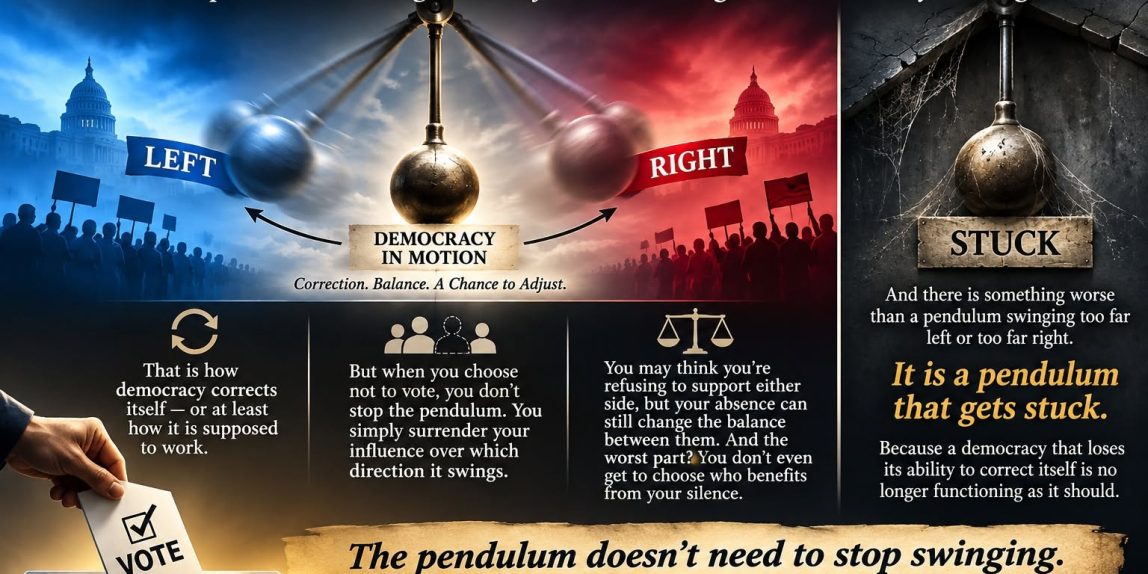
Politics is a pendulum, and democracy is the hand that keeps it moving. Refuse to use your hand, and someone else will gladly decide which way it swings. But beware the day it stops altogether—for then you may discover that the people holding it still have no intention of letting go. --YNOT!
Politics is a pendulum.
It swings to the left, then to the right, and eventually back again. Sometimes it swings gently, sometimes violently, and occasionally it swings so far in one direction that half the country becomes convinced civilization is about to end.
Fortunately, civilization has survived quite a few elections in which the losing side predicted precisely that.
This is the nature of politics. One generation becomes convinced that government has gone too far. The next becomes convinced that government hasn’t gone far enough. One crowd demands change, another demands a return to tradition, and somewhere in the middle stands an exhausted taxpayer wondering whether anybody intends to fix the potholes.
The beauty of democracy is not that the pendulum always swings in the correct direction. It is that the people retain the power to change its direction.
And that is a distinction worth understanding.
The Pendulum Is Supposed to Swing
There is a peculiar expectation among political enthusiasts that their preferred philosophy should prevail indefinitely.
Conservatives dream of a country that will finally learn its lesson and remain conservative forever. Progressives imagine a society that will eventually become enlightened enough to stop questioning progressive ideas.
Both sides seem to believe that history is a staircase leading inevitably toward their particular understanding of perfection.
Unfortunately for them, history is considerably less cooperative.
Political movements rise because people become dissatisfied with existing conditions. Governments accumulate power, regulations, promises, debts, and occasionally an impressive collection of excuses.
Eventually, the public becomes restless.
The people who once promised solutions become the people blamed for problems. Yesterday’s revolutionary becomes today’s establishment. Yesterday’s establishment reinvents itself as tomorrow’s revolutionary.
And around we go.
The political pendulum swings because human beings are remarkably consistent in their ability to become dissatisfied with arrangements they previously celebrated.
The same voters who demanded more government yesterday may demand less government tomorrow.
And that is not necessarily hypocrisy.
Sometimes it is learning.
Sometimes it is disappointment.
And sometimes it is simply discovering that a wonderful idea becomes considerably less wonderful when the bill arrives.
The People Who Refuse to Touch the Pendulum
Now we arrive at a particularly interesting creature in our democratic experiment.
The person who proudly announces:
“I don’t vote. They’re all the same.”
This individual often considers himself politically sophisticated. He has observed the flaws of both parties, recognized the shortcomings of numerous candidates, and concluded that the entire enterprise is beneath his participation.
He has, in effect, climbed onto the roof of a burning building and declared himself too intelligent to operate a fire extinguisher.
His reasoning is understandable.
Politicians disappoint. Campaign promises evaporate. Political advertisements routinely insult the intelligence of anyone possessing more than two functioning brain cells.
Nevertheless, refusing to vote does not remove someone from the political system.
It merely removes that person’s vote from the calculation.
When you refuse to vote, you do not stop the pendulum. You surrender your influence over which direction it swings.
And here is the remarkable part.
Your absence may benefit one political side or the other, depending on the election and who else participates.
But you don’t even get to choose which side benefits from your silence.
You have delegated that decision to everybody who bothered to show up.
It is rather like refusing to participate in a family discussion about where to have dinner, then complaining bitterly when everybody else chooses a restaurant you dislike.
You certainly have the right not to participate.
But the restaurant will still be selected.
And somebody will still hand you the bill.
Why the Pendulum Must Never Become Permanent
A pendulum that swings too far in either direction can create serious problems.
History provides plenty of examples of governments becoming dangerously convinced of their own righteousness.
Political movements sometimes begin with legitimate grievances and end with the belief that disagreement itself is an offense.
A party that wins an election may begin believing it has received a permanent mandate.
A political leader may confuse temporary popularity with unlimited authority.
And supporters may become so enthusiastic about defeating their opponents that they forget why limits on government power existed in the first place.
But democracy contains an important corrective mechanism.
The people can change their minds.
They can remove leaders.
They can reject policies.
They can elect the opposition.
They can decide that yesterday’s celebrated solution has become today’s expensive mistake.
This is not a weakness of democracy.
It is one of its greatest strengths.
The real danger begins when those correction mechanisms are weakened.
When political competition becomes meaningless.
When accountability disappears.
When institutions cease responding to legitimate public demands.
When the party in power becomes more interested in protecting its position than preserving the public’s ability to replace it.
Or when citizens become so convinced that participation is useless that they abandon the system altogether.
That is when the pendulum begins to lose its freedom of movement.
And a political pendulum that cannot move is no longer a corrective mechanism.
It becomes a decoration.
The Problem With Winning Forever
There is an old temptation in politics that can be summarized in four words:
This time, we’ve won.
Unfortunately, politicians frequently interpret those four words as permission to stop listening.
An electoral victory becomes a moral endorsement of every proposal.
A temporary majority becomes evidence of permanent public agreement.
And the opposition becomes something to be defeated rather than something to be heard.
Yet the opposition performs an essential function in a functioning democracy.
It challenges assumptions.
It exposes mistakes.
It offers alternatives.
And, when properly motivated, it reminds those in power that they are employees rather than owners of the government.
This does not mean every opposition argument is correct.
Nor does it mean that every compromise is wise.
Some policies are genuinely destructive. Some reforms are necessary. Some principles deserve defending even when unpopular.
But political competition forces governments to explain themselves.
And explaining oneself is an activity politicians generally prefer to avoid unless absolutely necessary.
A government that knows it can lose an election behaves differently from one that believes its authority is permanent.
At least it has a reason to consider the consequences of its decisions.
The purpose of elections is not to guarantee that the correct people always win. It is to preserve the people’s ability to remove the wrong people.
That distinction may be the most important one in democratic government.
When Both Sides Become Afraid of Losing
There is another problem with the political pendulum.
Sometimes people become so frightened of what might happen if the other side wins that they begin questioning whether the other side should be permitted to win at all.
Political disagreement becomes moral warfare.
Every election becomes the most important election in history.
Every opponent becomes an existential threat.
Every compromise becomes betrayal.
Every defeat becomes evidence that something must be wrong with the system.
And every victory becomes justification for changing the rules to make the next defeat less likely.
Such behavior creates a dangerous incentive.
Instead of persuading voters, political movements may concentrate on weakening the mechanisms through which voters can replace them.
The pendulum becomes something to control rather than something to respect.
But here is the irony.
The political protections you weaken today because they inconvenience your opponents may be the very protections you desperately need tomorrow.
Freedom of speech is considerably more valuable when the people in power dislike what you have to say.
Political competition is considerably more important when your preferred candidates are losing.
And limits on executive authority become remarkably attractive whenever the executive belongs to somebody else’s political party.
A principle that applies only when your side is winning is not much of a principle. It is a temporary convenience.
The Silent Majority Has a Peculiar Habit
We frequently hear politicians invoke the silent majority.
It is a wonderful political invention because the silent majority can be made to agree with almost anything.
Since it is silent, it rarely interrupts the speaker.
One politician insists the silent majority supports his policies.
Another insists the silent majority is furious about those same policies.
And somewhere, millions of actual citizens are watching television, paying bills, raising children, and wondering why gasoline, groceries, housing, and practically everything else seem determined to consume their paychecks.
The trouble with silence is that everybody gets to interpret it.
But ballots are considerably harder to reinterpret.
A vote is not a marriage proposal.
It is not a lifetime commitment to a political party.
It is not a declaration that your chosen candidate possesses extraordinary wisdom, moral perfection, or even particularly good judgment.
It is simply an exercise of political authority.
You may vote enthusiastically.
You may vote reluctantly.
You may vote for a minor-party candidate, an independent, or leave particular contests unanswered.
You may even decide that none of the available candidates deserves your support.
But there is an important difference between making a deliberate political choice and allowing the entire process to proceed without considering your influence upon it.
And there is an even greater difference between criticizing democracy and abandoning the responsibility of maintaining it.
A Pendulum That Gets Stuck
Now consider the most dangerous possibility.
Not a pendulum swinging too far left.
Not a pendulum swinging too far right.
But a pendulum that stops swinging altogether.
Imagine a political system in which elections continue to occur but changing the direction of government becomes increasingly difficult.
One in which public dissatisfaction grows while meaningful accountability declines.
One in which voters gradually conclude that their participation makes no difference.
Eventually, the public stops demanding correction because it no longer believes correction is possible.
That is a dangerous condition for any democracy.
The machinery may continue operating.
Politicians may continue giving speeches.
Political parties may continue raising money.
Candidates may continue promising that everything will improve immediately after the next election.
But something fundamental has disappeared.
The public’s practical ability—and willingness—to redirect its government.
Democracy does not require the people to agree. It requires their disagreements to remain capable of producing peaceful political change.
Without that possibility, the pendulum has no meaningful purpose.
The Wisdom of an Imperfect System
There is no perfect political system because there are no perfect human beings available to operate one.
Anyone waiting for a political party entirely free of fools, opportunists, hypocrites, and ambitious characters is likely to enjoy a very long wait.
Our choices are rarely between perfection and disaster.
More often, they are between imperfect alternatives promising different solutions, carrying different risks, and possessing different collections of undesirable characteristics.
The purpose of democracy is not to eliminate those imperfections.
It is to prevent them from becoming permanent.
It allows society to experiment, evaluate, reconsider, and reverse course.
It allows generations to question the assumptions of their predecessors.
It allows citizens to discover that what sounded wonderful during a campaign may require considerable revision once implemented.
And it allows a country to change direction without requiring a revolution every time the public becomes dissatisfied.
That last feature deserves considerably more appreciation than it generally receives.
Because history has demonstrated that changing governments through peaceful elections is preferable to settling every political dispute through violence.
The pendulum is imperfect.
Sometimes it moves too slowly.
Sometimes it swings too far.
Sometimes it seems determined to repeat mistakes that should have been obvious the first time.
But a pendulum capable of correcting its course is considerably more useful than one permanently attached to either wall.
The Final Swing
And so we return to our original observation.
Politics is a pendulum.
It swings left.
It swings right.
Occasionally, it passes through the middle, where reasonable people attempt to accomplish something before the next political argument begins.
The movement may frustrate us.
The extremes may frighten us.
The endless arguments may exhaust us.
But the ability to change direction remains fundamental to democratic government.
Voting does not guarantee wisdom.
Participation does not guarantee good leadership.
And political competition does not guarantee that every decision will be correct.
What these things help preserve is the possibility of correction.
The possibility of reconsideration.
The possibility that tomorrow’s citizens can peacefully reject the mistakes of yesterday’s leaders.
And that possibility is far too valuable to surrender through indifference.
So when someone tells you that voting makes no difference, remember that your individual vote may be small, but elections are nothing more than millions of individual choices added together.
Choosing not to participate does not place you above politics.
It simply leaves the choices to others.
And when the political pendulum swings in a direction you dislike, you may discover that standing aside was not quite the same thing as standing for something.
The danger isn’t that the political pendulum swings too far left or too far right.
The real danger is that someday it may stop swinging—and the people will discover they no longer have the power to move it.
A Final Thought from Modern Mark Twain
“Politics is a pendulum, and democracy is the hand that keeps it moving. Refuse to use your hand, and someone else will gladly decide which way it swings. But beware the day it stops altogether—for then you may discover that the people holding it still have no intention of letting go.”