Think of it as Yoga for the brain, we are going to stretch a bit.
Capitalism vs. Socialism — The Difference Between Opportunity and Permission
The greatest danger to a free society is not that some citizens become richer than others. It is that government becomes so powerful that citizens must ask permission to become anything at all. -- YNOT!
There is an old political trick that has survived kings, dictators, revolutions, elections, and several generations of university professors. It consists of promising people something for nothing, convincing them that somebody else will pay for it, and then expressing profound disappointment when the bill finally arrives.
In modern politics, this trick often comes wrapped in a beautiful word: Socialism.
It is a word that sounds wonderful when spoken by someone who has never had to operate a business, meet a payroll, or explain why the government warehouse has run out of toilet paper.
Capitalism, meanwhile, has a public-relations problem.
It promises nothing but opportunity. It guarantees neither success nor happiness. It allows people to make fortunes, lose fortunes, start businesses, fail spectacularly, and sometimes become wealthy enough to buy a yacht so large that even its owner cannot remember where he parked it.
Socialism promises something considerably more attractive: fairness, equality, security, and a government that will take care of everyone.
The trouble begins when somebody asks who will take care of the government.
And more importantly, who will pay for all the promises?
The Fundamental Difference: Opportunity vs. Permission
In a capitalist society, the basic proposition is remarkably simple.
You own your labor. You may own property. You may start a business.
You may invent something, manufacture something, sell something, or persuade someone to pay you for something.
If your idea is brilliant, you might become wealthy.
If your idea is terrible, you might become an expert in bankruptcy law.
Either way, the decision is largely yours.
The government establishes the rules, protects property rights, enforces contracts, and ideally prevents people from cheating one another.
In theory, it serves as the referee.
In practice, politicians occasionally decide they would rather own the stadium, manage both teams, sell the refreshments, and collect admission from the spectators.
But that is a corruption of capitalism, not its defining purpose.
Socialism, properly understood, places greater emphasis on collective or public ownership of productive resources. Its different schools propose different degrees of economic planning, worker ownership, and market activity.
At its most centralized and authoritarian, however, the distinction becomes painfully clear.
Under capitalism, you generally ask whether customers want what you are selling.
Under a command economy, you may have to ask the government whether you are permitted to sell it in the first place.
And the government, being the government, might require three forms, two inspections, a committee meeting, and a certificate proving that your ambition conforms to the latest five-year plan.
The difference between opportunity and permission is the difference between owning your future and applying for it.
The Great Socialist Promise: Equality for Everyone
Socialism’s greatest marketing advantage is that it appeals to something genuinely admirable: the human desire for fairness.
Nobody enjoys watching a child go hungry.
Nobody celebrates an elderly person losing a home.
Nobody believes that hardworking families should be condemned to poverty simply because they were born without advantages.
Those concerns are legitimate.
The disagreement begins with the proposed solution.
One approach seeks to create wealth, expand opportunity, and establish institutions that help people climb the economic ladder.
Another seeks to redistribute wealth through public institutions, sometimes extending government ownership and control over production itself.
Redistribution can be part of a successful mixed economy. The problem emerges when redistribution replaces wealth creation as the central economic objective.
Because wealth is not an inexhaustible natural resource.
Somebody has to produce it. Somebody has to invest. Somebody has to take risks.
Somebody has to build the factory, develop the software, operate the farm, construct the house, and figure out how to make a better mousetrap.
And when the political system begins treating those activities as suspicious exercises in selfishness, an economy may discover that it has become exceptionally good at dividing wealth and remarkably poor at creating more of it.
There is a limit to how many times you can divide a pie before somebody must bake another.
Socialism’s most appealing promise is that everyone gets a slice of the pie. Its most persistent problem, in centrally planned economies, has been finding someone willing and able to keep baking pies.
The Lessons of History — An Experiment Repeated Too Often
History provides several uncomfortable comparisons.
Consider East Germany and West Germany.
Following World War II, Germany was divided into two states with radically different political and economic systems.
West Germany developed a market-oriented economy supported by democratic institutions, private enterprise, and a substantial social safety net.
East Germany operated under a Soviet-style socialist system dominated by a communist party.
Both inherited the destruction of war. Both had educated populations and industrial traditions.
Yet their economic and political development diverged dramatically.
West Germany experienced extraordinary economic growth.
East Germany faced persistent shortages, political repression, and restrictions on movement.
Eventually, the East German government built a wall.
And here is a remarkable historical observation:
The wall was not built to keep West Germans from rushing into the socialist paradise.
It was built to prevent East Germans from leaving.
If you must construct a concrete barrier, install armed guards, and restrict travel to stop people from escaping your economic miracle, perhaps your miracle requires further examination.
Then consider the Korean Peninsula.
South Korea developed a capitalist economy and eventually became a prosperous democracy.
North Korea established a hereditary dictatorship organized around a centrally controlled economy.
Today, the contrast in economic conditions, personal freedoms, and access to the outside world is enormous.
Of course, history is complicated. Wars, foreign aid, sanctions, leadership, geography, and institutions all influence national outcomes.
But these comparisons demonstrate something important:
Economic freedom, political freedom, and accountable institutions are powerful advantages. Concentrating economic and political authority in the same hands creates enormous opportunities for abuse.
Cuba — The Revolution That Never Ends
Cuba offers another lesson, although not necessarily the one its revolutionaries intended.
In 1959, Fidel Castro helped overthrow Fulgencio Batista’s dictatorship.
The revolution promised justice, dignity, national independence, and an end to entrenched inequality.
Those were powerful promises in a country suffering from corruption and authoritarian government.
But the new government gradually eliminated much private ownership and concentrated political and economic authority in the state.
Six decades later, Cuba remains a one-party political system.
Private enterprise has been permitted in limited and changing forms, but the state continues to dominate important sectors of the economy.
Food shortages, unreliable infrastructure, limited economic opportunity, and outward migration have marked much of the country’s recent history.
Cuba also achieved genuine successes in areas such as literacy and medical training. Those achievements deserve acknowledgment.
Its economic failures deserve equal scrutiny.
The U.S. embargo, external pressures, domestic policy failures, and government restrictions have all affected Cuba’s development. Blaming every problem on one cause is not serious analysis.
Nevertheless, a fundamental question remains.
After more than six decades, why has a revolution promising economic liberation produced a system in which so many citizens have sought greater opportunity elsewhere?
At some point, a revolution must stop blaming its predecessor and accept responsibility for the country it has governed.
A revolution that spends sixty years promising a better tomorrow ought eventually to explain what happened to yesterday’s promises.
The Beautiful Cruelty of Choice
Capitalism contains a mechanism that politicians frequently dislike.
It is called competition. Suppose you open a restaurant.
You serve terrible food. Your prices are outrageous.
Your employees are miserable. Your customers complain.
Eventually, your restaurant closes. The marketplace has delivered its verdict.
Now imagine that the government owns the restaurant, employs the cooks, determines the menu, establishes the prices, and controls the supply of ingredients.
The food is still terrible. The employees are still miserable.
The customers still complain. But the restaurant may remain open because its survival depends on political decisions rather than satisfied customers.
And if there are no competing restaurants, the customers have nowhere else to go.
This does not mean private businesses never become inefficient or abusive. They certainly do.
Monopolies can suppress competition. Corporations can capture regulators. Powerful companies can seek government favors that protect them from smaller competitors.
Such practices undermine the very market discipline capitalism is supposed to provide.
That is why an effective market economy requires competition laws, independent courts, transparent institutions, and enforceable property rights.
Capitalism works best when businesses must earn customers, not when businesses can purchase politicians.
And socialism is not automatically immune to favoritism simply because the people allocating resources hold government titles rather than corporate ones.
Corruption does not disappear when you nationalize an industry.
Sometimes it merely changes offices.
The Most Dangerous Monopoly Is the Government Itself
People frequently complain about corporate monopolies. And they should.
A monopoly can restrict choices, raise prices, discourage innovation, and exploit consumers.
But imagine a monopoly that controls not merely one industry, but employment, housing, banking, transportation, communications, and the legal machinery used to enforce its decisions.
Now imagine that this monopoly also controls the police.
And the courts. And the newspapers. And the rules governing elections.
This is not an unavoidable feature of every socialist proposal. Democratic socialist traditions explicitly seek to preserve political rights and democratic accountability.
But when comprehensive state economic control is combined with one-party government, the resulting concentration of power can be extraordinary.
If the government is your employer, your landlord, your banker, and your political ruler, challenging the government becomes a very expensive hobby.
Losing your political argument might mean losing considerably more than an election.
That is why political liberty and economic independence frequently reinforce one another.
A citizen who can earn a living independently of the ruling party possesses a degree of freedom that cannot easily be granted by government permission.
When the government controls everything you need to survive, freedom becomes something you possess only as long as the government approves of how you use it.
But Capitalism Is Not Heaven, Either
Before anyone starts polishing a statue of Adam Smith, capitalism deserves some criticism of its own.
It is not a perfect system. It never was. Capitalism can produce extraordinary wealth alongside extraordinary inequality. It can reward innovation, but it can also reward speculation.
It can create jobs while simultaneously eliminating others.
A company can grow rich by developing a revolutionary product or by manipulating the rules to keep competitors away.
And no reasonable person should pretend that a child born into poverty possesses precisely the same opportunities as a child born into a billionaire’s household.
They do not. That is why functioning capitalist democracies establish public education, infrastructure, regulatory protections, social insurance, and programs intended to assist vulnerable citizens.
These institutions are not automatically incompatible with capitalism.
Indeed, some of the world’s most prosperous market economies maintain extensive public services.
The Nordic countries are frequently invoked as examples of successful socialism. Yet countries such as Denmark and Sweden retain predominantly private ownership, competitive markets, and substantial entrepreneurial activity alongside high taxation and comprehensive welfare programs.
They are better described as mixed economies with strong social-democratic institutions than as centrally planned socialist states.
This distinction matters. A social safety net is not the same thing as government ownership of the economy.
Providing assistance to someone who falls is different from requiring everyone to surrender control of the ladder.
The challenge is to develop policies that protect vulnerable people without destroying the incentives and institutions responsible for creating prosperity.
And governments have no monopoly on stupidity, just as businesses have no monopoly on greed.
The American Problem — Capitalism for the Poor, Socialism for the Rich?
Here is where the argument becomes particularly interesting.
Americans are frequently told that capitalism means accepting the consequences of their economic decisions.
Start a business and fail? You might lose everything.
Make a bad investment? You absorb the loss.
Buy something you cannot afford? The bank expects payment.
But when an enormous corporation makes disastrous decisions, the vocabulary sometimes changes.
Suddenly, we hear about systemic risk. Economic stability.
Emergency intervention. National necessity.
The same politicians who lecture ordinary citizens about personal responsibility may discover remarkable enthusiasm for public assistance when powerful institutions are in danger.
During financial crises, governments sometimes intervene for legitimate reasons, including preventing broader economic collapse.
Nevertheless, those interventions create an obvious moral hazard when investors come to expect public protection from private losses.
And that raises a rather uncomfortable question.
Why should the ordinary citizen be expected to practice capitalism while politically connected institutions occasionally receive protection from its consequences?
The answer should not be to abolish markets.
It should be to insist that markets operate under consistent rules.
A government that rewards connections over competition does not produce healthy capitalism. It produces crony capitalism.
And crony capitalism is what happens when the businessman and the politician discover that stealing from the taxpayer is easier when they cooperate.
The most profitable business partnership in America may be the one between a corporation that wants special treatment and a politician who wants campaign contributions.
The Psychology of Dependency
One of the least discussed aspects of economic systems is what they encourage people to believe about themselves.
Capitalism, at its best, tells individuals that their ideas, work, persistence, and decisions can influence their future.
Socialism, at its best, argues that people should not be abandoned merely because markets distribute rewards unequally.
Neither aspiration is inherently dishonorable.
The danger arises when political leaders convince citizens that virtually every important aspect of their lives must be managed by government.
Your employment. Your housing. Your healthcare. Your retirement. Your transportation. Your income. Your children’s future.
The more responsibility politicians assume, the more power they accumulate.
And the more dependent citizens become on political decisions, the harder it may be for them to challenge those making the decisions.
A functioning safety net should help people recover from hardship, not become a permanent substitute for opportunity.
Government assistance should ideally be judged by outcomes, not merely by how much money politicians announce they have spent.
Are people healthier?
Are children better educated?
Can families afford housing?
Can workers improve their circumstances?
Can citizens become economically independent?
Those are meaningful measures.
A politician announcing that he has spent another billion dollars is not necessarily announcing an accomplishment.
He may simply be announcing an expense.
Equality of Opportunity vs. Equality of Outcome
The distinction between opportunity and outcome sits at the heart of the debate.
Imagine two neighbors. Both receive access to education. Both enjoy legal protections.
Both are free to pursue careers, establish businesses, and own property.
One works eighty hours a week building a company.
The other prefers a quieter life, fewer working hours, and more leisure.
Both choices may be perfectly respectable.
But should the government guarantee identical economic outcomes?
And if it attempts to do so, what happens to the incentive to take risks, innovate, and work harder?
Not all differences in income reflect differences in effort or merit. Luck, inherited wealth, discrimination, health, family circumstances, and access to opportunity all matter.
A serious economic system must acknowledge these realities.
But it must also recognize that rewards influence behavior.
When effort, investment, and innovation produce no additional benefit, the motivation to undertake them may diminish.
The sensible objective is neither to guarantee equal wealth nor to ignore inequality.
It is to establish fair rules, provide genuine opportunities, protect basic rights, and allow people to benefit from productive contributions.
The goal should be to reduce poverty, not merely to reduce the number of people who are wealthy.
Making a millionaire poorer does not automatically make a poor family richer.
And making everyone equally poor is hardly a triumph of social justice.
The Great Political Sales Pitch
There is a reason politicians find promises of redistribution so appealing.
Creating wealth is difficult.
It requires investment, productivity, innovation, discipline, infrastructure, education, and sometimes decades of effort.
Promising to distribute someone else’s wealth requires considerably less imagination.
One merely needs a microphone.
Of course, redistribution is not inherently illegitimate. Every modern state collects taxes and allocates resources toward public purposes.
The question is whether the arrangement is sustainable, accountable, and economically productive.
A government cannot indefinitely consume more than an economy can support without consequences.
Debt must be financed. Taxes affect incentives. Regulations impose costs.
Public programs require competent management.
And the money that government spends must ultimately come from taxation, borrowing, or monetary expansion.
None of these is magic.
The American economy is not an unlimited checking account, regardless of how confidently Congress signs the checks.
But politicians have learned a valuable lesson.
Voters enjoy hearing about benefits.
They are considerably less enthusiastic about hearing who will finance them.
A politician who promises to give you something for free is usually counting on the fact that you will never examine the receipt.
The System That Corrects Its Mistakes
Perhaps the most important advantage of a competitive market economy is not that it avoids mistakes.
It is that it allows mistakes to be discovered and corrected through decentralized decisions.
Workers change employers. New competitors challenge established companies.
None of this occurs perfectly, and market failures sometimes require public intervention.
Nevertheless, a decentralized economy possesses countless sources of experimentation and feedback.
A centrally planned economy places a much heavier burden on government officials to determine what should be produced, how much should be produced, where resources should go, and what consumers should receive.
Even perfectly honest officials face an enormous information problem.
No committee can possess all the knowledge dispersed among millions of producers and consumers.
And when officials are politically insulated from failure, correcting mistakes becomes even harder.
A private business can discover that nobody wants its product.
A government bureaucracy may discover the same thing and request a larger budget.
That is not an argument against every public institution.
It is an argument for accountability.
Freedom Is More Than a Full Stomach
Economic prosperity matters.
But freedom involves more than material comfort.
It includes the right to speak, worship, criticize, organize, travel, work, own property, and disagree with those in power.
Capitalism alone does not guarantee all those freedoms. History contains capitalist economies governed by authoritarian regimes.
Likewise, democratic socialists can genuinely support civil liberties and competitive elections.
The important distinction is not simply whether a politician calls himself a capitalist or socialist.
It is whether the institutions of society protect individuals from excessive concentrations of power.
A market without the rule of law can become predatory.
A state without political accountability can become oppressive.
And a society without economic opportunity can become dependent.
The strongest arrangements disperse power, encourage enterprise, protect individual rights, and provide mechanisms for correcting injustice.
Freedom requires more than a slogan.
It requires institutions capable of defending it.
So Which System Wins?
If the choice is between a competitive market economy with private property and political freedom, and an authoritarian command economy in which government controls production and suppresses dissent, the historical evidence strongly favors the former.
The record of centrally planned communist economies is filled with inefficient allocation, shortages, restricted choices, and political repression.
That does not mean every government program is socialist.
It does not mean capitalism automatically solves every problem.
And it certainly does not mean that every businessman is virtuous or every government employee is a villain.
It means that economic incentives matter.
Competition matters.
Property rights matter.
Individual initiative matters.
And the concentration of economic power in political hands deserves extraordinary skepticism.
The capitalism worth defending is not a system in which the wealthy purchase government favors.
It is one in which ordinary people have the freedom to challenge the wealthy by building something better.
It is a system where the immigrant can establish a business, the employee can become an employer, the inventor can challenge an industrial giant, and the person born without money is not legally condemned to remain without it.
Not everyone will succeed. But the opportunity to try should never depend on the approval of a political committee.
That is the essential principle.
A Final Thought From Modern Mark Twain
There is something deeply revealing about the political language surrounding capitalism and socialism.
Capitalism is routinely criticized for allowing some people to become extraordinarily rich.
Authoritarian socialism deserves criticism when it concentrates both wealth and power among political elites while restricting the economic choices of ordinary citizens.
But the proper question is not which system produces the most beautiful political speeches.
Nor which ideology possesses the most emotionally appealing slogans.
The question is simpler. Where would you rather live?
In a country where you can start a business, own property, criticize the president, choose your employer, and attempt to build a better future?
Or in one where political authorities determine much of your economic life, restrict your choices, and insist that their decisions represent your collective interests?
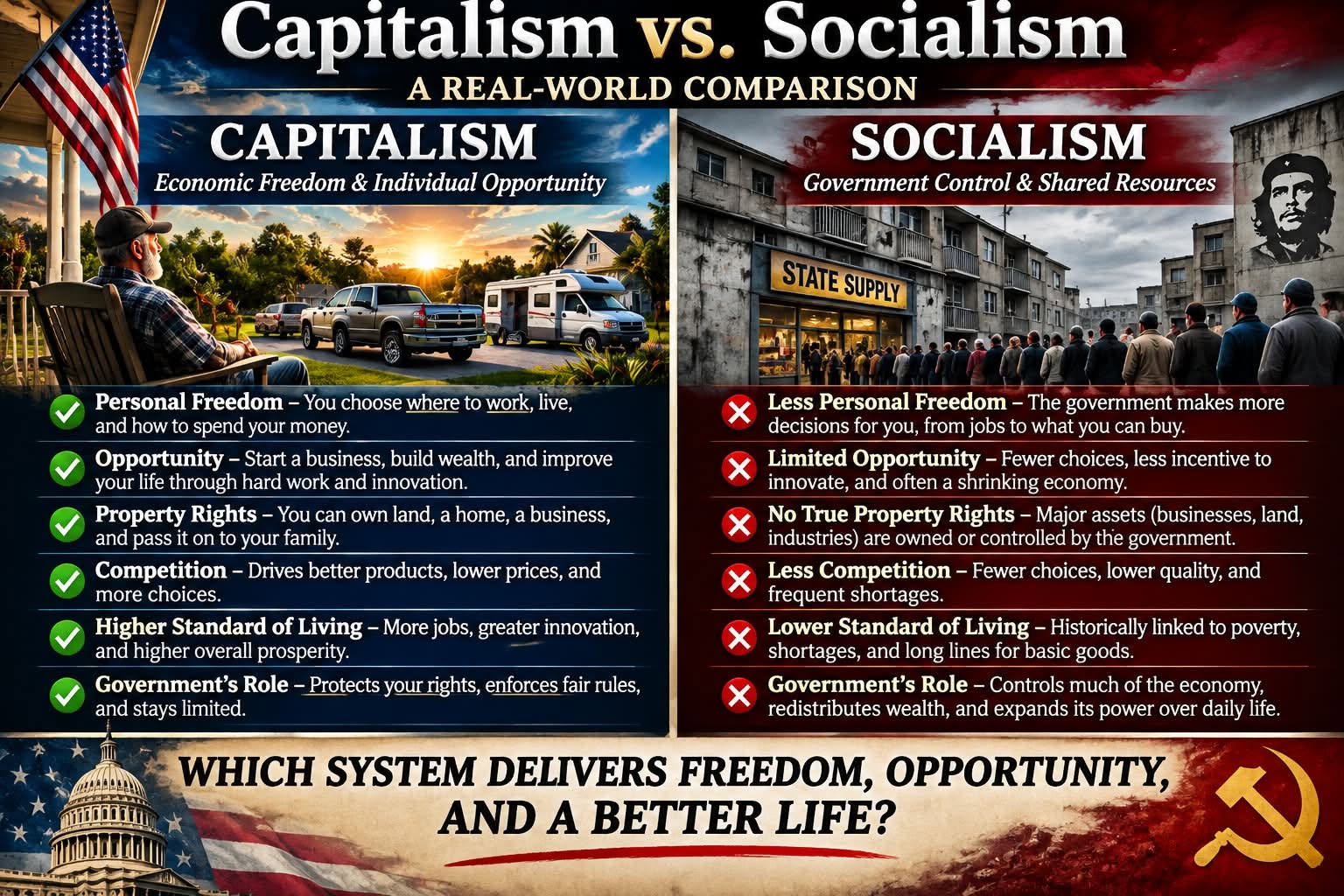
The illustration accompanying this commentary presents those choices in their most dramatic forms. Real economies are more complicated, and sensible public policy requires more than choosing between a suburban driveway and a Soviet apartment block.
But the underlying warning remains important.
Never confuse a government’s promise to protect your freedom with an unlimited license to exercise power over your life.
A government powerful enough to provide everything may also possess the power to deny everything.
And a politician who insists that freedom must be surrendered temporarily for the sake of a glorious future should be asked precisely when that freedom will be returned.
Preferably before he takes possession of the keys.
Because history has taught us that governments are remarkably skilled at acquiring authority.
Returning it is another matter entirely. Capitalism offers no guarantee that you will succeed.
Authoritarian socialism can make it exceedingly difficult to succeed without political permission.
And when evaluating either system, remember that the real measure of a society is not how loudly its leaders proclaim their concern for ordinary people.
It is how much freedom, opportunity, and prosperity ordinary people actually enjoy.
Final Observation
“Capitalism gives you the freedom to become wealthy, the freedom to fail, and the freedom to try again. Authoritarian socialism promises to protect you from failure, provided you surrender enough freedom to let the government decide what success looks like. The trouble with letting politicians plan your future is that they have a remarkable talent for improving their own.”