Think of it as Yoga for the brain, we are going to stretch a bit.
THE AMERICAN DREAM HAS A NEW PROBLEM — Everybody Wants a Piece of Your Paid-Off House
Where common sense is becoming uncommon, and the tax collector is the only fellow who never seems to retire, it may make sense to owe. -- YNOT!
There was a time in America when a man’s greatest financial ambition was to own his house free and clear.
Not a yacht. Not a private jet. Not a portfolio of stocks with names he couldn’t pronounce.
Just a house.
A modest piece of land, four walls, a roof that didn’t leak too badly, and the comforting knowledge that when the bank came calling, you could tell them to go bother somebody else.
Our grandfathers believed it. Our fathers preached it.
And most of us spent a good portion of our lives trying to accomplish it.
Pay off your mortgage. Own your home. Build equity. Secure your future.
That was the American Dream. It was good advice, too.
Unfortunately, nobody bothered to tell us that while we were busy paying off the mortgage, an entire industry of people was figuring out how to get their hands on what we’d accumulated.
And now I am beginning to wonder whether the greatest financial accomplishment of the American middle class has become its greatest vulnerability.
Because apparently, in modern America, owning something outright is an invitation for everybody else to start calculating their share.
THE HOUSE THAT GRANDPA BUILT
Imagine a working man in 1960.
He gets up before sunrise, works eight or ten hours, comes home tired, eats dinner with his family, and sends another mortgage payment to the bank.
He does this for thirty years.
He doesn’t own a Ferrari. He doesn’t speculate in cryptocurrency. He doesn’t hire a financial adviser who charges two percent annually to explain why his investments lost fifteen.
He simply works, saves, and pays his debts. And one glorious afternoon, the final mortgage payment goes out. His wife smiles. The children celebrate.
The old man sits on the porch, looks across his lawn, and says something that generations of Americans understood instinctively: “Whatever happens now, at least nobody can take our home.”
Well, Grandpa, I have some unfortunate news.
You may have gotten rid of the banker, but you’ve still got the property tax collector, the insurance company, the occasional fraudster, and a political system that is forever discovering new and imaginative ways to define your possessions as somebody else’s revenue.
And unlike your mortgage, some of those bills never get paid off. They just keep arriving.
Apparently, the American Dream now comes with a subscription fee.
And the cancellation department has been permanently closed.
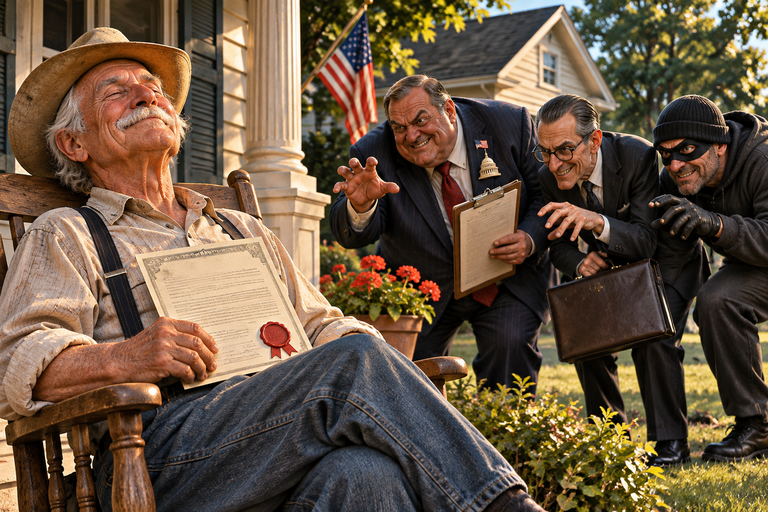
THE THREE MEN WAITING OUTSIDE YOUR HOUSE
There are three kinds of people who may become unusually interested in your home equity.
The first is the criminal. The second is the person who sees an opportunity for a lawsuit.
And the third is the politician who has discovered that your house is worth more than it was when you bought it.
The criminal might try deed fraud, identity theft, forged documents, or some other scheme designed to turn your life’s savings into his retirement plan.
The opportunistic plaintiff might see an accident, a disputed obligation, or an unfortunate event as an opportunity to pursue your assets through litigation.
Of course, legitimate lawsuits serve an important purpose, and many homeowners have legal protections against creditors. But that doesn’t mean a lifetime of accumulated wealth should be left without appropriate insurance or legal planning.
Then comes the politician. Now, the politician is different.
The criminal generally knows he’s trying to take something that doesn’t belong to him.
The politician believes he’s doing you a favor. And if you object, he will explain that you’re being selfish.
He calls it fairness. He calls it shared responsibility. He calls it investing in the community.
He has a remarkable vocabulary for a man who keeps asking other people for money.
But here’s the fascinating part. You don’t have to sell your house to discover that the government thinks it’s worth more.
You don’t have to refinance it. You don’t have to rent it. You don’t even have to make an extra dollar. The county can reassess its value, and depending on local tax laws and assessment limits, your property taxes can rise.
Your house appreciates on paper. Your wallet remains exactly where it was.
But the tax bill can grow anyway. What a marvelous invention!
A government that can recognize wealth you haven’t received and send you a bill you must pay with money you actually have.
If politicians ever learn how to tax imaginary friends, the national debt will disappear by Christmas.
THE GREAT AMERICAN MIRACLE: MONEY YOU HAVEN’T MADE
Let’s suppose you bought your house twenty years ago for $200,000.
You worked. You sacrificed. You replaced the roof, fixed the plumbing, painted the walls, and spent enough money at Home Depot to qualify for diplomatic immunity.
Today, that same house is worth $600,000. Congratulations!
According to the real estate market, you’ve become $400,000 wealthier.
Except there’s one small problem. You don’t actually have $400,000 in your pocket.
Your salary hasn’t increased by $400,000. Your checking account hasn’t increased by $400,000. You can’t walk into the grocery store and buy a week’s worth of food with the appreciation on your master bedroom.
The cashier won’t accept it. I’ve checked.
Yet your property can carry a higher taxable value, even though the appreciation hasn’t been converted into cash.
To be precise, property taxes generally apply to assessed property value, not the owner’s equity after subtracting the mortgage.
And that distinction is important. But so is the larger question:
How much of the rising value of a person’s home should the government be entitled to claim before that person has sold it?
Because if a retired homeowner is living on Social Security, a house that doubles in value doesn’t necessarily improve his standard of living.
It may simply make his neighborhood more expensive.
He may have become wealthy according to Zillow and poorer according to the grocery store.
And somewhere in government, an accountant is smiling.
THE POLITICAL ART OF TAXING WHAT PEOPLE OWN
For generations, taxation largely followed familiar categories.
You earned income. You paid income tax. You bought something. You paid sales tax.
You owned real estate. You paid property tax. You realized an investment gain. You might pay capital gains tax. Those distinctions mattered.
But modern debates increasingly include another possibility:
What if government could tax certain forms of accumulated wealth, even when the owner hadn’t sold the asset?
That is the controversy surrounding wealth taxes and proposals to tax unrealized gains.
Now, before somebody accuses me of inventing a new tax that has already been imposed on every American homeowner, let us separate political proposals from actual laws.
Massachusetts adopted an additional 4% income surtax above an inflation-adjusted threshold.
Washington enacted a millionaire income tax scheduled to begin in 2028.
California placed a proposed one-time tax on billionaires before voters in November 2026. The measure generally excluded real property, and unofficial results as of November 9 showed it trailing.
These are different policies. None of those examples establishes a general tax on the unrealized home equity of ordinary American homeowners.
But they do demonstrate that Americans are debating where taxation of income ends and taxation of accumulated wealth should begin.
And that debate deserves attention long before somebody decides to apply a new formula to the family home.
Because politicians have a curious habit of introducing taxes as temporary necessities and then developing a lifelong emotional attachment to the revenue.
Government programs, after all, need funding. Schools need teachers. Roads need maintenance. Fire departments need equipment. Nobody disputes that these services cost money.
The question is whether the method of raising that money is fair, transparent, sustainable, and considerate of the people expected to pay it.
And whether the people writing the laws remember that a person’s net worth and a person’s ability to pay a bill are not necessarily the same thing.
I would suggest that politicians study that distinction carefully.
Preferably before sending out the invoices.
FIRST THEY CAME FOR THE MILLIONAIRES
There is a familiar political argument that deserves examining.
“Don’t worry. This tax is only for millionaires.”
Well, that’s reassuring.
Unless, of course, you remember that the federal income tax began with very high exemptions and low initial rates before eventually reaching a much broader population.
A tax designed for a narrow population can remain narrow. But history also shows that tax systems can expand.
That doesn’t mean every tax on millionaires will inevitably become a tax on everybody else.
It means taxpayers have every right to ask what safeguards prevent that from happening.
Consider inflation. A million dollars once represented a level of wealth most Americans could scarcely imagine.
Today, in some expensive housing markets, a modest house, a retirement account, and a lifetime of disciplined saving can make an ordinary couple look wealthy on paper.
They may not feel wealthy. Their refrigerator still breaks. Their property insurance still increases. Their doctor still expects payment.
But on the government’s balance sheet, they may appear to possess considerable assets.
This raises a dangerous temptation.
When government needs more money, does it look first at controlling its expenses?
Or does it look around the country for somebody who appears to have something worth taxing?
I suspect we all know which option requires fewer difficult conversations.
A politician discussing spending cuts is a man preparing for a funeral. A politician proposing a new tax is a man organizing a parade.
And the parade always seems to end at somebody else’s wallet.
YOUR HOUSE IS NO LONGER HIDING FROM ANYBODY
There was a time when assessing property meant a county employee occasionally driving through the neighborhood and making observations.
Today, government agencies and private companies have access to aerial imagery, mapping systems, property databases, and sophisticated analytical tools.
Technology can help identify building improvements and support more accurate assessments.
That can be legitimate. A swimming pool, a major addition, or a newly constructed building may affect a property’s value.
But there is something unsettling about living in a world where your property can be examined from the sky while you are sitting in the backyard wondering why the government hasn’t fixed the pothole in front of your driveway.
They can find your swimming pool from space.
But somehow they can’t find the money that disappeared from last year’s budget.
A truly remarkable technological achievement.
The more important concern, however, is not the technology itself.
It is the accuracy of the information and the fairness of the resulting assessment.
An algorithm can make a mistake. A property database can contain incorrect information.
An assessor can overestimate a property’s value.
And a homeowner who never reviews the assessment may end up paying more than necessary.
Technology may make the government faster. It does not automatically make the government right.
THE PAID-OFF HOUSE: SECURITY OR FINANCIAL TRAP?
Now we arrive at the uncomfortable question – Is paying off your mortgage still a good idea? My answer is yes depending on where you live.
But not automatically, not for everybody, and not without considering what comes afterward. A paid-off home can provide enormous financial security.
No monthly principal and interest payments. Less exposure to interest rates.
Lower fixed financial obligations. More flexibility during retirement. Those are real advantages.
And I would never suggest that somebody should deliberately mortgage his home merely because he’s frightened of a tax proposal that may never become law.
That would be exchanging a possible future problem for a guaranteed present obligation.
A peculiar strategy, even by Washington standards.
But owning a house outright should not be confused with having a complete financial plan.
Your home may represent most of your wealth while providing very little cash flow.
You can be worth a million dollars and still struggle to pay a $10,000 emergency expense.
You can have half a million dollars in home equity and very little in liquid savings.
And the unpleasant truth is that property taxes, insurance, maintenance, and unexpected repairs don’t disappear when the mortgage does.
The banker may be gone. But everybody else still has your address.
BEWARE THE PEOPLE SELLING PROTECTION FROM TAXES THAT DON’T EXIST
There is another group worth discussing.
The people who promise to protect your wealth from every possible future tax.
Some recommend moving your deed into a trust. Some recommend placing your home inside an LLC. Others suggest opening a home equity line of credit or borrowing against the house and investing the money elsewhere.
These techniques can have legitimate uses. Trusts can support estate planning.
Certain business structures can provide organizational or liability benefits.
Borrowing against real estate can provide liquidity. But none should be treated as a magical invisibility cloak. An LLC does not automatically make a person’s beneficial ownership disappear for tax purposes.
A trust is not automatically exempt from taxes. An unused home equity line of credit does not reduce your outstanding mortgage balance or magically eliminate your net worth.
And borrowing against your house introduces additional financial risk, including the possibility of foreclosure if you cannot repay.
I would be particularly cautious of anyone who insists that you must act immediately before politicians supposedly impose some unspecified new tax.
Fear is an excellent sales technique. It is not a substitute for financial analysis.
Before restructuring ownership or borrowing against your home, consult a competent attorney and tax professional who understand your state’s laws.
Because there is nothing quite as tragic as spending $15,000 to protect yourself from a tax that doesn’t exist, only to discover you’ve created an actual problem with your title, financing, or homestead benefits.
That would be the financial equivalent of burning down your house to keep termites away.
THE HOMESTEAD: ONE OF THE LAST DEFENSES
Fortunately, homeowners are not entirely defenseless.
Many states provide homestead exemptions, assessment limitations, or other protections.
Florida’s Save Our Homes program, for example, generally limits annual increases in assessed value for qualifying homestead property to the lesser of 3% or inflation.
That protection can become enormously valuable when property prices rise faster than household income.
But homeowners must understand the eligibility rules, verify their exemptions, and examine their assessments.
An assessment is not a divine revelation. It is an administrative determination.
And administrative determinations can be challenged. You should know your property’s assessed value. You should know which exemptions apply.
You should understand the deadlines for appealing an assessment.
You should review your insurance coverage and legal protections.
And you should understand the consequences before transferring ownership, refinancing, or changing your estate plan.
None of this requires a conspiracy theory. It requires paying attention.
Which, unfortunately, is becoming a revolutionary act in modern American life.
THE REAL DANGER ISN’T WEALTH. IT’S ILLIQUID WEALTH.
Here is the part that troubles me most.
We have spent generations telling Americans to save, invest, buy homes, and prepare for retirement.
Then, when people succeed, we sometimes treat their accumulated assets as evidence that they can easily afford another financial obligation.
But accumulated wealth is not always spendable money.
A retired couple living in a house worth $900,000 may have less disposable income than a young professional renting an apartment and earning $150,000 annually.
The couple may have purchased that house forty years ago for a fraction of its present value. They may have spent decades improving it. They may have raised their children there. And they may have absolutely no intention of selling it.
Why should rising property values alone make it increasingly difficult for them to remain in their home?
The answer cannot simply be that their property is worth more.
If government wants to tax people based on what they own, then it must also confront the question of how those people are supposed to pay.
Should elderly homeowners be forced to borrow against their property?
Should they be encouraged to sell?
Should they be taxed on market gains that may disappear during the next downturn?
These are serious questions. And they deserve more sophisticated answers than declaring everybody with an appreciated house to be rich.
A man cannot eat the equity in his kitchen, sleep under the interest on his retirement account, or pay the electric company with a Zillow estimate.
At some point, wealth must be distinguished from cash flow.
Otherwise, we risk building a system where the people who worked hardest to become financially independent discover that independence has become too expensive to maintain.
THE GOVERNMENT’S NEVER-ENDING APPETITE
I have often wondered what would happen if government were required to approach its finances the way an ordinary American family must.
Imagine a husband telling his wife that the household budget is short by $20,000.
Naturally, she asks whether they should reduce expenses.
“Certainly not,” he replies. “I’ve decided that our neighbors are wealthier than we thought.”
She looks confused. “They bought their house thirty years ago,” he explains. “It’s worth much more now. Therefore, we should charge them a fee.”
“And what if they refuse?”
“We’ll call it fairness.”
“And if they still refuse?”
“We’ll call them selfish.”
“And what if we run out of money again next year?”
“Then we’ll need to find wealthier neighbors.”
A brilliant financial system.
One can only wonder why households haven’t adopted it.
Of course, actual public finance is more complicated than a family budget, and taxation is necessary to fund public responsibilities.
But that complexity doesn’t absolve elected officials from the obligation to spend responsibly.
A government that can always discover another taxable asset has less incentive to confront its own inefficiencies.
And a population that becomes accustomed to financing every new promise with someone else’s wealth should not be surprised when the definition of “someone else” eventually includes them.
WHAT GRANDPA DIDN’T KNOW
Perhaps our grandfathers were right about the importance of paying off a mortgage.
Perhaps they understood something that modern financial experts occasionally forget.
Debt is an obligation – Equity is ownership. And financial independence is worth pursuing.
But the world has become considerably more complicated since Grandpa made that final mortgage payment.
Today, protecting the family home requires more than simply paying the bank.
It requires understanding taxes, insurance, estate planning, property assessments, fraud prevention, and the growing debate over how accumulated wealth should be treated.
It also requires paying attention to government. Not because every politician is a thief.
Not because every tax is confiscation. And certainly not because every proposal to tax billionaires is secretly designed to seize Grandma’s bungalow.
But because laws have consequences
And those consequences are often considerably different for a family living on retirement income than for a billionaire with accountants, attorneys, financial advisers, and enough liquidity to buy a small country.
The wealthy have options. They can relocate. They can diversify. They can restructure investments. They can hire experts to analyze legislation before it reaches the governor’s desk.
The ordinary homeowner has a house, a property tax bill, and perhaps a calculator from 1987.
Both deserve fair treatment. But only one can afford a legal team to explain what fairness means.
THE AMERICAN DREAM SHOULD NOT HAVE AN EXPIRATION DATE
I still believe in owning a home. I still believe in paying your debts.
I still believe that a person who spends forty years working, saving, sacrificing, and building something should be entitled to enjoy the fruits of that effort.
And I still believe that property ownership is one of the foundations of individual independence.
But ownership should mean something.
It should mean more than occupying a property until the taxes, insurance, maintenance, or financial pressures become unbearable.
It should mean that a lifetime of responsible decisions provides a reasonable expectation of security.
This does not mean homeowners should never pay taxes.
It means taxation should recognize the difference between prosperity and liquidity, between realized income and paper appreciation, and between a family’s primary residence and a speculative investment.
It means governments should justify new taxes honestly, explain their consequences clearly, and establish protections against unintended harm.
And it means Americans should remain skeptical whenever a politician discovers that the solution to yesterday’s spending problem is tomorrow’s tax increase.
Because what concerns me isn’t simply that governments might tax wealth.
It is the possibility that we gradually redefine private ownership into something resembling an annual rental arrangement with the state.
You buy the land. You build the house. You maintain the property. You pay the mortgage. You pay the insurance. You pay the taxes.
And after thirty years, the bank finally sends you a letter confirming that the house belongs to you.
Then the county sends another letter reminding you that the payments must continue.
It is enough to make a man wonder whether he has finally become a homeowner or merely succeeded in replacing one landlord with another.
ONE FINAL THOUGHT
Grandpa used to say: “Pay off your house, son. Then nobody can take it away from you.”
Today, I would amend that advice. Pay off your house if it makes financial sense. Protect your title. Understand your taxes. Challenge unfair assessments. Keep enough savings to survive an emergency. And pay very close attention to the people who write the laws.
Because the greatest threat to the American Dream isn’t necessarily the banker, the lawyer, the fraudster, or even the politician.
It is the slow acceptance of the idea that whatever a citizen manages to accumulate through a lifetime of honest work must remain permanently available for somebody else to claim.
A house should be a home. Not a retirement trap. Not a political bargaining chip.
Not an invitation for every passing opportunist to take a share. And certainly not a financial achievement that becomes a punishment simply because you managed to accomplish it.
The American Dream was supposed to be about owning your future.
Not spending the rest of your life paying somebody else for permission to keep it.
And if that sounds old-fashioned, so be it.
I have always believed that a little old-fashioned common sense is preferable to a great deal of modern financial nonsense.
Florida’s Save Our Homes limitation is documented by the Florida Department of Revenue. The Consumer Financial Protection Bureau also confirms the financial risks associated with borrowing against home equity. https://floridarevenue.com/property/Documents/pt112.pdf
DISCLAIMER: THE PURPOSE IS TO MAKE YOU THINK, NOT TELL YOU WHAT TO DO.
The purpose of this article is not to sell you anything, frighten you, or pretend to offer professional financial, legal, or tax advice. It is simply to make you aware of issues that could affect your financial security, your home, and your future.
My goal is to encourage you to take a little time, examine your own circumstances, ask questions, and think critically about decisions that could affect the wealth you’ve spent a lifetime building.
Don’t take my word for it. And don’t blindly take anybody else’s word for it, either.
Educate yourself. Do your own research. Speak with qualified professionals, including financial advisers, tax specialists, and attorneys when appropriate. Better yet, seek opinions from at least two or three independent sources. Compare their recommendations, understand their reasoning, and determine what actually makes sense for YOU.
Remember, what works for your neighbor, your brother, or even a millionaire on television may be completely wrong for your circumstances.
And what makes sense for you today may not make sense five years from now. Your health changes. Your income changes. Your family circumstances change. Your investments change. And perhaps most importantly, tax laws, regulations, and government policies change.
That is why financial planning isn’t something you do once and forget. It’s something you should periodically review and adjust as your life evolves. There is no universal solution, no magic formula, and certainly no substitute for understanding your own situation.
This article is commentary intended to encourage awareness and independent thinking. It is not personalized financial, legal, investment, or tax advice. And remember one final thing: The most expensive advice you will ever receive may be the advice you followed without understanding it.
Learn. Question. Compare. Think. Then make an informed decision based on your own circumstances.
Because common sense isn’t about knowing everything. It’s about knowing enough to ask the right questions before making the wrong decisions.