Think of it as Yoga for the brain, we are going to stretch a bit.
THE GREAT KITTEN SWINDLE – Cats Conquered Humanity Without Ever Getting a Job
A dog thinks you're God. A cat thinks you're the hired help. And judging by the arrangements, the cat may be right.” -- YNOT!
There are three things in this world a sensible person should never trust: a politician promising lower taxes, a salesman offering a lifetime warranty, and a kitten pretending to love you. Of the three, the kitten is by far the most successful.
Now, I have lived long enough to recognize a con when I see one. I’ve seen investment schemes, pyramid operations, questionable business propositions, and politicians who could sell you your own wallet.
But nothing—and I mean NOTHING—compares to the elaborate criminal enterprise known as THE DOMESTIC HOUSE CAT.
And it all begins with a kitten.
THE BAIT: AN ANGEL IN A FUR COAT
You bring home this tiny, helpless creature.
It fits in the palm of your hand. Its eyes are enormous. Its paws are adorable. It makes little squeaking noises that could melt the heart of a tax collector.
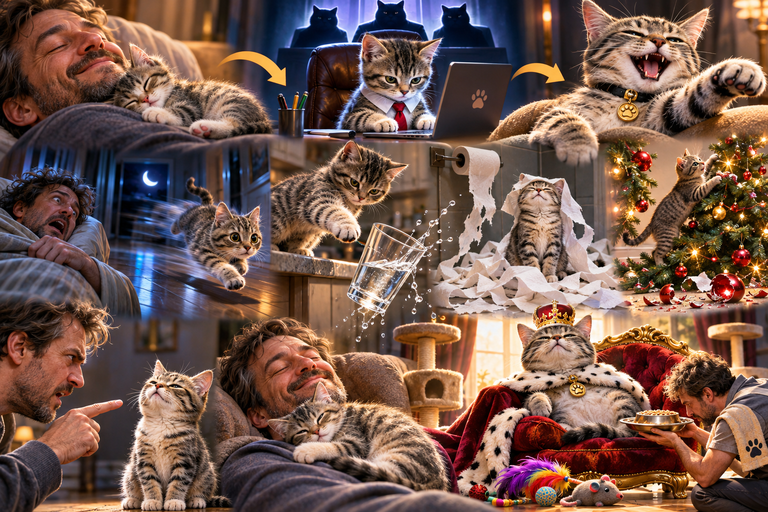
It sleeps on your chest. It purrs. It gazes lovingly into your eyes.
You think, “What a precious little companion. I shall protect and cherish this innocent creature for the rest of its life.”
And somewhere inside that tiny furry head, a criminal mastermind is thinking: “Excellent. The fool has taken the bait.”
You see, a kitten is not a baby cat. A kitten is a promotional offer. It’s the free trial version.
The first ninety days are designed to establish emotional dependency, secure housing, guarantee a lifetime food supply, and convince the victim that the arrangement was entirely his idea.
Then, at approximately three months of age, something extraordinary happens.
Corporate headquarters sends a memorandum.
SUBJECT: PROBATIONARY PERIOD COMPLETED.
Dear Agent Whiskers,
Congratulations. Your infiltration of the human household has been successful.
You are hereby authorized to begin Phase Two: Complete Domestic Domination.
Please proceed with destruction of property, sleep deprivation, psychological warfare, and random acts of inexplicable violence.
Remember: Maintain plausible deniability through excessive cuteness.
Sincerely, Feline International Headquarters
And overnight, your sweet little angel becomes a furry psychopath with absolutely no respect for law, order, or private property.
THE CRIME WAVE BEGINS
At 3:00 in the morning, the cat decides it’s time to conduct a high-speed NASCAR race through the bed room over your bed right over you to the window.
Not because something frightened it. Not because it’s hungry. Not because there’s an emergency. Because it’s Tuesday.
It launches itself across the furniture, ricochets off the walls, sprints down the hallway, and leaps onto your sleeping body like a miniature airborne terrorist.
You wake up convinced the house is being burglarized. Technically, it is. The burglar simply already lives there.
You get up to investigate. The cat stares at you.
“What? You got a problem?” Then it walks away. Slowly. With its tail in the air.
Like a mob boss leaving a crime scene.
PROPERTY RIGHTS? WHAT PROPERTY RIGHTS?
Leave a glass of water on the counter. The cat notices it. You notice the cat noticing it.
You say, “Don’t you dare.” The cat looks directly into your eyes. Raises one paw.
And gently pushes the glass toward the edge. You say, “NO!”
The cat pauses. Considers your objection. Then pushes it again. SLOWER.
Because apparently, destruction of property isn’t enough.
There must also be psychological humiliation.
The glass falls. Water everywhere.
The cat observes the damage, then looks at you as though you are the idiot who put the glass there. And from a certain legal perspective, it has a point.
After all, the cat didn’t sign a lease. The cat didn’t agree to your rules.
The cat has no income, no identification, and no intention of appearing in court.
Good luck prosecuting that.
THE GREAT TOILET PAPER MASSACRE
One morning, you walk into the bathroom and discover what appears to be the aftermath of an industrial paper-shredding accident.
Toilet paper covers the floor. The roll has been completely unraveled.
There are claw marks on the furniture and tiny pieces of evidence scattered throughout the crime scene. The suspect is sitting in the middle of the destruction.
Licking its paws. You demand an explanation. The cat offers none.
You ask, “WHY WOULD YOU DO THIS?”
The cat blinks. Apparently, it has exercised its Fifth Amendment rights.
You clean everything up. The cat watches.
Management is pleased with your performance.
CHRISTMAS: A FELINE DEMOLITION PROJECT
Humans spend considerable time decorating Christmas trees.
We carefully place ornaments. We string lights.
We arrange sentimental decorations passed down through generations.
And the cat sees all this and thinks: “Wonderful. They’ve built me a jungle gym covered in expensive breakable toys.”
Within twenty minutes, three ornaments are shattered, the angel is missing a wing, and the cat is halfway up the tree, looking down upon the wreckage like Napoleon surveying a conquered battlefield.
The tree falls. You shout. The cat escapes.
And somehow, by Christmas morning, you’re apologizing to the cat for raising your voice.
Which brings us to the most extraordinary part of this entire operation.
THE PSYCHOLOGICAL MASTERPIECE
Cats have perfected a system of emotional manipulation that would make the world’s most successful confidence men weep with professional jealousy.
They commit approximately forty-seven felonies before breakfast.
Then, without warning, the criminal climbs into your lap. Curls into a ball. Begins purring.
Looks up at you with those enormous, innocent eyes.
And suddenly, every crime is forgiven. The broken glass? Forgotten.
The destroyed curtains? A minor misunderstanding.
The $2,000 sofa that now resembles something recovered from a shipwreck?
An unfortunate business expense.
The cat has learned something about human psychology that politicians, advertisers, and organized crime have spent centuries trying to master:
If people love you enough, accountability becomes optional.
And cats have turned that discovery into a worldwide empire.
THE MOST SUCCESSFUL BUSINESS MODEL IN HISTORY
Consider the economic arrangement. You work. The cat sleeps.
You pay the mortgage. The cat owns the house.
You purchase expensive food. The cat sniffs it and walks away.
You buy a forty-dollar cat bed. The cat sleeps in the cardboard box it came in.
You spend eighty dollars on an elaborate electronic toy. The cat plays with a bottle cap.
You spend thousands on veterinary care. The cat rewards you by biting the veterinarian.
You are responsible for feeding, cleaning, grooming, entertaining, and providing medical services to an animal whose principal contribution to the household is occasionally depositing a dead insect beside your slippers.
And here’s the truly remarkable part:YOU THINK YOU’RE GETTING THE BETTER END OF THE DEAL.
If a human roommate behaved this way, you would have called the police six months ago.
But put whiskers on the criminal, and suddenly he’s a beloved member of the family.
I have studied capitalism, socialism, communism, and every economic theory mankind has managed to invent.
But I have finally discovered the perfect economic system. FELINISM.
From each human according to his ability.
To each cat according to its appetite.
The cat owns the means of production, the furniture, the heating system, and approximately seventy percent of the bed.
The human supplies the labor.
And unlike every other economic system ever attempted, this one has operated successfully for thousands of years without a single cat ever attending a budget meeting.
THE FINAL INSULT
Scientists tell us that humans domesticated cats. I would like to examine the evidence.
We domesticated dogs. Dogs guard our homes, herd livestock, assist the disabled, locate missing persons, and occasionally bring us the newspaper.
Dogs have jobs.
Cats? Cats have STAFF.
In ancient Egypt, cats were worshipped as gods.
Thousands of years later, they still expect the same treatment.
The only difference is that the Egyptians had the good sense to recognize what was happening.
We call it pet ownership. They called it religion.
THE MORAL OF THE STORY
I’ve come to the conclusion that cats are not domestic animals.
They are tiny, highly sophisticated confidence artists operating under the protection of extraordinary public relations.
They arrive disguised as helpless babies. They establish emotional control.
They seize your property. They destroy your belongings.
They interfere with your sleep. They demand tribute in the form of food and affection.
And whenever you begin questioning the arrangement, they roll onto their backs and show you their little bellies.
Which, incidentally, is another trap. Touch that belly, and you may lose a finger.
Yet despite all this, we continue feeding them, protecting them, loving them, and defending their behavior to anyone foolish enough to question it.
Why?
Because somewhere between the broken Christmas ornaments, the shredded toilet paper, and the 3 a.m. hallway Olympics, those little criminals somehow become family.
And that, my friends, may be the greatest scam of all. They convince us that we rescued them.
When all along, they were recruiting us. So if you’re thinking about adopting a sweet little kitten, I encourage you to proceed with caution.
Read the fine print. Secure your valuables. Update your insurance. And remember:
The kitten is free. The lifetime subscription is not.
And unlike Netflix, there’s no cancellation button.
Just a tiny furry landlord sitting on your chest at four in the morning, demanding breakfast.
Welcome to cat ownership. Or, as the cat would call it:
A SUCCESSFUL HOSTILE TAKEOVER. –
Observing human foolishness, one cat hair at a time.
P.S. If you disagree with this commentary, I suspect your cat is reading over your shoulder. Blink twice if you need rescuing.