Think of it as Yoga for the brain, we are going to stretch a bit.
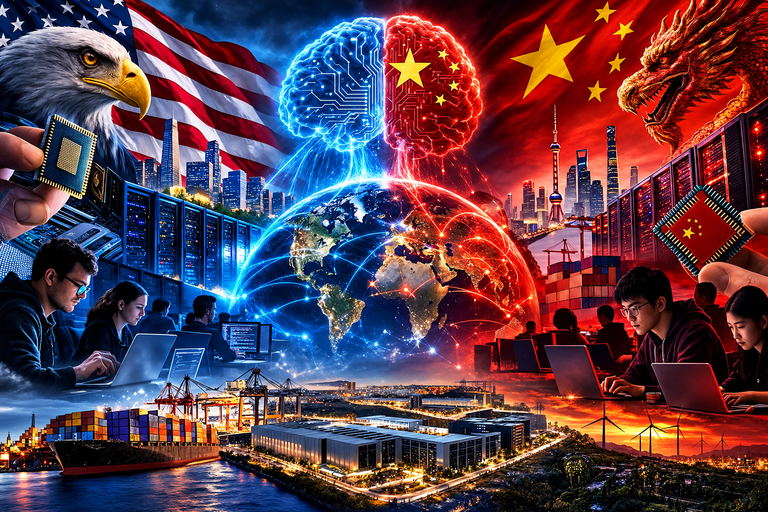
WORLD WAR AI The Battle Between the West and China for Control of Artificial Intelligence -Who Wins, Who Loses, and What the Effects Will Be
The greatest danger to America in the AI war is not that China will invent a smarter machine. It is that China will give the world a cheaper one, while American billionaires spend trillions convincing us that intelligence is something we must rent from them. And the greatest irony of all? America may lose the battle for capitalism because its most successful capitalists have forgotten the value of competition. -- YNOT!
THE FIRST WORLD WAR WHERE THE WEAPONS THINK FOR THEMSELVES
There is an old saying that war is the continuation of politics by other means.
Well, gentlemen, we have apparently reached the point where war is the continuation of business by computers.
Welcome to World War AI.
There are no invading armies, no soldiers storming beaches, and no generals moving tanks across borders.
Instead, we have billionaires building data centers, politicians arguing over computer chips, corporations spending fortunes they hope to recover someday, and governments trying to decide who should be permitted to own the intelligence of tomorrow.
And standing in opposite corners of this strange battlefield are the United States and China. One is the world’s leading technological superpower, with enormous financial resources, advanced semiconductor technology, and some of the most innovative corporations ever created.
The other is an industrial giant with enormous manufacturing capacity, a government willing to pursue long-term strategic objectives, and a growing collection of artificial intelligence systems that are rapidly challenging America’s technological advantages.
But here is the part that makes this war different. China does not necessarily have to build better artificial intelligence than America to win.
It may only have to make artificial intelligence sufficiently good, sufficiently cheap, and sufficiently available that the rest of the world begins using Chinese technology instead.
And if that happens, America could discover that it has spent a fortune building the world’s most expensive intellectual property while China has been busy making that property considerably less valuable.
There is nothing quite as embarrassing as building the world’s finest toll road only to discover that your competitor has opened a perfectly good highway next door.
Especially when he isn’t charging admission.
THE TWO AI EMPIRES — RENT THE BRAIN OR OWN THE MACHINE
To understand this war, we must first understand what everyone is fighting over.
Consider two businesses.
The first company builds an extraordinary artificial intelligence system.
It spends billions developing it, hires the smartest engineers it can find, purchases enormous quantities of computing equipment, and creates a machine capable of reasoning, writing, programming, analyzing, and solving problems.
Then it tells the world:
“You may use our intelligence, but you cannot have it. Pay us every month, follow our rules, and we will allow you access.”
This is the proprietary AI business model.
Companies such as OpenAI and Anthropic, along with Google’s most advanced proprietary systems, rely heavily on controlling access to their technology.
They sell subscriptions, enterprise services, API access, and specialized capabilities.
There is nothing inherently wrong with this arrangement.
Developing advanced technology costs money, and a company that invests billions expects to recover its investment.
But now consider the second company.
It develops a capable AI system and releases the model weights so that other organizations can download and operate the system themselves.
They can run it on their own servers, adapt it to their requirements, and sometimes modify it extensively.
This is the open-weight approach, often casually called open-source AI.
The distinction matters. Open-weight does not always mean fully open-source, and some models carry significant licensing restrictions.
Furthermore, downloading a model does not make the computers, electricity, engineers, or security operations required to run it free.
Nevertheless, the fundamental difference is enormous.
With proprietary AI, you rent access to someone else’s intelligence. With sufficiently open AI, you can operate that intelligence yourself.
Imagine if every automobile manufacturer required you to rent its engine by the hour.
You could own the car, polish it, wash it, insure it, and park it in your driveway.
But every time you turned the ignition, somebody in Detroit would send you a bill.
That would be an excellent business model. For Detroit.
The trouble begins when a competitor offers to sell you the engine instead.
And that, ladies and gentlemen, is the economic revolution taking place in artificial intelligence.
CHINA’S STRATEGY — YOU DON’T HAVE TO SELL WHAT YOU CAN GIVE AWAY
China has recognized something that should concern every American technology executive.
The most powerful AI system in the world is not necessarily the one that eventually dominates the market.
Sometimes the winner is the system that becomes the standard.
Microsoft understood this with operating systems.
Google understood it with search.
The internet demonstrated the enormous power of freely available protocols and technologies.
And China increasingly understands the strategic value of widely distributed AI models.
Chinese developers such as Alibaba’s Qwen, DeepSeek, Moonshot AI, MiniMax, and Z.ai have become major participants in the open-model ecosystem.
Their systems are increasingly capable, often competitive in particular tasks with expensive American alternatives, and available for deployment outside China.
In July 2026, Moonshot introduced Kimi K3, a 2.8-trillion-parameter open-weight model that demonstrated how rapidly Chinese developers were advancing toward the frontier of AI capability.
The largest models still require formidable computing infrastructure. Nobody should confuse downloading their weights with running them on an ordinary laptop.
But smaller models have also become remarkably useful.
A business no longer necessarily needs a giant data center to operate an AI assistant, analyze documents, automate workflows, or support its employees.
And that creates a strategic opportunity.
China can gain influence not simply by selling AI, but by encouraging the world to build its future on Chinese AI technology.
Imagine a developing country trying to modernize its hospitals, schools, factories, and government services.
An American company might offer an excellent proprietary AI system with recurring subscription charges.
A Chinese company might offer a sufficiently capable open model that local engineers can operate themselves.
Which will the country choose?
Naturally, the answer depends on capability, operating cost, security, and long-term reliability.
But price and independence matter enormously.
And once an entire generation of developers, universities, and businesses learns to build around a particular technology, replacing it becomes difficult.
The interesting question is not whether China wants to give the world free technology out of generosity.
Governments rarely operate international technology strategies for the pleasure of handing out presents.
The question is whether widespread adoption gives Chinese developers economic influence, technical credibility, and long-term strategic advantages.
The company that sells the product can make the money. But the country that establishes the standard can shape the entire industry.
That may be an even greater prize.
AMERICA’S SECOND WAR — AGAINST ITSELF
Now we arrive at something rather amusing.
America is fighting China for technological leadership.
But American technology companies are also fighting one another over what technological leadership should mean.
This is not simply America versus China.
It is also proprietary AI versus open AI, large corporations versus smaller competitors, shareholders versus consumers, and short-term profits versus long-term technological adoption.
Consider Nvidia. – Nvidia became one of the most valuable corporations in history because it supplies the advanced computing hardware used to train and operate artificial intelligence systems.
But Nvidia does not depend exclusively on collecting monthly subscriptions from people using AI models.
It makes enormous sums selling the equipment and software infrastructure that enables AI computing.
This produces an interesting economic incentive.
If artificial intelligence becomes cheaper and more widely available, more businesses may decide to operate AI systems.
More AI deployment can create additional demand for computing equipment.
More computing equipment can mean more business for Nvidia.
It is the old story of the California Gold Rush.
Some men became wealthy finding gold.
Others became wealthy selling shovels.
And the fellow selling shovels did not have to care which prospector struck gold, provided everybody kept digging.
In March 2026, reporting based on Nvidia’s financial disclosures indicated plans to invest approximately $26 billion over five years developing open-weight AI models.
And in July, Jensen Huang publicly supported an industry letter defending open-weight AI as important for American technological leadership.
The letter was backed by companies including Nvidia, Microsoft, Meta, and other major technology organizations.
Think about the significance.
American corporations were warning Washington that restricting open AI could actually weaken America’s position against China.
The argument was simple.
If America allows only large proprietary companies to develop competitive AI, while Chinese companies continue distributing open models around the world, America risks surrendering a major part of the global developer ecosystem.
You cannot win a competition for worldwide technological adoption by making your technology harder to adopt.
Of course, genuinely dangerous AI capabilities require appropriate safeguards, and national-security concerns cannot simply be dismissed.
But regulations must distinguish between real security risks and measures that primarily protect established businesses from competition.
Otherwise, government could accomplish what the largest corporations have dreamed about for generations.
Eliminating the competition while calling it public protection.
THE FALL OF JENSEN HUANG — A SHOCK TO THE AI EMPIRE
And then came a development that could have been borrowed from a political thriller.
On November 12, 2026, Nvidia announced that Jensen Huang, its longtime CEO and co-founder, had resigned from his leadership positions.
Colette Kress was named interim CEO.
The departure followed reports of Huang’s personal relationships, including an affair with a businesswoman whom American intelligence officials reportedly suspected of passing information to Beijing.
Nvidia had opened an investigation into the national-security concerns surrounding the relationship.
The company stated that it had no reason to believe its secrets or national security had been compromised.
The espionage allegations remain allegations, and Huang’s resignation is not evidence that he knowingly assisted Chinese intelligence.
But the departure of the man who helped build Nvidia into the central hardware supplier of the AI revolution is unquestionably significant.
Especially at a moment when the entire industry is debating who should control artificial intelligence.
Huang had become one of the most prominent corporate advocates of widely available AI models.
His position was especially interesting because Nvidia benefited from demand generated by both proprietary and open AI systems.
Now the company must choose its next permanent leader, manage the consequences of the investigation, and reassure investors.
Will its commitment to open AI remain unchanged?
Will Washington impose additional restrictions?
Will proprietary developers gain additional influence?
Or will Nvidia continue encouraging the broad distribution of AI because doing so expands the market for its computing platforms?
These are legitimate questions.
What would not be legitimate is to declare, without evidence, that Huang’s departure was orchestrated by corporations seeking to destroy open AI.
A suspicious sequence of events is not the same thing as proof of a conspiracy.
After all, the human imagination is an extraordinary machine.
Give it three coincidences and a villain, and it will happily manufacture a fourth before breakfast.
Nevertheless, Huang’s departure illustrates how vulnerable the AI industry has become to political controversy, national-security investigations, corporate governance failures, and the personalities of a relatively small number of powerful executives.
And China will certainly be watching.
THE TRILLION-DOLLAR GAMBLE
Now we come to the money.
And whenever enormous sums of money are involved, human judgment tends to become considerably less reliable.
America’s largest technology companies are spending extraordinary sums developing artificial intelligence. Not just on software.
They are building data centers, purchasing advanced semiconductors, expanding electrical infrastructure, acquiring networking equipment, and constructing facilities that require tremendous amounts of capital.
The International Energy Agency estimates that the world’s largest data-center operators are set to spend more than $700 billion on capital expenditures in 2026, primarily associated with new computing infrastructure.
That is a staggering investment. And investors naturally expect a return.
The problem is that AI technology is improving so quickly that yesterday’s premium capabilities can become tomorrow’s inexpensive commodity.
Imagine spending ten billion dollars developing a revolutionary product.
You calculate that customers will eventually pay enough to recover the investment.
Then, six months later, another company releases something almost as useful for a fraction of the price.
Your product may still be excellent. Your customers may still love it.
But your financial projections have just developed a serious medical condition.
This is the danger of technological commoditization.
It does not mean artificial intelligence becomes worthless.
It means the intelligence itself may become difficult to sell at the prices investors originally anticipated.
And there is an enormous difference between something being economically valuable and being enormously profitable for the company that invented it.
Consider electricity.
Electricity is one of the most valuable technologies in human history.
Modern civilization cannot function without it.
But electricity is generally sold as a utility under competitive and regulatory constraints, not as a miraculous product for which every consumer will happily pay unlimited prices.
If artificial intelligence follows a similar path, it could become extraordinarily valuable to society while producing much lower profits for some model developers than investors currently expect.
The winners might be the users. The losers might be shareholders who paid extraordinary prices for the promise of extraordinary future profits.
And as the old financial saying ought to go:
The market does not care how beautiful your invention is if somebody else can sell the same practical benefit for less money.
THE BATTLEFIELD NOBODY TALKS ABOUT — ELECTRICITY
Here is another little detail that Wall Street sometimes forgets.
Artificial intelligence may operate in a virtual world.
But its appetite for electricity is very real.
Every AI data center requires electrical power, cooling, advanced chips, memory, networking equipment, and continuous maintenance.
And the more advanced computing systems become, the greater the potential demands on energy infrastructure.
The International Energy Agency projects that global data-center electricity consumption could more than double by 2030.
In the United States, rapidly expanding data centers are becoming a major source of electricity-demand growth.
This means that the AI revolution is also an energy revolution.
And energy has a habit of ignoring political speeches.
A president can announce that America will dominate artificial intelligence.
A billionaire can announce the construction of the world’s largest data center.
Investors can applaud. The stock market can rise.
But somebody still has to build the electrical generation facilities.
Somebody has to manufacture transformers.
Somebody has to install transmission lines.
And somebody has to supply the copper, steel, cooling equipment, and other physical resources.
You cannot run an AI factory on press releases.
This introduces another dimension to the competition.
China has tremendous industrial capacity, extensive power infrastructure, and important positions in the supply chains for electrical equipment and critical materials.
America possesses major advantages in advanced chip design, software, finance, and research.
But America is not acting alone.
Taiwan plays a critical role in advanced semiconductor manufacturing. The Netherlands supplies essential lithography technology. South Korea and Japan contribute important memory, materials, and manufacturing capabilities.
Consequently, World War AI is not really a competition between two self-sufficient countries.
It is a struggle between competing technological ecosystems, international supply chains, political alliances, and industrial strategies.
And one of the most important questions is whether the United States can build the physical infrastructure required to support its ambitions.
Artificial intelligence may be the brain of the future, but electricity will remain its heartbeat.
Without it, even the smartest machine in the world is merely an expensive paperweight.
WHAT HAPPENS IF CHINA WINS?
Suppose China succeeds in establishing its AI models as the preferred foundation for a substantial part of the world.
What happens?
First, American proprietary AI companies could face increasingly severe pricing pressure.
Why should a hospital pay enormous recurring fees if it can operate a sufficiently capable alternative locally?
Why should a manufacturer send proprietary engineering data to an outside service if it can deploy AI within its own network?
Why should a government depend entirely on a foreign commercial provider if it can develop domestic capabilities using open models?
American companies would still have opportunities to compete through superior performance, reliability, security, specialized capabilities, and integration.
But the ability to charge premium prices merely for access to a capable general-purpose model could diminish.
Second, Chinese developers could gain global influence.
If universities, businesses, and governments build systems using Chinese-developed models, Chinese technology becomes part of their economic infrastructure.
That does not automatically give Beijing access to their private information.
A properly deployed local model does not inherently transmit its data to China simply because Chinese developers created it.
But dependence on foreign technology creates other concerns.
Software maintenance, security vulnerabilities, model behavior, licensing restrictions, supply chains, and future upgrades all matter.
Third, the United States could lose economic opportunities in foreign markets.
Not necessarily because American technology is inferior.
But because competitors have made acceptable alternatives easier or cheaper to adopt.
Fourth, AI could become significantly more affordable worldwide.
This would benefit entrepreneurs, researchers, students, hospitals, and businesses that previously could not afford advanced technology.
And here is the irony.
China winning the battle for AI adoption would not necessarily mean that American consumers lose.
They might receive cheaper and more capable technology.
The American companies selling expensive AI services could lose revenue.
But American businesses using AI could become more productive.
That is why this conflict cannot be reduced to a simple scoreboard.
China might win influence. American investors might lose money.
American consumers might save money.
And American businesses might become more competitive because they can operate cheaper AI.
It is entirely possible for the same technological development to be good for an economy and bad for certain corporations within that economy.
Capitalism has always been rather inconvenient that way.
WHAT HAPPENS IF AMERICA WINS?
Now consider the opposite outcome.
Suppose America maintains its leadership in frontier AI capabilities, advanced semiconductors, computing infrastructure, and global AI services.
American companies could capture substantial portions of the economic value generated by artificial intelligence.
Their technology could become embedded in banking, medicine, manufacturing, transportation, education, scientific research, and government operations.
American workers and businesses could benefit from major productivity improvements.
The United States might also strengthen its geopolitical influence by remaining an essential provider of advanced computing technology.
But even this victory contains risks.
What if a small number of giant corporations dominate the technology?
What if millions of businesses become dependent on a handful of AI providers?
What if access becomes expensive?
What if services are withdrawn, prices increase, or capabilities are restricted without meaningful alternatives?
And what if the government increasingly relies on those same corporations for national-security functions?
Then America might win the international competition while creating a domestic market dominated by a small number of extraordinarily powerful companies.
That would be a peculiar definition of victory.
We would have defended economic freedom abroad only to discover that we had neglected competition at home.
The better American victory would combine technological leadership with widespread access, genuine competition, trustworthy systems, and opportunities for smaller businesses.
America should not have to choose between being the world’s leader in artificial intelligence and allowing Americans to own and operate the technology themselves.
Those objectives can reinforce one another.
THE REAL LOSERS MAY BE THE WORKERS
Now comes the part that should concern ordinary people more than the daily stock market. Employment.
Artificial intelligence promises to automate enormous portions of work currently performed by human beings.
Accountants. Lawyers. Programmers. Customer-service representatives. Administrative workers. Financial analysts. Translators. Designers. Researchers. And many other occupations.
Some jobs will disappear. Others will change. New occupations will emerge.
But the transition is unlikely to be painless.
The International Monetary Fund has estimated that approximately 40% of jobs worldwide are exposed to AI-related changes, with greater exposure in advanced economies.
Exposure does not mean every affected job disappears.
Some workers may become much more productive.
Others may find their skills less valuable. And some will need to change occupations entirely.
Consider a company employing one hundred people.
Suppose artificial intelligence allows the same company to produce its goods and services with sixty employees.
From the company’s perspective, that represents an extraordinary productivity improvement.
Its costs decline.
Its profits may increase.
Its products may become cheaper.
But what happens to the forty people no longer required?
If they find better employment, society may benefit enormously.
If they remain unemployed or accept substantially lower wages, the gains become much less evenly distributed.
This is the great economic challenge of artificial intelligence.
Technology can make a society wealthier without automatically making every member of that society wealthier.
And governments depend heavily on the income generated by human labor.
When workers earn wages, governments collect income taxes and payroll taxes.
When workers spend money, economic activity supports businesses and additional tax revenues.
If AI substantially reduces employment income while increasing corporate profits and returns on capital, governments may have to reconsider how economic activity is taxed.
But there is an important distinction.
AI success does not automatically mean government revenues collapse.
Greater productivity can increase total economic output, business income, investment returns, and taxable profits.
Research from Yale’s Budget Lab indicates that strong AI-driven economic growth could increase federal revenues, although the distribution of gains between labor and capital would significantly influence the outcome.
The challenge is therefore not simply whether AI creates wealth.
It is who receives that wealth, how the tax system captures it, and whether displaced workers can participate in the new economy.
A society that becomes enormously productive while leaving large portions of its population economically stranded will eventually discover that economic statistics do not purchase social stability.
THE STOCK MARKET — WHEN EVERYBODY OWNS THE SAME DREAM
Now we turn to Wall Street.
The place where people have been known to pay enormous sums for tomorrow’s profits before anyone has figured out how to earn them.
The AI boom has contributed to extraordinary valuations for major American technology companies.
Investors believe artificial intelligence will transform economic activity and produce tremendous profits.
That expectation may prove correct.
But the danger is that expectations can grow faster than actual earnings.
Imagine a company valued at an extraordinary multiple of its profits because investors anticipate decades of rapid growth.
Now suppose competition forces AI service prices down.
The company may continue growing.
It may remain profitable.
It may even remain one of the world’s great businesses.
But if its future earnings are lower than investors anticipated, its stock price can decline dramatically.
This is something people frequently misunderstand.
A company does not have to go bankrupt for investors to lose money.
It merely has to become less valuable than they expected.
And when a large portion of the stock market is concentrated in technology companies exposed to similar risks, the consequences can extend beyond individual stocks.
Retirement accounts. Index funds. Pension investments. Corporate financing. Consumer confidence. All can be affected.
There are several plausible outcomes.
Perhaps AI produces extraordinary profits that justify today’s investments.
Perhaps AI succeeds technologically but becomes so competitive that profits are much smaller than expected.
Or perhaps companies construct far more computing capacity than the market can profitably absorb in the near term.
That could create painful investment losses even while AI continues improving.
Remember the internet. The internet was not a failed invention. It transformed civilization.
Yet enormous amounts of money were lost during the dot-com collapse because investors confused a revolutionary technology with an assurance that every company pursuing it would become enormously profitable.
Being right about the future does not guarantee that you paid the right price to invest in it.
That lesson has already cost investors several fortunes.
There is no reason to believe it has suddenly become obsolete.
DOES AI THREATEN THE AMERICAN DOLLAR?
Some financial commentators argue that the AI revolution could create a dangerous dilemma for the United States.
Their reasoning generally follows two possibilities.
If AI investments fail financially, enormous amounts of capital could be lost, companies could default on debt, and financial markets could experience a severe correction.
If AI succeeds but replaces large amounts of taxable labor income, governments could face budgetary pressures even as productivity improves.
Some analysts conclude that either outcome could eventually encourage aggressive monetary expansion, inflation, and a weakening dollar.
These are scenarios worth examining. But they are not inevitable.
Not all AI investment is financed with debt. Not every financial loss requires a government bailout.
And increases in automation do not necessarily eliminate the economic activity on which taxation depends.
Governments also have choices involving spending, borrowing, taxation, regulation, and monetary policy.
The real danger is more complicated.
America already carries substantial fiscal obligations.
Now it is experiencing a major technological transformation that could influence employment, financial markets, industrial investment, international trade, and the distribution of income.
If badly managed, these changes could contribute to economic instability.
If managed successfully, AI-driven productivity growth could strengthen the economy and improve the government’s fiscal position.
As for the dollar, its international importance depends on much more than the profitability of American AI companies.
It depends on confidence in American institutions, financial markets, economic productivity, government debt, international commerce, and the availability of dollar-denominated assets.
China cannot destroy the dollar merely by distributing inexpensive AI models.
But a significant loss of American technological leadership, combined with fiscal weakness and declining international confidence, could contribute to a gradual reduction in American economic influence.
That is the strategic risk. Not that tomorrow morning the dollar becomes worthless because somebody in Beijing released a clever computer program.
But that over time, the technological advantages supporting American economic leadership become less exclusive.
Empires rarely lose their advantages all at once. More often, they discover that the rest of the world has slowly learned to function without them.
WHO REALLY WINS AND WHO REALLY LOSES?
So, after all the billions spent, all the political arguments, all the technological breakthroughs, and all the predictions of economic disaster, who wins?
The answer depends on what we mean by winning.
If China wins the battle for global adoption, Chinese developers and the broader Chinese technology ecosystem gain influence. American proprietary model providers face more competition, and customers may benefit from cheaper AI.
If America wins the battle for technological superiority, American companies retain major advantages in research, advanced computing, and premium services. But consumers may still face high prices if competition remains limited.
If open AI wins regardless of nationality, smaller businesses, independent developers, universities, and countries seeking technological independence could gain enormously.
If proprietary AI dominates, leading technology corporations may capture more revenue, potentially financing further research, while users face greater dependence on their providers.
If AI investments fail to produce adequate financial returns, shareholders, creditors, and overextended developers could suffer major losses.
If AI succeeds beyond expectations, productivity could rise substantially, but workers, governments, and educational institutions will need to adapt to rapid economic change.
And there is a final possibility. Perhaps nobody wins completely.
America retains its lead in advanced chips and some frontier models.
China becomes a major supplier of open-weight systems.
Europe develops its own capabilities. India expands its technology infrastructure.
Other countries build domestic AI systems using components and models from several competing ecosystems.
And artificial intelligence becomes something resembling the internet.
A global infrastructure with powerful commercial providers, open technologies, national restrictions, and constant competition.
This may actually be the most plausible long-term outcome.
There may never be a single winner. But there will certainly be winners and losers.
And the difference may depend less on who invents the technology first than on who adapts to it most effectively.
WHAT AMERICA SHOULD LEARN BEFORE IT IS TOO LATE
America possesses extraordinary advantages.
It has world-class universities, financial markets, research institutions, innovative entrepreneurs, advanced technology companies, and an economic culture that has historically rewarded experimentation.
But those advantages are not permanent.
The United States cannot assume that technological leadership belongs to it by divine appointment.
Nor can it protect that leadership indefinitely by restricting competition.
America needs advanced semiconductor manufacturing, sufficient electricity, strong cybersecurity, modern infrastructure, and a capable workforce.
It also needs a healthy ecosystem of both proprietary and open AI.
There is room for companies that sell sophisticated commercial systems.
There is room for smaller developers creating specialized applications.
And there should be room for businesses and individuals who want to operate capable AI models on their own equipment.
National-security protections are necessary.
But they should address identifiable threats rather than become convenient excuses for preserving existing market shares.
Regulations should protect people without making it prohibitively expensive for smaller innovators to compete.
And perhaps most importantly, America must invest in education and workforce adaptation.
Because the real competition is not simply about creating machines that can think.
It is about preparing human beings to live and work in a world where machines perform an increasing share of intellectual tasks.
A country that builds the world’s smartest computers while neglecting the education of its own citizens has misunderstood the purpose of progress.
We are supposed to build technology to improve civilization.
Not build civilization solely to serve technology.
THE FINAL VERDICT: THE REAL WAR IS ABOUT CONTROL
And now we arrive at the heart of World War AI.
This conflict is not simply about America versus China.
It is about competing visions of technological power.
Who owns the intelligence?
Who controls access?
Who decides what the machines are allowed to do?
Who collects the profits?
Who supplies the energy?
Who determines the standards?
And who becomes dependent on whom?
China may discover that giving technology away creates influence worth far more than subscription fees.
American technology companies may discover that controlling advanced capabilities produces enormous profits but also invites relentless competition.
Governments may discover that regulating artificial intelligence is considerably easier to promise than to accomplish.
Investors may discover that a revolutionary invention does not automatically justify a revolutionary stock price.
And workers may discover that the greatest economic transformation of their lifetime has arrived without asking whether they were prepared.
But there is one final question that matters more than all the others.
What happens when artificial intelligence becomes so powerful, so inexpensive, and so widely available that no single country or corporation can control it?
That may be the ultimate destination. Not an American AI empire. Not a Chinese AI empire.
But a world in which intelligence becomes a widely available resource, much like computing, electricity, and communication.
Such a world could create extraordinary prosperity.
Or it could concentrate power in the hands of those who control the physical infrastructure, financial resources, and institutions on which everyone else depends.
The outcome is not predetermined.
It will depend on the decisions made by governments, corporations, investors, engineers, workers, and ordinary citizens.
And that brings us to one last observation.
History is full of powerful nations that confused their present advantages with permanent superiority.
The British Empire once controlled much of global commerce.
American industry once seemed practically invincible.
IBM dominated computing. Kodak dominated photography. Nokia dominated mobile phones.
Each believed it understood the market it had helped create.
Then technology changed. Competition changed. Consumers changed.
And yesterday’s king discovered that the throne had been moved while he was busy admiring the crown.
The greatest danger to American leadership in artificial intelligence may not be China’s technological progress.
It may be America’s willingness to protect yesterday’s business models at the expense of tomorrow’s opportunities.
China is playing a long game.
America is capable of playing an equally long one.
But that requires understanding the difference between protecting innovation and protecting the companies that currently profit from it.
There is nothing un-American about making a profit.
There is also nothing un-American about allowing a competitor to produce something better or cheaper.
In fact, that is supposed to be how capitalism works.
And if America forgets that principle while fighting a country governed by a Communist Party, the irony will be extraordinary.
We may discover that the greatest challenge to American capitalism was not Chinese communism.
It was American capitalism becoming so successful that some of its largest beneficiaries decided they no longer cared for competition.
WORLD WAR AI has begun.
The weapons are algorithms. The ammunition is electricity. The factories are data centers.
The generals are technology executives. The financiers are Wall Street.
The governments are choosing sides.
And the ordinary citizens of the world are both the potential beneficiaries and the people who may pay the highest price.
But unlike the wars of the past, the final victor may not be the nation that controls the most territory.
It may be the nation whose technology becomes so useful, so affordable, and so deeply embedded in everyday life that the rest of the world cannot imagine functioning without it.
And there is a considerable difference between ruling the world and making the world depend on you.
The first requires power. The second requires everybody else to believe they are better off using what you provide.
China understands that. Does America?
That, ladies and gentlemen, is the real question of WORLD WAR AI.
EPILOGUE
This commentary examines technological competition, economic incentives, national security, and potential future scenarios. Predictions concerning market crashes, inflation, employment, or geopolitical dominance are possibilities rather than established outcomes. References to investigations or intelligence allegations should not be interpreted as findings of guilt. The purpose is to encourage readers to examine who controls emerging technologies, who benefits from them, and how their development could influence our economic future. No one knows the future… The Future is Unwritten…
Research and verification notes
Several findings are particularly important to the credibility of the article:
Nvidia: Jensen Huang’s resignation is confirmed by Nvidia’s November 12 announcement. The reported intelligence concerns remain subject to investigation; there is no established evidence that his departure was engineered to suppress open AI. NVIDIA Newsroom
American investment: The IEA estimates that major data-center operators will spend more than $700 billion on capital expenditures in 2026. Nvidia’s reported $26 billion open-model investment plan is also documented. IEA
Chinese competition: Hugging Face’s 2026 analysis documents extensive adoption of Chinese open models. Moonshot’s Kimi K3 demonstrates Chinese progress, although the largest models remain expensive to operate. Hugging Face
Employment and tax revenues: IMF research supports concerns about labor-market disruption, while Yale’s Budget Lab shows that AI-driven growth could also increase government revenues. An unavoidable tax collapse is not an established prediction. International Monetary Fund
Electricity: U.S. electricity generation has grown recently and reached a record in 2025. The stronger argument is that AI demand is increasing faster than some areas can expand their electrical infrastructure—not that America has produced no additional electricity for twenty years.