Think of it as Yoga for the brain, we are going to stretch a bit.
REMEMBER THIS… THE PROBLEM ISN’T GOVERNMENT SPENDING. IT’S WHAT WE GET FOR OUR MONEY.
The measure of good government isn't how much money it spends, how many programs it announces, or how many promises politicians make. It's what the people actually get for their money.--YNOT!
REMEMBER THIS… THE PROBLEM ISN’T GOVERNMENT SPENDING. IT’S WHAT WE GET FOR OUR MONEY.
There is an old saying in business: It doesn’t matter how much money you spend. What matters is what you get for it.
Well, apparently nobody explained that to Washington.
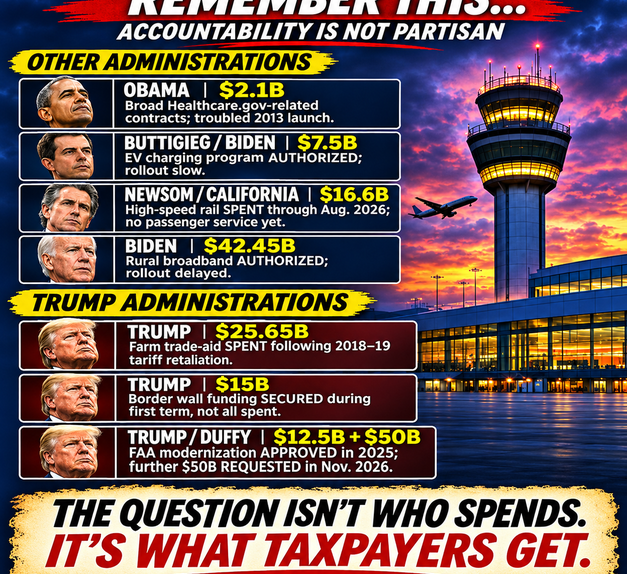
Look at the accompanying picture. It lists billions of dollars spent on government projects, many of which have become symbols of government incompetence, bureaucracy, political favoritism, and terrible management.
And then we have a Transportation Secretary asking Congress for another $30 billion to modernize our air traffic control system.
But before we start pointing fingers, let’s look at the actual numbers, because some of the claims in this picture are misleading, even though the underlying problems are very real.
THE OBAMACARE WEBSITE — $2.1 BILLION
Remember Healthcare.gov? When it launched in 2013, it was a technological disaster.
People couldn’t register. The system crashed. Applications failed. Millions of dollars were spent fixing problems that should have been identified before launch.
One analysis placed the cost of the website and related systems at approximately $2.1 billion, although the government’s narrower accounting was considerably lower.
Now, I’ve been working with computer systems, networks, databases, and business software for decades. 2 Billion for a website, were people should have been able to register. That is all it had to do. No Fancy medical advice.
Let me explain something. When you build a system for a customer, you establish requirements. You design it. You test it. You verify that it works. And then you deliver it.
If your customer is a grocery store and your point-of-sale system doesn’t work, they don’t care about your excuses. They want their registers working.
Healthcare.gov was eventually repaired, but its disastrous launch demonstrated what happens when enormous contracts, complicated management structures, and inadequate accountability come together.
And here’s my question. Who was held financially responsible for delivering a system that wasn’t ready?
THE ELECTRIC VEHICLE CHARGING PROGRAM — $7.5 BILLION
Under the Biden administration, Congress authorized approximately $7.5 billion to expand America’s electric vehicle charging infrastructure.
Sounds reasonable enough. You want electric vehicles? You need charging stations.
But the program became notorious for how slowly it produced results.
By 2024, only a handful of federally funded stations had opened under its principal deployment program.
The $8 billion was the overall multiyear funding authorization, not the amount paid to construct eight stations.
By June 2026, approximately 183 stations had opened under the main federal program.
Nevertheless, think about this. Congress approved billions in 2021. Five years later, the program was still struggling to deliver infrastructure at the scale originally envisioned.
How many businesses could survive if they operated that slowly?
And how much of the delay came from engineering challenges versus permitting, regulation, bureaucracy, and changing political priorities?
Those are the questions worth asking.
CALIFORNIA HIGH-SPEED RAIL — $16 BILLION
Now this one is a real masterpiece of government project management.
California voters approved a high-speed rail initiative in 2008.
The original vision was relatively straightforward. Build a high-speed passenger railroad connecting major California cities.
The project was originally promoted with an estimated construction cost of approximately $33 billion.
Fast-forward to 2026. More than $16 billion has been spent.
The estimated cost of the complete system has grown enormously, exceeding $100 billion in various projections. And not one paying passenger has taken a high-speed train on the system.
Now, to be fair, infrastructure has been constructed. Bridges, guideways, earthworks, and other facilities exist.
It isn’t literally nothing. But imagine explaining this to your banker.
You borrowed money to build a business. Eighteen years later, you’ve spent billions, you’re nowhere near delivering the original business plan, and you need significantly more money to finish. Do you think your banker would approve another loan?
And this project isn’t exclusively Gavin Newsom’s responsibility.
It began before he became governor. The real problem is the entire structure of government megaproject management.
Who establishes the original budget?
Who approves the changes?
Who is responsible when the promised delivery date keeps moving?
And at what point does somebody say that the original plan simply doesn’t make economic sense anymore?
RURAL BROADBAND — $42.45 BILLION
This is another example of a good objective becoming buried in bureaucracy.
Millions of rural Americans need better internet access.
I understand that problem. Broadband is essential infrastructure for modern business, education, healthcare, and communication.
Congress authorized $42.45 billion in 2021 to expand broadband access.
But the program spent years working through state plans, eligibility rules, environmental requirements, permitting, and administrative approvals.
By the time Biden left office, the major deployment program had not yet started connecting homes.
Actual BEAD-funded household connections finally began in 2026.
The entire authorized budget hadn’t been spent, and connections have now begun.
But the delay itself is a legitimate concern. After $43 billion was spent it is already obsolete. Consider what technology has done during those same five years.
Satellite internet has improved dramatically. Wireless technology has advanced. Fiber installation methods have evolved. Yet government programs can spend years deciding how to spend the money.
Sometimes the technology changes faster than Washington can complete the paperwork.
USAID — $273 BILLION
Now we are starting to talk real numbers, a quarter of trillion dollars and foreign aid is one of the most controversial categories of government spending.
The United States has distributed hundreds of billions of dollars in foreign assistance over the years. Some of that money has supported disaster relief, food assistance, disease prevention, and humanitarian emergencies.
Other programs have faced serious questions about effectiveness, oversight, political objectives, and whether American taxpayers should be financing them.
Around $273 billion was thrown away over ten years, mostly on countries and people that really do not appreciate it. On worthless ideas, much of it stolen in fraud. The spending magnitude is unbelievable.
So taxpayers have every right to ask: Why are we funding this program?
What is the objective?
Who benefits?
How much reaches the intended recipients?
How much goes to administration, contractors, consultants, and intermediaries?
And most importantly, what measurable results did we purchase?
Foreign aid should not be exempt from the standards we apply to domestic programs.
Neither should military expenditures, subsidies, government contracts, or infrastructure projects.
THE FAA — NOW ANOTHER $30 BILLION? OR $50 BILLION?
And that brings us to the point of this entire discussion.
America’s air traffic control system desperately needs modernization. Nobody who understands large computer networks should be surprised.
Much of the national aviation infrastructure was designed many decades ago. Much of the equipment has become obsolete. Systems have been patched, upgraded, modified, and patched again.
Hardware reaches the end of its useful life. Software becomes difficult to maintain. Communications systems become increasingly complicated as new technology is integrated with old systems. And eventually, something fails.
On November 13, 2026, a major nationwide air traffic control communications failure disrupted thousands of flights.
Transportation Secretary Sean Duffy has been asking for approximately $30 billion in additional aviation modernization funding.
Following the disruption, he publicly pushed for as much as $50 billion.
Congress had already provided $12.5 billion in 2025 for a new air traffic control modernization initiative.
Democratic lawmakers questioned the additional request, arguing that only about $1 billion of that earlier funding had actually been spent.
Duffy argues that much of the existing funding is already committed to specific projects and that a complete overhaul requires additional money.
Both questions deserve answers.
Does the FAA need modernization? Absolutely.
Does that automatically justify every dollar requested? Absolutely not.
In fact, the Government Accountability Office reported in September 2026 that the FAA had not developed a comprehensive, well-documented lifecycle cost estimate for its new modernization initiative.
Think about that.
We are discussing tens of billions of dollars, and the government still needs a complete accounting of what the entire project will cost over its lifetime.
Before Congress approves another enormous allocation, taxpayers deserve a clear project plan, realistic cost estimates, milestones, independent oversight, and measurable deliverables.
THE REAL PROBLEM — GOVERNMENT DOESN’T OPERATE LIKE A BUSINESS
I’ve spent much of my life working with businesses.
Small businesses, large businesses, computer systems, construction, and technology.
And there is one basic economic principle that applies to almost everything.
Resources are limited. Money is limited. Labor is limited. Time is limited.
When you spend money on one thing, you don’t have that money available for something else. That’s called opportunity cost.
In a private business, poor decisions have consequences.
If you continuously miss deadlines, exceed budgets, disappoint customers, and fail to deliver, eventually you lose business. You may lose your investors. You may lose your company.
Government operates differently.
When a project runs over budget, the agency frequently requests additional appropriations. When a project falls behind schedule, the deadline moves. When something fails, investigations begin.
And when elected officials change, responsibility is often shifted to the previous administration.
Sometimes additional spending is justified. Large infrastructure projects are complicated, and unforeseen problems happen.
But there must be a point where somebody is responsible for the outcome.
AND THIS IS WHERE POLITICS MAKES EVERYTHING WORSE.
Here is what bothers me most.
When Democrats propose a massive spending program, Republicans often call it wasteful.
When Republicans propose a massive spending program, Democrats often question its necessity.
Sometimes those criticisms are justified.
Sometimes they’re simply politics.
But why does the identity of the person spending the money matter more than the results?
A billion dollars doesn’t become more valuable because a Republican spent it.
And it doesn’t become less valuable because a Democrat spent it.
It is the same billion dollars. It comes from the same taxpayers. And it carries the same economic opportunity cost.
If a Republican wastes money, hold him accountable.
If a Democrat wastes money, hold him accountable.
If a government contractor fails to deliver, hold the contractor accountable.
And if an agency consistently cannot manage its projects, perhaps we should reconsider how that agency operates.
IT’S NOT ALWAYS THE CONTRACTORS — IT’S THE GOVERNMENT TOO
There’s something else people need to understand.
It’s not always contractors defrauding the government. Sometimes the government itself makes everything more expensive.
I’ve had several government contracts over the years, including a major IT contract with the U.S. Postal Service, work for the State of Florida, and various local governments back when I owned my computer company.
And I learned something very quickly. I had to charge government customers at least 30% more than private businesses just to cover the additional costs and risks.
Why? For starters, the government takes its time paying. Net 30 often means you’re lucky to get paid in 45 to 60 days. Meanwhile, you’re paying employees, buying equipment, and covering thousands of dollars in operating expenses out of your own pocket.
Then there are the contracts themselves. Government agencies can change their minds, modify requirements, or cancel projects after you’ve already committed substantial resources.
I remember one contract involving four truckloads of large mainframe computers. We were transporting equipment across the state when the government office changed its mind halfway through the job.
What started as a $20,000 contract suddenly became a $10,000 contract. And guess what? My expenses didn’t magically drop by 50%! and as a attorney told me, “What are you going to do sue the Federal government over $10,000
And that’s just the beginning. Government contracts come with additional specifications, paperwork, reporting requirements, compliance costs, and sometimes rules dictating how much you must pay your employees.
Then you have the politics, favoritism, and occasional corruption that can influence government procurement. All those things add costs that simply don’t exist, or exist to a much lesser degree, when doing business with private companies.
Here’s the point.
When you see the government paying 30%, 50%, or even more for something than a private company would pay, don’t automatically assume the contractor is getting rich or cheating the taxpayers. Sometimes that contractor is just trying to make enough profit to justify dealing with the government in the first place. The government frequently creates the very inefficiencies it later blames on private contractors.
And who ultimately pays for all of it?
We do. The taxpayers.
WHAT SHOULD WE DEMAND?
I would propose some basic rules.
Every major government project should have clearly defined objectives before funding is approved.
Every project should have a realistic initial budget, with independent estimates and contingency allowances.
Every project should have published milestones and completion dates.
Every dollar should be traceable from appropriation to actual expenditure.
Independent auditors should periodically evaluate financial performance and actual results.
Contractors should be paid according to enforceable agreements, with appropriate consequences for failures under their control.
Significant cost overruns should trigger mandatory independent reviews before additional funding is approved.
The public should be able to see what was promised, what was spent, what was delivered, and what remains unfinished.
And finally, before approving another multibillion-dollar project, Congress should review the performance of similar projects already funded.
Not to prevent government from investing.
But to make government accountable for its investments.
THE BOTTOM LINE
America needs infrastructure.
We need reliable air traffic control systems.
We need highways, bridges, airports, communications networks, energy infrastructure, and modern technology.
And yes, those things cost money.
The question isn’t whether we should spend money.
The question is whether we are purchasing something of value.
Because spending $10 billion doesn’t mean you accomplished $10 billion worth of work.
Announcing a program isn’t delivering a program.
Appropriating money isn’t the same as spending it.
And spending money isn’t the same as producing results.
Those are three very different things.
Government doesn’t create efficiency simply by writing bigger checks.
It creates results through good engineering, competent management, realistic budgets, and accountability.
And accountability cannot depend on which political party happens to control Washington.
The American taxpayer should demand the same thing from every administration.
Show us the money. Show us the work. Show us the results.
And stop treating government spending as a political football.
JUST THE NUMBERS
FAA Funding by Presidential Administration — 1997–2026
The Federal Aviation Administration has received hundreds of billions of dollars over the past 30 fiscal years, under both Republican and Democratic presidents.
For this comparison, I’m using total annual FAA appropriations, including air traffic control operations, airport improvements, facilities and equipment, and aviation research.
These are federal funding amounts, not necessarily money spent in the same year.
Important: The figures are in actual dollars at the time, without inflation adjustments. Extraordinary emergency funding is identified separately.
1. Annual FAA Funding — 30 Years
All amounts are in billions of dollars, rounded.
President
Fiscal year
FAA funding
Bill Clinton
1997
$8.56B
Bill Clinton
1998
$9.14B
Bill Clinton
1999
$9.81B
Bill Clinton
2000
$10.04B
George W. Bush
2001
$12.63B
George W. Bush
2002
$13.82B
George W. Bush
2003
$13.49B
George W. Bush
2004
$13.84B
George W. Bush
2005
$13.86B
George W. Bush
2006
$14.31B
George W. Bush
2007
$14.54B
George W. Bush
2008
$14.92B
Barack Obama
2009
$16.77B
Barack Obama
2010
$15.99B
Barack Obama
2011
$15.93B
Barack Obama
2012
$15.90B
Barack Obama
2013
$15.24B
Barack Obama
2014
$15.86B
Barack Obama
2015
$15.85B
Barack Obama
2016
$16.28B
Donald Trump — First term
2017
$16.41B
Donald Trump — First term
2018
$18.00B
Donald Trump — First term
2019
$17.45B
Donald Trump — First term
2020
$17.62B
Joe Biden
2021
$17.97B
Joe Biden
2022
$23.86B
Joe Biden
2023
$24.02B
Joe Biden
2024
$25.08B
Donald Trump — Second term
2025
$26.02B
Donald Trump — Second term
2026
$27.21B
How the presidents are assigned: Fiscal years are grouped into conventional four- or eight-year presidential blocks. Because federal fiscal years begin October 1, some budgets were negotiated or enacted under the preceding administration. For example, FY2021 is grouped under Biden even though much of its regular funding was enacted under Trump.
2. Total FAA Funding by Presidential Administration
Administration
Years
Total funding
Annual average
Bill Clinton
4
$37.55B
$9.39B
George W. Bush
8
$111.41B
$13.93B
Barack Obama
8
$127.82B
$15.98B
Donald Trump — First term
4
$69.48B
$17.37B
Joe Biden
4
$90.92B
$22.73B
Donald Trump — Second term
2
$53.22B
$26.61B
TOTAL
30
$490.40B
$16.35B
These are approximate totals calculated from the annual funding figures above.
The principal sources for the historical comparison are:
Congressional Research Service, FAA funding history for FY2001–FY2007. Every CRS Report
Department of Transportation, historical funding levels for FY2005–FY2014. GovInfo
Congressional Research Service, FAA appropriations for FY2012–FY2017. Every CRS Report
Congressional Research Service, FY2018–FY2023 funding. Every CRS Report
Congressional Research Service, FY2022–FY2026 enacted funding. Every CRS Report
3. Important: Additional FAA Funding
The $490.4 billion comparison excludes some extraordinary appropriations.
Most significantly:
COVID-19 airport assistance: Congress provided approximately $20 billion in emergency assistance to airports in 2020 and 2021. This is excluded from the standard funding totals above.
2025 air traffic control modernization: Congress separately appropriated approximately $12.5 billion for air traffic control improvements in July 2025.
Adding that $12.5 billion to the FY2025 regular FAA funding figure would bring that year’s funding to approximately $38.54 billion. Every CRS Report
4. What About Actual Air Traffic Control Modernization?
This is an important distinction in evaluating the current request for additional FAA funding.
The FAA’s total budget is not exclusively used for air traffic control technology.
It includes controller salaries, aviation safety inspections, airports, infrastructure, administration, research, and other responsibilities.
The Facilities and Equipment (F&E) account is particularly relevant because it funds much of the FAA’s modernization work.
Fiscal year
Facilities & Equipment funding
2018
$3.25B
2019
$3.00B
2020
$3.05B
2021
$3.02B
2022
$2.89B
2023
$2.95B
2024
$3.19B
2025
$3.18B
2026
$4.00B
Total
$28.53B
These are regular F&E appropriations, excluding the separate $12.5 billion modernization allocation. Every CRS Report
What the figures tell us
Over 30 fiscal years, approximately $490 billion in regular and infrastructure-related FAA funding was provided.
Between 2018 and 2026 alone, approximately $28.5 billion was allocated to Facilities and Equipment, with additional funding provided for air traffic control through other FAA accounts.
However, these figures do not establish how much was specifically spent replacing obsolete radar, communications, automation, and other air traffic control systems.
The central question for evaluating Duffy’s additional modernization request is this:
After decades of FAA funding, how much was specifically allocated to modernizing the national air traffic control system, how much was actually spent, and what equipment or systems were delivered?