Think of it as Yoga for the brain, we are going to stretch a bit.
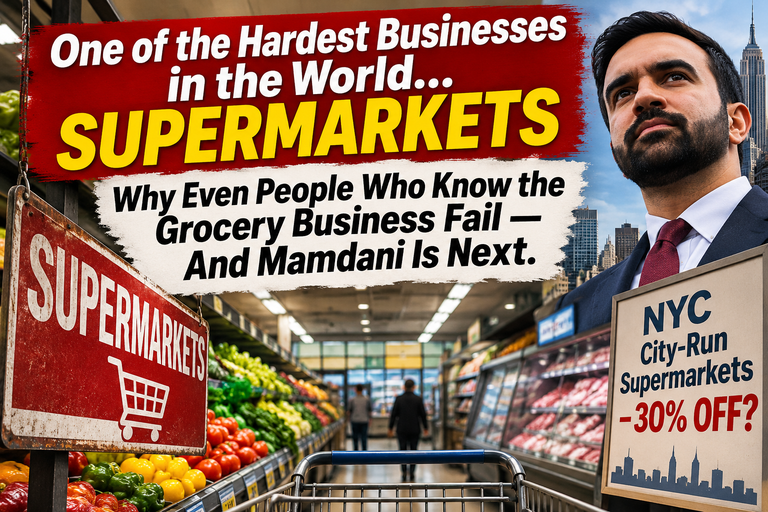
The Hardest Business in the World — Supermarkets – Even People Who Know the Business Fail — Mamdani is Next
Anybody can sell groceries below cost. The real talent is selling them at a price that keeps the doors open. And when politicians confuse subsidies with profits, it's usually the taxpayer who ends up paying the difference. --- YNOT!
Let me tell you a little story about business, economics, supermarkets, and why politicians who have never operated a business should be very careful about promising to run one.
Many decades ago, I was in the business of installing point-of-sale systems. POS systems, as we called them. The computers, cash registers, inventory systems, and software that businesses use to keep track of what they sell, what they buy, and hopefully, what they make. We had some friends who owned a chain of grocery stores, and we installed a system for them.
The owner was an older Cuban gentleman who had come to America with practically nothing. He started with one little grocery store. Then he opened another. Then a third. Eventually, he owned a substantial chain of supermarkets that you would probably recognized today.
I spent a lot of time talking to this gentleman, learning how his business worked, and understanding something that most people, particularly politicians, don’t seem to understand.
THE DIFFERENCE BETWEEN OWNING A BUSINESS AND MAKING MONEY
This gentleman wasn’t rich when he owned his first grocery store. He wasn’t particularly rich when he owned his second or third, either. In fact, as he explained to me, it wasn’t until he owned perhaps ten or twenty stores that he really started accumulating substantial wealth.
Why?
Because owning one grocery store is often more like buying yourself a job than buying yourself an investment.
You put up a substantial amount of money. You borrow money. You buy equipment, refrigeration, inventory, cash registers, shelving, and everything else.
Then you work. And work. And work some more. Seven days a week. Twelve hours a day.
You might make a decent living. But when you calculate the hours you work, the capital you have invested, and the risks you take, your return isn’t necessarily very impressive.
It’s much the same with owning one McDonald’s, Burger King, or other small franchise.
People see a business doing millions of dollars in annual sales and assume the owner must be rich. But revenue isn’t profit. And profit isn’t necessarily a good return on your investment.
Let’s say you invest $2 million in a business, work sixty or seventy hours a week, and make $100,000 a year.
Sounds pretty good, right?
Except that’s only a 5% annual return on your invested capital before considering the value of your own labor, assuming that $100,000 is your entire economic return.
You might have made more money working for somebody else and investing your capital somewhere else. And you probably would have slept better.
But something interesting happens when you own ten or twenty stores.
THE MAGIC OF ECONOMIES OF SCALE
Let’s assume each store produces $100,000 a year in net profit.
One store: $100,000.
Five stores: $500,000.
Ten stores: $1 million.
Twenty stores: $2 million.
Of course, those are simplified numbers. Real businesses have debt, taxes, corporate overhead, capital expenditures, and other expenses.
But here’s where the real money starts. With ten or twenty stores, you can negotiate better prices from suppliers. You can buy truckloads of products instead of cases. You can have centralized purchasing. You can operate your own warehouses. You can spread accounting, technology, advertising, management, and administrative expenses across multiple locations. You can hire people who specialize in inventory, logistics, pricing, and operations. And instead of personally running a grocery store twelve hours a day, you’re running a company that owns grocery stores.
That’s an entirely different business.
That’s how my Cuban friend built his wealth. He had 4 sons. they are ran a store, then managed a part of the business. Eventually the wives and grandchildren all work in the business, which meant control.
But you don’t make money be by selling expensive milk or charging outrageous prices for eggs. But by understanding the business, working incredibly hard, controlling costs, and gradually building economies of scale.
And even then, he was operating in one of the most difficult industries imaginable.
MY FIRST BUSINESS WAS SELLING HOT DOGS
Now, I learned some of these lessons myself. One of my first businesses was operating hot-dog stands. Sounds simple, doesn’t it?
Buy hot dogs. Buy buns. Heat them up. Sell them. Collect money. Get rich! Well, not exactly.
I discovered very quickly that the hot dog itself was only one little part of the business.
You had buns that went stale. Hot dogs that spoiled. Condiments that disappeared. Equipment that broke. Licenses. Employees who didn’t show up or worse who stole.
Rainy days. Slow days. And, of course, the wonderful experience of throwing away food that you had already paid for.
That last one taught me a particularly valuable lesson.
You can make a very good profit selling a hot dog. But if you buy a hundred hot dogs and only sell sixty, the economics change dramatically. And the same thing happens in a supermarket.
Only instead of throwing away fifty dollars worth of hot dogs and buns, you might be throwing away thousands of dollars worth of meat, produce, bread, dairy products, and prepared foods.
Every single day.
WELCOME TO THE SUPERMARKET BUSINESS
Here’s something most consumers don’t understand.
Supermarkets operate on extraordinarily thin net profit margins.
According to the Food Industry Association, the average net profit margin for food retailers in 2025 was approximately 2.1%.
Think about that. For every $100 worth of groceries sold, the business keeps approximately $2.10 in net profit. The other $97.90 goes toward merchandise, payroll, rent, utilities, insurance, transportation, refrigeration, security, maintenance, and all the other costs of operating the business.
And remember, that’s an industry average. Some stores do better. Others lose money.
Let’s look at a simplified example. A supermarket sells $20 million worth of groceries annually. At a 2.1% net profit margin, it earns $420,000. That sounds like a lot of money.
Until you realize how much capital and operational risk is involved in generating those sales. Now suppose the store experiences an additional $300,000 in annual losses from spoilage, theft, higher labor expenses, or refrigeration problems.
Its profit drops from $420,000 to $120,000.
One more substantial expense, and suddenly that profitable supermarket is losing money.
That’s how thin the margins can be.
And that’s why people who have spent their entire lives in this business sometimes fail.
THE SUPERMARKET PROFIT MARGIN TRAP
Now, not every product in a supermarket has the same profit margin.
This is important. There is a huge difference between gross profit and net profit.
Gross profit is what remains after subtracting the cost of the merchandise sold.
Net profit is what’s left after paying the other expenses of operating the business.
Here are some representative historical gross profit margins by supermarket department, based on the 2020 National Grocers Association independent-grocer financial survey.
Department
Gross Margin
Grocery Products
24.7%
Dairy
25.4%
Frozen Foods
30.0%
Produce
30.8%
Fresh Meat
26.4%
Seafood
24.2%
Bakery
43.9%
Deli
44.6%
Floral
32.6%
General Merchandise
28.7%
Health and Beauty
22.6%
Total Store Gross Margin
28.9%
These are historical averages, not current margins or guaranteed profits. Individual products and stores vary considerably.
Notice something interesting. The deli and bakery departments can have relatively high gross margins.
Why?
Because you’re not just selling raw ingredients. You’re selling preparation, convenience, labor, and service. But those departments also require employees, equipment, refrigeration, preparation space, and additional waste. Most of the time they are selling food that was going to waste anyway. Yes, they recycle the food that was going to be thrown away. That is why every supermarket has a cafeteria.
A 44% gross margin certainly doesn’t mean a 44% net profit.
Meanwhile, competitive staples such as milk, eggs, bread, and certain advertised products may be sold at particularly low margins to attract customers.
The idea is simple. Get the customer into the store for the milk.
Hopefully, they’ll also buy a sandwich, some prepared food, a birthday cake, or something else that contributes more to your profitability.
That’s the business. And it takes experience to understand how all those departments interact.
FOOD IS A TERRIBLE PRODUCT TO SELL
Now, let me explain why I consider food one of the most difficult products in the world to sell.
First, food is largely a commodity.
You cannot sell the same ordinary steak for $15 a pound when the supermarket across the street sells it for $8, unless you offer customers some compelling reason to pay more.
Second, food is perishable.
You cannot put a piece of fresh fish on the shelf and wait six months for somebody to buy it.
Third, food requires specialized handling.
Refrigeration. Freezers. Sanitation. Temperature monitoring. Transportation. Food safety inspections.
Fourth, food requires constant replenishment.
Every day, trucks arrive. Employees unload them. Products get checked. Shelves get stocked. Old inventory gets rotated. Expired inventory gets discarded.
Fifth, inventory losses are unavoidable.
Food spoils. Packaging gets damaged. Customers break things. Employees make mistakes. People steal.
And every one of those losses comes directly out of your already tiny profit margin.
Now add New York City expenses. High labor costs. Expensive utilities. Real estate. Insurance. Security. Regulatory compliance.
And suddenly, operating a supermarket becomes an extraordinarily challenging undertaking.
SO WHY AM I TELLING YOU ALL THIS?
Because New York City’s mayor, Zohran Mamdani, believes the city government can operate a network of supermarkets that will substantially undercut existing grocery prices.
And this is where economics meets politics.
Mamdani’s administration has committed $70 million in capital funding to develop five municipal supermarkets.
One in each borough. The city will provide the facilities and cover major property and construction expenses.
Experienced private operators will actually manage the stores under city-imposed requirements.
And the administration has promised that a selected basket of products, including fresh produce, meat, seafood, and certain everyday staples, will be priced approximately 30% below average market prices.
The administration estimates that shoppers could save approximately 15% on their overall grocery bills, or around $1,000 annually.
Sounds wonderful. Who wouldn’t want cheaper groceries?
But here’s my question.
WHO IS ACTUALLY PAYING FOR THE DISCOUNT?
Let’s examine the economics.
If a private supermarket sells an item for $10, and the city-backed store sells an equivalent item for $7, the customer saves $3. Great!
But the cost of acquiring, transporting, storing, displaying, and selling that product doesn’t magically disappear.
Some costs may be reduced through better purchasing or more efficient operations.
But if the city eliminates rent and certain property expenses, those costs haven’t necessarily disappeared either.
They have simply been transferred. The taxpayer now pays them.
That’s not automatically wrong. Governments subsidize all sorts of public services.
But let’s call it what it is. A publicly subsidized grocery operation.
And if the purpose is to make food affordable for struggling families, we should ask whether this is the most efficient way to accomplish that objective.
Consider another problem. The city is proposing discounts that, for some products, could be larger than the supermarket’s entire gross margin.
Take a product normally selling for $10. Suppose its wholesale cost is $7.50.
The private supermarket has a 25% gross margin. Now sell that same product for $7.
You’re losing fifty cents before paying the employees, electricity, insurance, or anything else. Of course, not every product has that exact cost structure, and the city may negotiate different purchasing terms.
But this is precisely why a 30% discount requires more explanation than a political speech.
You need a detailed operating model. You need purchasing contracts. You need projected sales volume. You need inventory costs. You need spoilage estimates.
And, most importantly, you need to know who covers the losses if the projected savings don’t materialize.
AMAZON COULDN’T MAKE ITS STORES WORK
Here’s another fascinating part of the story. Amazon.
One of the largest and most technologically sophisticated companies in the world.
Amazon has enormous purchasing power, sophisticated logistics, tremendous capital, and access to some of the most advanced inventory and retail technology ever developed.
Its overall grocery business generates more than $150 billion in annual gross sales.
And in January 2026, Amazon announced that it was closing its Amazon Fresh and Amazon Go physical stores.0
Why?
Because the company concluded that those formats had not developed the customer experience and economic model necessary for large-scale expansion.
Amazon didn’t abandon groceries.0 Far from it.
It continues operating Whole Foods, expanding grocery delivery, and investing in successful formats. But it abandoned those particular store concepts.
Think about that. A company with extraordinary logistical capabilities and virtually unlimited access to sophisticated technology decided that certain grocery-store business models simply weren’t worth continuing.
Now, that doesn’t prove government-supported supermarkets cannot succeed. The customers, locations, financial objectives, and operating arrangements may be different.
But it certainly demonstrates something important.
Even Amazon cannot overcome bad retail economics simply by throwing money and technology at the problem.
And now New York City wants to demonstrate that it can operate a different model successfully.
Good luck.
KANSAS CITY ALREADY LEARNED AN EXPENSIVE LESSON
We don’t have to rely entirely on theory.
Kansas City, Missouri, invested approximately $17 million to redevelop a shopping center and establish a grocery store serving an underserved neighborhood.
The Sun Fresh supermarket opened in 2018. The project had a legitimate objective.
Provide affordable, accessible groceries to people who didn’t have good shopping options.
But the business struggled. There were reports of crime. Security problems. Declining customer traffic. Empty shelves. Financial losses. And additional taxpayer support.
In August 2025, the supermarket closed.
Nearly $18 million in municipal investment had failed to keep that grocery operation functioning.
The location eventually reopened in 2026 under a different operator, United Market, which has reported stronger customer traffic.
That’s an important distinction. The original operation failed, but the new operation is showing that a publicly supported location isn’t necessarily doomed.
What failed was a particular combination of management, market conditions, security, and economics.
And that should be a warning to New York. Government funding does not guarantee commercial success. Neither does having a worthwhile social objective.
A supermarket still has to be operated competently.
WHY THE EXISTING GROCERS ARE ANGRY
Now, here’s the part that really bothers me.
Remember that Cuban gentleman I told you about?
He came to America with nothing. He worked his way up. He invested his own money. He borrowed money. He took risks. He hired employees. He paid rent, taxes, insurance, and utilities. He competed against other businesses. And eventually, after years of hard work, he built something substantial.
New York City has hundreds of independent supermarkets and bodegas owned by immigrants and small-business entrepreneurs who have followed similar paths.
Many are family businesses. Some have been operating for generations. Now the government wants to open competing stores that receive financial support unavailable to those same businesses. The city-backed operator won’t face the same property and capital expenses as an ordinary private supermarket.
And that’s creating a very legitimate concern.
In September 2026, the National Supermarket Association, representing approximately 450 independent grocery stores, joined litigation challenging the city’s proposed grocery program.
The grocery owners argue that government subsidies will create unfair competition.
Mamdani’s administration disagrees, arguing that the initiative can coexist with private grocers and provide meaningful relief to consumers.
But let’s look at the pote0ntial consequences. Suppose a family-owned supermarket makes $150,000 a year. A city-subsidized competitor opens nearby.
Customers begin shopping at the government-backed store because certain products are substantially cheaper. The independent supermarket loses sales. But its rent doesn’t go down. Its insurance doesn’t go down. Its refrigeration costs don’t disappear. And its employees still have to be paid. Eventually, its business may become unprofitable.
It closes. And then what?
The government-backed operation might remain, but it could also require continuing subsidies. So taxpayers could end up supporting one store while helping drive another taxpaying business out of the neighborhood. That outcome is not inevitable, but it’s a risk policymakers must examine carefully.
And if it happens, what have we actually accomplished?
THE PROBLEM WITH POLITICIANS RUNNING BUSINESSES
I have nothing against helping people afford groceries.
In fact, I think it’s an excellent objective. Food is essential.
Families should have access to affordable, nutritious food.
But understanding a problem isn’t the same thing as understanding how to solve it.
And promising lower prices isn’t the same thing as creating the economic conditions that make lower prices sustainable.
A politician can announce a 30% discount. A business owner has to figure out how to pay for it.
A politician can promise better wages. A business owner has to produce enough revenue to cover payroll.
A politician can announce a new store. A business owner has to find customers, manage inventory, control expenses, and keep that store operating year after year.
And here’s a particularly important difference. When a private business fails, investors and creditors generally bear much of the financial loss.
When a government-funded operation loses money, taxpayers may be asked to cover the shortfall.
That changes the incentives.
There’s another problem.
A mayor is elected for a limited term. A supermarket needs to survive indefinitely.
The first of Mamdani’s municipal supermarkets is currently scheduled to open in 2027.
The East Harlem location is planned for 2029. His administration says all five will open by the end of his first term. But what happens after that?
What happens if the supermarkets require another $20 million? Or $50 million?
What happens when the next mayor takes office? Does the city continue the subsidies?
Does it raise prices?
Does it close stores?
Does it sell the properties?
These are the questions taxpayers should be asking before the money gets spent.
THERE ARE BETTER WAYS TO HELP PEOPLE BUY FOOD
Here’s something else worth considering.
Instead of competing directly against independent grocers, why not help those grocers reduce their operating costs?
Reduce unnecessary regulations.
Make it easier to open and expand stores.
Improve neighborhood security.
Reduce permitting delays.
Encourage competition among wholesalers.
Help existing independent supermarkets develop purchasing cooperatives.
Improve transportation and distribution.
Target food assistance directly toward families who need it.
Encourage investment in neighborhoods that don’t have enough grocery stores.
In fact, Mamdani’s administration has also expanded programs that work with existing supermarkets, including Get the Good Stuff, which provides matching benefits to eligible SNAP shoppers purchasing fruits and vegetables.
That approach deserves attention. Rather than spending millions constructing competing stores, the city can use existing private retail infrastructure to deliver targeted food assistance. The private business continues operating.
The customer receives additional purchasing power. And the taxpayer can evaluate the cost of the assistance directly. It may not be the best answer in every neighborhood, but it is certainly an alternative worth comparing against building a new municipal grocery network.
THE BIGGER ECONOMIC LESSON
I go back to my Cuban friend. He didn’t become successful because somebody handed him millions of dollars. He became successful because he learned a business that most people don’t understand.
He learned how to buy. How to sell. How to negotiate. How to control inventory.
How to manage employees. How to expand. And, perhaps most importantly, how to survive when things went wrong.
He understood something that I learned operating my little hot-dog business.
It doesn’t matter how much money you collect at the register.
What matters is how much you have left after paying everybody and everything.
And then you have to ask whether that return justified the money, labor, and risk you invested.
That’s the real lesson of business. Not revenue. Not political promises. Not slogans about helping people.
Economics.
SO WILL MAMDANI’S SUPERMARKETS FAIL?
I can’t tell you that they will. Nobody can honestly make that prediction with certainty before the first store has even opened.
New York has substantial purchasing power, existing public property, access to experienced grocery operators, and the ability to subsidize costs.
Those advantages could help the program achieve its goals.
But here’s what I can tell you. The supermarket business is exceptionally difficult.
Experienced operators fail. Large corporations fail. Well-financed chains fail.
And public subsidies do not eliminate the underlying costs of selling groceries.
Mamdani’s program will need to demonstrate not simply that it can sell groceries at a discount, but that the benefits to consumers justify the total public cost without causing unacceptable damage to existing businesses.
If the five stores succeed, show us the numbers. If they lose money, show us the numbers.
If shoppers save $1,000 annually, show us how much taxpayers spent to generate those savings.
And if nearby independent supermarkets lose business, include that in the analysis too.
Because there is nothing wrong with wanting to help people. But good intentions don’t balance a cash register.
AND HERE’S MY FINAL THOUGHT
That Cuban gentleman spent years building a grocery business.
He worked extraordinarily hard. He risked his own money. And he learned the business one store at a time.
I learned some of the same lessons selling hot dogs. Some days you made money.
Some days you threw away the profits. And some days you wondered why you ever got into the business in the first place.
Now imagine somebody walks into your store, looks around for fifteen minutes, and announces: “I’ve never operated a supermarket, but I know how to do it better. And I’m going to sell everything cheaper.”
You would probably laugh. Unless that person was the mayor.
And unless he was planning to use your tax money to prove it.
Financial examples are illustrative. Gross and net margins vary by product, operator, location, and year. The municipal grocery program is a developing initiative; its future financial performance is not yet established.