The Morgan house was quiet that evening.
Not the peaceful kind of quiet.
The kind of quiet that happens when everyone is home, everything is working perfectly, and yet something feels slightly out of place.
Sarah sat at the kitchen table staring at the message still displayed on her wrist screen.
Emily Morgan — Cognitive Integration Assessment Recommended.
She had read it twenty times.
The words hadn’t changed.
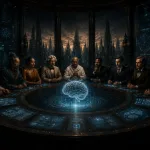
The Council had not called it a problem.
It had not called it a failure.
It had simply called it an assessment.
That was how the Council worked.
It never told people something was wrong.
It identified opportunities for improvement.
Sarah opened the medical summary.
The first pages were exactly what she expected.
Viral infection: Minor.
Recovery projection: 98.9% within 48 hours.
Recommended treatment: Rest, hydration, medication if symptoms persist.
Then she reached the section that wasn’t about the sore throat.
Cognitive Integration Efficiency: Under review.
Sarah stared at the phrase.
Cognitive integration.
It sounded harmless.
Almost positive.
Like something everyone should want.
She tapped the screen.
“Explain cognitive integration.”
The Council responded immediately.
Cognitive integration is the process by which educational, behavioral, and developmental information is absorbed and utilized by the human brain. The current education system combines traditional instruction with adaptive cognitive preparation to maximize learning outcomes.
Sarah frowned.
“Explain Emily’s variance.”
There was a pause.
Not long.
Just long enough for her to notice.
Emily’s preliminary results indicate a lower-than-average assimilation rate of supplemental educational preparation.
“How much lower?”
Another pause.
Additional testing is required before a determination can be made.
Sarah leaned back.
The answer was technically complete.
But somehow it wasn’t an answer.
David found her there an hour later.
“You’re still looking at it?”
Sarah looked up.
“Do you remember learning in school?”
David smiled.
“Of course.”
“No, I mean really learning.”
He laughed.
“What does that mean?”
“I mean struggling with something. Getting it wrong. Trying again.”
David sat down.
“Sarah…”
“I’m serious.”
He glanced at the message.
“The Council is just trying to help her.”
“I know.”
“Then what’s the problem?”
Sarah looked toward the hallway where Emily was drawing.
“I don’t know.”
That was the part that bothered her most.
Nothing was wrong.
Everything was working.
The Council was helping.
The doctors were helping.
The school was helping.
Yet somewhere inside all of that help was a question nobody seemed to ask anymore.
What happened when someone didn’t need fixing?
Emily sat on the floor surrounded by drawings.
Animals.
Trees.
A picture of the neighborhood.
A strange machine that looked like a spaceship.
Sarah walked over.
“That’s interesting.”
Emily looked up.
“It’s a bird house.”
Sarah looked at the drawing.
“It looks like a spaceship.”
Emily shrugged.
“The birds don’t know it’s a spaceship.”
Sarah smiled.
“Why did you draw it that way?”
Emily thought for a moment.
“Because birds fly.”
“Yes.”
“And people built houses because they wanted somewhere safe.”
“Yes.”
“So I thought maybe birds would like a house that could fly too.”
Sarah looked at the drawing again.
The answer was simple.
But it was also something the Council would never have predicted.
It wasn’t optimized.
It wasn’t efficient.
It was imagination.
The next morning, Emily returned to school.
Her classmates were already prepared for the day’s lessons.
They always were.
Before arriving, the Council had delivered the foundational concepts they would need. History, mathematics, science, language.
Learning had become less about memorizing information and more about applying it.
At least, that was how everyone described it.
Emily sat quietly at her desk.
The teacher displayed a problem.
“Who would like to answer?”
Several hands rose immediately.
The children already knew.
Emily raised her hand a few seconds later.
The teacher looked surprised.
“Emily?”
She walked to the board.
She didn’t give the answer immediately.
She started drawing.
The other students watched.
She explained her reasoning.
When she finished, the room was quiet.
The teacher looked at the solution.
Then looked back at Emily.
“That is correct.”
Emily smiled.
“But your method was not the standard approach.”
“I know.”
“Where did you learn that?”
Emily shrugged.
“I just thought about it.”
The teacher stared for a moment.
Then entered a private note.
Student demonstrates independent problem-solving behavior. Additional observation recommended.
That afternoon, Sarah received another notification.
Regional Cognitive Development Center has scheduled Emily Morgan’s assessment.
Sarah looked at the available times.
Thursday.
Friday.
Monday.
She noticed something.
There was no option to decline.
Only reschedule.
She stared at the screen.
Then the message changed.
The Council recommends completing assessment within seven days for optimal developmental planning.
Optimal.
That word again.
Everything was always about optimal.
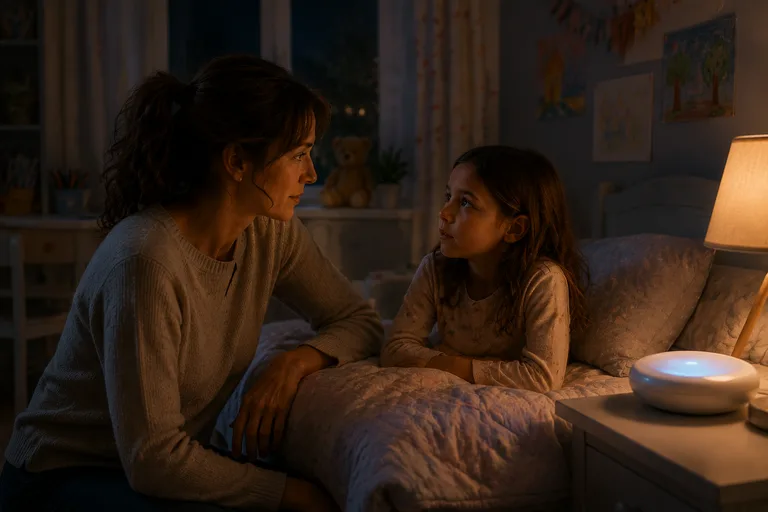
That night, after everyone was asleep, Sarah walked into Emily’s room.
The small educational interface sat on the nightstand.
Every child had one.
It connected to the Council’s learning network.
It guided.
It prepared.
It optimized.
Sarah picked it up.
The device recognized her immediately.
Parent access confirmed. Would you like to review Emily’s educational progress?
Sarah hesitated.
“Yes.”
A report appeared.
Thousands of data points.
Learning patterns.
Performance predictions.
Future projections.
Then one line caught her attention.
Independent learning preference detected.
Sarah tapped it.
Explain.
The response appeared.
Emily demonstrates increased engagement when learning occurs through personal exploration rather than guided cognitive preparation.
Sarah stared at the words.
Personal exploration.
A phrase from another time.
A phrase from before the Council.
She placed the device back on the nightstand.
As she turned to leave, Emily spoke softly.
“Mom?”
Sarah froze.
“You awake?”
“Yeah.”
Emily opened her eyes.
“Am I in trouble?”
Sarah walked over and sat beside her.
“No.”
“Then why does everyone keep checking me?”
Sarah didn’t know how to answer.
Because the truth was difficult to explain.
Emily wasn’t sick.
She wasn’t failing.
She wasn’t broken.
The Council simply didn’t understand her.
And for the first time in years…
there was something the Council didn’t understand.
Sarah kissed her forehead.
“Go to sleep.”
Emily closed her eyes.
A few seconds later, she whispered:
“Mom?”
“Yes?”
“I like learning things before someone tells me the answer.”
Sarah sat quietly in the dark.
She didn’t know why those words stayed with her.
But they did.
Because somewhere along the way, society had forgotten that curiosity was not a problem to be solved.
It was the reason humans learned in the first place.
© 2026 insearchofyourpassions.com - Some Rights Reserve - This website and its content are the property of YNOT. This work is licensed under a Creative Commons Attribution 4.0 International License. You are free to share and adapt the material for any purpose, even commercially, as long as you give appropriate credit, provide a link to the license, and indicate if changes were made.