Think of it as Yoga for the brain, we are going to stretch a bit.
Che Guevara: Revolutionary Soldier, Executioner, Architect of Violence and Death
Ernesto “Che” Guevara is often presented as a romantic rebel: the bearded doctor who abandoned comfort to fight injustice, became a commander in the Cuban Revolution, and died attempting to spread revolution abroad.
That image leaves out the central fact of his adult life.
Che Guevara was a professional revolutionary who believed political violence was not merely unavoidable but necessary. He fought as a guerrilla commander, imposed severe discipline on his own men, participated in executions during the insurgency, supervised revolutionary tribunals after victory, and spent his final years trying to create new wars in Africa and Latin America.
He was a physician by training, but soldiering became his vocation.
From Medical Student to Marxist Revolutionary
Ernesto Guevara was born in Rosario, Argentina, on June 14, 1928. He studied medicine at the University of Buenos Aires and traveled extensively through Latin America as a young man.
Those travels exposed him to poverty, inequality, political instability, and foreign economic influence. He increasingly interpreted Latin America through Marxist ideas, concluding that existing governments and institutions could not be reformed gradually. In his view, they had to be overthrown through armed revolution.
A decisive experience came in Guatemala in 1954, when the government of Jacobo Árbenz was overthrown after a CIA-backed intervention. Guevara emerged from Guatemala convinced that revolutionary governments could survive only if they destroyed their enemies, armed their supporters, and resisted compromise.
This lesson shaped everything that followed.
He did not become a democratic socialist or a reformer.
He became an advocate of revolutionary warfare.
Joining Fidel Castro
In Mexico City in 1955, Guevara met Fidel Castro and joined the July 26 Movement, which was preparing an armed expedition against Cuban dictator Fulgencio Batista.
Che originally joined as the group’s doctor. After the rebels landed in Cuba aboard the Granma in December 1956 and were nearly annihilated, the survivors retreated into the Sierra Maestra.
There, Guevara ceased functioning primarily as a physician and became a combatant.
He later described the symbolic moment when, under fire, he chose a box of ammunition over a medical bag. Whether treated literally or as personal mythology, the story captures the identity he adopted: he was no longer simply a doctor accompanying soldiers. He had chosen to become a revolutionary soldier.
Che proved disciplined, physically courageous, intellectually committed, and ruthless. Castro promoted him to comandante, the highest field rank in the rebel army.
Discipline Through Fear
Che’s guerrilla command was not democratic.
He believed a revolutionary army required absolute discipline. Desertion, betrayal, theft, disobedience, and collaboration with the enemy could be punished severely, including by death.
The best-documented personal execution occurred during the Sierra Maestra campaign. A peasant guide and rebel informant named Eutimio Guerra was accused of betraying rebel positions to Batista’s forces. Guevara wrote in his own account that he shot Guerra in the head.
This matters because it removes any argument that Che was only an administrator who never personally killed prisoners.
He personally carried out at least one documented execution.
Other killings attributed directly to him remain disputed or are based on testimony that is harder to verify. It is therefore more accurate to say that the documentary record conclusively establishes his personal execution of Guerra, while broader claims about large numbers personally shot by Che are not supported with the same certainty.
What is not disputed is that Che accepted execution as a legitimate instrument of revolutionary command.
A Guerrilla Commander in Cuba
Che became one of the revolution’s most important field commanders. His column conducted ambushes, sabotage, raids, forced marches, and attacks against government positions.
His most celebrated military operation came during the final rebel offensive in 1958. Che led Column 8 from the Sierra Maestra toward central Cuba, establishing operations in the Escambray region and advancing toward Santa Clara.
In December 1958, rebel forces attacked Santa Clara, a strategically important city. Che’s fighters helped derail an armored train carrying soldiers, weapons, and supplies. The collapse of government resistance in Santa Clara contributed to Batista’s decision to flee Cuba on January 1, 1959.
The victory transformed Che from guerrilla commander into one of the new regime’s most powerful men. It also gave him control over prisoners and defeated enemies.
La Cabaña and the Revolutionary Tribunals
After Batista fled, Che was placed in command of La Cabaña fortress in Havana.
The fortress became one of the principal locations for revolutionary imprisonment, trials, and executions during the first months of 1959.
Che’s responsibility was not incidental. He supervised the prison, oversaw the revolutionary tribunal system operating there, reviewed appeals, and held authority within a process that regularly imposed death sentences.
The defendants included members of Batista’s military, police officers, alleged torturers, informants, political enemies, and others accused of crimes against the revolutionary movement. But it included many others that simply disagree with the new regime.
The tribunals frequently lacked the safeguards expected in an independent judicial system. They were military proceedings conducted by the victorious revolutionary forces. Judges were aligned with the new government. Trials could be rapid. Political pressure was intense. Appeals ultimately passed through revolutionary authorities rather than an independent judiciary.
Contemporary reporting described hundreds of executions across Cuba during the opening months of the new regime. TIME reported in January 1959 that more than 200 men had already been executed after summary revolutionary trials.
Estimates of the number executed specifically under Che’s jurisdiction at La Cabaña vary substantially. Published estimates commonly range from approximately 55 to more than 100, depending on how researchers define his period of command and whether they count sentences approved under his authority but carried out in his absence.
Claims that Che personally shot 175 prisoners at La Cabaña, or personally executed 23 at Santa Clara and 14 in the Sierra Maestra, require stronger documentation than is usually supplied with those figures. His direct responsibility for supervising and approving executions is well established; precise claims that he personally fired the weapon in dozens or hundreds of cases are much harder to substantiate.
Was It Justice or Murder?
Supporters call the La Cabaña executions revolutionary justice.
They argue that Batista’s police and military had tortured and killed Cubans, that the public demanded punishment, and that the revolutionary government was prosecuting war criminals whom the previous system would never have punished.
That explanation provides historical context, but it does not erase the nature of the system Che administered.
The revolutionary government acted simultaneously as accuser, prosecutor, judge, appellate authority, and executioner.
The outcome was often decided by men whose stated mission was not impartial justice but the consolidation and defense of the revolution.
Che was not troubled by this conflict.
He openly defended firing squads as necessary. He regarded opposition to the revolution not simply as political disagreement but as participation in a struggle in which one side had to defeat and eliminate the other.
In a revolutionary system, the distinction between a genuine war criminal and a political enemy can disappear very quickly. Che helped create precisely that kind of system.
Whether every condemned man was innocent is not the relevant question. Many may have been guilty of serious abuses. The central problem is that guilt and punishment were determined through a politicized process controlled by the victorious armed movement.
Che knowingly participated in, ordered, approved, and defended lethal political violence outside the standards of an independent civil judiciary.
Violence as Revolutionary Purification
Che did not regard violence as a regrettable temporary measure.
It occupied an important place in his revolutionary philosophy.
He believed armed struggle transformed the fighter. The guerrilla was not merely a soldier attempting to defeat an opposing army. He was supposed to become a new kind of human being, purified through sacrifice, discipline, ideological commitment, and hatred of the enemy.
Che’s writings praised hatred as a force that could turn a revolutionary into an effective, selective, and cold killing machine.
This is essential to understanding him. His violence was not simply tactical.
It was ideological.
He believed that revolutionary morality was superior to ordinary legal morality. Actions that would otherwise be condemned—execution, coercion, confiscation, political imprisonment, and war—became justified when performed in defense of the revolution.
That belief placed no stable limit on violence except the needs of the revolutionary cause.
Government Official, Still a Soldier
After the consolidation of Castro’s government, Che held several major positions. He became president of the National Bank of Cuba and later minister of industries.
These roles did not represent a departure from his revolutionary mission.
He promoted rapid nationalization, centralized economic control, collectivist labor incentives, and the creation of a communist state aligned with the Soviet bloc.
He remained deeply hostile to the United States and supported the international export of revolution.
Economic administration did not suit him as well as warfare. Cuba suffered from low productivity, disorganization, failed industrial ambitions, and increasing dependence on Soviet assistance.
Che increasingly viewed bureaucratic office as spiritually empty. He wanted to return to armed struggle.
The Congo Campaign
In 1965, Che secretly left Cuba and traveled to the Congo to support Marxist insurgents fighting the government associated with Moïse Tshombe and Joseph Mobutu.
He believed the Congo could become a base for continental African revolution.
The mission was a failure.
Che arrived with a small group of Cuban fighters and attempted to train and organize local Simba rebels. He encountered poor discipline, internal rivalries, weak command structures, limited popular support, and military pressure from opposing forces.
His Congo diary reflects his frustration with the fighters he had come to assist. He blamed factionalism, disorder, lack of commitment, and ineffective leadership.
The campaign demonstrated one of Che’s most persistent errors: he assumed that a determined revolutionary nucleus could generate a broader uprising even when local political and social conditions were unfavorable.
The National Security Archive describes the Congo expedition as part of Che’s attempt to export guerrilla warfare and notes that he later carried veterans of that failed mission into Bolivia. (National Security Archive)
He withdrew from the Congo in defeat. But he did not abandon the strategy.
The Bolivian Disaster
Che next attempted to establish a guerrilla movement in Bolivia.
He entered the country secretly in 1966 and organized the National Liberation Army of Bolivia. His force began with only a few dozen fighters, including Cubans, Bolivians, and other foreign revolutionaries.
The operation was strategically weak from the beginning. The guerrillas had limited local support.
The Bolivian Communist Party did not provide the cooperation Che expected.
Many peasants distrusted the outsiders.
Communications failed. Supply lines became fragile. The guerrillas were increasingly isolated.
The Bolivian army, assisted by U.S. intelligence and American-trained personnel, gradually closed in on them.
Che’s theory assumed that guerrilla action itself could create revolutionary conditions. Bolivia demonstrated the weakness of that assumption. A small armed group could not simply manufacture a mass political movement by entering a rural region and beginning a war.
Declassified records describe a campaign plagued by strategic errors, dependence on an unresponsive peasant population, and the near impossibility of extracting the leadership once the guerrillas became surrounded. (National Security Archive)
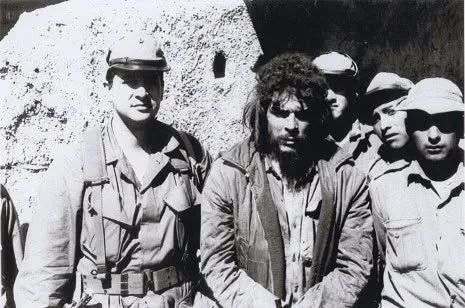
On October 8, 1967, Bolivian troops wounded and captured Che near Quebrada del Yuro.
He was taken to a small schoolhouse in La Higuera.
The following day, on orders from the Bolivian government, Sergeant Mario Terán shot him.
Che, who had approved and defended executions in Cuba, died by summary execution himself.
From Defeated Guerrilla to Global Icon
Che’s Bolivian campaign recruited few local supporters and ended with the destruction of his force.
Militarily, it was a complete failure. But his death transformed him.
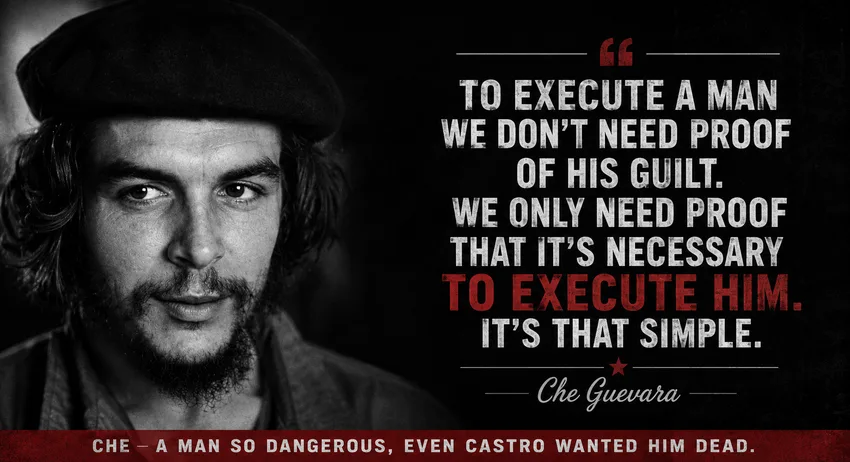
The famous photograph taken by Alberto Korda years earlier became an international emblem of rebellion. Posters, books, films, shirts, banners, and political movements converted a hardened Marxist soldier into an abstract symbol of resistance.
The commercial image concealed the historical man.
The poster did not show Eutimio Guerra lying dead after Che shot him.
It did not show the firing squads at La Cabaña.
It did not show prisoners awaiting revolutionary tribunals.
It did not show the failed Congo expedition.
It did not show Bolivian peasants refusing to join his revolution.
It showed only the face.
Che’s greatest victory came after his death, when visual mythology separated him from the political violence he practiced and defended.
Soldier or Murderer?
Che Guevara was unquestionably a soldier.
He fought in the Cuban Revolution, commanded guerrilla columns, conducted military operations, endured severe physical conditions, and repeatedly exposed himself to death.
He was also an executioner. He personally killed at least one accused traitor in a documented summary execution.
He commanded a fortress where prisoners were condemned and shot.
He reviewed and approved death sentences.
He defended firing squads as necessary instruments of revolution.
He attempted to initiate additional wars in countries where the population had not invited him and where his campaigns produced further death.
The most precise description is not that Che was merely a “mass murderer,” because that phrase often combines documented acts with inflated or poorly sourced numerical claims.
The more historically defensible conclusion is severe enough:
Che Guevara was a committed revolutionary warrior who personally participated in killing, exercised command responsibility over political executions, rejected liberal standards of due process, and treated organized violence as an indispensable instrument for creating and preserving a communist state.
He was not simply a physician who happened to become involved in a revolution.
He chose the gun. He became a commander. He administered firing squads.
And after gaining power, he devoted the remainder of his life to creating new battlefields where more people would kill and die for his ideology.
How and Why Che Died in Bolivia: Betrayed by His Own People
Ernesto “Che” Guevara did not die in Bolivia as the clean revolutionary legend printed on posters and T-shirts. He died abandoned, hunted, captured, and executed in a remote village far from the Cuban revolution he helped build. The official mythology says Che was a heroic guerrilla who fell fighting imperialism. The darker possibility is that Che was sent into a trap — or at least sent into a doomed mission by people who no longer wanted him around.
By the mid-1960s, Che Guevara had become more than a revolutionary commander. He had become an international symbol. To young radicals around the world, Che was the romantic face of revolution: the bearded fighter, the man of action, the ideologue willing to export armed struggle everywhere. But inside Cuba, that fame may have become dangerous.
Fidel Castro was not a man who shared the spotlight easily. Revolutions often begin with brotherhood, but they rarely end that way. Once power is captured, yesterday’s comrade can quickly become tomorrow’s rival.
Che was too famous, too radical, and too independent. He was openly impatient with Soviet-style compromise. He criticized the Soviet Union and wanted revolution exported aggressively across Latin America and Africa. But Cuba, by then, was becoming increasingly dependent on Moscow for money, oil, weapons, and survival. Fidel needed Soviet support. Che’s romantic global crusade was becoming inconvenient.
After Che’s failed mission in the Congo, the question became: where would he go next?
Public records confirm that Fidel steered Che toward Bolivia. That fact matters. Bolivia was not Che’s natural battlefield. It was landlocked, isolated, difficult terrain, and lacked the kind of broad revolutionary support Che had counted on. Unlike Cuba’s Sierra Maestra, Bolivia did not produce a popular uprising around him. The local Communist Party was divided. The peasants did not rally to him. His guerrilla band became isolated, hungry, sick, and increasingly exposed.
In other words, Bolivia was a bad place for Che to survive — but a very convenient place for him to disappear.
According to Félix Rodríguez, the Cuban-American CIA operative who was present when Che Guevara was captured in Bolivia, Che’s end was not simply a battlefield accident. According to Rodríguez, Castro’s own circle wanted Che gone. By the mid-1960s, Che had become too famous, too radical, and too inconvenient for Fidel Castro, especially as Cuba became more dependent on the Soviet Union.
Public records confirm that Fidel steered Che toward Bolivia, that Che had become a liability, and that the CIA and Bolivian military hunted him down there. Someone from Castro’s side helped make sure the CIA knew where to find him.
It proves the old rule of revolutions: among murderers, loyalty lasts only until one man becomes a threat to another.
Che arrived in Bolivia in disguise in 1966. He tried to create a new revolutionary front, but the mission went badly almost from the beginning. His group was small. His radio communications failed. His supply lines collapsed. The local Communist Party did not fully support him. The peasants often feared him more than followed him. Instead of becoming the spark of a continental revolution, Che became a fugitive moving through hostile terrain.
The CIA, working with Bolivian intelligence and the Bolivian military, tracked the guerrilla movement. The United States did not want another Cuba in Latin America. Bolivia’s government wanted the rebellion crushed. Che was no longer the hunter. He was the hunted.
On October 8, 1967, Che’s guerrilla column was surrounded in the Quebrada del Yuro. He was wounded, his rifle was damaged, and he was captured by Bolivian soldiers. The great revolutionary commander, the man who had helped bring firing squads to Cuba, was taken alive.
The next day, October 9, 1967, Che was held in a small schoolhouse in La Higuera. Félix Rodríguez was there. He spoke with Che before the execution. The Bolivian high command gave the order: Che was to be killed, not kept alive for trial.
That detail is important. A public trial would have turned Che into a global platform. It would have embarrassed governments, exposed intelligence operations, and given Che one last stage. Dead, he was easier to control. Alive, he was dangerous.
Bolivian Army Sergeant Mario Terán Salazar carried out the execution. Che was shot in the schoolhouse, and the government tried to make it look like he had died from combat wounds.
But Che did not die in battle. He was captured alive. He was executed.
The irony is impossible to ignore. Che Guevara had personally killed suspected traitors during the Cuban guerrilla war. After Castro took power, Che oversaw executions at La Cabaña prison. He defended revolutionary killing as necessary. He believed violence was the engine of history.
Then history returned the favor.
The revolution that Che helped build did not protect him. The comrades he served did not save him. The system of ruthless power he believed in eventually treated him the same way it treated others: as disposable.
That is the lesson behind Che’s death in Bolivia. It was not just the death of a guerrilla fighter. It was the collapse of the romantic lie around revolution. These movements talk about justice, brotherhood, liberation, and sacrifice. But once power is involved, the brotherhood ends. The purges begin. The rivals disappear. The loyal soldier becomes a problem. The icon becomes competition.
Fidel Castro turned Che into a martyr after his death because a dead Che was useful. A dead Che could be printed on banners, quoted in speeches, and sold as revolutionary mythology. A living Che was unpredictable. A living Che had opinions. A living Che had followers. A living Che could challenge the direction of the Cuban revolution.
So Che’s death served everyone except Che.
The Bolivian government eliminated an insurgent. The CIA removed a revolutionary threat. Castro inherited a martyr without having to live with the man.
That is why the story matters.
Che Guevara died in Bolivia not simply because his guerrilla mission failed, but because he became isolated from the very revolution he helped create. Che was sent into a battlefield where he had little support, few exits, and many enemies – betrayed by his own.
In the end, Che learned the oldest rule of revolutionary power too late:
The revolution does not love its soldiers. It uses them.
And when they become inconvenient, it buries them.