Think of it as Yoga for the brain, we are going to stretch a bit.
Cuban Overseas Intelligence – the Who, How, and What
Cuba never needed to be the largest power in the world. It only needed the patience to place or extort the right person in the right room—and wait. -- YNOT!
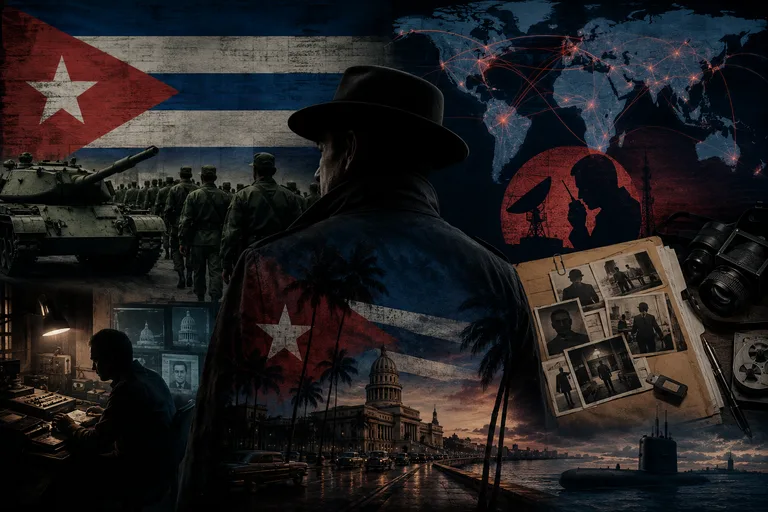
Cuba is a small island with limited economic resources, but since Fidel Castro took power in 1959, it has operated an overseas military and intelligence apparatus far larger than its size would suggest.
Cuban soldiers fought in Africa and the Middle East. Cuban advisers trained foreign militaries, guerrillas, police forces, and intelligence services. Cuban diplomats were accused of operating under intelligence cover. Cuban agents infiltrated exile organizations, military installations, universities, and some of the most sensitive offices of the United States government.
The most important lesson is that these activities were not all the same.
A Cuban tank commander in Angola was not necessarily a spy. A military adviser in Ethiopia was not the same as an illegal agent living under a false identity in Miami. A diplomat expelled for activities incompatible with diplomatic status was not legally equivalent to a government employee convicted of passing classified information.
To understand Cuba’s overseas intelligence system, we must separate three interconnected activities:
Open military intervention
Military assistance, revolutionary support, and covert action
Espionage, infiltration, intelligence collection, and influence operations
Together, these activities formed an overseas apparatus that allowed Havana to project power across Latin America, Africa, the Middle East, Europe, and, most importantly, inside the United States.
What Is Cuban Overseas Intelligence?
Following the revolution, Cuba established a foreign intelligence organization generally known as the Dirección General de Inteligencia, or DGI, later commonly shortened to the Dirección de Inteligencia, or DI.
A declassified CIA historical assessment described the DGI as Cuba’s agency for foreign espionage and subversion and placed it within the Ministry of the Interior. Its responsibilities extended beyond simply stealing military documents. The service collected political information, recruited foreign agents, infiltrated opposition groups, supported revolutionary movements, conducted influence operations, and protected Cuba’s interests abroad.
Cuba’s intelligence system was heavily influenced by Soviet training and methodology during the Cold War. But Cuban intelligence developed its own characteristics.
Its greatest strength was not advanced technology. It was human intelligence.
Cuban intelligence became particularly effective at identifying people who were ideologically sympathetic to the revolution, opposed to American foreign policy, interested in Latin American political movements, or emotionally receptive to the idea that helping Cuba represented a higher moral cause.
Money was not always necessary.
Ana Belén Montes, one of the most damaging Cuban agents ever uncovered in the United States, said she acted primarily because she opposed American policy toward Cuba and Central America. The FBI reported that she received little beyond reimbursement for expenses.
That ideological component is essential to understanding the Cuban model. Havana did not merely purchase secrets. It persuaded selected people that betraying their government was an act of justice.
How Cuban Intelligence Operates
The publicly exposed cases reveal several recurring methods.
Ideological recruitment
Cuban intelligence frequently sought people whose political beliefs could be transformed into operational loyalty.
The objective was not necessarily to recruit someone who already possessed classified information. A promising student, academic, junior government employee, activist, or diplomat could be recruited early and encouraged to seek positions that would eventually provide access.
According to the indictment of Marta Rita Velázquez, Cuban intelligence allegedly recruited Ana Montes before Montes joined the Defense Intelligence Agency. Velázquez was accused of helping position Montes for a future intelligence career rather than waiting until she already possessed valuable secrets.
Long-term placement
Cuba has repeatedly demonstrated patience.
An agent might remain in place for years or decades, gradually advancing into more influential positions. Víctor Manuel Rocha entered the U.S. Foreign Service, served on the National Security Council, became ambassador to Bolivia, worked at the U.S. diplomatic mission in Havana, and gained access to nonpublic and classified information while secretly serving Cuba.
Rocha admitted that his clandestine relationship with Cuba began in 1973 and continued until his arrest approximately half a century later.
Infiltration of organizations
Not every target was a government agency.
Cuban intelligence infiltrated Cuban exile organizations, political associations, humanitarian groups, universities, and organizations that Havana considered hostile.
The Wasp Network penetrated anti-Castro organizations in South Florida and sought information about American military facilities. Members entered organizations not only to collect information but also to influence decisions, identify members, observe internal disputes, and report future activities to Havana.
Diplomatic cover
Embassies, consulates, interests sections, and United Nations missions provide intelligence officers with access, mobility, communications, and diplomatic protection.
When a diplomat is suspected of espionage, the host government frequently cannot prosecute the person because of diplomatic immunity. Instead, the diplomat is declared persona non grata and ordered to leave.
An expulsion is therefore significant, but it is not the same as a criminal conviction. The government may possess classified evidence it cannot reveal publicly, or the expulsion may be based on an intelligence assessment rather than proof presented in court.
Illegal identities and civilian cover
Some Cuban officers operated without official diplomatic status.
The Wasp Network included Cuban intelligence officers living under false identities, along with agents using ordinary employment and community relationships as cover. Their occupations helped them enter military facilities, universities, exile organizations, and other targeted institutions.
Coded communications
The known cases include:
Shortwave radio broadcasts
Encrypted computer files
Coded numerical messages
False names
Clandestine meetings
Instructions delivered through handlers
Meetings in third countries
Information memorized rather than physically removed
Ana Montes memorized classified material at work, reconstructed it at home, encrypted it, and followed instructions received through coded shortwave broadcasts.
Walter and Gwendolyn Myers likewise used coded communications, shortwave radio, covert meetings, and travel outside the United States during their decades of service to Cuba.
What Cuban Overseas Intelligence Was Designed to Accomplish
Cuban intelligence operations generally served several strategic objectives.
Protect the Castro government
The first priority was regime survival.
That meant identifying exile organizations, dissidents, defectors, hostile military plans, covert operations, and political developments that could threaten the Cuban government.
Penetrate American decision-making
Cuba sought information about how Washington understood the island, what actions the United States might take, and which officials shaped American policy.
An agent inside the Defense Intelligence Agency, State Department, National Security Council, immigration system, or U.S. military structure could provide both information and insight into how decisions were being made.
Monitor the Cuban exile community
South Florida became one of Cuban intelligence’s most important operating environments.
Havana wanted to know:
Which exile organizations were planning operations
Who financed them
Which groups had government contacts
Which activists were influential
Which aircraft or boats might travel toward Cuba
Which Cubans might cooperate with American agencies
Support allied governments and movements
Cuban intelligence also assisted governments and revolutionary movements considered strategically or ideologically important.
This could include training, security advice, counterintelligence assistance, weapons, communications, logistical coordination, political organization, and liaison with Cuban military personnel.
Conduct influence operations
Intelligence is not limited to stealing secrets.
Influence operations attempt to shape political beliefs, public discussion, institutions, activist networks, media narratives, and government decisions. Diplomatic, cultural, educational, solidarity, and friendship organizations can all provide legitimate international engagement while also presenting opportunities for intelligence collection or political influence.
The existence of contact with Cuba does not automatically make an individual or organization an intelligence asset. The distinction depends on direction, secrecy, tasking, reporting, and the nature of the relationship.
The Americans Who Secretly Worked for Cuba
The strongest publicly documented record of Cuban espionage comes from the United States because the American legal system produced indictments, guilty pleas, trials, sentencing records, and declassified counterintelligence accounts.
Ana Belén Montes: The DIA’s Top Cuba Analyst
Ana Belén Montes became one of the most important Cuba specialists in the American intelligence community.
She joined the Defense Intelligence Agency in 1985 after being recruited by Cuban intelligence. Eventually, she became the DIA’s senior Cuba analyst, advising American policymakers about the very government she was secretly serving.
Montes did not regularly carry classified documents out of her office. She memorized information, reconstructed it at home, typed it into a computer, transferred it to encrypted media, and communicated with her handlers through coded shortwave transmissions.
She disclosed the identities of four undercover American intelligence officers and supplied other classified national-defense information to Cuba.
The FBI arrested her on September 21, 2001, ten days after the September 11 attacks, because she was about to gain access to information concerning planned American military operations in Afghanistan.
Montes pleaded guilty in 2002 to conspiracy to commit espionage and received a 25-year sentence.
Víctor Manuel Rocha: The Agent Who Became an Ambassador
Víctor Manuel Rocha’s case demonstrated the value of patience and institutional placement.
Rocha served in the State Department, on the National Security Council, at the U.S. Interests Section in Havana, and as United States ambassador to Bolivia. He had access to sensitive information and opportunities to influence American foreign policy.
He concealed his relationship with Cuba for decades and cultivated a public identity that helped protect him from suspicion.
His downfall came after an undercover FBI employee approached him while pretending to represent Cuban intelligence. Rocha made recorded statements describing his long service to Cuba and referring to the United States as the enemy.
In April 2024, Rocha pleaded guilty to secretly acting as an agent of Cuba and received the statutory maximum sentence of 15 years. He admitted beginning his clandestine service in 1973 and continuing until his arrest.
Walter Kendall Myers and Gwendolyn Steingraber Myers
Walter Kendall Myers worked in positions connected to the State Department and possessed access to highly classified information.
Together with his wife, Gwendolyn, he served Cuba for nearly 30 years.
Kendall Myers was identified in the case as Agent 202. Gwendolyn Myers used designations including Agent 123 and Agent E-634.
The couple communicated through coded shortwave broadcasts, clandestine meetings, and travel outside the United States. Gwendolyn helped receive messages, prepare information, and facilitate contacts with Cuban handlers.
Both pleaded guilty in 2009.
Kendall Myers received life imprisonment without the possibility of parole. Gwendolyn Myers received 81 months.
Mariano Faget Jr.: Operation False Blue
Mariano Faget Jr. was a senior Immigration and Naturalization Service official in Miami with access to sensitive information involving Cuban defectors and law-enforcement sources.
The FBI created a counterintelligence sting called Operation False Blue. Faget was deliberately given a fabricated story about the coming defection of a senior Cuban intelligence officer.
Within minutes, he passed the information to his friend and business associate Pedro Font, who was expected to meet Cuban diplomat José Imperatori.
Faget was convicted in 2000 of disclosing classified information, converting government information for personal use, lying on a security form, and lying about contacts with a Cuban official.
Imperatori was expelled from the United States, although he denied being a spy.
Carlos Alvarez and Elsa Alvarez
Carlos Alvarez was a psychology professor at Florida International University. His wife, Elsa Alvarez, worked as an FIU counselor and social worker.
Federal investigators accused the couple of secretly supplying information about South Florida’s Cuban exile community to Havana.
Carlos admitted that he had been a collaborator with Cuban intelligence beginning in 1977. The information was not described as classified military intelligence, but it included information about political attitudes, exile organizations, influential individuals, and contacts within the community.
Carlos pleaded guilty to conspiracy to act as an unregistered Cuban agent and received five years in prison.
Elsa pleaded guilty to concealing her husband’s activities and failing to report them. She received three years. The legal distinction is important: Carlos admitted collaboration with Cuban intelligence, while Elsa’s conviction concerned concealment and her related conduct rather than a traditional espionage charge.
The Wasp Network
The most extensive publicly exposed Cuban intelligence operation in South Florida was known as La Red Avispa, or the Wasp Network.
On September 12, 1998, the FBI arrested ten people connected to the network. The original federal announcement said they had been directed to infiltrate American agencies, military installations, and anti-Castro organizations.
The network sought information concerning:
U.S. Southern Command
Boca Chica Naval Air Station
American military operations
Cuban exile organizations
Brothers to the Rescue
Planned flights and maritime activity
Individuals active against the Castro government
Five defendants went to trial and became internationally known as the Cuban Five.
Gerardo Hernández Nordelo
Gerardo Hernández, operating under the identity Manuel Viramontez, was a senior Wasp Network figure.
He was convicted of acting as an illegal foreign agent, espionage-related conspiracy, and conspiracy to murder in connection with the 1996 Cuban shootdown of two Brothers to the Rescue aircraft.
Prosecutors argued that Hernández helped obtain flight information and warned Cuban agents not to travel on specific Brothers to the Rescue flights before Cuban military aircraft shot down the planes, killing four men.
His murder-conspiracy conviction survived appellate review.
Ramón Labañino Salazar
Ramón Labañino operated under the identity Luis Medina.
He was identified as a Cuban intelligence officer and convicted of conspiracy to commit espionage and acting as an unregistered foreign agent. His assignments included obtaining information relating to American military facilities.
Antonio Guerrero Rodríguez
Antonio Guerrero worked at the Boca Chica Naval Air Station in the Florida Keys.
He gathered and reported information concerning the base, aircraft, military activity, facilities, and operations. He was convicted of conspiracy to commit espionage and acting as an unregistered Cuban agent.
Fernando González Llort
Fernando González operated under the identity Ruben Campa.
He was identified as a Cuban intelligence officer who supervised agents in the network. He was convicted of conspiracy and acting as an unregistered agent of a foreign government.
René González Sehwerert
René González infiltrated Brothers to the Rescue and other exile activities.
He was convicted of acting as an unregistered Cuban agent and conspiracy offenses. Unlike Hernández, Labañino, and Guerrero, he was not convicted of conspiracy to commit espionage.
The Five Additional Wasp Network Defendants
Five other people arrested in the 1998 operation entered guilty pleas rather than joining the five defendants at trial:
Alejandro M. Alonso
Nilo Hernandez-Mederos
Linda Hernandez
Joseph Santos-Cecilia
Amarilys Silverio-Garcia
The original federal announcement identified all ten people arrested. Contemporary reporting on the verdict stated that five additional members had pleaded guilty and cooperated with prosecutors.
The Agents Who Escaped or Were Never Apprehended
Marta Rita Velázquez
Marta Rita Velázquez, also known as Marta Rita Kviele and by the alleged code name Barbara, was charged with helping Cuban intelligence recruit Ana Montes.
The indictment alleged that Velázquez introduced Montes to a Cuban intelligence officer in New York, accompanied her on a clandestine trip to Cuba for intelligence training, and helped her obtain employment at the Defense Intelligence Agency.
Velázquez left the United States and was living in Sweden when the indictment was publicly unsealed in 2013.
She has not been convicted. The allegations remain charges contained in an indictment, and she was never brought before an American court.
Juan Pablo Roque
Juan Pablo Roque was a former Cuban military pilot who entered the United States and became active in Brothers to the Rescue.
He flew with the organization, developed relationships inside the exile community, and had contacts with American law enforcement. On February 23, 1996—one day before Cuban fighters shot down two Brothers to the Rescue planes—Roque reappeared in Havana.
He publicly denounced Brothers to the Rescue and denied being a Cuban agent. American officials and prosecutors connected him to the Wasp Network, and he was later indicted on charges including failure to register as a foreign agent.
Because he returned to Cuba before the FBI dismantled the network, he was never tried in the United States.
Cuban Diplomats Expelled From the United States
Diplomatic expulsions represent another part of the record.
José Imperatori
José Imperatori was a Cuban diplomat connected by American investigators to the Mariano Faget case.
After Faget passed information from the False Blue operation to Pedro Font, who was expected to meet Imperatori, the United States declared Imperatori persona non grata and ordered him to leave.
Imperatori denied being a spy and was not criminally convicted in the United States.
Gustavo Machín Gómez and Oscar Redondo Toledo
In November 2002, the United States expelled Cuban first secretaries Gustavo Machín Gómez and Oscar Redondo Toledo.
The expulsions were linked publicly to the Ana Montes espionage case. Cuba rejected the accusations.
The Fourteen Cuban Diplomats Expelled in 2003
In May 2003, the United States expelled 14 Cuban diplomats—seven from the Cuban Interests Section in Washington and seven from Cuba’s United Nations mission in New York.
The State Department said they had engaged in activities harmful to the United States and outside their diplomatic responsibilities, diplomatic language generally associated with suspected espionage.
Among the senior officials publicly identified were Cosme Torres at the Cuban Interests Section and Adrián Francisco Delgado González at the United Nations mission.
These were diplomatic expulsions, not criminal espionage convictions. Cuba called the accusations false.
The 2019 United Nations Expulsions
In September 2019, the United States expelled two members of Cuba’s United Nations mission for what the State Department called influence operations against the United States.
Their names were not publicly released in the announcement. The remaining Cuban diplomats at the United Nations were subjected to tighter travel restrictions. Cuba again denied the allegations.
A More Recent Arrest: Tomás Emilio Hernández Cruz
In 2025, U.S. Immigration and Customs Enforcement arrested Tomás Emilio Hernández Cruz, whom the agency described as a former high-ranking Cuban intelligence officer.
The allegation was that Hernández Cruz had concealed his intelligence background and obtained American immigration status through fraudulent statements.
This case should not be misrepresented. He was arrested for alleged immigration fraud and concealment of his past—not publicly charged with conducting an espionage operation inside the United States.
Have Cuban Spies Been Caught in Other Countries?
Yes, but the public record outside the United States is much thinner.
In other countries, suspected Cuban operatives were more frequently expelled, quietly removed, returned to Cuba, or handled as diplomatic problems rather than prosecuted in open espionage trials.
Colombia: José Manuel Peña García
The strongest recent non-American example I found occurred in Colombia.
In March 2019, Colombian authorities detained and expelled Cuban citizen José Manuel Peña García.
He was reportedly discovered near the Colombian Air Force’s Palanquero base without authorization. Preliminary reports said authorities suspected him of collecting information for Cuban intelligence about the base’s operations.
Migración Colombia barred him from returning for ten years and stated that the expulsion was based on its authority to remove foreign nationals whose activities threatened national security.
Peña García was expelled rather than prosecuted in a public espionage trial. Therefore, he can accurately be described as a Cuban detained and expelled on suspicion of intelligence activity—not as someone convicted of espionage.
Mexico: José Ramón Pérez Ayala and Arturo Guzmán Nolasco
In September 1983, Mexican security officers arrested two Cuban officials:
José Ramón Pérez Ayala
Arturo Guzmán Nolasco
Pérez Ayala was accredited to the Cuban Embassy in Mexico. Guzmán Nolasco entered Mexico with a diplomatic passport and was described by sources as a suspected Cuban security officer.
The two were detained while attempting to meet Cuban exiles at a Mexico City bus station. They were informally accused of preparing to deliver explosives, although the Cuban Embassy denied that explosives existed and claimed the men had been entrapped.
Mexican authorities held the Cubans for approximately a week and then returned them to Cuban officials for transportation to Havana.
This episode appears closer to a suspected covert-action operation than a conventional case of stealing government secrets. It did not result in a public espionage trial or conviction.
Peru: Ambassador Carlos Zamora
In November 2025, Cuban ambassador Carlos Zamora ended his functions and permanently left Peru after a meeting involving Peru’s Foreign Ministry.
Peruvian and exile publications circulated allegations that Zamora had an intelligence background and had interfered in domestic political affairs. However, Peru’s official announcement did not publicly accuse him of espionage or explain the reason for his departure.
For that reason, Zamora should not be listed as a convicted or proven spy. He belongs in a separate category: a diplomat removed or recalled amid intelligence and political-interference allegations that were never publicly established in court.
Venezuela: Intelligence Partnership Rather Than “Spies Caught”
Venezuela represents a different model.
Cuban military, security, and intelligence personnel operated with the cooperation of the governments of Hugo Chávez and Nicolás Maduro. They were not necessarily clandestine foreign agents hiding from the host government. Many were invited advisers embedded in Venezuelan institutions.
Cuba helped train, reorganize, advise, and influence Venezuelan military, counterintelligence, and security structures. This may be described as extensive foreign intelligence penetration or security dependency, but it is not equivalent to Colombia discovering and arresting a Cuban operative.
The host government itself accepted the relationship.
The Military Side of Cuba’s Overseas Apparatus
Cuba’s intelligence expansion cannot be separated entirely from its military internationalism, but soldiers and spies should not be placed in the same category.
The best-documented direct Cuban combat deployments included:
Algeria, during the 1963–64 conflict with Morocco
Syria, during the period surrounding the 1973 Arab-Israeli war
Angola, where Cuba conducted its largest foreign military intervention
Ethiopia, during the war against Somalia
Grenada, where armed Cuban personnel fought during the 1983 American-led invasion
Congo/Zaire, where Cuban personnel supported revolutionary and military operations
Academic analysis frequently identifies Algeria, Syria, Angola, and Ethiopia as Cuba’s four major overt foreign military interventions. Declassified American records also document major Cuban deployments and advisory forces in Angola, Ethiopia, Nicaragua, Grenada, Congo, Libya, Mozambique, and South Yemen.
These military deployments gave Cuban intelligence additional opportunities to establish liaison relationships, gather information, train local services, monitor allied governments, and build networks that could remain after combat forces departed.
The Wider Geographic Reach
At different times after 1959, Cuba provided some combination of revolutionary training, weapons, military advice, political support, intelligence assistance, diplomatic coordination, or covert help in numerous countries.
The Latin American and Caribbean record includes:
Argentina, Bolivia, Brazil, Chile, Colombia, the Dominican Republic, Ecuador, El Salvador, Grenada, Guatemala, Haiti, Nicaragua, Panama, Paraguay, Peru, and Venezuela.
The African and Middle Eastern record includes:
Algeria, Angola, the Republic of Congo, the Democratic Republic of Congo/Zaire, Equatorial Guinea, Ethiopia, Ghana, Guinea, Guinea-Bissau, Iraq, Libya, Mozambique, Sierra Leone, Somalia, South Yemen/Yemen, and Syria.
The precise activity differed enormously from country to country. Some hosted Cuban combat troops. Others received military instructors. Some had relations with Cuban-supported guerrillas. Others contained Cuban diplomatic, political, or intelligence networks.
Declassified American assessments described Cuban international activity across Latin America, the Caribbean, Africa, the Middle East, and parts of Asia, but such Cold War assessments must be read as American intelligence judgments—not as criminal verdicts against every Cuban who served abroad.
Other countries—including Morocco, Israel, South Africa, Namibia/South West Africa, and Somalia—appeared as opposing forces or connected theaters in wars involving Cuban personnel. Their presence in the history does not mean that Cuba necessarily operated an independent intelligence network inside each one.
Why Most Known Cases Come From the United States
There are several reasons the American list is much longer.
First, the United States was Cuba’s most important intelligence target.
Second, South Florida contained a large Cuban exile community, anti-Castro organizations, military installations, immigration offices, political groups, and individuals with direct connections to Cuba.
Third, American courts produced public indictments, trial transcripts, plea agreements, and sentencing documents.
Fourth, other governments frequently handled suspected Cuban intelligence activity quietly. A diplomat could be expelled without a public explanation. A suspected operative could be deported under immigration law. An allied government might welcome Cuban intelligence advisers rather than investigate them.
Therefore, the absence of a public trial does not prove that Cuban intelligence was absent. But neither does political suspicion prove that a named person was a spy.
Proven, Accused, and Suspected Are Not the Same
A responsible history must preserve the distinction.
Convicted or admitted
This category includes people such as:
Ana Belén Montes
Víctor Manuel Rocha
Walter Kendall Myers
Gwendolyn Steingraber Myers
Mariano Faget Jr.
Carlos Alvarez
Elsa Alvarez, for her related concealment offense
Gerardo Hernández
Ramón Labañino
Antonio Guerrero
Fernando González
René González
Alejandro Alonso
Nilo Hernandez-Mederos
Linda Hernandez
Joseph Santos-Cecilia
Amarilys Silverio-Garcia
Indicted but never tried
This includes:
Marta Rita Velázquez
Juan Pablo Roque
Expelled or removed over suspected intelligence activity
This includes cases such as:
José Imperatori
Gustavo Machín Gómez
Oscar Redondo Toledo
The 14 Cuban diplomats expelled in 2003
The two Cuban United Nations diplomats expelled in 2019
José Manuel Peña García in Colombia
José Ramón Pérez Ayala and Arturo Guzmán Nolasco in Mexico
Accused but not publicly proven
This category includes diplomats and officials such as Carlos Zamora, whose departure from Peru generated intelligence allegations but no public espionage prosecution.
The Real Power of Cuban Intelligence
Cuban intelligence succeeded because it understood that access is frequently more important than technology.
It did not need to penetrate every government computer if it could recruit the analyst interpreting the information.
It did not need to control an American agency if it could place one patient, ideologically committed person inside it.
It did not need to destroy an exile organization if it could enter the organization, identify its members, understand its plans, deepen its divisions, and report its movements to Havana.
The most striking Cuban cases were not quick operations. They were investments measured in decades.
Ana Montes entered the Defense Intelligence Agency already committed to helping Cuba. Víctor Manuel Rocha built an entire diplomatic career while concealing his allegiance. Walter and Gwendolyn Myers operated for almost 30 years. The Wasp Network created identities, relationships, employment histories, and community connections designed to make its agents appear ordinary.
That is the central lesson of Cuban overseas intelligence:
Cuba compensated for limited money, technology, and conventional power with patience, ideology, placement, infiltration, and an extraordinary willingness to wait.
Its battlefield interventions attracted headlines. Its spies operated quietly.
And in intelligence, the operation that remains invisible is usually the one doing the greatest damage.