Artificial intelligence will become the greatest educational opportunity in human history — and why we need to start building the tools today. -- YNOT!
My perspective on education, technology, and the future of our children.
There is an old habit humanity has, and we’re remarkably good at it.
Whenever somebody invents something that makes life easier, we immediately start worrying that it will make our children stupid.
When calculators arrived, we worried children would forget mathematics.
When computers arrived, we worried they would forget how to write.
When the internet arrived, we worried they would never open another book.
And now that artificial intelligence has arrived, we’re worried children will forget how to think.
Well, I’ve got some news for you.
Artificial intelligence isn’t going away, and the children who don’t learn how to use it may find themselves competing against children who do.
And that isn’t a competition I would want my children or grandchildren to lose.
We can spend the next twenty years arguing about whether AI belongs in classrooms, or we can spend those same twenty years teaching children how to master it.
Personally, I think the second option makes a whole lot more sense.
Because the world doesn’t stop changing just because somebody on the school board is uncomfortable with it.
And the future certainly isn’t going to wait for permission.
A little cat and a very big idea
Recently, I’ve been involved in developing a project called CAT AI.
It’s an artificial intelligence learning platform designed specifically for children.
Now, on the surface, it might look like a relatively simple idea.
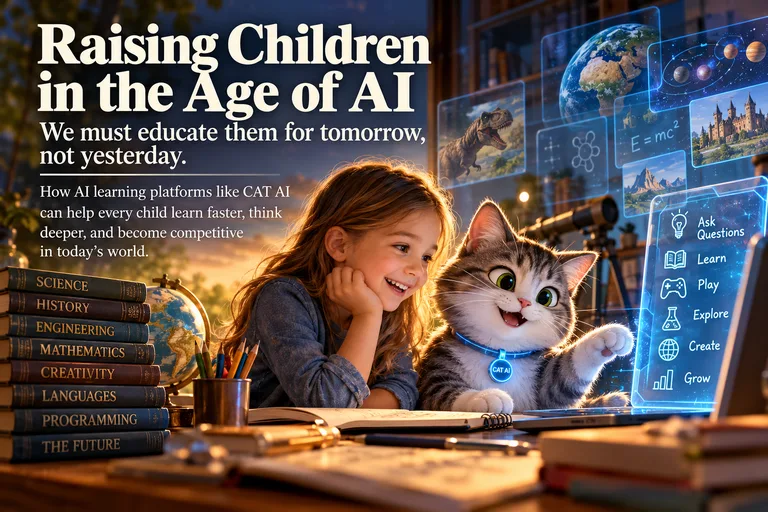
Give children their own friendly, customizable AI cat that they can talk to, ask questions, play games with, tell stories to, and learn from.
Sounds cute, doesn’t it? Well, it is.
But there’s something considerably more important happening underneath that friendly little cat.
We’re introducing children to artificial intelligence in an environment where they can actually learn how to use it.
Not simply consume whatever information it gives them.
Not sit in front of a screen mindlessly watching videos.
Not become dependent on a machine to do all their thinking.
But interact with intelligence, ask questions, explore ideas, make mistakes, and learn.
CAT AI is designed as a child-centered, local-first learning companion, with customizable AI interactions, tutoring, storytelling, games, and opportunities to explore how changing instructions affects an AI’s responses. Its design also gives parents and educators oversight, including usage boundaries and learning settings. CAT AI
And here’s why I think this approach is so important.
We shouldn’t be teaching children merely how to operate artificial intelligence. We should be using artificial intelligence to teach children how to learn.
Those are two very different things.
And the second one could revolutionize education.
Imagine having Albert Einstein as your personal tutor
Let me give you an example. Imagine you’re eight years old.
You’re sitting at home trying to understand fractions.
Your teacher explained fractions in class. Unfortunately, the explanation went right over your head.
Your mother tries explaining it. Still nothing.
Your father takes a turn.
Now everybody’s frustrated, including the dog, who has wisely decided to leave the room.
In a traditional educational environment, that child might simply struggle until the next lesson.
Perhaps the teacher has time to provide additional help.
Perhaps the parents can afford a tutor.
Perhaps the child eventually figures it out.
Or perhaps the child begins believing they’re simply not very good at mathematics.
Now imagine that same child sitting down with an AI learning companion.
The child says, “I don’t understand fractions.”
And instead of repeating the exact same explanation, the AI tries something different.
It says, “Imagine you have a pizza.”
Now we’ve got the child’s attention.
“If you cut that pizza into four equal pieces and eat one, how much pizza have you eaten?”
The child answers, “One piece.”
“That’s right. And that one piece is one-fourth of the pizza.”
Suddenly, something clicks. The child asks another question. Then another.
Perhaps the AI uses pictures, stories, games, or examples involving toys, candy, or whatever happens to interest that particular child.
And here’s the wonderful part. The AI doesn’t have to get tired of explaining fractions.
It can try ten different approaches. Twenty different approaches.
It can adjust to the child’s understanding, provided the system is designed to recognize confusion and respond appropriately.
It can ask the child to explain the concept back.
It can introduce increasingly difficult problems when the child demonstrates understanding.
And it can revisit material whenever necessary.
Now multiply that concept across mathematics, reading, science, history, geography, computer programming, languages, and practically every other subject.
Imagine the possibilities.
Of course, AI isn’t literally Einstein, and it can make mistakes. A good educational platform must verify learning, use reliable instructional material, and know when to involve a human teacher.
But the underlying possibility is enormous.
We are approaching a time when personalized tutoring could become available to millions of children who would otherwise never have access to it.
That is a genuinely revolutionary opportunity.
Why should every child learn at exactly the same speed?
Here’s something I’ve never particularly understood about traditional education.
We put twenty or thirty children in a classroom. They’re all approximately the same age.
Then we expect them to learn approximately the same material at approximately the same speed.
Why? Because they were born in the same year?
What a peculiar way to organize human intelligence.
Imagine organizing a professional sports team entirely by birthdays.
Never mind ability, training, experience, or talent.
Everybody born in March runs at one speed.
Everybody born in April jumps the same height. Absurd, isn’t it?
Yet education frequently organizes children by age and moves them through material according to a predetermined schedule.
Some children learn mathematics quickly but struggle with reading.
Others are extraordinary readers but need additional help understanding scientific concepts.
Some children can master material after one explanation. Others need five.
And some children are capable of learning subjects considerably more advanced than their grade level, but the classroom curriculum simply hasn’t reached that material yet.
Why should a child who can understand sixth-grade mathematics be required to spend another year repeating fourth-grade mathematics?
And why should a child who needs additional time to understand fractions be pushed into algebra before mastering the fundamentals?
AI gives us an opportunity to rethink that entire approach.
Instead of expecting every child to follow precisely the same educational schedule, imagine allowing children to advance according to demonstrated understanding.
A child who masters a concept moves forward. A child who struggles receives additional explanations, practice, and encouragement.
A child who becomes fascinated with astronomy can begin exploring increasingly sophisticated ideas.
A child who loves music can learn mathematical concepts through rhythm.
A child who enjoys computer games can learn programming through creating simple games.
The possibilities are almost endless. And here’s the real opportunity.
We could begin measuring education by what children actually understand, rather than simply how much time they’ve spent sitting in a classroom.
That would be a remarkable improvement.
The difference between learning faster and simply finishing faster
Now, there’s an important distinction here.
Just because artificial intelligence can provide answers instantly doesn’t mean children are learning anything.
In fact, AI could create an entire generation of children who are exceptionally good at producing answers and remarkably poor at understanding them.
Imagine a student who asks AI to complete every homework assignment.
The machine writes the essay. The machine solves the equation. The machine answers the science questions. The student submits the assignment.
Perfect score. Wonderful.
Except for one minor problem.
The child hasn’t learned a damn thing. That’s not education. That’s outsourcing.
And if we design educational AI systems that simply hand children answers, we will have missed one of the greatest opportunities in history.
Consider another approach. A child asks CAT AI to solve a mathematics problem.
Instead of immediately providing the answer, the system asks:
“How would you start solving this?” The child tries.
The AI identifies where the reasoning went wrong.
Then it provides a hint. The child tries again.
And eventually, the child solves the problem independently.
That is real learning. We need AI systems that teach children how to reason, experiment, question assumptions, and recognize mistakes.
We should be building software that encourages children to become more intelligent with every interaction.
Not software that simply makes it unnecessary for them to think.
The goal isn’t to make homework disappear. The goal is to make learning more effective.
And yes, perhaps considerably faster.
Could AI actually accelerate education?
This is where things get particularly interesting.
The idea that AI can help students learn more efficiently is no longer just speculation.
A randomized controlled study published in Scientific Reports in June 2025 compared an AI-powered tutoring approach with active-learning classroom instruction among college students.
The researchers found that the AI-tutored students achieved significantly greater learning gains in less time and reported higher engagement and motivation. DOI
That’s exciting. But there is another side to the story.
A 2026 randomized university study involving 2,379 students found that access to a course-integrated AI tutor was associated with lower academic performance and reduced participation in existing learning activities. IZA
What does that tell us? Something enormously important.
Artificial intelligence does not automatically improve education simply because you put it in front of a student.
The design matters. The teaching methodology matters.
The involvement of parents and teachers matters.
And whether the student is actually thinking matters.
These studies involved university students, so we shouldn’t automatically assume identical results for young children.
But they reinforce the same basic principle.
A good educational AI system shouldn’t merely be a chatbot wearing a graduation cap.
It needs to be designed to teach. And that’s exactly the kind of software we should be developing.
Children need to learn AI the way previous generations learned to read
When I was growing up, computers were something relatively few people had access to.
Eventually, computer literacy became an increasingly important skill.
Then came the internet. Suddenly, knowing how to search for information became essential.
Today, nearly everyone understands that children need basic computer and internet skills.
Well, artificial intelligence is becoming another fundamental technology.
And children need to understand it.
They need to know how to ask good questions.
They need to understand that the instructions they give an AI can dramatically change the results they receive.
They need to recognize that AI can be wrong.
They need to understand why they shouldn’t share private information with unfamiliar systems.
They need to learn how to verify information instead of blindly trusting something because a computer generated it.
And perhaps most importantly, they need to understand that artificial intelligence is something they can direct and control.
Not something they should automatically obey.
One of the ideas behind CAT AI is allowing children to experiment with AI settings and instructions, so they can discover how those instructions influence the system’s behavior. CAT AI
Think about the educational value of that. A child changes an instruction.
The AI responds differently. The child changes another instruction.
The response changes again.
Without necessarily realizing it, the child is learning something about programming logic, cause and effect, experimentation, and the importance of precise communication.
Those are valuable skills. And they’re being introduced through play.
A child who learns to direct artificial intelligence is developing a very different skill from a child who simply accepts whatever artificial intelligence produces.
That’s the distinction we need to encourage.
A five-year-old and a fifteen-year-old shouldn’t use the same AI
Another important consideration is age.
A five-year-old doesn’t need the same educational experience as a fifteen-year-old.
That should be obvious.
Unfortunately, a tremendous amount of software seems to be designed around the assumption that everyone wants approximately the same experience, just with different colors and larger buttons.
Children’s educational needs change dramatically as they grow.
A very young child might use a supervised AI learning companion to practice recognizing shapes, identifying animals, understanding colors, learning vocabulary, and participating in simple interactive stories.
An eight-year-old might use it to explore mathematics, geography, science, reading comprehension, and introductory logic.
A twelve-year-old might begin learning basic programming, researching historical events, understanding scientific concepts, and developing more sophisticated problem-solving skills.
A fifteen-year-old could use appropriately designed AI tools to explore engineering, computer science, economics, advanced mathematics, creative writing, entrepreneurship, and career-related skills.
Now imagine software capable of adapting not only to the child’s age but also to their abilities and demonstrated progress.
A ten-year-old who demonstrates advanced mathematical understanding could receive more challenging material.
A fourteen-year-old who needs additional reading support could receive explanations tailored to that need without being embarrassed in front of classmates.
The child’s abilities should help determine the pace of education, not merely the date on their birth certificate.
For young children, of course, AI should be used with substantial adult involvement, age-appropriate safeguards, and plenty of real-world activity.
A friendly digital cat can be an educational tool.
It cannot replace a real childhood. And it certainly cannot replace a parent.
We need to stop treating curiosity like an inconvenience
Here’s another thing that fascinates me about children.
They’re naturally curious. Anybody who has spent time around a four-year-old understands this.
Why is the sky blue?
Why do airplanes fly?
Where does electricity come from?
Why does the moon follow our car?
Why can’t dogs talk?
Why can’t I have ice cream for breakfast?
Question after question after question.
Eventually, even the most patient adult reaches the point where the answer becomes:
“Because I said so.”
Which, as educational explanations go, is not particularly impressive.
But imagine having an educational assistant that can help explore those questions.
A child asks why airplanes fly. The AI explains lift using simple language.
The child asks why birds can fly. The conversation moves into biology.
Then gravity. Then physics. Then engineering.
Before long, the child who originally wanted to understand airplanes is learning the basic principles of aerodynamics.
All because somebody encouraged a simple question.
Now imagine that happening every day.
What if we stopped treating children’s endless questions as interruptions and started treating them as opportunities?
I believe AI could help us do exactly that.
Curiosity is one of the most important engines of human intelligence.
We should be encouraging it at every opportunity.
And if artificial intelligence can help parents and teachers respond to that curiosity more effectively, then we should be building systems specifically designed to do so.
The real educational revolution may happen outside the classroom
When people discuss AI in education, they usually begin with schools.
How will teachers use it?
Will students cheat?
Should AI be permitted during examinations?
Those are legitimate questions.
But I believe we’re overlooking something much larger.
Education does not begin when a child enters school, and it doesn’t end when the school day is over.
Children learn at home. They learn while playing. They learn from conversations.
They learn from television, books, games, friends, and increasingly, technology.
Imagine educational AI systems becoming part of that broader learning environment.
A child interested in dinosaurs could spend an afternoon exploring prehistoric ecosystems.
Another child could create a simple computer game while learning programming concepts.
Another could practice speaking Spanish with an interactive tutor.
Another could explore how businesses work by creating a fictional lemonade stand, managing expenses, setting prices, and calculating profits.
Think about that last example.
A child learning mathematics through operating a pretend business.
Now suddenly fractions, percentages, addition, subtraction, and multiplication have a practical purpose.
The child isn’t merely memorizing formulas. They’re applying knowledge.
And that creates opportunities for learning that are both useful and enjoyable.
The classroom will remain important. Teachers will remain important.
Human interaction will remain important.
But the idea that meaningful education must occur primarily within a classroom during predetermined hours deserves serious reconsideration.
Learning should become something children can do throughout their lives, whenever curiosity strikes.
AI could make that considerably easier.
A child in poverty should not have to inherit an educational disadvantage
Perhaps the most important opportunity of all is access.
For centuries, education has been closely connected to wealth.
Wealthy families could afford private tutors.
They could purchase books. They could send children to excellent schools.
They could provide educational experiences unavailable to less fortunate families.
Poor children often had fewer opportunities.
Not because they lacked intelligence. Not because they lacked ambition.
But because they lacked access.
Now imagine a child living in a rural community where educational resources are limited.
Imagine a child whose parents cannot afford private tutoring.
Imagine a child who wants to learn computer programming but has nobody nearby who understands it.
AI-powered educational platforms could help close some of those gaps.
Not automatically. Children still need reliable devices, internet access or suitable offline systems, quality learning materials, safe environments, and supportive adults.
And we need to make sure these tools actually improve learning rather than merely creating the appearance of progress.
But consider the potential. A child whose parents cannot afford a tutor might have access to personalized instructional assistance.
A child in a remote community might be able to explore subjects that aren’t offered locally.
A child with an unusual talent might discover opportunities to develop that talent much earlier.
Human intelligence is distributed throughout the world. Educational opportunity is not.
Artificial intelligence gives us an opportunity to narrow that gap.
And I believe that may ultimately become one of its greatest contributions to humanity.
The next generation isn’t competing against yesterday’s children
Now let’s talk about something parents may not particularly enjoy hearing.
The world their children will enter as adults is likely to be substantially different from the world we know today.
Artificial intelligence is already changing how software is developed, how information is analyzed, how businesses operate, and how people perform many kinds of work.
The pace and consequences of those changes remain uncertain.
But the direction is clear enough that ignoring AI would be a mistake.
A student who graduates from school without understanding how to work with intelligent systems may face a serious disadvantage.
Not because AI will necessarily replace every job. That’s an oversimplification.
But because people who understand how to use powerful tools can often accomplish things that others cannot.
Think about the difference between an accountant using a calculator and one doing everything by hand.
Or an architect using computer-aided design and one relying entirely on manual drafting.
Or a researcher using the internet and one limited to the books available in a small local library.
Technology changes what individuals can accomplish.
Artificial intelligence may amplify that difference considerably.
Imagine two young adults entering the workforce.
Both are intelligent. Both are motivated. Both received a reasonable education.
But one has spent years learning how to use AI for research, problem-solving, software development, analysis, and creative work.
The other has barely used it.
Which one will be better prepared for tasks that increasingly involve those technologies?
I wouldn’t automatically assume the first person will succeed at everything.
Human judgment, creativity, integrity, experience, and interpersonal skills still matter enormously.
But I certainly wouldn’t want to be the second person simply because somebody decided AI was too dangerous to teach.
We should not allow children to graduate into a technological world they were never taught to understand.
That’s not protecting them. That’s leaving them unprepared.
We need thousands of educational AI applications, not just another chatbot
And this brings me to what I believe should be one of our priorities.
We need to build more educational software specifically designed around artificial intelligence.
Much more. Not simply general-purpose chatbots with a cartoon character pasted on the screen.
Not software that keeps children entertained for hours while teaching them practically nothing.
And certainly not systems designed primarily to maximize screen time, collect personal information, or sell children products.
We need intelligent educational software built around clear learning objectives.
Imagine applications dedicated to teaching mathematics through interactive problem-solving.
Applications that help children learn languages through conversations and games.
Applications that teach financial literacy by allowing children to manage virtual businesses.
Applications that teach history by exploring historical events and examining different perspectives.
Applications that teach science by allowing children to conduct virtual experiments and then reproduce safe versions in the real world.
Applications that introduce engineering through interactive construction projects.
Applications that teach computer programming by helping children design and build working software.
And applications that help children understand artificial intelligence itself.
How it works. What it can do. What it cannot do.
Why it sometimes makes mistakes.
And how humans should remain responsible for decisions.
CAT AI is one example of the kind of learning environment I’m talking about.
It’s not the final answer, and I wouldn’t pretend that any single platform has solved the enormous challenges of AI education.
It’s a developing approach built around the belief that children should become capable users of AI, with adults setting appropriate boundaries.
The CAT AI website expresses an important principle: children should learn to use AI better, rather than simply use it more. CAT AI
That distinction is fundamental. We need educational systems that measure actual progress.
Can the child solve problems independently?
Can the child explain what they’ve learned?
Can the child recognize an incorrect answer?
Can the child apply knowledge to unfamiliar situations?
Can the child create something new?
Those are meaningful measures of success.
How many hours a child spent talking to a digital cat?
Not particularly meaningful by itself.
The goal should be better-educated children, not more-engaged customers.
And that’s a principle educational software developers should take seriously.
Parents need to participate in this revolution
Now, before parents start imagining that they can buy an AI subscription and retire from parenting, let me clarify something.
That’s not how this works. Artificial intelligence isn’t a substitute for parents.
It isn’t a substitute for teachers. And it isn’t a substitute for the tremendous educational value of human relationships.
Children need encouragement. They need discipline. They need emotional support.
They need to learn how to interact with other human beings.
They need physical activity, friendships, outdoor experiences, and opportunities to make real-world mistakes.
They also need adults who can recognize when technology is helping and when it’s becoming a problem.
An AI system might explain why sharing personal information online is dangerous.
But parents still need to teach responsible behavior.
An AI system might help a child understand a complicated scientific concept.
But teachers still need to evaluate understanding and guide learning.
An AI system might help a child write a story.
But the child should still develop imagination, creativity, and independent thought.
And if a child begins treating an AI companion as a replacement for human friendships, that deserves attention rather than encouragement.
The best approach is collaboration. Parents, teachers, children, and technology working together.
Not one replacing the others. We need to teach children that AI is a tool they use, not an authority they surrender their judgment to.
Because no matter how intelligent these systems become, knowing how to think independently will remain one of the most important human abilities.
The greatest danger may not be AI itself
Whenever artificial intelligence comes up in conversation, somebody inevitably asks whether it’s dangerous.
Of course it can be dangerous. So can automobiles. So can electricity. So can the internet.
And so can practically every powerful technology humanity has ever invented.
The question isn’t whether risks exist. The question is what we’re going to do about them.
We must establish safeguards. We must develop appropriate educational standards.
We must protect children’s privacy. We can test systems for accuracy and age suitability.
We must involve parents and educators. We must regulate genuinely harmful practices.
And we can teach children to recognize both the capabilities and limitations of the technology.
But refusing to teach children about AI because AI presents risks would be like refusing to teach children to swim because water can be dangerous.
The danger doesn’t disappear simply because we refuse to acknowledge it.
And ignorance is rarely an effective safety strategy.
There is, however, another danger that receives considerably less attention.
What happens if we fail to prepare an entire generation for the technology that will shape their future?
What happens when children leave school without understanding the tools that businesses, universities, researchers, and employers increasingly use?
What happens when educational institutions spend years arguing about whether AI should exist in classrooms while the technology continues advancing?
What happens when wealthy families provide their children with sophisticated AI learning tools while less fortunate families are left behind?
Those are serious questions. Because the educational divide of tomorrow may not simply be between children who have computers and children who don’t.
It may be between children who know how to work intelligently with artificial intelligence and children who never learned.
And that’s a divide we should be working to prevent today.
We cannot afford to graduate children who are already obsolete
Now, I know some people won’t like the word obsolete when discussing children.
And they’re right about one thing. Children themselves are never obsolete.
Human beings aren’t outdated machinery. But educational methods can become obsolete.
Skills can become less relevant. Curriculums can fall behind.
And institutions can continue preparing young people for a world that no longer exists.
That’s the problem.
Imagine graduating from school in 2026 with an education designed around the technological assumptions of 1996.
Now imagine graduating in 2040 with an education that barely acknowledges artificial intelligence.
What an extraordinary disservice that could be. We’re supposed to prepare children for the future. Not preserve the past simply because we’re comfortable with it.
There is enormous value in traditional education.
Reading matters. Writing matters. Mathematics matters. History matters. Science matters.
And learning to think without technological assistance matters.
I wouldn’t eliminate any of those foundations.
Quite the opposite. I would strengthen them.
But I would also integrate artificial intelligence into education in ways that make those foundational skills more useful.
A child should learn arithmetic. And then learn how AI can help explore more complicated mathematical problems.
A child should learn to write. And then learn how AI can help revise, critique, and improve writing without replacing the child’s own voice.
A child should learn history. And then learn how to use AI to explore historical questions while verifying sources and recognizing bias.
A child should learn programming fundamentals. And then learn how to work with AI coding tools to create increasingly sophisticated applications.
We don’t need to choose between traditional intelligence and artificial intelligence.
We need to teach children how to combine them.
That’s where the opportunity lies.
What if the next Einstein is sitting in a classroom somewhere, bored to death?
Here’s a thought that should make every educator stop and think.
Somewhere in the world right now, there may be a child with extraordinary intellectual potential.
Perhaps that child has a natural understanding of mathematics.
Perhaps they’re fascinated by chemistry.
Perhaps they have an unusual talent for engineering, music, or computer programming.
But perhaps they’re also sitting in a classroom where the material moves too slowly.
Or perhaps they’re struggling because the teaching method doesn’t match the way they learn.
Or perhaps they live somewhere with very limited educational opportunities.
How much human potential have we lost throughout history simply because children never received the opportunity to develop their abilities?
We will never know. But I suspect the number is staggering.
Now imagine educational systems capable of recognizing unusual interests and helping children explore them.
A child demonstrates an advanced understanding of mathematics.
The system offers more challenging problems. The child becomes interested in physics.
The system introduces appropriate concepts. The child begins experimenting with programming. The system helps them understand algorithms and develop simple applications.
Teachers and parents observe the progress and provide additional opportunities.
Suddenly, that child’s potential is no longer constrained entirely by the standard curriculum.
And this doesn’t apply only to exceptionally gifted children.
It applies to every child. Some children need additional support.
Some need different explanations. Some need more time.
Some need more challenging material. Every child deserves an opportunity to develop their abilities.
The great promise of personalized AI education isn’t that every child will become Einstein.
It’s that fewer children will have their potential limited simply because nobody had the time or resources to teach them differently.
That’s a goal worth pursuing.
It’s time to start building the future
So where do we go from here? I believe we need a serious effort to develop AI-powered educational platforms specifically for children.
We need software developers working with educators.
We need parents participating in the design process.
We need child-development specialists helping establish appropriate safeguards.
We need educational systems that measure real learning instead of merely generating impressive demonstrations.
And we need to make these tools affordable and accessible.
Not every child needs the most expensive computer.
Not every educational application needs to depend on enormous cloud infrastructure.
Smaller AI models, private systems, carefully designed learning activities, and increasingly efficient hardware create opportunities to build educational tools in different ways.
Some applications may operate primarily online.
Others may be capable of operating locally or with limited connectivity.
Some may focus on a single subject. Others may provide broader learning experiences.
CAT AI is one effort in that direction. And I hope there will be thousands more.
Because no single company, school, developer, or government should have a monopoly on the future of children’s education.
We need experimentation. We need competition. We need innovation.
And most importantly, we need to remain focused on the children themselves.
Not the technology companies. Not the software. Not the marketing. The children.
Are they learning? Are they becoming better thinkers?
Are they more curious? Are they developing useful skills?
Are they better prepared for the world they’ll inherit?
Those should be the questions that determine whether educational AI is succeeding.
One final thought
I grew up in a world where calculators were new. I learned to use a slide rule.
I watched personal computers arrive. I watched the internet transform civilization.
And now I’m watching artificial intelligence begin what may become an even greater transformation.
Every technological revolution has brought fears. Some justified. Some exaggerated.
And some that eventually looked rather silly.
But progress doesn’t stop because we’re nervous.
Humanity has never advanced by refusing to learn how to use its own inventions.
We advance by understanding them, improving them, correcting our mistakes, and finding better ways to use them.
Artificial intelligence is another chapter in that story.
And our children are going to live in that chapter whether we prepare them or not.
I want them prepared. I want children to grow up understanding artificial intelligence as naturally as previous generations learned to use calculators, computers, and the internet.
I want them to have access to educational opportunities that previous generations could only dream about.
I want a child from a poor family to have a genuine opportunity to develop the same intellectual abilities as a child from a wealthy family.
I want children who struggle with traditional teaching methods to discover different ways of learning.
And I want exceptionally curious children to have the freedom to explore subjects as deeply as their abilities and interests allow.
Most of all, I want children to understand that artificial intelligence is not something they should fear.
It’s something they should learn to use wisely. Because the future isn’t going to belong exclusively to the people who build artificial intelligence.
It will also belong to the people who understand how to use it creatively, responsibly, and intelligently.
We spent the last century teaching children how to use machines.
We are entering a century in which we must teach children how to work with intelligence itself.
And if we do it correctly, we may unlock more human potential than at any previous point in history.
But we have to start now. Not ten years from now. Not when every school district finally agrees on a policy. Not when every parent is comfortable with the technology.
Now.
Because a five-year-old entering school today will be entering the workforce in a world we can barely predict. And that child deserves an education designed for the world ahead, not the world behind.
We owe our children more than an education that teaches them how yesterday worked.
We owe them an education that prepares them to build tomorrow.
And perhaps, just perhaps, a friendly little AI cat helping a child understand fractions, ask better questions, or discover a passion for science is one small example of how that future begins.
After all, the greatest revolutions don’t always begin with enormous machines and grand announcements.
Sometimes they begin with a child asking a simple question.
And this time, that child might have a very knowledgeable little cat ready to help find the answer.
Let’s make sure the next generation doesn’t enter the future already behind. Let’s give them the tools to lead it.
About CAT AI: cat-ai.org is a developing AI educational platform designed to help children learn, create, explore, and understand artificial intelligence through a customizable learning companion, with parental and educational oversight. The public site currently offers beta enrollment. It is a prototype for an idea.
Part of the ideas explored in my book Raising Children in the World of AI.