Think of it as Yoga for the brain, we are going to stretch a bit.
Is 2026 the Year Silent Wars Become Noisy?
“If you look at history, war isn’t announced—it just keeps raising the volume until denial can no longer hear itself think.” --YNOT!
War is already burning in Europe, and every morning the news sounds a little more like a prelude than a report. The unsettling part isn’t the explosions we can see—it’s the ones being carefully rehearsed just offstage. The quiet wars. The “don’t-look-here” wars. The kind that don’t ask permission before they get loud.
So let’s take a sober walk through the flashpoints that could crack open in 2026. Not the obvious ones—the ones people argue about on television—but the places where pressure is building while everyone pretends it isn’t.
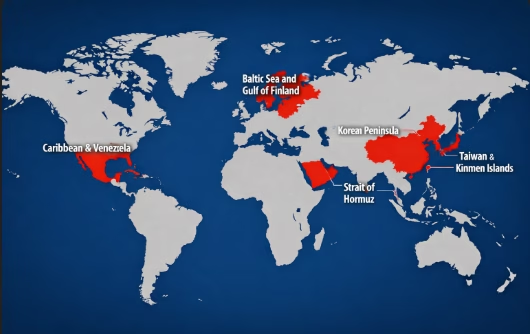
Let’s begin somewhere unexpected: the Caribbean.
That’s usually where you go to forget about geopolitics, not confront it. But right now, the United States is assembling one of the largest naval and military presences the region has seen in years, and this is not a long-term sightseeing tour. The focus is Venezuela. The goals are blunt and unromantic: remove Nicolás Maduro, choke off human trafficking northward, redirect oil wealth back toward Venezuelans instead of criminal networks, and reduce the drug flow poisoning American cities.
You don’t assemble that kind of force unless you intend to use it—or at least want everyone watching to believe you might. Military buildups are expensive, politically noisy, and hard to sustain. They exist for a reason. That makes Venezuela one of the fastest-moving flashpoints on the board, where events could escalate suddenly and decisively.
Zoom out, and the pattern becomes clearer. Across the globe, we’re seeing more sabotage, more aggressive naval maneuvers, more aircraft testing boundaries they technically didn’t cross—except they did. These are not accidents. They are probes. And probes are what you do before you strike.
In Europe, Russia has learned an uncomfortable lesson: muted responses invite repetition. Vladimir Putin’s invasion of Ukraine continues to bleed his country, but it has also taught him where NATO hesitates. Expect him to lean into gray-zone tactics—sabotage, cyber interference, deniable maritime operations—especially in northern waters.
The Baltic Sea, and particularly the Gulf of Finland, is one of the most dangerous places on Earth right now. Russian-linked vessels—part of the so-called shadow fleet—move through narrow chokepoints, suspected of cutting undersea internet cables, launching drones, and skirting sanctions. This same fleet quietly keeps Russia’s oil economy alive, funneling barrels to whoever will pay. Roughly 80 percent of Russian oil exits through this corridor.
Add to that Russian fighter jets flirting with NATO airspace, forcing rapid-response scrambles, and you have all the ingredients for a “miscalculation” that no one can walk back from. If 2025 is any guide, the Baltic doesn’t need much encouragement to explode.
Then there’s the Korean Peninsula—technically still at war, just paused by paperwork. The demilitarized zone isn’t peace; it’s a buffer holding back two armies that never signed a settlement. What’s changed is the confidence of the man in Pyongyang.
Kim Jong-un is no longer acting alone. He is supplying a staggering share of Russia’s ammunition, advancing his nuclear and missile programs, and being paraded as a legitimate power broker alongside Moscow and Beijing. That kind of validation does things to a man. Dangerous things.
If the United States becomes distracted elsewhere—Ukraine, Taiwan, the Middle East—or reduces its presence in South Korea, Kim may decide the moment has arrived. Reunification, by force, would not begin gently. With nuclear weapons in play, his opening move could be catastrophic. Seoul sits within range. The question is not whether the world could respond—but how it would, and how fast.
Shift east, and the tension tightens further.
China has made its intentions toward Taiwan unmistakably clear. Xi Jinping doesn’t speak in hypotheticals. Taiwan, increasingly confident in its own sovereignty, sees itself as a separate nation. Beijing sees an errant province. Both cannot be right, and both are preparing accordingly.
But the most interesting chess piece here may not be Taiwan itself—it’s the Kinmen Islands. Tiny, rocky outposts sitting just miles from the Chinese coast, far closer than Taiwan proper. China could seize them with minimal force and then stop. Wait. Watch. See who blinks.
Would the United States go to war with China over a handful of rocks? Would Taiwan? Would anyone? That answer would tell Beijing everything it needs to know about the international community’s resolve—and 2026 may be the year China asks the question out loud.
Finally, there’s the place nobody likes to talk about until it’s too late: the Strait of Hormuz.
Nearly half of the world’s oil and gas passes through that narrow channel. Iran knows this. Iran has always known this. And while it has remained relatively restrained amid recent Israeli and American strikes, restraint is not the same as surrender.
If internal unrest grows, or if pressure from the West increases, Iran has a simple, devastating option: close the strait. No missiles required. Just enough disruption to send energy markets into chaos and shock the global economy awake. A cornered power doesn’t need a grand strategy—it needs a pressure point. Hormuz is one of the biggest on Earth.
So is 2026 the year silent wars become noisy?
History suggests this: wars rarely begin with speeches. They begin with testing. With small moves everyone pretends are meaningless—until they aren’t. The world isn’t short on weapons or grievances. What it’s short on is patience.
And patience, once it runs out, tends to make a very loud sound.
SO what are the odds?
Venezuela / Caribbean (United States, Venezuela, Colombia, Caribbean states):
A sustained U.S. military buildup suggests Washington may be preparing to forcibly resolve Venezuela’s collapse rather than manage it. Estimated odds of armed conflict in 2026:30–40%
Baltic Sea & Gulf of Finland (Russia, NATO, Finland, Estonia, Latvia, Lithuania, Sweden):
Russia’s shadow fleet, sabotage, and airspace violations are turning NATO’s northern flank into a live wire waiting for a spark. Estimated odds of armed conflict in 2026:35–45%
Korean Peninsula (North Korea, South Korea, United States, China, Russia):
An emboldened, nuclear-armed North Korea may see global distraction as a rare window to force reunification on its terms. Estimated odds of armed conflict in 2026:25–35% (Low probability, catastrophic consequence)
Taiwan & Kinmen Islands (China, Taiwan, United States, Japan):
China could seize a small, symbolic target to test whether deterrence still exists—or whether it has already expired. Estimated odds of armed conflict in 2026:40–50% (Especially via limited or “test” actions rather than full invasion)
Strait of Hormuz (Iran, United States, Israel, Gulf States, Global energy markets):
Iran doesn’t need war—closing this chokepoint alone would be an act of economic warfare felt worldwide. Estimated odds of armed conflict in 2026:20–30% (Higher odds of disruption than open naval war)
The dangerous thing about 2026 isn’t that war is inevitable—it’s that everyone is testing how much violence they can get away with without triggering one. History shows that this game usually ends the same way: someone misreads the room, and silence breaks.
History doesn’t usually announce the year a war begins—it circles it quietly, raising the volume one provocation at a time. Naval exercises become blockades, sabotage becomes “technical failures,” and leaders convince themselves the other side will blink because it always has before. The danger in 2026 isn’t ideology or ambition; it’s overconfidence stacked on top of distraction, in a world where too many actors believe escalation is controllable. It never is. When silent wars turn noisy, they do so without asking whether anyone is ready.