Think of it as Yoga for the brain, we are going to stretch a bit.
The Day Iran Sneezes, China and Russia Catch a Cold
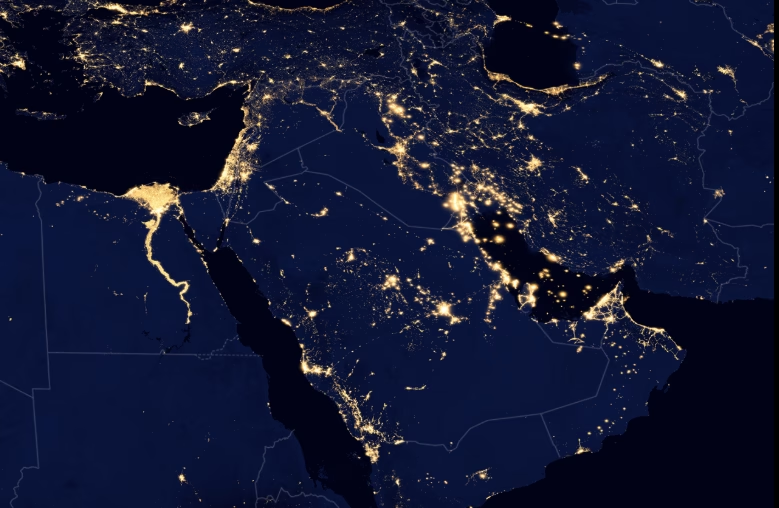
History has a funny habit of pretending it’s not about to happen—right up until it does. Iran looks stable right up to the moment it isn’t, and when that moment comes, the shockwave won’t stop at its borders. It will travel east to Beijing and north to Moscow, like a bill nobody wants to pay but everyone owes.
Let’s speak plainly.
Iran is not just a country; it’s a keystone. Pull it out, and two empires-in-denial—China and Russia—suddenly discover how much of their global posture was being propped up by duct tape and discounted oil.
China: Cheap Energy, Expensive Illusions
China’s relationship with Iran is simple in theory and desperate in practice: oil at a discount, paid quietly, shipped creatively. Iran has been one of Beijing’s favorite loopholes—a sanctioned producer willing to sell cheap, no questions asked, as long as the cash keeps moving.
If Iran falls—meaning regime collapse, civil chaos, or a Western-aligned government—those barrels don’t just vanish. They get repriced. They get regulated. They get watched.
And China’s energy bill suddenly looks like a mortgage payment instead of a coupon.
Beyond oil, Iran is a crucial land bridge in China’s Belt and Road vision. Ports, rail, pipelines—grand maps drawn in conference rooms far from reality. Instability turns those routes into liabilities. You can’t run a trade empire through a burning house.
China fears chaos more than confrontation. A collapsing Iran doesn’t just threaten supply chains; it threatens the narrative that authoritarian “stability” is superior to messy freedom. That story sells well—until it doesn’t.
Russia: The Partner Who Needs the Partner
Russia’s stake in Iran is less about money and more about leverage. Tehran has been a loyal co-signer on Moscow’s bad behavior—drones, arms coordination, sanctions evasion, and a shared talent for blaming the West for everything, including gravity.
A fallen Iran means Russia loses:
A weapons customer
A sanctions workaround
A regional spoiler
And most importantly, a co-conspirator
Russia’s foreign policy works best when the world is distracted. Iran has been an excellent distraction. Without it, Moscow stands more exposed, more isolated, and more alone—never a comfortable position for a country that confuses fear with respect.
And let’s not ignore the irony: Russia, already stretched thin, would have no capacity to stabilize Iran even if it wanted to. Empires love influence right up until influence requires responsibility.
The Real Problem: This Was Supposed to Be Slow
China and Russia planned for a gradual decline of U.S. influence, a long twilight where power quietly shifted east. Iran’s sudden collapse would be the geopolitical equivalent of someone turning on the lights in a room full of secrets.
Energy markets reprice.
Alliances get tested.
Neutral countries start choosing sides.
And the myth of the “inevitable multipolar world” starts looking less inevitable and more improvised.
The 2026 Truth
China and Russia didn’t back Iran because it was strong.
They backed it because it was useful.
When useful things break, they don’t inspire loyalty—they inspire distance.
The fall of Iran wouldn’t end their ambitions. But it would remind them of something empires hate to remember:
You can build a global strategy on oil, fear, and resentment—but the moment one pillar collapses, the rest start arguing about whose fault it was.