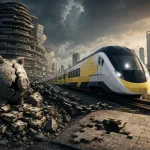
Think of it as Yoga for the brain, we are going to stretch a bit.
What if the future they warned us about quietly arrived right on schedule?
The video to this incredible 99 year old movie is at bottom of this post - in both original Black & White and Colorized -
Watch it... Specially were the droid becomes alive. -- YNOT!
Did you know Metropolis—a silent film made nearly a century ago—takes place in 2026?
That’s not a typo. Fritz Lang pointed his finger straight at now.
In Metropolis, the city of the future is tall, polished, efficient, and dazzling from above. Air traffic glides between towers. Machines hum with religious devotion. Everything looks like progress—if you’re standing on the balcony.
But underground, it’s a different story.
The workers live beneath the city, feeding the machines like sacrificial offerings. Their lives are measured in shifts, not dreams. The clock rules them. The machine doesn’t care.
Sound familiar?
Lang wasn’t predicting flying cars. He was diagnosing human nature. He understood something timeless: when technology races ahead of wisdom, people don’t become freer—they become useful. And when efficiency becomes the highest virtue, humanity quietly becomes a rounding error.
The genius of Metropolis isn’t the skyline.
It’s the warning.
The film’s famous line says the mediator between the head and the hands must be the heart. In plain modern language: if systems are built without empathy, they will eventually eat the people who built them.
And here we are—2026—living in a world run by algorithms, metrics, dashboards, and machines that never sleep. We optimize everything except meaning. We automate everything except responsibility. We celebrate innovation while quietly asking why everyone feels so replaceable.
Metropolis wasn’t about the future.
It was about us, once the noise died down.
The unsettling part isn’t that Lang got the year right.
It’s that he understood the cost—and we’re still arguing over whether it’s worth paying.
How did a silent film from 1927 become the most expensive warning ever put on screen?
A brief, proper history of Metropolis
Metropolis was released in 1927, at the height of Germany’s Weimar Republic—a period when art, anxiety, and ambition were all running at unsafe speeds.
It was directed by Fritz Lang, written by Lang and Thea von Harbou, and produced by Universum Film AG (UFA), then one of the most powerful studios in the world.
This was not an indie experiment.
This was Germany announcing, “We can out-Hollywood Hollywood.”
Who made it—and why it mattered
Fritz Lang was already a rising star, known for precision, obsession, and control. He believed cinema should think, not just entertain. His films were engineered like machines—ironically fitting for Metropolis.
Thea von Harbou, his wife at the time, wrote the original novel Metropolis alongside the screenplay. Her writing gave the film its mythic structure: messiah figures, Babel imagery, class struggle, and moral reconciliation.
Together, they weren’t predicting the future.
They were warning Europe about itself—industrial power without moral restraint.
Budget: staggeringly expensive for its time
Estimated budget: ~5–7 million Reichsmarks
Modern equivalent: roughly $200–250 million USD
At the time, Metropolis was the most expensive film ever made.
Thousands of extras were used. Massive sets were built. Miniatures, optical effects, and lighting techniques were pushed to the limit. Some scenes required actors to stand in freezing water for hours. The production nearly bankrupted UFA.
The irony was perfect:
A film about machines crushing humans nearly did the same to the studio that made it.
Music: the heartbeat of the machine
The original score was composed by Gottfried Huppertz, written specifically to synchronize with the film—a major innovation at the time.
Fully orchestral
Romantic, Wagner-influenced
Uses recurring themes (early leitmotifs) for characters and ideas
The music wasn’t background—it was narrative.
It told you when to fear the machine, when to pity the workers, and when to believe reconciliation might still be possible.
Modern restorations continue to use Huppertz’s score, often reconstructed note by note from original manuscripts.
Release—and immediate backlash
When Metropolis premiered in Berlin in January 1927, reactions were mixed to hostile:
Critics said it was too long
Too political
Too expensive
Too pessimistic
Too philosophical
International distributors cut it mercilessly. Subplots vanished. Characters lost motivation. For decades, audiences saw a mutilated version of the film and judged it accordingly.
Lang himself later called the original release a failure.
History, as usual, disagreed.
Loss, rediscovery, and resurrection
For decades, Metropolis existed only in fragments.
Then, in 2008, a nearly complete print was discovered in Buenos Aires, missing only a few minutes. This led to the 2010 restoration, considered the closest version to Lang’s original vision.
That restoration changed everything.
Suddenly, Metropolis wasn’t just a technical marvel—it was coherent, emotional, and disturbingly relevant.
Influence: almost everything you’ve seen since
Metropolis shaped modern cinema more than most people realize:
Blade Runner
Star Wars
The Matrix
Gotham City
Cyberpunk aesthetics
AI and robot archetypes
Dystopian class-divided futures
The city of tomorrow—towering above forgotten people—starts here.
Final quiet truth
Metropolis failed commercially because it asked the wrong question for its time.
It didn’t ask, “What can machines do?”
It asked, “What happens to people when they do?”