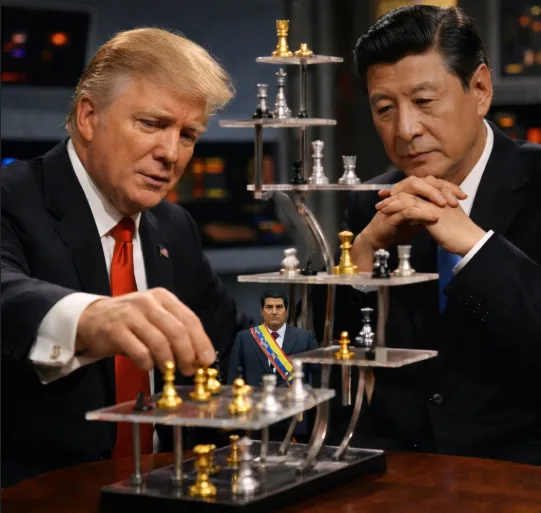
Think of it as Yoga for the brain, we are going to stretch a bit.
What Trump Did With Venezuela Was Genius? Checkmate BRICS? Or Was it?
In Star Trek II: The Wrath of Khan (1982). Spock says, “He is intelligent, but not experienced. His pattern indicates two-dimensional thinking.” -- SPOCK
Most people think the Venezuela operation was about politics, ideology, oil, gold or even revenge. That framing misses the point entirely.
What happened in early January 2026 was not just the removal of Nicolás Maduro. It was the activation of a long-dormant strategic asset—one that touches oil, refining dominance, critical minerals, gold, dollar demand, and long-term American economic leverage. The legal justification was obvious. The geopolitical justification was louder. But the real benefit—the one few people are discussing—was economic, structural, and generational.
This was not a short-term headline play. It was a board-level move.
Venezuela: The Most Misunderstood Strategic Asset on Earth
Venezuela is not just another oil state. It is arguably the single most resource-dense country in the Western Hemisphere.
It holds:
The largest proven oil reserves in the world (over 300 billion barrels)
The second-largest natural gas reserves in the Americas
The largest gold reserves in Latin America
Some of the largest undeveloped critical mineral deposits in the Western Hemisphere, including rare earths and bauxite
This is what economists call vast geological wealth—a country whose economic value is embedded primarily in its geology rather than its institutions. Venezuela has been poor not because it lacked resources, but because those resources were mismanaged, weaponized, or left dormant under the Chávez–Maduro regime.
Trump understood this distinction.
Oil Was Only Step One — Refining Is the Real Prize
The global energy narrative is often framed around who owns oil. That’s a mistake.
What matters is who refines it.
The United States has the largest and most sophisticated refining capacity on Earth. U.S. refineries were specifically designed decades ago to handle heavy crude—the exact type of oil Venezuela produces in abundance. Venezuela, by contrast, lacks both modern drilling and refining infrastructure.
This creates a natural asymmetry:
Venezuela extracts
The United States refines
The United States controls pricing, distribution, and end markets
When you control the final product, you control the leverage.
Under this model, Venezuelan crude flows north, refined fuel flows globally, and the pricing, logistics, insurance, and settlement are all denominated in U.S. dollars. This quietly reinforces dollar demand at the exact moment the world is trying to escape it.
This is not about cheap gas alone. This is about:
Industrial energy dominance
Military fuel security
Petrochemical supply chains
Dollar settlement enforcement
Critical Minerals: The China Problem Trump Targeted Directly
China’s real leverage over the West is not oil. It is refining control over critical minerals.
China controls:
40–60% of global rare earth processing
A dominant share of aluminum precursor refinement
Strategic choke points in battery, aerospace, and defense materials
One mineral matters more than most people realize: bauxite.
Bauxite is the precursor to aluminum. No bauxite, no aluminum. And aluminum is everywhere:
Aircraft
Missiles
Vehicles
Electronics
Packaging
Power infrastructure
The United States has almost no meaningful domestic bauxite reserves.
Venezuela does.
And unlike Australian bauxite (often refined in China), Venezuelan bauxite can move through the same logistics corridors as oil—ports, shipping lanes, Gulf Coast terminals—into U.S. refining and manufacturing hubs.
This is how you decouple from China without firing a shot.
Gold: The Quiet Sovereign Wealth Weapon
Oil moves economies. Gold preserves them.
Venezuela holds the largest gold deposits in Latin America. Control over Venezuelan gold does not mean flooding markets. In fact, the opposite strategy makes more sense.
Gold behaves differently than currency:
Currency is meant to be manipulated
Gold is meant to anchor value
By controlling gold supply without aggressively mining it, the United States gains:
A strategic hedge against foreign gold manipulation
A reserve expansion option without immediate inflationary impact
A long-term sovereign wealth lever
Gold prices rise when supply is constrained and demand persists. Every central bank on Earth understands this. The goal is not volume—it is price control through restraint.
This is why fears of “gold flooding” miss the point. Gold is more valuable when it stays underground.
Dollar Demand: The Hidden Feedback Loop
Here is where the strategy becomes elegant.
Even if the U.S. purchases Venezuelan resources in local currency, once those resources are refined and resold, everything clears in dollars.
That creates:
External dollar demand
Higher dollar velocity abroad
Reduced domestic inflation pressure
Stronger purchasing power at home
Americans feel this through:
Lower energy costs
Lower input costs across the economy
Rising asset valuations
Reduced reliance on adversarial supply chains
You don’t need a new reserve currency system when you control the choke points of trade.
Was This Checkmate to BRICS?
Not an immediate checkmate—but a positional advantage.
BRICS has focused on bypassing the dollar at the transaction level. Trump’s move focuses on controlling what must be transacted.
If you control:
Energy refinement
Critical material processing
Strategic mineral access
Gold supply discipline
Then settlement systems become secondary.
This was not about humiliating Maduro. It was about repositioning the United States at the center of physical reality—resources, logistics, refinement, and reserves.
Final Thought
You don’t have to like Trump to recognize the move.
This wasn’t ideological.
It wasn’t emotional.
It wasn’t short-term.
It was structural.
Venezuela was not a problem to be punished—it was an asset to be unlocked. And in a world drifting toward fragmentation, whoever controls real resources—not abstractions—writes the next chapter.
And now the Counter-Argument: Why the Venezuela Move May Not Be Genius
A strong thesis deserves an equally strong challenge. The argument that the Venezuela operation was a masterstroke rests on several assumptions—each of which carries real risks that cannot be dismissed as partisan noise.
1. Assumption of Durable Control Is Unproven
The strategy assumes that U.S. influence in Venezuela will be stable, long-term, and enforceable. History suggests otherwise.
Venezuela has:
Weak institutions
Deep internal factionalism
Powerful non-state actors controlling territory and resources
A long record of nationalist backlash against foreign influence
Removing a leader does not guarantee compliance, continuity, or legitimacy. If future Venezuelan governments pivot away from U.S. alignment—whether through elections, coups, or popular unrest—the entire resource strategy collapses or becomes politically radioactive.
Control without legitimacy is expensive and fragile.
2. Resource Extraction Is Not the Same as Resource Availability
Venezuela’s resources are massive—but they are not turnkey.
Oil infrastructure is degraded. Mining regions are unsafe. Logistics corridors are underdeveloped. Corruption remains endemic. Bringing Venezuelan oil, bauxite, and gold online at scale would require:
Tens of billions in capital
Long timelines
Security commitments
Environmental and labor concessions
These are not guaranteed returns. If global demand shifts faster than infrastructure can be rebuilt—particularly toward renewables, nuclear, or alternative materials—the strategic window may close before benefits materialize.
3. Dollar Reinforcement Could Backfire
While refining dominance strengthens dollar demand in theory, aggressive economic leverage can accelerate de-dollarization efforts in practice.
China, Russia, and aligned states may respond by:
Accelerating alternative settlement systems
Locking in long-term bilateral trade deals outside U.S. influence
Weaponizing supply chains in retaliation
In other words, asserting control can provoke exactly the coordination it seeks to prevent. BRICS may not win today—but pressure can force them to innovate faster tomorrow.
4. Gold Control Is Not Absolute
The idea that Venezuelan gold gives the U.S. hemispheric leverage assumes gold markets are centrally controllable.
They are not.
Gold is:
Globally fungible
Traded through opaque markets
Influenced by central bank behavior worldwide
If the U.S. were perceived as manipulating gold supply for strategic ends, other countries could respond by:
Increasing domestic mining
Accelerating gold accumulation
Supporting alternative reserve assets
Gold’s strength lies in neutrality. Turning it into a geopolitical lever risks undermining the very stability that makes it valuable.
5. Moral and Legal Precedent Matters
Even if strategically sound, the operation sets a precedent.
Other nations will study it.
Some will imitate it.
Others will justify their own interventions using it.
Once sovereignty becomes conditional on alignment, the international system becomes more transactional—and more volatile. Markets dislike unpredictability. Investors demand rule consistency. Long-term capital flees ambiguity.
Short-term advantage can create long-term instability.
6. Genius Requires Outcomes, Not Intent
Strategy is judged by results, not brilliance of design.
If:
Venezuela fails to stabilize
Infrastructure rebuild stalls
Political backlash erupts
Allies distance themselves
Markets price in higher geopolitical risk
Then what looked like genius becomes overreach.
History is full of plans that made perfect sense on paper.
Bottom Line of the Counter-Argument
The Venezuela move could be a masterstroke—but it could also be:
A costly overextension
A catalyst for faster global fragmentation
A bet that assumes control where influence may be temporary
Genius in geopolitics is only proven in hindsight.