Think of it as Yoga for the brain, we are going to stretch a bit.
China China China — The 2026 Wave Is Brushing Over It
“2026 won’t just turn over every rock—it will send most of them tumbling down the hill.” -- YNOT!
Everyone can agree on one thing: 2026 is shaping up to be anything but boring.
Across geopolitics, trade, and military power, pressure waves are moving fast—and China is right in the path. What we’re seeing now doesn’t look like a single event. It looks like a system under strain.
Let’s zoom out, then dive in.
China in Turmoil: Power, Purges, and Paranoia
Reports out of Beijing suggest deep instability inside the Chinese Communist Party, particularly within the military.
A stunning development:
China’s top uniformed military officer, widely viewed as Xi Jinping’s most trusted ally, has been accused of corruption and allegedly leaking nuclear weapons secrets to the United States.
Whether the espionage claim is true or not is almost beside the point.
What matters is this:
The allegation itself provides justification to remove him.
The senior leadership of the PLA appears to be getting dismantled.
This looks less like routine anti-corruption and more like political survival mode.
Even long-time China watchers note that we don’t know everything—but what we do know is enough to raise alarms.
When top generals disappear, military readiness suffers, coordination weakens, and trust inside the system erodes. Large-scale operations require confidence, cohesion, and continuity—none of which thrive in purge environments.
Taiwan: The Risk Didn’t Vanish—It Changed Shape
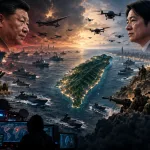
For years, the “Davidson Window” suggested China might move on Taiwan by 2027. But with China’s military leadership in chaos, a clean, coordinated invasion looks increasingly unlikely.
That does not mean the danger is gone.
In fact, the risk may now be more dangerous, not less.
Why?
A weakened leader has more incentive to keep tensions high.
Internal instability raises the chance of miscalculation.
If an incident spirals, de-escalation becomes politically impossible.
This is how accidents turn into wars.
Canada, China, and a Trade Fault Line
At the same time, a second front is opening—North America.
Canada’s flirtation with deeper trade ties to China, including allowing Chinese EVs into the country, has triggered sharp warnings from Washington. The concern isn’t just economics—it’s national security.
Chinese EVs aren’t viewed as cars.
They’re viewed as rolling data-collection platforms.
Allowing them into Canada creates a backdoor into U.S. infrastructure, given how tightly integrated the two economies are—especially in auto manufacturing.
The message from Washington is blunt:
Canada needs the U.S. market.
The U.S. does not need Canada nearly as much.
Turning Canada into a transshipment hub for China is a red line.
This isn’t rhetoric. It’s leverage.
The Bigger Picture: Re-Anchoring Power
While China and Canada appear weakened or divided, the United States is moving in the opposite direction:
Rebuilding domestic supply chains
Expanding shipbuilding and defense manufacturing
Reframing national defense around homeland protection
Pushing strategic initiatives like missile defense, Arctic security, and Greenland
The Pentagon’s 2026 posture signals a reality shift:
China is no longer treated as a distant competitor—but as a systemic challenge that cannot be stabilized through wishful thinking.
Calls for “strategic stability” sound good on paper, but they don’t account for a regime in internal turmoil.
You can’t normalize relations with a system that’s purging itself.
Today’s Takeaway – Tomorrow might be different
This doesn’t look like the calm before the storm.
It looks like the storm has already started—just unevenly distributed.
China is under pressure from within.
Allies are being tested.
Trade lines are hardening.
Security assumptions are being rewritten.
The 2026 wave isn’t crashing yet.
But it’s brushing over everything—and leaving marks.
Stay alert.
There’s an old Chinese proverb: “Two tTigers cannot share One Mountain.” It’s an apt description of the growing tension between the United States and China—and the inspiration behind a site I use to analyze this unfolding rivalry. Explore it here: https://twotigersonemountain.com/