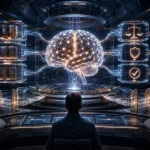
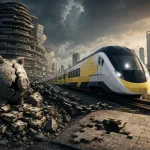
The future didn’t arrive with trumpets. It arrived quietly—updates downloading overnight, systems learning while we slept. And now the question is no longer if AI will shape our world, but how—and who is in control.
AI can be a friend.
A tireless assistant that amplifies human capability. It can cure diseases faster, reduce drudgery, surface truth from oceans of data, and give ordinary people leverage once reserved for elites. Used well, AI compresses inequality of access—turning expertise into a utility.
AI can also become a conqueror.
Not through evil intent, but through indifference. Systems optimized for efficiency without values. Decisions made at machine speed without human judgment. Power concentrated in the hands of those who own the models, the data, and the compute—while everyone else becomes dependent, monitored, optimized.
Here’s the hard truth: AI doesn’t decide its role. We do.
The real dividing line isn’t technology. It’s agency.
If humans stay awake, AI remains a tool.
If humans grow lazy, AI becomes a governor.
If humans abandon responsibility, AI fills the vacuum.
History is clear on this point:
Every powerful tool reshapes society. Printing presses empowered citizens—or fueled propaganda. Electricity lit cities—or powered surveillance. The tool is neutral. The structure around it is not.
So what determines the outcome?
The Friend Path
Humans remain in the loop
Decisions are auditable and reversible
AI augments judgment, not replaces it
People learn how systems work, not just how to use them
The Conqueror Path
Blind trust in black boxes
Delegation of moral responsibility
Centralized control with opaque incentives
Comfort traded for autonomy
This isn’t science fiction.
This is governance.
This is culture.
This is education.
And most of all, this is choice.
AI will not wake up one morning and conquer humanity.
Humanity may simply stop paying attention.
The future is here right now.
Whether AI becomes our friend or our conqueror depends on a single factor:
Do we use it to think more—or to think less?
The Long Road Ahead: How AI Will Transform Us — and How we can Do It
AI isn’t a gadget phase or a software upgrade. It’s a civilizational shift. The long road ahead won’t be paved by hype or shortcuts; it will be built by choices—technical, moral, economic, and deeply human.
1) What AI Will Change
Work → Leverage. Routine cognition will be automated. Human value moves up the stack: judgment, synthesis, taste, ethics, leadership.
Knowledge → Access. Expertise becomes cheap; wisdom becomes scarce. The edge won’t be knowing more, but knowing what matters.
Institutions → Adaptation. Education, healthcare, finance, and governance will either refactor around AI or calcify and fail.
Identity → Agency. As tools grow powerful, the question becomes: who is steering? Humans must remain the authors, not passengers.
2) What AI Will Not Replace
Meaning. Purpose isn’t computed.
Responsibility. Accountability cannot be delegated to a model.
Values. Optimization needs a north star; humans set it.
3) The Real Risk
Not that AI becomes superhuman—but that humans become passive. Delegating thinking is easy. Delegating judgment is fatal. The danger isn’t intelligence runaway; it’s attention runoff.
4) How We’re Going to Do It
a) Build with Constraints.
Power without guardrails erodes trust. We design systems that are auditable, reversible, and aligned with human oversight.
b) Teach the Stack.
Everyone learns the basics: prompts, data literacy, verification, and model limits—like reading and arithmetic in earlier eras.
c) Keep Humans in the Loop.
Critical decisions—medical, legal, military, financial—require human sign-off. AI proposes; humans dispose.
d) Reward Judgment, Not Just Output.
Incentives must value process and ethics, not just speed or volume.
e) Local Control, Global Standards.
Decentralized deployment with shared norms: privacy, transparency, safety.
5) The Payoff
If we do this right, AI amplifies the best of us: creativity without exhaustion, analysis without paralysis, scale without dehumanization. We get more time for what only humans can do—care, create, decide.
6) The Promise
The long road isn’t about building smarter machines. It’s about becoming wiser stewards. AI will transform us—but only if we insist on shaping it, not surrendering to it.
The future isn’t automated. It’s authored.
Our we just give up – let it take over, and we will all live in a bad Sci-Fi Movie.