Think of it as Yoga for the brain, we are going to stretch a bit.
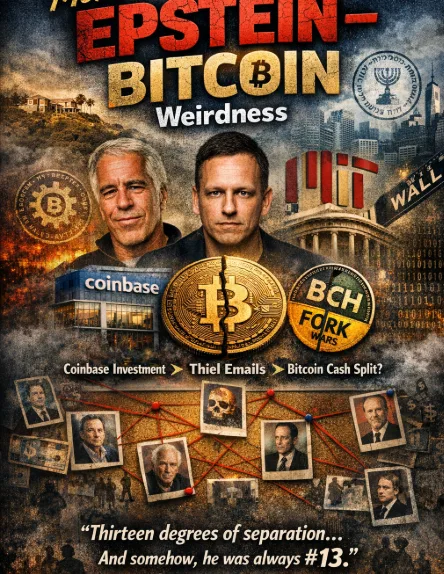
More EPSTEIN Weirdness – Was Epstein Connected to Bitcoin — or Is This Just Another Power Game?
“They say there are six degrees of separation to everyone. With Epstein, it felt like thirteen — and somehow, he was always the thirteenth. Just Follow the Money”-- YNOT!
Just when you think the Epstein story has reached the bottom of the well, someone lowers another bucket.
Now the latest rumor making the rounds says the Epstein network didn’t just dabble in Bitcoin — they tried to influence it, maybe even destroy it. And if you listen to some corners of the internet long enough, you’ll hear everything from “Bitcoin was created by Epstein” to “Bitcoin is a Mossad project” to “Wall Street tried to hijack it from day one.”
That’s a lot of smoke. The question is: is there fire, or just a room full of people lighting matches?
The Epstein Pattern
Jeffrey Epstein wasn’t just a man. He was a network. A fixer. A collector of powerful friends. A man who seemed to know everyone who mattered and somehow never quite explained how.
There are documented facts:
He reached out to technologists.
He invested in startups.
He had contact with high-profile figures in finance and academia.
He showed interest in emerging financial systems.
There are also emails showing curiosity about Bitcoin developers around 2011. Curiosity. Not authorship. Not creation.
And here’s the part people forget: Bitcoin launched in 2009. The white paper was released in 2008. By the time Epstein’s inquiries show up, the train was already moving.
That matters.
Bitcoin: Open Code, Open War
Bitcoin is not a company. It’s not a CEO. It’s not a headquarters in Switzerland with a secret basement.
That doesn’t mean nobody tried to steer it. It means steering it completely is another matter.
2014: The Coinbase Investment
Why Was Epstein Investing in Coinbase — and What Was He Talking About with Peter Thiel?
When a man like Jeffrey Epstein invests in something, people don’t assume it’s about the tech.
They assume it’s about leverage.
And when his name appears in the same sentence as Coinbase and Peter Thiel, the temperature in the room rises a few degrees.
Let’s slow this down and separate what is known from what is imagined.
The Coinbase Investment (What’s Documented)
In 2014, Epstein participated in a funding round involving Coinbase. Not as the founder. Not as the architect. As an investor.
That year matters.
2014 was:
Post–Silk Road.
Post–Mt. Gox collapse.
Peak skepticism toward Bitcoin.
The era when crypto exchanges were fragile and experimental.
Coinbase was positioning itself as the compliant, regulated bridge between crypto and the traditional banking system.
If you were a financier who understood that crypto might become a major rail of global finance, you’d want exposure. That doesn’t make you a mastermind. It makes you opportunistic.
And Epstein was many things. Opportunistic was one of them.
There is no evidence he controlled Coinbase.
There is no evidence he shaped Bitcoin’s protocol.
There is evidence he invested.
That’s it.
The Peter Thiel Conversation (Where It Gets Interesting)
Emails later surfaced showing communication between Epstein and Peter Thiel around crypto and related financial ideas.
Now, here’s where people leap.
Thiel co-founded PayPal.
He was early in Facebook.
He backed disruptive technologies.
He’s no stranger to systems that challenge financial power structures.
So when Epstein emails someone like that, speculation fills the gaps.
Some reports reference discussions about:
Bitcoin’s public perception.
Strategic positioning.
Potential discrediting or reshaping narratives.
But here’s the problem: emails discussing a strategy are not proof of an executed conspiracy.
People in finance discuss positioning all the time.
“Should we support this?”
“Should we compete with this?”
“Should we neutralize this?”
That’s not a secret council of doom. That’s capitalism with sharp elbows.
2015: MIT and the Digital Currency Initiative
Did Epstein Fund MIT to Control Bitcoin — and Did He Cause the 2017 Bitcoin Cash Split?
When you mix Jeffrey Epstein, Massachusetts Institute of Technology, and Bitcoin Cash into the same sentence, you don’t get calm discussion.
You get fireworks.
So let’s take the oxygen out of the room and walk through this carefully.
Part 1: Epstein, MIT, and the Digital Currency Initiative (DCI)
In 2015, MIT’s Media Lab launched the Digital Currency Initiative (DCI) — a research effort supporting open blockchain development, including Bitcoin Core contributors.
It is documented that Epstein donated to MIT’s Media Lab.
It is documented that some funds associated with him flowed into Media Lab–linked projects.
It is documented that DCI funded several Bitcoin Core developers.
Now here’s the leap people make:
“Epstein funded MIT. MIT funded developers. Therefore, Epstein controlled Bitcoin.”
That’s a three-step jump across a canyon.
What Funding Actually Buys
Funding:
Pays salaries.
Supports research.
Keeps contributors full-time.
Funding does not:
Grant unilateral control of Bitcoin’s protocol.
Override consensus rules.
Force miners and node operators to accept code.
Secretly rewrite the blockchain.
Bitcoin code changes require:
Public proposals (BIPs).
Community debate.
Miner and node adoption.
Open-source visibility.
Even if a developer is funded by someone questionable, their code is still publicly reviewable. Thousands of eyes can inspect it.
Influence? Possibly.
Backdoor control? No evidence.
Epstein-funded developers were involved in creating Bitcoin Cash as a deliberate sabotage operation.
What is factual?
Some developers connected to broader funding ecosystems supported block-size increases.
Bitcoin Cash emerged from ideological disagreement about scaling.
What is not proven?
That Epstein orchestrated the fork.
That the fork was a coordinated intelligence attack.
That it was a master plan to destroy Bitcoin.
Forks are possible precisely because Bitcoin is open-source.
If you don’t like the rules, you copy the code and go your own way.
That’s not sabotage.
That’s open governance — messy, emotional, and public.
Influence vs Control
Here’s where people get sloppy.
If someone invests in: A Bitcoin company
A developer research fund
An exchange
A privacy coin alternative
That is influence. That is not control.
Financial ecosystems attract power players. They always have. Railroads did. Oil did. Telecom did. The internet did. Crypto is no different.
If Epstein funded research or invested in early crypto companies, that doesn’t make him Satoshi Nakamoto. It makes him opportunistic.
And opportunists follow money.
Motive: Destroy or Control?
This is where things fork.
If Bitcoin threatens:
Central banking power
Fiat dominance
Surveillance rails
Financial gatekeeping
Then powerful people will either:
Try to destroy it.
Try to control it.
Try to profit from it.
History says most choose option three.
Wall Street didn’t destroy the internet. They IPO’d it.
They didn’t destroy derivatives. They monetized them.
So if Epstein or Thiel discussed Bitcoin strategy, the more plausible motive isn’t mystical sabotage.
It’s positioning.
And positioning is not the same thing as authorship or control.
Could Divide-and-Conquer Be a Strategy?
Yes.
Financial power structures often:
Encourage fragmentation.
Fund alternatives.
Back competing narratives.
Exploit internal disputes.
That’s how politics works.
That’s how corporate warfare works.
That’s how finance works.
So is it possible that powerful actors amplified divisions? Absolutely.
Is there documented proof that Epstein masterminded Bitcoin Cash to destroy Bitcoin? No.
And in high-stakes financial analysis, “possible” is not the same as “proven.”
Why This Story Feels Plausible
Here’s why people believe it:
Epstein was deeply embedded in elite networks.
He funded institutions.
Institutions fund developers.
Bitcoin had a massive internal fracture.
The timing overlaps.
Our brains love pattern completion. But correlation is not command.
The Structural Reality
Bitcoin’s security does not depend on: One developer. One university. One funding source.
It depends on: Distributed nodes. Distributed miners. Economic majority consensus.
Bitcoin Cash forked off and claimed to be “the real Bitcoin.”
Markets decided otherwise.
If this were a master sabotage attempt, it failed.
Bitcoin continued. Hashrate recovered. Price eventually surged.
That’s not how a successful covert takedown looks.
The Real Fear Beneath the Story
This isn’t really about Epstein. It’s about trust.
People don’t trust: Governments. Banks. Intelligence agencies. Media narratives.
So when Epstein’s name touches anything — even loosely — it triggers a deeper anxiety: Is everything compromised?
That’s the emotional engine driving the Bitcoin weirdness.
What About the “Destroy Bitcoin” Narrative?
There have been documented attempts to:
Centralize custody. Launch derivatives to influence price. Create competing forks. Fund alternative protocols. Push regulatory choke points.
That’s not conspiracy. That’s how financial power operates.
If something threatens an existing system, that system pushes back.
The gold market saw it.
The internet saw it.
Media saw it.
Crypto sees it.
Bitcoin being under attack doesn’t prove a shadow empire controls it. It proves it’s disruptive enough to be worth fighting over.
The Marketing Angle (Read Carefully)
Notice how quickly conspiracy content slides into:
“Exit the system.”
“Buy through this link.”
“Use this wallet.”
“Join this platform.”
“Become sovereign today.”
Fear sells. So does outrage. So does secrecy.
When every shocking headline ends in an affiliate link, you might want to ask who’s monetizing your anxiety.
So What’s Actually Weird?
What’s weird isn’t that Epstein’s circle intersected with finance and tech. That’s predictable.
What’s weird is how quickly the narrative mutates into:
Bitcoin was created by intelligence.
Bitcoin is controlled by Israel.
Bitcoin is a deep state asset.
Bitcoin was engineered to trap dissidents.
There is no evidence supporting those claims.
Speculation? Yes.
Evidence? No.
And in finance, speculation without evidence is just another form of leverage.
The Hard Truth
If Epstein invested in Coinbase, that tells us:
He saw crypto as important.
He wanted exposure.
He moved in circles where disruptive finance mattered.
If he emailed Peter Thiel, that tells us:
He had access.
He was curious.
He wanted proximity to power.
It does not prove:
He created Bitcoin.
He controlled Bitcoin.
He orchestrated Mt. Gox.
He owned the network.
There is zero evidence of those claims.
And in financial analysis, absence of evidence matters.
The Bigger Question
Here’s the uncomfortable thought.
If Bitcoin is strong enough to attract billionaires, intelligence-linked figures, venture capitalists, hedge funds, and political players — that doesn’t prove it’s compromised.
It proves it matters.
Power doesn’t chase irrelevant things.
It circles leverage.
And sometimes the weirdness isn’t proof of corruption.
Sometimes it’s proof that the thing is too important to ignore.
Maybe the real lesson isn’t that Bitcoin is controlled.
Maybe the lesson is this:
When money changes form, everyone with power tries to touch it.
The question isn’t who tried.
The question is whether they succeeded.
So far, the network still runs.
And that might be the strangest part of all.
The Hopefully finally Take
More Epstein. More Bitcoin weirdness.
Here’s the simple version:
Powerful networks try to influence everything.
Bitcoin is valuable enough to attract those networks.
Influence attempts are not proof of control.
Fear narratives are profitable.
Markets react to stories — especially dark ones.
Bitcoin doesn’t need to be perfect to survive. It just needs to remain decentralized enough that no single actor can dominate it.
So far, it has.
And here’s the uncomfortable thought:
Maybe the real system isn’t controlled by secret masterminds pulling every string.
Maybe it’s messier than that.
Maybe it’s just powerful people trying — and often failing — to grab whatever looks like the next lever of control.
Sometimes the scariest story is the one where nobody is fully in charge.
And that might be the most honest explanation of all.
And you know what I have a headache – Good night – and thank you for reading all the way to the bottom.