Think of it as Yoga for the brain, we are going to stretch a bit.
Agroterrorism – Can a Country Be Brought to Its Knees by a Fungus?
“With AI and gene-editing tools, it’s no longer science fiction to design a virus or fungus that targets a specific crop—or even a genetic strain. So the question isn’t can it be done… it’s why fire missiles at a nation, when a hidden organism can quietly do far more damage? May be it already has” --YNOT
Most people still imagine war the old-fashioned way. Tanks rolling. Missiles flying. Men in uniforms making speeches about freedom while somebody else’s town catches fire. But the modern world has a more elegant form of ugliness. If you really want to hurt a country, you do not always need to fire a bullet. You just need to make sure its people cannot eat. And that, friends, is where the scary-as-heck truth about agroterrorism begins.
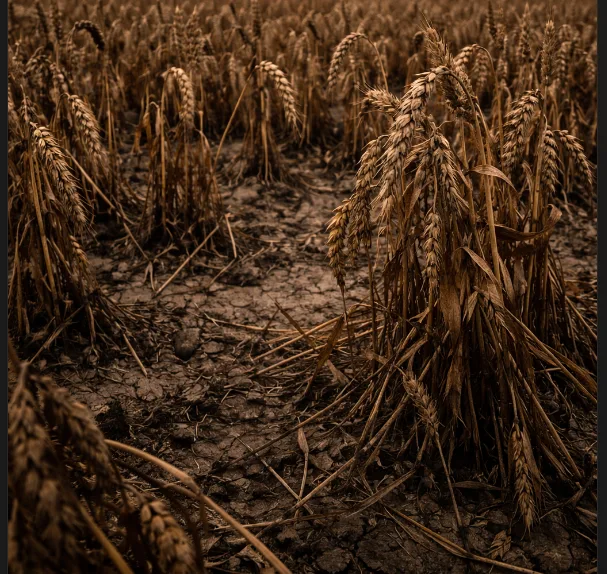
This is not some late-night conspiracy cooked up by a man with three energy drinks and no supervision. In June 2025, federal prosecutors in Michigan charged two Chinese nationals, Yunqing Jian and Zunyong Liu, in connection with smuggling Fusarium graminearum into the United States. The Justice Department said scientific literature classifies the fungus as a potential agroterrorism weapon because it causes head blight in wheat, barley, maize, and rice, and because it can contaminate grain with toxins dangerous to humans and livestock. One of the defendants, Jian, later pleaded guilty in November 2025. (Department of Justice)
Now let us pause and appreciate the peculiar genius of this danger. A bomb is loud. A missile is obvious. A fungus is quiet. It does not march in formation. It does not wave a flag. It just slips into the food chain like a pickpocket in a crowded station and starts doing arithmetic with your harvest. The USDA notes that this pathogen reduces yield and seed quality, producing those shriveled “tombstone” kernels, while also contaminating grain with mycotoxins that can make it unsafe for food or feed. That is not merely a farm problem. That is a grocery-store problem, an inflation problem, a livestock problem, and before long, a political problem. (ARS)
And here is the part people miss because supermarkets have spoiled us. Civilization is only a few missed meals away from bad manners. Food is not just another commodity sitting on a spreadsheet beside copper and soybeans. Food is order. Food is patience. Food is the thin line between a family planning next year and a mob blaming whoever is nearest. The world depends heavily on a few staple crops, and FAO has long noted that just three crops—rice, maize, and wheat—provide about 60 percent of the world’s food energy intake. Put pressure on those systems, and you are not just attacking agriculture. You are attacking confidence itself. (FAOHome)
That is what makes agroterrorism so wicked. It works in shadows. A crop failure can be mistaken for weather, bad luck, poor seed, or bureaucratic incompetence. By the time people realize something was intentional, the harvest is already ruined, prices are already climbing, rumors are already spreading, and every crank with a phone is explaining to the public who secretly poisoned whom. A country does not need to be invaded when it can be confused, divided, and made hungry. Hunger has a way of turning political arguments into street theater in a real hurry.
The frightening thing is not that every case is a proven act of state sabotage. The frightening thing is that the method is plausible. It is cheap, deniable, and hard to spot early. A hostile state, a proxy network, or even a small determined cell does not have to conquer your army if it can rattle your food supply, wreck your farm economy, and make your citizens lose trust in the people supposed to protect them. That is the sort of attack that arrives without drumrolls and leaves everybody arguing while the shelves thin out.
So yes, this is real. The 2025 smuggling case was real. The pathogen was real. The risk is real. And the lesson is plain: in today’s world, a nation can be weakened without a single shot being fired. The battlefield may look less like Normandy and more like a wheat field. That sounds absurd right up until the bread costs twice as much, the livestock feed runs short, and the politicians start blaming the weather.
That is the joke modern civilization plays on itself. We built a world so advanced, so connected, so efficient, that one of the oldest enemies on earth — a fungus — can still walk in and remind us who is boss.