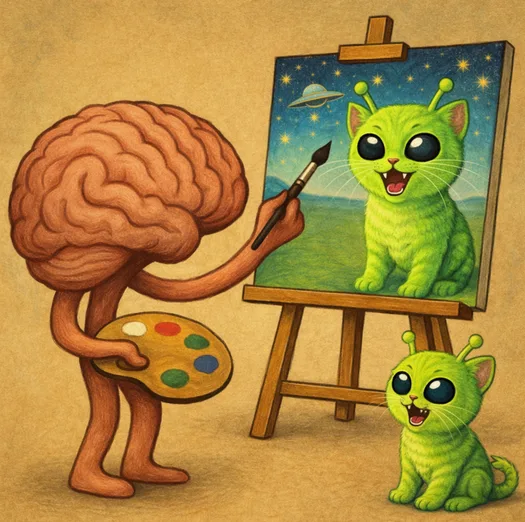
Think of it as Yoga for the brain, we are going to stretch a bit.
What Happens When You Truly Believe “Whatever the Mind Can Conceive and Believe, It Can Achieve”?
“nothing they plan to do will be impossible for them.”-- GOD Genesis 11:6
What if the biggest prison most people live in has no bars, no guards, and no walls—just a set of ideas they were told to never question?
Napoleon Hill built a whole philosophy around the notion that the human mind is not some dusty storage closet for facts, but a workshop. A noisy one. A messy one. A place where strange parts get thrown together until something useful, beautiful, or profitable comes walking out. The trouble is, most people don’t use their minds that way. They use them like a waiting room. They sit there politely with their little number in hand, hoping life will call them next.
That famous line—“Whatever the mind can conceive and believe, it can achieve”—gets repeated so often it risks becoming wallpaper. People hear it, nod like they just swallowed wisdom, and then go right back to doubting every unusual thought they have. They will say they believe in possibility, but the minute an idea looks odd, inconvenient, or a little embarrassing, they put it down like it was radioactive.
Now there’s the joke: nearly every breakthrough looks ridiculous in its first pair of shoes. A flying machine sounded absurd until one flew. Talking to a person on the other side of the planet would’ve sounded like lunacy once. Carrying the world’s information in your pocket would have gotten you laughed out of the room not that long ago. The world is full of people enjoying miracles they would have mocked the day before they arrived.
That is why an open mind matters. Not because every strange idea is true. Lord knows plenty of ideas are as useless as a screen door on a submarine. But if you slam the door on all unconventional thinking, you also slam it on the rare idea that could change your life.
An open mind is not gullibility. It is not believing every fool with a microphone, a podcast, or a PowerPoint deck. It is something far more practical. It is the willingness to say, “I may not understand this yet, but I won’t bury it just because it is unfamiliar.” That little sentence has probably made more money, saved more businesses, and changed more destinies than most motivational posters ever printed.
Out-of-the-box thinking is a phrase people love right up until somebody actually does it. Then they call it reckless, unrealistic, or dangerous. What they usually mean is this: you are making me uncomfortable by showing me the box was never as solid as I thought. Human beings get attached to their boxes. We decorate them. Defend them. Build careers inside them. And then we act offended when somebody cuts a window in the wall.
If you want extraordinary thinking, you have to make peace with discomfort. You have to let ideas in before they are proven, polished, and socially approved. You have to be willing to look naive for a while. That is the price of original thought. Most people would rather be safely wrong with the crowd than awkwardly right by themselves.
The mind does something funny when it believes a thing is possible. It starts hunting for paths. It notices patterns. It takes risks it would otherwise avoid. It asks better questions. It stops saying, “That will never work,” and starts asking, “What would make this work?” That one change alone can turn a dead end into a doorway.
But belief is not magic dust. Hill was not saying you can sit on a couch, think rich thoughts, and wait for the universe to direct-deposit a miracle into your checking account. Belief is the spark. Work is the engine. Discipline is the steering wheel. Imagination opens the door, but somebody still has to walk through it carrying tools.
So keep your mind open—but not empty. Let in bold ideas, difficult questions, and possibilities that make ordinary people roll their eyes. Test them. Wrestle with them. Improve them. Throw out the nonsense and keep the gold. That is how real thinking works. Not by blind acceptance and not by cynical rejection, but by intelligent curiosity.
Because the people who do extraordinary things are rarely the ones who knew for certain. They are usually the ones who were open enough to consider what everybody else dismissed.
And that may be the funniest truth of all: what we call impossible is often just a label the fearful put on the unfamiliar—right before somebody else goes and builds it.
What If Opening Your Mind Was a Skill You Could Practice?
Here’s a 10-point plan. Not the fluffy kind that makes you feel wise for twelve minutes and changes nothing. The kind you can actually use.
Question one thing you “know” every day.
Pick one belief, opinion, habit, or assumption and ask, How do I know this is true? Most people don’t think. They just rearrange their prejudices and call it wisdom.
Read from people you normally disagree with.
Not to get mad. Not to win imaginary arguments in the shower. Read to understand how another mind builds its case. A closed mind loves an echo. An open mind can survive a contradiction.
Talk to people outside your tribe.
Different age, class, politics, religion, profession, country, whatever. Reality is too big to be understood from one porch.
Replace “That’s stupid” with “What am I missing?”
That one sentence can save you from a lifetime of smug ignorance. Some ideas really are foolish. But some only look foolish because they are new.
Travel when you can. If you can’t, change your routine.
Go somewhere unfamiliar. Eat somewhere different. Visit places where you are not the default setting. A mind gets stale the same way bread does: by sitting too long in one place.
Keep an idea journal, especially for strange ideas.
Most people kill unusual thoughts before breakfast. Write them down instead. Bad ideas can turn into good ones, and good ones often arrive wearing ugly clothes.
Run small experiments.
Don’t just think differently—test differently. Try a new workflow, new book genre, new skill, new conversation style, new business angle. Tiny experiments are how the mind learns it has more room than it thought.
Learn something that makes you uncomfortable.
Study a subject that stretches you: philosophy, physics, art, music, coding, psychology, history, finance. Nothing opens the mind like realizing how much you don’t know. Humility is a fine locksmith.
Spend time in silence.
Walk without noise. Sit without a screen. Let your mind finish a thought for once. Most people are not open-minded; they are just overstimulated and too distracted to notice.
Separate your identity from your opinions.
This is the big one. If every opinion feels like part of your soul, you’ll defend nonsense like it’s your child. But if you can say, I was wrong, you become dangerous in the best possible way—you can actually grow.
The trick is this: an open mind does not mean believing everything. That’s not wisdom. That’s just intellectual shoplifting. An open mind means being willing to examine, test, revise, and sometimes abandon what no longer fits the facts.
Most people want new results while guarding old assumptions like family heirlooms. That is like asking for fresh air while refusing to open a window.
And there’s the rub: the mind does not open all at once. It opens a crack, then an inch, then a door. Usually right after pride leaves the room.