Think of it as Yoga for the brain, we are going to stretch a bit.
What Can Democrats Learn From Trump Changing the Republican Party?
A political party can survive disagreement. It cannot survive pretending three different groups with three different visions of reality all want the same future. Eventually, somebody grabs the steering wheel — and the others realize they were never driving.--YNOT!
The Democrats’ biggest problem may not actually be Republicans.
It may be that they are quietly becoming three different parties pretending to be one.
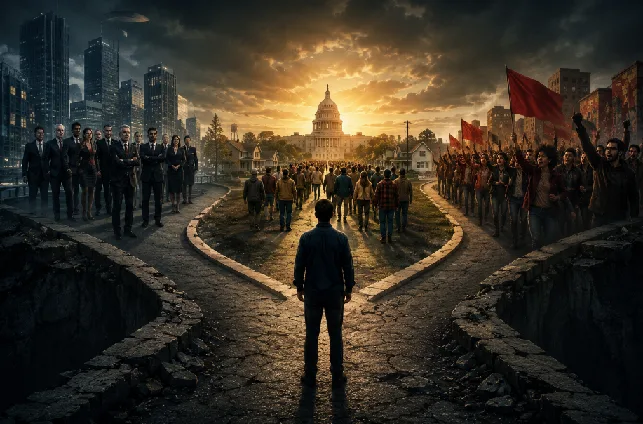
On one side, you have the Democratic establishment — the DNC, major donors, consultants, career politicians, media allies, and the institutional power structure. These are the people who still largely control the machinery: fundraising, messaging, endorsements, party rules, and bureaucracy.
They speak the language of management, strategy, polling, and “narratives.”
Then you have the normal Democrats.
The school teachers.
Union workers.
Minorities trying to move into the middle class.
Suburban families.
Working people who mostly just want:
stable jobs,
affordable groceries,
safe neighborhoods,
decent healthcare,
and a future for their children.
A lot of these people are not ideological revolutionaries. They’re just trying to survive modern America without losing their minds or their savings account.
And then there’s the third camp.
The rising socialist-progressive wing surrounding figures like Bernie Sanders, Alexandria Ocasio-Cortez, and Zohran Mamdani.
This faction increasingly views capitalism itself as the problem. They push for large-scale wealth redistribution, expanded government control, aggressive identity politics, and economic systems far more influenced by democratic socialism than traditional American liberalism.
Now here’s where things get complicated.
These three groups often vote together…
but they do not see the world the same way.
The DNC elites want control and electability.
The working-class Democrats want stability and opportunity.
The socialist wing wants transformation.
That is not a small disagreement.
That’s three different visions of America sharing one logo.
And Trump exposed that fracture the same way a hammer exposes cracks in concrete.
Because when economic pressure rises, people stop speaking in theories and start speaking in survival.
A father working two jobs doesn’t care about academic slogans if he can’t afford rent. A mother buying groceries doesn’t care what elite institutions call “the narrative” if eggs doubled in price. Working people eventually become immune to political poetry when the electricity bill shows up.
Trump understood something many Democrats forgot:
People will forgive rough language faster than they will forgive feeling ignored.
That doesn’t mean Trump solved everything. Far from it. But he recognized anger that many establishment politicians dismissed as ignorance.
And the Democratic Party now faces the same crossroads Republicans faced a decade ago:
Do they remain controlled by institutions and consultants?
Do they move further toward socialism?
Or do they reconnect with ordinary working Americans who increasingly feel politically homeless?
Because history has a funny habit. When normal people believe neither party truly represents them anymore, they stop voting for politicians…
…and start voting against whoever they think looks most responsible for the mess.
That is how political earthquakes begin.
The Republican Party got reshaped by populist anger.
The Democratic Party may soon have to decide whether it wants to resist that force… or become its own version of it.
And that decision may define American politics for the next twenty years.