Think of it as Yoga for the brain, we are going to stretch a bit.
Diem Sustine: When All You Can Do Is Endure the Day
Diem sustine—endure the day when you must, but never build your home on the battlefield. -- YNOT!
Survival is a legitimate short-term strategy. It is a terrible permanent way of life.
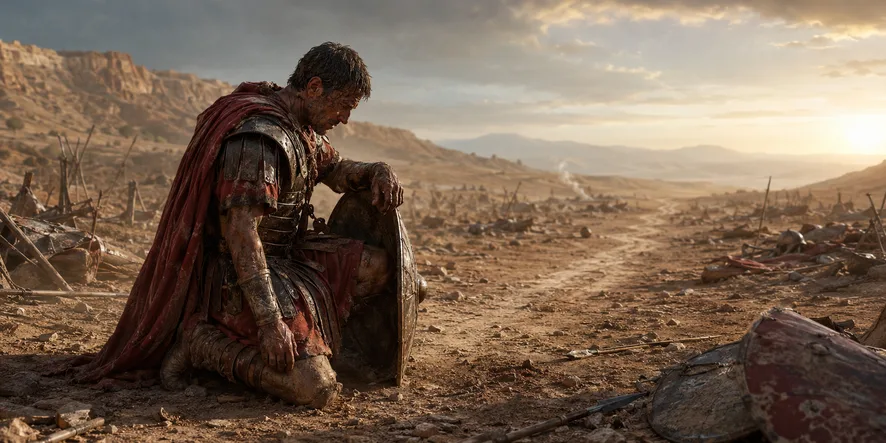
Imagine that you are a Roman soldier stationed somewhere at the edge of the empire.
You are standing in a desert under an unforgiving sun. Your armor is hot enough to burn your skin. Your sandals are worn through, your water is warm, and the food in your pack has been traveling with you for months.
Then the enemy attacks. Friends you marched beside yesterday are dead. Half your unit is wounded, missing, or exhausted. Nobody is talking about victory anymore. Nobody is dreaming about glory, medals, promotions, or returning triumphantly to Rome.
There is only one objective left: Survive the day.
In Latin, we might express it as: Diem sustine. Endure the day.
Not carpe diem—seize the day.
Not conquer the enemy. Not capture the city. Not expand the empire.
Just endure the day.
Have you ever felt that way in your business, career, marriage, or family?
You wake up already tired. You are not building anything. You are not excited about the future. You are simply putting on your armor and trying to make it through another day without being destroyed.
If that is where you are, something is wrong.
You may not have created the original problem. The economy may have changed. A partner may have betrayed you. A customer may have left. A competitor may have attacked. Your family may be going through a crisis that you did not cause. But even when you did not create the battlefield, you are still responsible for deciding what you will do on it.
The First Bad Solution: Destroy Yourself
Some people decide that the pain is permanent and that the only escape is to end their lives. It is not a solution.
It does not repair the business, heal the family, pay the debts, or answer the unanswered questions. It transfers the pain to everyone left behind.
I have known people who chose that road. Their problems did not disappear. Their problems became part of somebody else’s life.
When a person reaches that point, he does not need another motivational slogan. He needs immediate help, distance from the battlefield, and another human being beside him. Never make a permanent decision during a temporary defeat.
The Second Bad Solution: Abandon Everything
The second option is to pack your bags and disappear.
Leave the company. Leave the career. Leave the family. Move to New Zealand and start over where nobody knows your name.
People do it.
After a divorce, some people discover that they have no real friends, no meaningful career, and no idea who they are without the relationship. They move somewhere else and attempt to create an entirely new life.
I understand the temptation. I once started over myself. I did not go to New Zealand, but I went farther down that road—and stayed there longer—than I probably should have.
Sometimes leaving is necessary. There are abusive relationships, corrupt organizations, destructive partnerships, and failing businesses that cannot be saved.
But changing locations does not automatically change the person making the move.
If you do not understand what happened, you may rebuild the same prison in a different country.
The Third Bad Solution: Numb Yourself
The third option is to stop feeling.
Some people use alcohol. Others use drugs, gambling, food, sex, shopping, or endless entertainment. Some bury themselves in work and call it ambition.
The method changes, but the objective is the same: avoid thinking.
Numbing yourself may make tonight easier, but it makes tomorrow harder. While you are escaping, the problems continue to grow. The debt compounds. The relationship deteriorates. The business weakens. Your health declines.
Eventually, the painkiller becomes another source of pain. You are no longer fighting one enemy. You are fighting two.
The Fourth Bad Solution: Blame Everyone Else
This is the most popular solution because it requires the least work.
Blame your employees. Blame your customers. Blame your spouse. Blame your parents. Blame the government, the economy, your competitors, your childhood, or your former business partner.
Then complain.
Complain in the morning. Complain at lunch. Complain over drinks. Find people who agree with you and complain together.
The dangerous thing is that your complaints may be completely justified.
You may have been betrayed. You may have been treated unfairly. Other people may have caused most of the damage.
But proving that somebody else started the fire does not extinguish it.
Blame explains the past. It does not build the future.
The Only Solution That Works
The real solution begins when you stop running, stop numbing yourself, and stop preparing your case against everybody else.
You sit down.
You take some time away from the noise and look honestly at what is wrong. You examine your life as if you were examining somebody else’s business.
What would you see if you were an outside consultant?
Would you tell the owner that the company has too much debt? That he trusts the wrong people? That he avoids difficult conversations? That he is trying to save a partnership that died years ago? That he confuses loyalty with weakness? That he keeps repeating the same mistake because admitting it would injure his pride?
Sometimes you need another person to help you see clearly—a friend, mentor, counselor, accountant, attorney, or experienced businessperson who is not emotionally trapped inside the situation.
But whether you do it alone or with help, the essential ingredient is the same: Honesty.
Part of that honesty is recognizing two truths at the same time:
You may not have caused everything that happened.
You are still part of the situation and therefore part of the solution.
That is not the same as blaming yourself.
Responsibility is not blame. Responsibility is power.
If everything is somebody else’s fault, then your future depends entirely on somebody else changing. The moment you identify your part, you discover something you can control.
The CEO Cookbook Recipe
The problem
You have stopped trying to build a better future. Your entire life has become an exercise in surviving the present.
The ingredients
Time alone without distractions
An honest inventory of the situation
Financial and operational facts
One trusted outside perspective
The courage to admit your contribution
A short list of things you can control
A realistic plan for changing or leaving the situation
The method
First, stabilize the immediate crisis. A wounded soldier cannot redesign the empire while arrows are still flying. Protect your health, cash flow, family, and essential operations.
Second, separate what happened to you from what you did in response. You may not control the first, but you can change the second.
Third, identify the repeated pattern. Ask yourself:
What warning signs did I ignore?
What conversation did I avoid?
What decision did I postpone?
What behavior am I tolerating?
What am I afraid to lose?
What truth do I already know but refuse to admit?
Fourth, decide whether the situation must be repaired, redesigned, or abandoned.
Finally, take one concrete action. Not a speech. Not a promise. Not another complaint. An action.
Make the call. Review the numbers. End the destructive agreement. Replace the manager. Ask for help. Begin the treatment. Apologize. Establish the boundary. Prepare the exit.
Then take another action tomorrow.
Endurance Is Not the Destination
There are times when enduring the day is an accomplishment.
When you are wounded, grieving, overwhelmed, or under attack, survival is enough. There is no shame in lowering your head, lifting your shield, and making it through until nightfall.
Diem sustine. Endure the day.
But do not build your home on the battlefield.
If every morning feels like another enemy attack, endurance is no longer a virtue. It is a warning.
You were not born merely to survive meetings, tolerate a miserable marriage, carry a dying company, or spend your career counting the hours until you can go home.
There comes a moment when diem sustine must become carpe diem.
You must stop merely enduring the day and begin seizing it again.
The Final Lesson
You may not be responsible for everything that happened to you. Other people may have lied, cheated, failed, abandoned, or attacked you.
But your recovery belongs to you.
Sit down. Become quiet. Look at the facts as if they belonged to somebody else. Admit what is broken. Admit your part in it. Decide what must change, and then begin changing it.
If today is especially hard, endure it. You will survive.
But when morning comes, do not simply prepare to endure another day.
Start planning your way off the battlefield.
One Final – Final Note
You do not want to be the last soldier standing on a battlefield that has already been lost.
Remember the movie 300? The Spartans fought bravely. They fought until the bitter end—and in the end, they still died.
There is courage in standing your ground, but there is also wisdom in knowing when the battle is no longer worth fighting.
I often ask my clients a question that initially shocks them:
Do you want to be rich, or do you want to be right?
Sometimes the smartest decision is to shut things down, take whatever money and resources you have left, and walk away. You may be far better off preserving your capital, health, relationships, and future than fighting until there is nothing left to save.
Walking away does not necessarily mean you were wrong. It does not mean the other side won. And it does not always mean that you gave up.
Sometimes giving up is not giving up.
Sometimes it is simply being smart enough to survive the battle—and wise enough to choose a better one.