Think of it as Yoga for the brain, we are going to stretch a bit.
AI Is Changing How We Learn — and That is a Good Thing
Remember back in ancient times when kids had to prepare for the SATs?
You bought the giant prep book. You went to classes. You memorized vocabulary words, formulas, rules, tricks and practice questions.
A lot of education was basically: memorize this, remember it long enough to pass the test, and then move on.
Today, it sometimes feels like education has become a race to the bottom.
But it doesn’t have to be that way.
Artificial intelligence could actually move education in the opposite direction.
AI is beginning to transform competitive exam preparation from rote memorization into something much more interactive: personalized practice, instant feedback, microlearning, tutoring and continuous problem-solving.
Instead of carrying around material and notes from five different classes, websites and tutoring centers, a student can now sit down with an AI tutor and say:
“I don’t understand this.”
“Explain it another way.”
“Give me five problems like this.”
“Don’t give me the answer. Help me figure it out.”
“Make this harder.”
“Show me where I went wrong.”
That is a very different way of learning.
Conversational AI tutors can answer questions, generate practice problems and even conduct Socratic-style conversations where the student is pushed to think instead of simply being handed an answer.
Multimodal AI makes this even more interesting.
A student can give the AI a textbook page, diagram, graph, photograph, worksheet or handwritten problem and work through it interactively.
That doesn’t mean traditional learning disappears.
It shouldn’t. The best system will probably be a hybrid.
Books, teachers, lectures and traditional materials can provide structure and foundational knowledge. AI can then become the practice partner — asking questions, testing understanding, generating examples, explaining difficult ideas and finding areas where the student is weak.
Imagine an AI that knows your syllabus, knows what you have already studied, remembers which problems you struggled with and creates a personalized revision schedule around your weaknesses.
That is potentially much more useful than simply telling every student:
“Study chapters 1 through 10.”
One of the biggest changes AI may bring is moving education away from consuming more information and toward doing more practice.
That matters.
Reading something and understanding something are not the same thing.
Watching a video about algebra is not the same thing as solving algebra problems.
Reading about programming is not the same thing as writing a program.
AI can provide active recall, repetition and immediate feedback almost endlessly.
And it can do it in small doses. Ten minutes waiting for a ride. Fifteen minutes before dinner. Twenty minutes before bed.
Microlearning and conversational learning fit naturally into daily life because students don’t necessarily have to sit through another two-hour lecture. They can learn in short, focused sessions.
There is also a tremendous opportunity for accessibility.
A student who cannot afford an expensive tutor may still be able to access an AI tutor.
A student in a rural community may suddenly have access to explanations and practice material that once required attending an elite school or tutoring center.
A student sharing a phone with family members could potentially practice whenever the device becomes available.
That is powerful. But there is also a danger.
AI can create the illusion of learning.
If the student simply asks the AI for every answer, copies the response and moves on, very little learning has taken place.
If AI does all of the thinking, eventually the student may stop thinking.
That is why the goal should never be to replace the student’s brain.
The goal is to augment it.
A good AI tutor shouldn’t always say: “Here is the answer.”
Sometimes it should say: “What do you think the answer is?”
“Why?”
“What happens if we change this variable?”
“Try again.”
“Explain the concept back to me.”
That is where AI becomes an educational tool instead of a cheating tool.
Teachers aren’t going away either.
Good teachers provide something technology still struggles to replicate: judgment, motivation, experience, human understanding and the ability to recognize when a student needs encouragement, discipline, explanation or simply someone who believes in them.
AI should complement teachers, not replace them.
And there is another part of this conversation that we don’t talk about enough.
Everything I just described applies to adults too.
Want a better job? Use AI to learn a new skill.
Want to learn Python? Have AI teach you.
Want to understand accounting? Ask questions until it makes sense.
Want to repair something in your house? Learn how it works first.
Want to understand investing, gardening, history, electronics, photography, woodworking or your favorite hobby?
You now have access to something resembling a patient tutor that can work with you whenever you want.
That doesn’t mean the AI is always right. It isn’t.
You still have to question it, verify important information and learn how to tell the difference between a confident answer and a correct answer.
And that may become one of the most important skills of the next generation.
Not memorizing everything. Not blindly trusting technology.
But learning how to work with AI intelligently.
People are going to have to learn how to use these tools to remain competitive.
Children will. Workers will. Businesses will. Schools will. Entire countries will.
Being afraid of AI isn’t going to make it disappear.
Trying to hide children from AI isn’t going to prepare them for the world they are entering either.
We need to teach people how to use it. How to question it. How to verify it.
How to think with it without allowing it to think for them.
Because the real educational revolution may not be AI giving us all the answers.
It may be AI giving millions of people the ability to keep asking better questions.
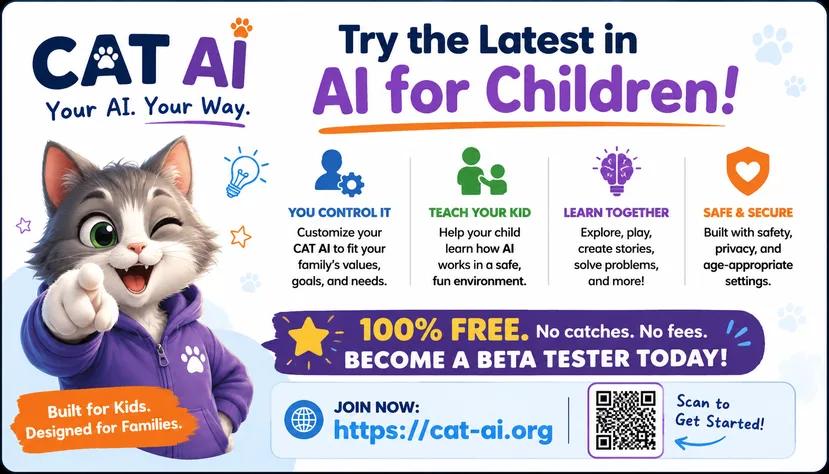
And this why We’re Building CAT AI
That brings us to CAT AI. CAT AI is our attempt to answer a very simple question:
If children are going to grow up with artificial intelligence, how do we teach them to use it well?
Trying to keep kids away from AI is not a long-term solution. AI will be in their schools, their phones, their jobs, their cars, their homes and probably in places we haven’t even imagined yet.
So instead of pretending it isn’t coming, CAT AI is being designed as a safe, controlled environment where children can learn how to use AI with parents, teachers and other trusted adults still involved.
The idea is deliberately different from simply handing a child a chatbot.
CAT AI gives the child an AI companion — represented by their own customizable cat — that can talk with them, teach them, answer questions, help them practice schoolwork, explore hobbies and gradually teach them how artificial intelligence itself works.
But the CAT shouldn’t simply do the child’s work.
Sometimes it should answer a question.
Sometimes it should explain something.
Sometimes it should give a hint.
And sometimes it should say: “You try it first.”
That distinction is important.
We want children to learn when AI is appropriate, when they should work independently, when AI should assist them and when they need to verify what the AI tells them.
In other words, the lesson isn’t simply how to use AI.
The lesson is AI literacy.
CAT AI is also being designed around something the commercial AI world often gets backward: the child is not the product.
We’re not trying to sell children things.
We’re not trying to keep them endlessly scrolling.
We’re not trying to maximize clicks, advertising impressions or screen time.
The objective is learning, curiosity and responsible use.
Parents should be able to participate.
Teachers and schools should be able to participate.
Different environments can have different rules.
A child’s personal CAT can be fun, conversational and creative, while a school CAT can operate within educational boundaries established by teachers and institutions.
And underneath all of it is a larger idea:
AI should not replace parents, teachers or human relationships. It should make those people more effective.
A teacher cannot sit beside every student individually for three hours every evening.
A parent may not remember algebra, chemistry or the causes of the First World War.
But an AI companion can provide unlimited practice and explanation — while the adults remain responsible for the child’s education and development.
That is why we are building CAT AI.
Not because children need another app.
Not because they need another screen.
And certainly not because they need another company trying to monetize their attention.
We’re building it because children need a place to learn how to live with AI before AI simply becomes part of everything around them.