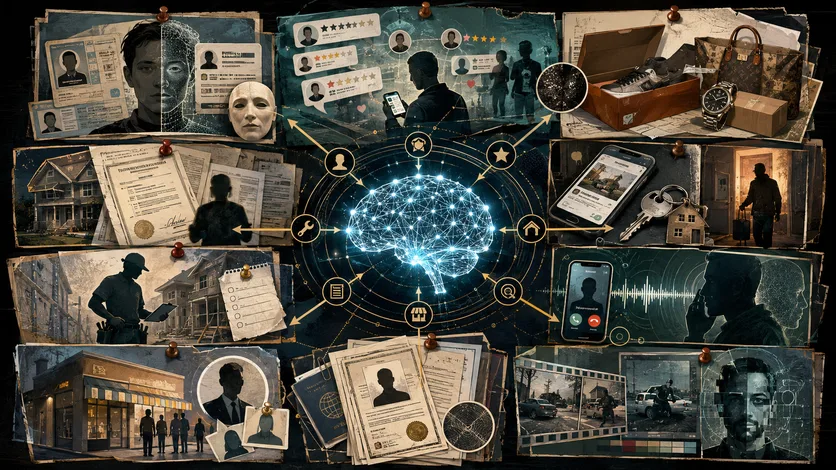
Think of it as Yoga for the brain, we are going to stretch a bit.
Crime in the Age of AI
The real danger of AI isn’t that it can lie. People have been doing that for thousands of years. The danger is that now every liar can afford a research department, a design studio, a voice actor, a lawyer, and 10,000 fake friends. --YNOT!
The burglar got smarter. The con man got a staff. And none of them had to hire anybody.
There was a time when being a criminal required certain talents.
You had to know how to pick a lock. You had to know how to forge a signature.
You had to be a convincing liar. You had to know somebody who knew somebody.
You needed a printer, a camera, a fake ID guy, a crooked notary, a fence, a bookkeeper, perhaps a cousin with questionable morals and a van.
Artificial intelligence is changing that.
Today, one reasonably competent criminal with a laptop can have a graphic designer, a translator, a copywriter, a researcher, a voice actor, a video editor, a document specialist, a marketing department and a very patient assistant working for him at three in the morning.
And unlike the cousin with the van, AI does not ask what the job is for.
We spend a great deal of time talking about AI and cybercrime.
And certainly that matters.
AI can help criminals write better phishing emails, search for computer vulnerabilities, automate scams, impersonate companies and improve malware.
But that is only the obvious part.
The more interesting question is what AI is doing to ordinary crime.
The local stuff. The guy stealing your house.
The woman selling your grandmother a fake investment.
The contractor who does not exist. The fake business with 400 glowing reviews.
The stolen car with convincing paperwork.
The counterfeit product that arrives with a beautiful instruction manual, warranty card and customer-service website.
The person who exists everywhere on the internet except in real life.
Welcome to crime in the age of artificial intelligence.
The Industrialization of Lying
The important thing about AI is not that it invented fraud.
Fraud is considerably older than electricity.
What AI has done is make fraud cheaper, faster, more professional and infinitely easier to scale.
A bad liar can now sound like a good liar. A terrible writer can produce a professional business proposal. A person who barely speaks English can suddenly correspond like a lawyer in London.
Someone who knows nothing about construction can create a convincing roofing company.
Someone who has never met you can study your social-media history and speak as though he has known you for twenty years.
Someone sitting halfway around the world can create what appears to be a perfectly ordinary local business five miles from your house.
That is the transformation. AI is becoming a credibility machine.
And credibility has always been one of the principal raw materials of crime.
Fake People
For most of history, creating another human being was a rather involved process.
Today it can be done before lunch. AI can generate photographs of people who never existed. It can write their biographies. Create résumés. Create employment histories. Generate social-media posts. Write comments from supposed friends. Produce professional headshots.
Create dating profiles. Generate business biographies.
Write LinkedIn-style career histories. Create fake customer reviews.
Even manufacture years’ worth of apparent opinions, interests and personal details.
The result is something we are going to encounter increasingly often:
A person who has a complete online life but no physical existence.
The fake employee. The fake tenant. The fake buyer. The fake seller. The fake romantic partner. The fake investor. The fake consultant. The fake expert. The fake witness. The fake customer. The fake political activist. The fake neighborhood resident. The fake executive.
AI does not merely create a fake photograph anymore.
It can create the surrounding mythology that makes the photograph believable.
That is considerably more dangerous.
Fake Businesses
The same thing applies to companies.
A criminal can create a business name and within hours have:
A logo. A website. Employee biographies. A mission statement.
A customer-service department. A catalog. A privacy policy. Terms and conditions. Testimonials. Advertising. Invoices. Proposal templates. Social-media accounts. Blog articles. Photographs of supposedly completed projects. And hundreds of artificial customer reviews.
Twenty years ago, building that much infrastructure around a fake company required considerable effort.
Today it can be accomplished over a weekend.
Which means the next fraudulent roofer, moving company, investment company, home health agency or automobile dealer may not look suspicious at all.
It may look better than the legitimate company down the street.
Fake Reviews
We once looked at reviews to protect ourselves from bad businesses.
Now the reviews themselves may be the fraud.
AI can generate thousands of different reviews written in different voices.
Some short. Some long. Some enthusiastic.
Some mildly critical, because a page containing nothing but five-star praise looks suspicious. Some written like elderly customers. Some written like young parents. Some written like contractors. Some written in Spanish. Some mentioning specific neighborhoods.
The clever criminal does not generate perfect reviews.
He generates believable imperfection.
That is a much more sophisticated form of fraud.
Fake Products
Counterfeiters have always copied products.
AI lets them copy the entire ecosystem around the product.
Imagine a fake electrical component. The old counterfeiter copied the label. The modern counterfeiter can create: Packaging. Technical documentation. Installation instructions. Safety warnings. Warranty cards. Certification-looking documents. Product photography. Instructional videos. Customer-service emails. A fake manufacturer’s website. Fake online reviews. Fake comparison articles. Fake forum discussions praising the product.
Suddenly the counterfeit product has something counterfeit products historically lacked:
A convincing history.
This applies to electronics. Automobile parts. Tools. Cosmetics. Medical devices. Building Materials. Luxury goods. Industrial components. Collectibles.
And eventually almost anything worth copying.
The fake product no longer arrives alone.
It arrives with an entire artificial civilization supporting it.
Fake Documents
Forgery used to require craftsmanship.
AI is rapidly changing that equation.
Criminals can use modern tools to help create convincing-looking:
Pay stubs. Employment verification letters. Bank statements. Invoices. Insurance documents. Rental histories. Business licenses. Certificates. Receipts. Letters of recommendation. Educational credentials. Tax-looking documents. Vendor statements. Contracts. Purchase orders. Financial summaries.
Even supporting correspondence that appears to verify the document.
The real danger is not necessarily one forged document.
It is the ability to create ten supporting documents that agree with each other.
Fraud becomes much more convincing when every piece of the story supports every other piece.
Fake Property Transactions
Real estate is particularly attractive because the numbers are large.
A criminal does not need to steal a thousand dollars from a thousand people if he can steal one property.
AI can assist criminals in creating convincing correspondence involving property sales, ownership claims, rental arrangements, lien disputes and supposed title transactions.
A vacant property is especially vulnerable.
Imagine somebody impersonating the owner of a vacant lot.
They create identification. They create supporting documents. They establish an email history. They know the property’s history. They know the owner’s name. They know the surrounding neighborhood. They can communicate professionally with a real-estate agent. They can answer questions. They can sound like a perfectly ordinary property owner. The criminal does not need AI to alter the official property record directly.
He needs AI to convince enough legitimate people along the way that he is the person entitled to change it.
That distinction matters.
The fraud enters the real world through human trust.
Fake Landlords
Imagine answering an advertisement for an apartment. The apartment exists. The address exists. The photographs may even be real. The landlord does not.
AI can help produce a professional lease, answer tenant questions, explain utility arrangements, describe the neighborhood, provide supposed references and communicate politely for weeks.
The prospective tenant eventually sends a deposit.
Then the landlord disappears.
The apartment belonged to somebody else.
The criminal may never have been in the same state.
Fake Tenants
Naturally, the process works in reverse.
A landlord receives an application. Excellent job. Good salary. Professional résumé. Previous landlord references. Employment confirmation.
Well-written explanation of why the applicant is moving.
Everything seems perfect.
Except that much of it may have been generated or coordinated artificially.
The applicant may be real.
The financial life surrounding the applicant may not be.
Fake Contractors
This will become an enormous local problem.
After hurricanes, floods, fires and other disasters, temporary contractors already appear like mosquitoes after rain. AI makes the disguise far better.
A fraudulent contractor can create a polished website, licensing-looking documents, insurance-looking paperwork, project photographs, customer reviews and professional estimates.
He can even generate detailed explanations of construction techniques.
He sounds knowledgeable because the AI actually is knowledgeable.
The homeowner assumes expertise where there may be none.
The deposit gets paid. The truck disappears. Fake Professionals
The internet has already blurred the line between actual expertise and apparent expertise.
AI may finish the job.
A criminal can present himself as a:
Financial adviser.
Insurance specialist.
Immigration consultant.
Real-estate expert.
Contractor.
Engineer.
Technology consultant.
Medical-industry representative.
Business broker.
Recruiter.
Investment analyst.
Legal-services consultant.
AI can generate explanations filled with the correct vocabulary.
And vocabulary is frequently what ordinary people use as a shortcut for expertise.
Someone sounds like he knows what he is talking about.
Therefore we assume he does.
That assumption is becoming dangerous.
Fake Voices
The telephone used to provide a certain amount of reassurance.
You recognized the person’s voice. That reassurance is disappearing.
Voice cloning means a criminal may someday need only a small sample of somebody speaking.
The resulting call may sound like your child. Your boss. Your employee. Your business partner. Your accountant. Your customer. Your mother.
Imagine receiving a telephone call. “Dad, I’m in trouble.”
The voice is right. The cadence is right. The little verbal habits are right.
And the emergency is perfectly designed to prevent you from thinking clearly.
That is not a computer crime.
That is an old-fashioned confidence trick with extraordinarily modern props.
Fake Video
Video used to be evidence. Then photographs became questionable.
Now video is following. Deepfake technology makes it increasingly possible to fabricate meetings, statements and events that never occurred.
This may become particularly important in local disputes.
Divorces. Employment conflicts. Insurance claims. Business disputes. Political campaigns. Neighborhood arguments. Blackmail. Reputation attacks.
Imagine being shown a video of yourself apparently doing something you never did.
The future defense may sound ridiculous: “That is not me.”
Unfortunately, sometimes it will be true.
Fake Evidence
This may become one of the most difficult problems for courts and police.
If photographs can be generated… If audio can be generated… If video can be generated… If text messages can be fabricated…
If documents can be generated.. Then evidence itself becomes less automatically trustworthy. Ironically, this creates two problems.
Criminals may create fake evidence.
And guilty people may dismiss real evidence by claiming AI created it.
The existence of deepfakes creates what researchers sometimes call a liar’s dividend:
Once everyone knows convincing fakes exist, authentic evidence becomes easier to deny.
The counterfeit damages the value of the real thing.
Fake Receipts and Insurance Claims
Insurance fraud has always involved exaggerated losses.
AI makes documentation easier.
A claimant can produce detailed inventories of supposedly damaged possessions.
Ask about family. Discuss hobbies. Offer emotional support. Create photographs.
Generate voice messages. Potentially even appear in fabricated video.
The scam becomes less like a criminal sending messages and more like a professionally managed fictional relationship.
That may sound absurd but it is happening now.
So did online dating once.
Fake Kidnappings and Emergencies
One of the ugliest applications will be simulated emergencies.
A cloned voice says a family member has been kidnapped.
A frantic message demands money.
Artificial audio creates crying or screaming.
Personal information gathered online makes the story convincing.
The criminal understands something fundamental:
People verify information carefully when they are calm.
They verify poorly when terrified.
AI gives the criminal better tools for manufacturing terror.
Fake Employees
Businesses will increasingly have to verify that remote workers are who they claim to be.
A fake applicant can create an impressive employment history, answer technical interview questions with AI assistance and provide fabricated references.
Even the supposed former supervisor providing the reference might be artificial or controlled by the same person.
A company believes it hired John Smith from Ohio.
John Smith may actually be somebody completely different.
Or several people.
Or in certain aspects, nobody at all.
Fake Customers
Businesses can also be attacked by artificial customers.
Fraudulent warranty claims. Return fraud. Chargebacks. False complaints. Fake Reservations. Fake purchases. Fake leads designed to waste competitors’ time.
AI enables thousands of unique interactions that no longer look automated.
The bot has learned how to complain politely.
Fake Crowds
Perhaps one of the strangest developments is that AI allows one individual to create the appearance of many individuals.
A restaurant appears to have hundreds of supporters.
A politician appears to have thousands of angry constituents.
A neighborhood issue appears to have widespread opposition.
A company appears universally hated.
A product appears extraordinarily popular.
One person can simulate a crowd.
For centuries, society has treated numbers as evidence.
If 500 people are saying something, we assume something must be happening.
But what happens when the 500 people are one person and a computer?
Fake Reputation
Character assassination becomes easier too.
AI can generate accusations, comments, reviews, social-media accounts and fabricated conversations.
A business can be buried beneath negative reviews.
A person can appear to have made offensive statements.
A professional can appear to have dozens of dissatisfied clients.
Reputation took decades to build because human attention was expensive.
Destroying reputation may become cheaper because artificial attention is almost free.
Fake News at Neighborhood Scale
People generally think of misinformation as presidents, wars and elections.
But AI misinformation will increasingly become local.
“There was a shooting at the school.”
“The water is contaminated.”
“That restaurant poisoned somebody.”
“That doctor lost his license.”
“That contractor stole money.”
“That neighbor is a sex offender.”
“That business is closing.”
A convincing article can be created in seconds.
Add a fake photograph.
Add fabricated eyewitness comments.
Add a phony screenshot.
Then distribute it through local Facebook groups or neighborhood platforms.
By the time somebody verifies the story, thousands of people may already believe it.
A lie can travel halfway around the world while the truth is putting on its shoes.
He would have appreciated artificial intelligence.
The lie now owns a motorcycle.
Fake Legal Threats
Criminals can generate extremely intimidating legal-looking correspondence.
The language can sound sophisticated because the language actually may have been generated from millions of examples of sophisticated language.
An ordinary person receives something that looks legal and assumes it must be legitimate.
Frequently the objective is simply to scare the recipient into paying.
Fake Authority
Authority itself can be manufactured.
A caller sounds like a police officer.
An email appears to come from a government department.
A letter looks like it came from a law firm.
A website resembles a licensing agency.
The AI provides the vocabulary.
The graphic tools provide the appearance.
Public databases provide enough real information to make the story plausible.
Authority has always been partly theatrical.
AI simply improves the costume department.
Criminal Market Research
There is another aspect that receives less attention.
AI can help criminals choose victims.
Who owns multiple properties?
Who recently lost a spouse?
Who operates a small business?
Who is elderly?
Who just inherited property?
Who is involved in a lawsuit?
Who recently listed a house for sale?
Who owns a vacant property?
Who is publicly complaining about financial trouble?
Who is hiring employees?
Who recently received an insurance settlement?
Enormous amounts of legal public information already exist online.
AI makes it easier to organize.
The criminal no longer has to search through hundreds of pages manually.
He can ask questions. Find patterns. Build profiles. Prioritize targets.
In other words, AI does not merely improve the scam.
It improves customer acquisition.
Criminals have sales funnels too.
Personalized Fraud
Traditional scams were generic. “Dear Sir, I am a Nigerian prince.”
The spelling was terrible. The story was ridiculous.
And oddly enough, people still sent money.
Imagine the same concept after AI studies your LinkedIn page, Facebook account, property records, company website and public photographs.
Now the scam knows:
Where you work. Who your employees are. What charities you support. What school your children attend. What conference you recently attended. What company you just purchased equipment from. Who your accountant is. What neighborhood you live in.
The company sells a fake product. The fake product has fake reviews.
The company has fake employees. The employees have fake LinkedIn accounts.
The company publishes fake articles. The articles quote fake experts.
The experts appear in fake videos. The business has fake customers.
The customers post fake testimonials.
And all of it appears perfectly normal when viewed casually online.
That is the important concept.
We are not merely entering an age of fake pictures.
We are entering an age of synthetic reality.
Entire stories can be manufactured.
And human beings have always been vulnerable to stories.
The Return of Verification
There is an interesting irony here.
Technology spent thirty years making everything easier.
Click here. Instant approval. Automatic checkout.
Remote closing. Digital signature. Online application. One-click payment.
No human interaction necessary.
AI-generated fraud may force us to move slightly backward.
We may once again need to verify people.
Call somebody independently. Check the phone number ourselves.
Confirm the bank instructions. Look up the license. Verify ownership.
Inspect original documents. Use trusted intermediaries.
Ask questions a stranger should not know.
Meet people physically when large amounts of money are involved.
Confirm unusual requests through a second communication channel.
In other words, the future may require something our grandparents understood perfectly well:
Know who you are dealing with.
The New Question
For years the internet taught us to ask: “Is this website real?”
That question is no longer sufficient.
The website may be real. The company may not be.
The person may have a real photograph.
The photograph may depict nobody.
The voice may sound real. The speaker may never have said the words.
The documents may look real. The transaction may be fraudulent.
The reviews may be real sentences written by no real customers.
The correct question is becoming:
What independent evidence do I have that this is real?
That is a much harder question.
AI Did Not Invent the Crook
We should also keep some perspective.
Artificial intelligence did not invent criminals.
It did not invent greed. It did not invent forgery. It did not invent impersonation. It did not invent theft.
Human beings managed all of those remarkably well without computer assistance.
AI is a tool.
The same technology that helps a doctor analyze information, helps a student learn mathematics, helps a small business write advertisements and helps a programmer write software can also help somebody construct a convincing lie.
Every important technology has had this problem.
The automobile helped bank robbers escape faster.
The telephone created telephone scams.
The photocopier improved forgery.
Email created phishing.
Social media created industrial-scale misinformation.
Artificial intelligence may be different primarily because it touches nearly all of them at once.
It does not give the criminal one new tool. It gives him a toolbox.
The Cost of Trust
The greatest damage may not ultimately be the money stolen.
It may be what happens to trust.
If photographs cannot automatically be trusted…
If voices cannot automatically be trusted…
If video cannot automatically be trusted…
If reviews cannot automatically be trusted…
If documents cannot automatically be trusted…
If online identities cannot automatically be trusted…