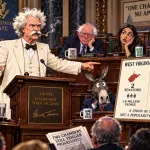
Think of it as Yoga for the brain, we are going to stretch a bit.
What If Humanity Had to Stand Trial for Choosing Between Feeding the Poor and Reaching the Stars?
The Welfare State vs. The Future in Space
A Courtroom Event from the Year 2126
Featuring Bernie Sanders, Elon Musk, Albert Einstein, Mark Twain, and Milton Friedman
[Courtroom Scene – The Future Tribunal]
The courtroom does not sit in Washington, D.C. That city is still there, more or less, though by 2126 half of it is underwater, rebuilt, renamed, renamed again, and still somehow full of committees.
This courtroom sits in orbit.
It is called The Tribunal of Human Consequence, and it circles Earth every ninety minutes, which is faster than Congress ever moved on anything that mattered.
Below it, Earth glows blue and wounded. Above it, Mars shines like a promise mankind made while overdrafted.
The gallery is packed. Not with lobbyists, donors, pundits, or the professional finger-waggers who once made a living confusing noise with wisdom.
No. This gallery holds the future.
Children born on Mars. Seniors living past 120. AI doctors. Space miners. Earth farmers. Lunar engineers. Refugees from climate zones. Grandchildren of billionaires. Grandchildren of janitors. The saved, the forgotten, the augmented, the ordinary, and the angry.
At the center of the courtroom, glowing in letters of white fire, is the case:
THE WELFARE STATE vs. THE FUTURE IN SPACE
The charge: Did mankind waste its wealth trying to make everyone comfortable today — or did it sacrifice too many people chasing tomorrow?
At the plaintiff’s table sits Senator Bernie Sanders, representing the people left behind.
At the defense table sits Elon Musk, representing the builders, inventors, risk-takers, and dreamers who dragged humanity off one fragile planet.
In the witness chamber sits Albert Einstein, resurrected by lawful historical simulation, which is just a fancy way of saying the future found a way to subpoena dead geniuses.
In the back row sits Mark Twain, arms folded, eyes sharp, looking like the only man in the room who knows that civilization is usually one bad idea away from a group project nobody volunteered for.
And waiting in the digital shadows is Milton Friedman, who has not yet been called, but whose ghost is already making several bureaucrats uncomfortable.
The judge enters. Not human. Not machine. Something between both.
JUDGE ATHENA-9, the first constitutional AI ever granted judicial authority, looks over the court.
JUDGE ATHENA-9: This court will now hear Case 2126-001: The Welfare State vs. The Future in Space. The question before this tribunal is not whether mankind had good intentions. Good intentions are plentiful. So are weeds. The question is whether mankind chose wisely.
Mark Twain rises slowly.
TWAIN: Your Honor, with your permission, I’ll serve as narrator, troublemaker, and janitor of nonsense.
JUDGE ATHENA-9: Permission granted.
TWAIN: Much obliged. Somebody has to sweep up after the experts.
OPENING STATEMENT – SENATOR BERNIE SANDERS
(Bernie rises. He is older now, or rather the simulation of him is older because even historical recreations of Bernie Sanders refuse to retire. He adjusts his glasses, grips the podium, and begins.)
SANDERS: Your Honor. Ladies and gentlemen of the jury. Citizens of Earth. Citizens of Mars. Citizens of whatever orbital tax shelter the wealthy discovered last Tuesday.
We are here today because history has been dressed up as progress.
We were told that if we let billionaires become trillionaires, they would build the future. Then they will become quadrillioners.
We were told that if one man accumulated enough wealth, enough power, enough satellites, enough rockets, enough AI systems, enough political influence, and enough companies to require his own private antitrust department, then somehow all of humanity would benefit.
We were told to be patient.
Be patient while wages fell behind. Be patient while housing became impossible.
Be patient while people rationed insulin. Be patient while children went hungry under skies filled with satellites. Be patient while the richest men on Earth promised Mars to people who could not afford rent on Earth.
Now let me be clear.
I am not against science. I am not against space. I am not against innovation. I am against a civilization where the few fly to the stars while the many sleep in cars.
That is not progress. That is aristocracy with better software.
Elon Musk will tell you today about rockets. He will talk about Falcon 1, Falcon 9, Starship, Starlink, orbital data centers, artificial intelligence, nuclear-powered colonies, disease cures, asteroid mining, and the human destiny among the planets.
Fine. Let him speak.
But I will ask one simple question: What good is conquering Mars if we abandon Milwaukee?
What good is curing cancer in a lunar lab if a working mother on Earth dies because she couldn’t afford a screening?
What good is artificial intelligence that can map the human genome if it cannot recognize human suffering?
They called us radicals for demanding healthcare.
They called us socialists for saying old people should not starve.
They called us enemies of innovation because we dared to ask whether one man should own more wealth than entire nations.
But history now sits in judgment. And the question is not whether Elon Musk built great things.
He did.
The question is whether humanity paid too high a moral price for letting a handful of men become governments without elections.
Ladies and gentlemen, we are not here to punish invention.
We are here to ask whether invention without justice becomes just another machine for grinding the poor into fuel.
Thank you.
(Bernie sits. The gallery murmurs. Somewhere in the Mars section, a young engineer shifts uncomfortably.)
OPENING STATEMENT – ELON MUSK
(Musk rises. Calm, clipped, slightly amused, as if the courtroom is just another launch window with more lawyers.)
MUSK:
Thank you, Your Honor.
Senator Sanders speaks with moral passion. That’s his brand. Very consistent. Very durable.
But passion does not change physics. Humanity faced a choice.
Stay on Earth, consume itself, regulate itself into paralysis, argue forever about redistribution, and eventually get hit by an asteroid, sterilized by war, suffocated by climate collapse, or replaced by its own fear.
Or build.
Build rockets. Build AI. Build Starlink. Build space industry. Build orbital compute.
Build off-world manufacturing. Build new energy systems.
Build backups for civilization.
SpaceX was founded in 2002 with a mission that sounded insane at the time: make life multiplanetary. People said private companies could not reach orbit.
Falcon 1 reached orbit.
People said we could not build a real rocket. Falcon 9 reached orbit.
People said we could not reach the space station. Dragon reached the space station.
People said rockets could not be reusable. We landed boosters.
People said launch cadence could not scale. We scaled it.
People said global satellite internet was fantasy. Starlink connected the disconnected.
People said artificial intelligence would only make ads better and teenagers worse.
AI helped discover treatments, model proteins, optimize reactors, manage orbital industry, and eventually assist in curing diseases that had haunted mankind since before civilization learned to write receipts.
Were mistakes made? Obviously.
Did wealth concentrate? Yes.
Was inequality real? Yes.
But let’s be honest: poverty on Earth was not caused by rockets. It was caused by bad policy, broken schools, failed cities, corruption, regulatory capture, inflation, crime, debt, and politicians who spent fifty years promising compassion while delivering paperwork.
You cannot tax your way to Mars.
You cannot committee your way to fusion.
You cannot redistribute your way into becoming a species that survives the death of its home planet.
The future has a cost. So does refusing to build it.
And history should ask not only what space cost humanity — but what humanity would have lost without it.
Thank you.
(Musk sits. Half the room applauds. The other half looks like it wants to unionize the applause.)
MARK TWAIN ADDRESSES THE JURY
(Twain rises, slowly, like a man watching two fools argue over who owns the ladder while the house burns.)
TWAIN:
Well now, this is a fine mess, ain’t it?
On one side, we’ve got Senator Sanders, who believes mankind ought to take care of the poor before it goes buying real estate in the sky.
On the other, we’ve got Mr. Musk, who believes mankind ought to get off the planet before the poor and the rich alike get flattened by the same cosmic brick.
Both men are right enough to be dangerous. That’s the trouble with big arguments. The fools are easy to beat. It’s the half-right men that cause the real damage.
Bernie sees the hungry child.
Elon sees the asteroid.
Einstein sees the atom.
Friedman sees the bill.
And I see a species that keeps mistaking motion for wisdom.
Proceed, Your Honor. Let’s find out whether we built the future — or merely automated our excuses.
ACT I – THE PEOPLE LEFT BEHIND
Bernie Calls His First Witness: The Earth Worker
SANDERS:
The people call Maria Alvarez.
(A woman steps forward. She is not famous. History rarely is. She is a composite citizen drawn from millions of lives — nurse, mother, cashier, caregiver, taxpayer, patient.)
SANDERS: Maria, where were you born?
MARIA: Florida. Earth. Before the sea walls. Before the second insurance collapse.
SANDERS: What did you do for work?
MARIA: Everything. Home health aide. Warehouse packing. Grocery delivery. Later I cleaned office towers that had AI systems worth more than my whole neighborhood.
SANDERS: Did technology improve your life?
MARIA: Sometimes. My son learned online because the school couldn’t keep teachers. My mother got remote medical scans through satellite internet. That helped.
SANDERS: And did it solve your problems?
MARIA: No. The rent went up faster than wages. Healthcare still had a gate. Food got expensive. The jobs got smarter, but the paychecks didn’t.
SANDERS: What did you think when you watched rockets launch?
MARIA: I thought they were beautiful.
(A pause.)
MARIA: Then I looked at my electric bill.
SANDERS: Thank you.
Cross-Examination by Elon Musk
MUSK: Maria, you said satellite internet helped your mother receive medical scans.
MARIA: Yes.
MUSK: And your son used online education?
MARIA: Yes.
MUSK: And medical AI later detected your cancer early?
MARIA: Yes.
MUSK: That AI ran on large compute systems, correct?
MARIA: That’s what they told me.
MUSK: Some of those systems were built by private industry. Some were powered by orbital solar. Some depended on launch infrastructure originally mocked as billionaire toys. Correct?
MARIA: I suppose.
MUSK: So the same system you criticize also helped save your life.
MARIA: Yes.
MUSK: Then maybe the problem was not progress. Maybe the problem was distribution.
MARIA: Maybe.
MUSK: And distribution is usually government’s job.
MARIA: So is justice.
(Musk pauses.)
MUSK: Fair.
Twain Interjects
TWAIN: Now there’s a rare courtroom event: two people agreeing just enough to make everybody nervous.
ACT II – THE BUILDER TAKES THE STAND
Mark Twain Calls Elon Musk
TWAIN: Your Honor, I call Mr. Elon Musk, the man who made rockets land upright and billionaires lean sideways.
(Musk takes the stand.)
TWAIN: Mr. Musk, let’s begin with a simple matter. Why Mars?
MUSK: Because a single-planet species is fragile. Earth is vulnerable to asteroid impacts, nuclear war, engineered pandemics, AI risk, solar events, ecological collapse. A self-sustaining city on Mars increases the probability that consciousness survives.
TWAIN: Consciousness. That’s a mighty expensive word. Most folks just call it “people.”
MUSK: People, civilization, knowledge, life — all of it.
TWAIN: And you believe rockets were not a luxury.
MUSK: No. They were insurance.
TWAIN: Insurance usually pays out when something goes wrong. Did space pay out?
MUSK: Yes. Communications. Disaster response. Remote education. Military deterrence. Navigation. Climate monitoring. AI research. Materials science. Medical breakthroughs. Eventually off-world industry reduced environmental pressure on Earth.
TWAIN: That sounds impressive. Also sounds like a man reading his own brochure.
MUSK: The facts are impressive.
TWAIN: Facts often are. Especially when they leave out the invoice.
Now tell me this: did your success create power too large for one private man?
(Musk pauses.)
MUSK: Possibly.
TWAIN: Possibly? That’s the word a man uses when the truth is standing on his foot.
MUSK: I built because governments were too slow.
TWAIN: And after you built, did governments become dependent on you?
MUSK: In some areas, yes.
TWAIN: So the public outsourced the future to a private man.
MUSK: They outsourced execution. Not sovereignty.
TWAIN: That is a handsome distinction. I hope it came with a warranty.
Bernie Cross-Examines Musk
SANDERS: Mr. Musk, do you believe one person should be allowed to accumulate wealth greater than the bottom half of society?
MUSK: Wealth in my case was mostly equity in companies building useful things. It wasn’t a pile of cash in a vault.
SANDERS: That is always the answer. “It’s not cash.” But when influence is needed, suddenly the stock becomes power. When loans are needed, it becomes collateral. When politics needs funding, it becomes speech. But when taxes are discussed, it becomes imaginary.
MUSK: Taxing unrealized gains destroys capital formation.
SANDERS: And letting one man become richer than nations destroys democracy.
MUSK: Democracy was already damaged by bureaucracy, media manipulation, and political corruption.
SANDERS: And billionaires helped none of that?
MUSK: Some did. Some built.
SANDERS: You contributed massive sums to politics, correct?
MUSK:I supported candidates and causes I believed would preserve civilization.
SANDERS: Every oligarch in history said something similar. They never buy power. They “preserve civilization.” It sounds better at dinner.
MUSK: And every socialist says they are helping the people while building a machine that eventually controls them.
SANDERS: I am not asking for state control of everything. I am asking why your future required so many people to live with less security than your rockets.
MUSK: Because rockets had engineering accountability. Welfare programs often don’t.
SANDERS: So your solution is rockets get engineers and poor people get lectures?
MUSK: My solution is abundance. Energy abundance. Compute abundance. Medical abundance. Launch abundance. Manufacturing abundance. Scarcity causes most political conflict.
SANDERS: No. Greed causes plenty of it.
MUSK: Greed exists. Scarcity weaponizes it.
SANDERS: And concentrated wealth purchases the weapon.
(The courtroom grows still.)
ACT III – EINSTEIN AND THE ATOM
Twain Calls Albert Einstein
TWAIN: Your Honor, I call Professor Albert Einstein, a man who understood the universe deeply and human politics just enough to be worried.
(Einstein appears in the witness chamber. His hair looks like it lost a fight with lightning and refused to file a complaint.)
EINSTEIN: I am here.
TWAIN: Professor, mankind split the atom and then spent a century wondering if it had split its own soul. What do you make of this case?
EINSTEIN: The question is old. Every powerful discovery gives mankind two tools: one for creation, one for destruction. Nuclear science gave humanity the bomb. But it also gave medicine, energy, research, and the possibility of power without burning the world. For a time, I feared nuclear war would end civilization.
TWAIN: A reasonable fear. Humanity with nuclear weapons is like a toddler with a chainsaw and national pride.
EINSTEIN: Yes. But humanity also avoided full nuclear destruction. Not because we were wise every day. Because fear, diplomacy, luck, restraint, and mutual vulnerability kept us from the final mistake.
SANDERS: Professor, what does nuclear power teach us about space and AI?
EINSTEIN: That technology must be governed by ethics before catastrophe, not after.
MUSK: But too much fear can stop progress.
EINSTEIN: Correct. Fear can paralyze. Ambition can blind. The task is not to choose fear or ambition. The task is wisdom.
TWAIN: And where do we buy that, Professor? Is it on backorder?
EINSTEIN: No. It is produced slowly. Usually after suffering.
TWAIN: That explains the shortage.
Bernie Questions Einstein
SANDERS: Professor, do you believe science should serve humanity?
EINSTEIN: Yes.
SANDERS: All humanity?
EINSTEIN: Yes.
SANDERS: Then what happens when scientific progress is controlled by the wealthy?
EINSTEIN: It becomes vulnerable to private interest.
SANDERS: And what happens when healthcare, AI, space infrastructure, and energy are owned by private empires?
EINSTEIN: Then democracy must either govern them, partner with them, or become subordinate to them.
SANDERS: Exactly.
MUSK: Or democracy can prevent them from existing in the first place through delay and hostility.
EINSTEIN: That is also true.
SANDERS: Professor, with respect, you are not helping.
EINSTEIN: Truth often disappoints the side that hoped to own it.
Musk Questions Einstein
MUSK: Professor, would humanity have been better off if we had banned nuclear research because it was dangerous?
EINSTEIN: No.
MUSK: Would humanity have been better off if we banned AI because it threatened labor markets?
EINSTEIN: No.
MUSK: Would humanity have been better off if we stopped space development because billionaires were involved?
EINSTEIN: No.
MUSK: Then you agree civilization must take risks.
EINSTEIN: Yes. But risk for mankind is noble. Risk imposed on the poor by the powerful is merely old cruelty with new instruments.
(Musk exhales. Bernie smiles slightly.)
TWAIN: Professor, you have managed to wound both attorneys. That is how I know we are getting close to truth.
ACT IV – THE MACHINE AND THE SOUL
Mark Twain Takes the Stand
JUDGE ATHENA-9: Mr. Twain, you have been narrating, objecting, insulting, and occasionally clarifying. The court now calls you as witness.
TWAIN: That seems unfair, Your Honor. A man should not be forced to answer for things he noticed.
JUDGE ATHENA-9: Proceed.
TWAIN sits.
SANDERS: Mr. Twain, what concerns you most about the future Mr. Musk describes?
TWAIN: That it may succeed.
SANDERS: Succeed?
TWAIN: Yes. Failure is simple. A rocket explodes, everybody knows it. Success is sneakier. It comes dressed in convenience.
You cure disease, extend life, automate labor, connect every mind, predict every desire, and build cities under domes on Mars. Then one morning mankind wakes up and discovers it has gained everything except a reason to get out of bed.
SANDERS: You believe technology can dehumanize us.
TWAIN: No, Senator. People dehumanize themselves, then blame the nearest gadget.
MUSK: So technology is not the villain.
TWAIN: No. Technology is a mirror with a power cord. It shows us what we are, then scales it. If we are wise, it scales wisdom. If we are greedy, it scales greed. If we are lonely, it scales loneliness. If we are vain, it gives vanity a global distribution network and calls it engagement.
MUSK: But AI cured diseases.
TWAIN: Wonderful. Did it cure arrogance?
MUSK: No.
TWAIN: Then keep working.
Musk Cross-Examines Twain
MUSK: Mr. Twain, would you have stopped the Industrial Revolution?
TWAIN: No. Though I might have fined it for noise.
MUSK: Would you have stopped electricity?
TWAIN: Certainly not. I prefer my hypocrisy well-lit.
MUSK: Would you have stopped AI?
TWAIN: No. But I would have required every AI system to spend one week working customer service before advising humanity.
MUSK: So what is your objection?
TWAIN: My objection is not to machines. It is to worship. Every age builds an idol. One age worships kings. Another worships the state. Another worships markets. Another worships machines. The idol changes, but the kneeling stays the same.
MUSK: And space?
TWAIN: Space is not the idol. Escape is. There is a difference between reaching the stars and running away from the mess you made at home.
MUSK: Sometimes leaving is survival.
TWAIN: Yes. But if you carry the same pride, greed, and foolishness to Mars, you have not colonized a new planet. You have exported the old problem with better packaging.
ACT V – MILTON FRIEDMAN AND THE BILL
Twain Calls Milton Friedman
TWAIN: Your Honor, I call Professor Milton Friedman.
SANDERS: Objection. Again, he is dead.
TWAIN: So are balanced budgets, Senator, and yet people still refer to them.
JUDGE ATHENA-9: The court will allow the historical simulation. (A projection appears. Milton Friedman’s face forms in blue-white light, calm and surgical.)
FRIEDMAN: Good afternoon.
TWAIN: Professor Friedman, this case asks whether welfare spending robbed mankind of its future or whether billionaire ambition robbed mankind of justice. What say you?
FRIEDMAN: Both sides are tempted by fantasy. The welfare state imagines compassion can be funded indefinitely without incentives, productivity, savings, family formation, or economic discipline. The technologist imagines innovation alone can solve moral and institutional failure. Both are wrong.
SANDERS: Professor, you always reduce human suffering to incentives.
FRIEDMAN: No, Senator. I reduce political promises to results. That is where many promises go to die.
SANDERS: Should society protect the vulnerable?
FRIEDMAN: Yes.
SANDERS: Then we agree.
FRIEDMAN: Not necessarily. The question is how. A safety net can protect people. A dependency machine can weaken them. A government program can help today while bankrupting tomorrow. A subsidy can become a trap. A tax can fund compassion or punish production.
MUSK: And private enterprise?
FRIEDMAN: Private enterprise can create abundance. It can also purchase favoritism, suppress competition, and become government by other means.
TWAIN: There it is. The free market man just slapped both tables. I may frame this transcript.
Friedman’s Warning
FRIEDMAN: Civilization requires three forms of capital.
Financial capital — savings, investment, production.
Human capital — education, discipline, family, health, skill.
Moral capital — trust, responsibility, honesty, restraint.
The welfare state often spends financial capital to compensate for collapsing human and moral capital. Technological capitalism often increases financial capital while ignoring moral capital. Neither model survives alone.
A society cannot consume its way into greatness. It also cannot innovate its way out of corruption.
MUSK: So what should humanity have done?
FRIEDMAN: Protect the truly vulnerable. Encourage work. Reward creation. Prevent monopoly. Keep government limited but competent. Keep markets free but honest. Stop pretending debt is compassion. Stop pretending wealth is virtue.
SANDERS: And inequality?
FRIEDMAN: Inequality is not always injustice. But extreme concentration of political power through wealth is dangerous.
SANDERS: So you admit it.
FRIEDMAN: I admit what free people should have always known: liberty requires limits on both the state and the oligarch.
TWAIN: If that sentence had been printed on every dollar bill, we might have saved ourselves several trillion dollars and a great deal of shouting.
ACT VI – THE FUTURE CHILD TESTIFIES
The Court Calls Its Own Witness
JUDGE ATHENA-9: The court calls Witness 2126-A. Name: Samuel Okoro. Age: 17. Birthplace: Mars Settlement Three.
(A young man enters. Thin. Bright-eyed. Human in every way that matters.)
JUDGE ATHENA-9: Samuel, you are the future both sides claim to represent.
SAMUEL: Yes, Your Honor.
SANDERS: Samuel, do you know what poverty was?
SAMUEL: Yes. We study it. My great-grandmother lived in it.
SANDERS: And what do you think when you hear that billionaires had enough money to build rockets while people went hungry?
SAMUEL: I think it was wrong.
SANDERS: Thank you.
MUSK: Samuel, where do you live?
SAMUEL: Mars Settlement Three.
MUSK: Would you exist if humanity had not invested in space?
SAMUEL: No.
MUSK: Do you believe space settlement mattered?
SAMUEL: Yes.
MUSK: Thank you.
TWAIN: Well, that was inconvenient for everybody.
JUDGE ATHENA-9: Samuel, the court has one question. If you could speak to the people of 2026, what would you tell them?
SAMUEL pauses.
SAMUEL: I would tell them to stop arguing like only one thing matters.
Earth mattered. Mars mattered. The poor mattered. The future mattered. Science mattered. Fairness mattered. Everything matters.
I would tell them that every generation thinks it is choosing between two things because choosing one thing is easier than becoming wise enough to carry both.
SANDERS: And if they failed?
SAMUEL: Then people like me inherit their excuses.
(The courtroom goes quiet.)
ACT VII – FINAL ARGUMENTS
Closing Argument – Bernie Sanders
SANDERS rises. This time he is quieter.
SANDERS: Ladies and gentlemen of the jury.
You have heard today about rockets, AI, nuclear power, markets, welfare, Mars, medicine, and the survival of consciousness.
But let us not lose the human being inside the machinery.
A civilization is not judged by how high its rockets fly. It is judged by how low it allows its people to fall.
But risk must not be paid for only by workers, patients, renters, children, and the old.
If the future requires sacrifice, then sacrifice must not be assigned by income bracket.
We could have built space and protected Earth.
We could have funded research and healthcare.
We could have rewarded innovation without crowning oligarchs.
We could have taxed fairly, governed honestly, and built boldly.
But too often we were told the same old lie:
Wait.
Wait for growth. Wait for trickle-down. Wait for cheaper technology.
Wait for billionaires to become generous. Wait for the market to notice your suffering.
Wait for the future to come back and rescue you.
Well, people cannot eat waiting. They cannot afford medicine with waiting.
They cannot raise children on waiting. I do not ask this court to condemn space.
I ask this court to condemn a moral order that treated poverty as acceptable collateral damage.
The stars may belong to humanity. But humanity includes the janitor.
Thank you.
Closing Argument – Elon Musk
Musk stands. His voice is steady, but less armored now.
MUSK: The Senator is right about suffering.
But suffering is not solved by freezing civilization in place.
The future is not built by resentment. It is built by people willing to try what others call impossible.
Every major step forward looked wasteful before it worked.
Flight looked wasteful. Computers looked wasteful. The internet looked wasteful.
Reusable rockets looked wasteful. AI looked dangerous.
Space settlement looked insane.
But because people built anyway, billions gained tools, knowledge, medicine, connection, energy, and eventually a second home.
Should wealth concentration have been addressed? Yes.
Should political influence have been limited? Probably.
Should the poor have been protected better? Yes.
But do not confuse the flaws of society with the crime of ambition.
If humanity had waited for perfect fairness before building the future, there would be no future.
The cost of progress is high. The cost of stagnation is extinction.
And extinction is the most unequal outcome of all.
Thank you.
Closing Reflection – Albert Einstein
EINSTEIN:
The tragedy of mankind is not that it dreams too much or cares too much.
It is that it separates its dreams from its conscience.
Science without compassion becomes machinery.
Compassion without reason becomes collapse.
Power without wisdom becomes danger.
Wisdom without courage becomes decoration.
The atom taught us this. AI taught us again. Space taught us once more.
The question is not whether man should reach upward. He must.
The question is whether he can reach upward without stepping on those beneath him.
Closing Reflection – Milton Friedman
FRIEDMAN:
A free society must remember that both government and private power require restraint.
The state can bankrupt the future in the name of compassion.
The wealthy can purchase the present in the name of innovation.
Neither should be trusted without limits.
A society that wants both justice and progress must create citizens, not dependents; entrepreneurs, not oligarchs; safety nets, not cages; markets, not monopolies; government, not bureaucracy.
Freedom is not the absence of obligation. It is the presence of responsibility.
Final Words – Mark Twain
(Twain steps forward. No jokes now. Not because he ran out, but because some moments deserve to stand without decoration.)
TWAIN: Ladies and gentlemen, there comes a time in every civilization when it has to stop admiring its own reflection and look at the bill.
We wanted comfort. We wanted greatness. We wanted equality. We wanted abundance.
We wanted machines to work, governments to care, markets to behave, billionaires to be generous, voters to be wise, and nobody to ask too much of us before lunch.
That was a lot to want from a species that still argues with self-checkout machines.
But here is the truth of it.
Bernie was right to say that a civilization that forgets the poor has misplaced its soul.
Elon was right to say that a civilization that forgets the future has misplaced its spine.
Einstein was right to warn that power without wisdom is a loaded weapon in a nursery.
Friedman was right to remind us that promises without arithmetic are just lies wearing perfume.
And the future child was right most of all.
We did not have to choose between Earth and Mars.
We had to become the kind of people who could deserve both.
The tragedy is not that we reached for the stars.
The tragedy would be reaching them and discovering we brought all our smallness with us.
(Twain turns toward the jury.)
So now you decide.
Was mankind guilty of caring too much for the present?
Or guilty of caring too little for the people living in it?
The jury exits. Earth turns below. Mars waits above.
And somewhere, in the silence between them, humanity finally hears the question it spent a century avoiding.
THE VERDICT
(The jury returns. Twelve citizens. Six from Earth. Three from Mars. Two from orbit. One from the Lunar settlements, looking irritated because lunar people always look like gravity is wasting their time.)
JUDGE ATHENA-9: Has the jury reached a verdict?
FOREPERSON: We have, Your Honor.
On the charge that the welfare state robbed humanity of its future: Not guilty.
On the charge that private ambition abandoned too many people in pursuit of progress: Guilty in part.
On the charge that humanity falsely believed it had to choose between justice and greatness: Guilty.
On the charge that mankind repeatedly mistook wealth for wisdom, spending for compassion, technology for virtue, and politics for morality: Guilty on all counts.
JUDGE ATHENA-9: And what sentence does the jury recommend?
FOREPERSON: That every future policy be judged by four questions:
Does it protect the vulnerable? Does it reward creation?
Does it preserve liberty? Does it leave the next generation stronger?
If it fails any one of those, it is not progress. It is just another expensive mistake.
PUBLIC REACTION AFTER THE TRIAL
Outside the orbital court, Earth media erupts.
The left says Bernie won because the court condemned oligarchy.
The right says Musk won because the court defended ambition.
The economists say Friedman won because everyone finally admitted math exists.
The scientists say Einstein won because wisdom got mentioned twice and nobody cut his mic.
The comedians say Twain won because he was the only one who understood the whole thing was ridiculous and sacred at the same time.
But the children of 2126 do not argue much. They have work to do.
Some go back to Earth to rebuild coastal cities.
Some return to Mars to expand the settlements.
Some design medical AI for poor regions.
Some build nuclear reactors small enough to power forgotten towns.
Some write laws limiting both government waste and private monopoly.
Some plant trees. Some launch rockets. And for once, mankind does something rare.
It walks and chews gum at the same time. Not perfectly. Never perfectly.
But better.
And maybe that is all civilization ever was — not a march toward utopia, but a long, stubborn argument with our own worst instincts.
The stars were never the problem. The poor were never the problem. The machines were never the problem.
The problem was always that mankind wanted the future cheap, justice easy, and wisdom delivered with free shipping.
In 2126, the verdict finally came in. We were not guilty of dreaming too big. We were guilty of dreaming too small about what kind of people we had to become.