Think of it as Yoga for the brain, we are going to stretch a bit.
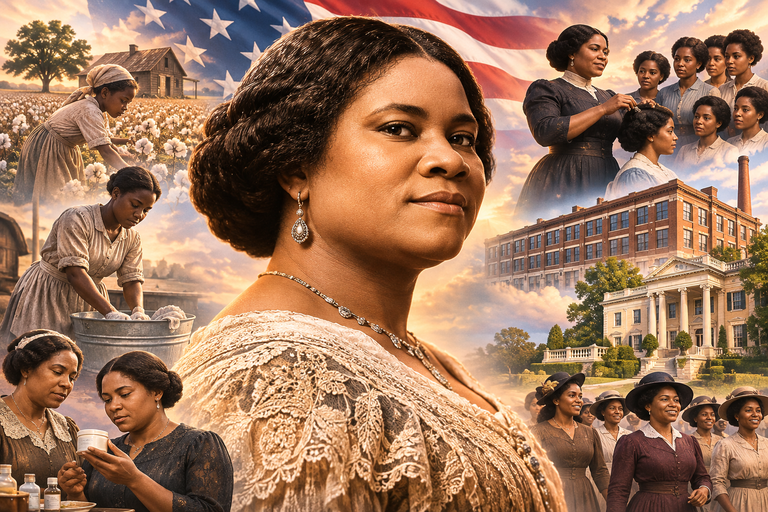
Madam C.J. Walker — From Daughter of Slaves to America’s First Self-Made Female Millionaire — AMERICAN DREAM
She did not know she was oppressed - She spent those decades surviving, working, raising her daughter, and learning. Her business success came later after decades of hard work. --YNOT!
She Was Born With Almost Nothing. She Died Having Built an Empire.
When people discuss the American Dream, they often talk about immigrants who arrived in this country with little money, worked hard, started businesses, and eventually became successful.
But what about someone who was born right here in America, into a family that had only recently been freed from slavery?
Someone who never had the opportunity to receive a proper education.
Someone who was orphaned at seven, married at fourteen, became a mother at seventeen, and was a widow before her twentieth birthday.
Someone who spent nearly two decades washing other people’s clothes just to survive.
And then, approaching forty years old, decided she was going to become a businesswoman.
Not just any businesswoman. One of the most successful female entrepreneurs of her generation. Her name was Madam C.J. Walker.
And this is her American Dream.
1867 — Born Free, But Not Free From Poverty
Sarah Breedlove was born on December 23, 1867, in Delta, Louisiana.
The Civil War had ended just two years earlier.
Her parents, Owen and Minerva Breedlove, had been enslaved on the very plantation where Sarah was born.
Sarah was the fifth of six children and the first born after emancipation.
Think about that for a moment. Her older siblings had been born into slavery.
She was born legally free. One generation separated her from a system in which people could be bought and sold as property.
But freedom did not mean prosperity.
Her parents became sharecroppers, farming land they did not own and receiving a portion of the crop in exchange for their labor.
Sharecropping often trapped families in debt. They worked the land, borrowed against future harvests, and frequently ended the year owing money.
Sarah grew up in a one-room cabin. As a young child, she carried water to laborers and worked in cotton fields. She had little opportunity to attend school.
And life was about to become considerably worse.
An Orphan at Seven
By the time Sarah was seven years old, both her parents had died.
She went to live with her older sister, Louvenia.
The sisters worked in the cotton fields and eventually moved to Vicksburg, Mississippi.
Sarah’s childhood was effectively over. She worked because she had to eat.
She had no savings, no inheritance, no family business, and no wealthy relatives waiting to provide opportunities.
At fourteen, she married Moses McWilliams, largely to escape an abusive situation in her sister’s household.
At seventeen, she gave birth to her only child, a daughter named Lelia.
In 1887, her husband died. Sarah was nineteen years old.
She was a young widow with a two-year-old daughter, little education, and almost no money.
For most people in her position, the future would have appeared painfully predictable.
Find work. Feed the child. Survive another day.
But Sarah wanted something better for her daughter.
And that desire would eventually change both their lives.
St. Louis — The Woman Who Washed Clothes
In 1889, Sarah moved to St. Louis, Missouri, where her four brothers had established themselves as barbers.
She found employment washing clothes and working as a domestic servant.
Sometimes she earned only $1.50 a day. Imagine the work.
There were no modern washing machines.
Clothes were scrubbed by hand, often using harsh soaps, boiling water, and washboards.
The work was physically exhausting. And Sarah continued doing it for years.
But she made an important decision. She would do everything possible to ensure her daughter received the education she herself had been denied.
She saved what she could and sent Lelia to school.
She also became involved with St. Paul African Methodist Episcopal Church.
This was important. The church introduced her to educated, successful Black professionals and businesswomen.
People who demonstrated that there were possibilities beyond the laundry room.
Sarah began to see a different future. And here is the first important lesson in her story.
Sometimes changing your life begins by changing the people and ideas you surround yourself with.
She didn’t suddenly become rich. She started learning what success could look like.
The Problem That Became a Business
During the 1890s, Sarah began experiencing serious problems with her hair and scalp.
She was losing her hair. At the time, proper hair care could be difficult, particularly for working-class women living without modern plumbing and sanitation.
Sarah tried different treatments. Her brothers, who worked as barbers, offered advice.
She experimented with products that were already available.
Eventually, she began using products developed by another Black entrepreneur, Annie Turnbo Malone.
This is an important part of the story that is sometimes overlooked.
Madam C.J. Walker did not invent the Black hair-care industry.
She learned from someone who was already successful in it.
Malone had created a growing cosmetics business and employed women to sell her products. Sarah became one of those sales agents.
She learned about the products, customers, demonstrations, and direct selling.
In other words, before becoming a successful entrepreneur, she learned the business by working in it. Something many entrepreneurs forget today.
Sometimes the best education is working for someone who already understands the industry you want to enter.
1905 — At Nearly Forty, She Starts Over
In 1905, Sarah moved to Denver, Colorado.
She was thirty-seven years old. Think about that.
By then, she had spent much of her life doing manual labor.
She had already experienced poverty, the deaths of her parents and first husband, an unsuccessful second marriage, and the responsibility of raising a daughter.
Many people would have decided that their opportunity had passed.
But Sarah was just getting started. She began developing and selling her own hair-care preparations.
One of her best-known products became Madam Walker’s Wonderful Hair Grower.
She marketed a system of hair and scalp care that combined cleansing, conditioning, treatments, and personal instruction.
She sold products directly to women. She demonstrated how to use them.
She listened to customers. And she discovered something that many large companies of her era had ignored.
Black women represented a substantial market with specific needs, yet relatively few major manufacturers were paying attention to them.
Sarah recognized an opportunity. She understood her customers because she was one of them. That is one of the oldest principles in business.
Find a problem people have. Develop a practical solution. This is called Opportunity.
And convince customers that your product provides real value.
The Birth of Madam C.J. Walker
In 1906, Sarah married Charles Joseph Walker, a newspaperman who had experience in advertising.
She began doing business under the name Madam C.J. Walker.
The name sounded professional, sophisticated, and memorable.
Her husband initially helped with advertising and promotion.
But the vision driving the company was hers.
Walker understood something that remains fundamental to business success today.
Having a product is not enough. You need customers. You need marketing.
You need distribution.
And eventually, you need a system that allows your business to grow beyond what you can personally sell.
She traveled extensively, demonstrating her products in homes, churches, and community gatherings.
She advertised in Black newspapers. She developed mail-order sales.
And then she made the decision that transformed her small business into something much larger.
She started training other women to sell her products.
She Didn’t Just Create Products. She Created Entrepreneurs.
This is probably the most interesting part of Walker’s business story.
Instead of trying to sell every product herself, she recruited women, trained them, and provided opportunities for them to build businesses of their own.
These women became known as Walker agents.
They learned how to provide hair treatments, sell products, maintain business records, and develop relationships with customers.
Some established beauty shops.
Others worked directly with customers in their communities.
Walker was building a distribution network.
Today we might describe elements of her model as direct selling, professional training, brand licensing, and franchising.
But remember the period. This was the early 1900s.
Women did not yet have the nationwide constitutional right to vote.
Black Americans faced segregation, violence, discrimination, and extensive economic restrictions.
And here was a Black woman building a national business that offered other Black women a route toward financial independence.
By the end of her life, her organization had developed a vast network of sales agents, with historical estimates reaching into the tens of thousands.
She was not merely manufacturing cosmetics. She was creating a business ecosystem.
And she understood that her company’s success depended on the success of the people representing it.
The more successful her agents became, the more successful her company became.
That is a lesson worth remembering in almost any business.
1910 — From the Kitchen to the Factory
As demand increased, Walker needed more manufacturing capacity.
In 1908, she established a beauty school in Pittsburgh known as Lelia College.
Then, in 1910, she moved her principal business operations to Indianapolis, Indiana.
Indianapolis was a major transportation and manufacturing center, with railroad connections that made nationwide distribution possible.
Walker established a factory, a salon, and another training school.
She was no longer just mixing preparations and selling them herself.
She was operating a manufacturing and distribution company.
She had employees. She had sales representatives.
She had inventory, advertising, training, accounting, and logistics.
And she had a recognizable national brand.
It was the transformation from self-employment into a scalable business.
There is an enormous difference between the two.
When you work for yourself, your income is often limited by the number of hours you can work.
When you build a successful company, you create a system that can continue operating when you are not personally doing every task.
Walker understood that distinction. And she built the organization necessary to make it happen.
1912 — A Woman Who Refused to Be Ignored
Success did not eliminate the obstacles she faced.
In 1912, Walker attended a convention of the National Negro Business League, an organization associated with Booker T. Washington.
Despite her growing success, she had not been given a speaking opportunity.
She was surrounded by male business leaders. But Walker was not interested in being ignored.
She stood and spoke about what she had accomplished. One of her most memorable statements was: “I have built my own factory on my own ground.”
Consider the significance. A woman whose parents had been enslaved.
A woman who had worked in cotton fields. A woman who had washed other people’s clothes for years. Now owned her own manufacturing operation.
And she was determined that the business community would recognize it.
The following year, she was invited to speak at the organization’s convention.
She had earned her place.
The Million-Dollar Businesswoman
By the late 1910s, Walker had become extraordinarily wealthy.
Her company’s annual sales reportedly exceeded $500,000 by the final year of her life.
That was an enormous business for the period.
She invested in real estate, including a prominent townhouse in Harlem.
She also built an impressive mansion overlooking the Hudson River in Irvington, New York.
It was called Villa Lewaro. The home became a symbol of how far she had traveled economically and socially.
The daughter of formerly enslaved parents was now living in the kind of neighborhood associated with some of America’s wealthiest families.
Guinness World Records recognizes Walker as the first self-made female millionaire.
The exact value of her estate remains a matter of historical interpretation, and other women may have accumulated comparable fortunes earlier.
But there is little doubt about the central accomplishment.
She had built a major company and accumulated extraordinary personal wealth without inheriting a fortune.
And she accomplished it during an era when both her race and her sex presented formidable barriers.
But She Wasn’t Finished
Here is another part of her story that deserves attention.
Walker did not view her wealth as something that existed only for her personal enjoyment.
She became a philanthropist. She supported educational institutions, including Tuskegee Institute. She contributed to organizations serving Black communities.
She made a substantial donation toward establishing a YMCA for Black residents in Indianapolis.
And she became involved in the campaign against lynching.
In 1917, following deadly racial violence in East St. Louis, Illinois, Walker joined other community leaders in a delegation to Washington to demand federal action.
She also encouraged members of her sales organization to participate in civic and community affairs.
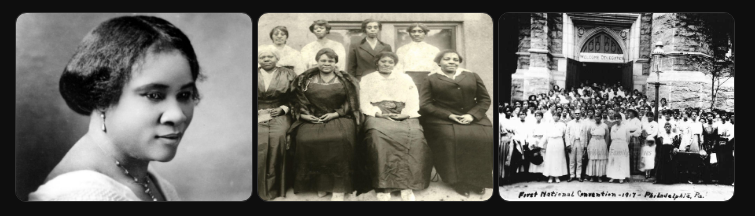
That same year, she organized a national convention of Walker agents in Philadelphia.
It was an extraordinary gathering of women who were not simply employees but business participants, sales professionals, and entrepreneurs.
Walker recognized that financial independence could provide women with greater influence over their own lives.
She had experienced the helplessness of poverty.
She understood what earning your own money could mean.
1919 — The End of an Extraordinary Life
Madam C.J. Walker died on May 25, 1919. She was fifty-one years old.
She had lived just over five decades. During that time, she had experienced some of the harshest conditions in American society.
She had been born into poverty. She had lost her parents.
She had been a child laborer. She had married young, become a mother, and been widowed. She had worked as a washerwoman for years.
And then she built an extraordinary business.
She had gone from washing clothes to owning a manufacturing company, from struggling to feed her daughter to helping thousands of other women earn an income.
Her daughter, A’Lelia Walker, continued the family’s business and social legacy, becoming an important patron of the Harlem Renaissance.
The company and cultural institutions associated with Walker’s name continued long after her death.
What Madam C.J. Walker Teaches Us About Business
I have always believed there is a difference between people who simply want to make money and people who understand how to build a business.
Walker understood that difference. There are several lessons in her story worth remembering.
First: You don’t have to start young.
She was approaching forty when she established her own product business.
By modern standards, many people would already have decided they were too old to start something new.
She didn’t. Second: You don’t necessarily have to invent something new.
Walker did not invent the hot comb or create the entire industry.
She recognized an existing market, developed products and services for it, and built an exceptional marketing and distribution organization.
Innovation isn’t always a new invention.
Sometimes it is finding a better way to serve customers.
Third: Learn the business before trying to dominate it.
She gained experience working with Annie Malone’s successful company.
She understood the products, customers, and sales process before building her own organization.
Fourth: Build systems, not just jobs.
If Walker had continued selling everything herself, she would have remained a small business operator.
Instead, she trained agents, built distribution channels, established manufacturing facilities, and delegated responsibilities.
That is how businesses scale. Fifth: Other people’s success can contribute to your success.
Her sales network helped women establish careers and earn money.
The success of those women contributed to the growth of Walker’s company.
And finally: Wealth can be used to create opportunity for others.
Walker supported education, community institutions, civil rights, and economic independence.
Her contribution went far beyond the personal fortune she accumulated.
The American Dream — What Her Story Really Means
There is a tendency today to look at a wealthy person and see only the money.
People see the mansion. The successful business. The personal fortune.
They don’t see the decades of work that came before it.
They don’t see the failures, disappointments, sacrifices, and risks.
And sometimes they forget just how difficult the journey was.
Madam C.J. Walker did not inherit a business. She did not inherit a fortune.
She was not born into a wealthy family with powerful connections.
She was born two years after the Civil War, to parents who had only recently been freed from slavery.
Her opportunities were constrained by poverty, racial discrimination, and restrictions imposed on women.
And yet she built a company. Not because the system was always fair.
It clearly wasn’t. Not because success was guaranteed.
It never is. She succeeded through determination, business judgment, mentorship, the ability to recognize an underserved market, and the discipline to build an organization around it.
The American Dream is not a promise that everyone will become wealthy.
It is the possibility that a person can improve their circumstances through enterprise, education, opportunity, and hard work.
Madam C.J. Walker demonstrated just how extraordinary that transformation could be, while also reminding us that opportunities have never been equally available to everyone.
Her parents had been enslaved. She was born free.
Her daughter grew up educated and eventually participated in one of America’s most important cultural movements.
Three generations. Three dramatically different lives.
And that, to me, is one of the most remarkable parts of her story.
The American Dream is not always about what you accomplish for yourself.
Sometimes it is about how much further the next generation can go because of what you built.
Madam C.J. Walker — December 23, 1867 – May 25, 1919.
From a Louisiana cotton field to a national business empire.