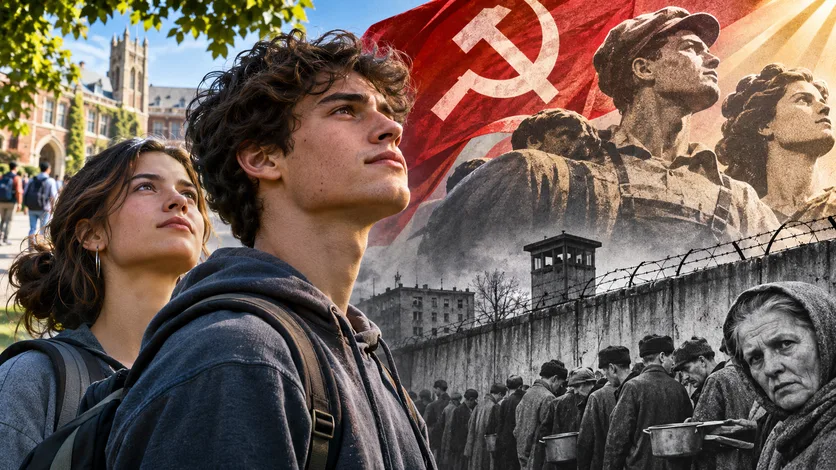
Think of it as Yoga for the brain, we are going to stretch a bit.
Why Young People Don’t Understand Socialism
The danger is not that young people want a better world. The danger is believing that a political system can deliver that better world simply because its promises sound compassionate. History judges governments by what they do to people, not by what they promise to do for them. -- YNOT!
There is something remarkable happening in America.
The New Generations are Embracing an Idea Their Grandparents Learned to Fear.
A growing number of young Americans have favorable opinions of socialism, an economic and political philosophy associated with some of the most consequential—and, in its authoritarian forms, some of the most catastrophic—experiments of the twentieth century.
For many young people, socialism represents fairness, compassion, affordable housing, free education, universal healthcare, and a society in which nobody gets left behind.
Those are understandable aspirations.
But there is a problem.
The socialism many young Americans imagine is often very different from the socialism millions of people experienced.
Their grandparents remember the Cold War, the Soviet Union, the Berlin Wall, communist revolutions, political repression, and the desperate attempts of people to escape socialist dictatorships.
Their grandchildren see a different picture: a promise of economic equality and a government willing to solve problems that capitalism supposedly cannot.
How did two generations develop such different understandings of the same political philosophy?
And more importantly, how much of the historical record do young Americans actually understand?
The answer involves education, economics, psychology, popular culture, and something particularly important: the difference between what a political ideology promises and what happens when governments attempt to put it into practice.
Young Americans and Socialism — What the Numbers Tell Us
Start with the numbers, because they reveal an extraordinary generational divide.
In September 2026, Gallup reported that 43% of Americans had a positive view of socialism, the highest percentage recorded since Gallup began tracking the question in 2010.
But the differences between age groups were even more revealing.
Among Americans aged 18 to 34: 57% viewed socialism positively. 43% viewed capitalism positively.
Among Americans aged 55 and older: 34% viewed socialism positively. 65% viewed capitalism positively.
That is a substantial reversal in how different generations perceive the two economic systems.
But there is another number that deserves attention.
Harvard University’s Fall 2025 Youth Poll found that only 21% of Americans aged 18 to 29 said they supported socialism, while 29% supported democratic socialism.
These figures were considerably lower than the percentages expressing a favorable impression of the word socialism in other surveys.
Why the discrepancy?
Because liking an idea and understanding how it would operate are two very different things. Ask someone whether they support fairness, economic security, affordable healthcare, and helping poor families.
Most people will say yes.
Ask that same person whether government should control major industries, direct economic production, determine prices, and restrict private ownership of productive assets.
You may receive a very different answer.
That distinction is central to understanding the appeal of socialism.
In fact, a 2025 college-student survey conducted by North Dakota State University’s Challey Institute found substantial disagreement among students about what socialism means. Many associated it with redistribution and a larger welfare state rather than central planning and collective ownership.
In other words, some young Americans may be expressing support for a collection of social policies rather than for the economic system historically associated with socialism.
That raises an obvious question.
If people cannot agree on what socialism actually means, how can they intelligently evaluate whether it works?
Why Young People Don’t Understand Socialism
Most people know surprisingly little about history, particularly the radical political movements of the twentieth century.
For someone who lived through the Cold War, the fall of the Berlin Wall in 1989 was an extraordinary event. For someone born in 2005, it is ancient history.
They did not grow up watching Soviet tanks, listening to reports about communist repression, or seeing desperate East Germans attempt to cross the Berlin Wall.
They did not experience the daily possibility of nuclear confrontation between the United States and the Soviet Union. They inherited the results of the Cold War without experiencing the conflict itself.
Socialism appeals to a fundamental human emotion: compassion. People see suffering, inequality, poverty, and injustice, and they want something done. Socialism offers a morally attractive answer.
Give society collective responsibility for economic resources, redistribute wealth, and provide greater security for everyone.
The attraction is understandable.
People are often less resentful of economic inequality when they believe the system is fair.
Consider professional sports. A young person may admire an athlete earning $50 million annually without resenting that person’s success.
Why?
Because the athlete’s extraordinary performance appears to justify the reward.
The same young person may resent a corporate executive earning millions while employees struggle to pay rent.
The difference is not necessarily the amount of money. It is whether the reward appears deserved. A fair society must distinguish between hierarchies built on competence and those maintained through corruption or coercion.
That is an important distinction.
A system that rewards innovation, productivity, and hard work is very different from one where political connections determine who succeeds.
The problem is not simply that young people dislike inequality. It is that many increasingly believe the economic game is rigged.
And when people lose confidence in the fairness of an economic system, they become more receptive to alternatives—even alternatives with troubling historical records.
3. What Schools and Popular Culture Leave Out
Here is where education becomes critically important.
For decades, American students have studied the American Revolution, the Constitution, slavery, the Civil War, the Great Depression, and World War II.
But how deeply have they studied the Soviet collectivization of agriculture?
Mao Zedong’s Great Leap Forward?
The Cambodian communist regime?
The East German secret police?
The consequences of central economic planning?
The question is not whether these subjects are ever taught. Many schools and universities cover them, sometimes extensively.
The question is whether students leave school understanding the economic mechanisms, political institutions, and human consequences involved.
There is evidence of a broader problem with historical knowledge.
According to the National Assessment of Educational Progress, only 13% of American eighth-grade students scored at or above the NAEP Proficient level in U.S. history in 2022.
Only 22% reached that level in civics. Those results do not establish that schools are deliberately concealing socialism’s failures. They do demonstrate serious weaknesses in historical and civic knowledge.
This creates a dangerous opportunity for oversimplified political narratives.
A student might learn that capitalism produces inequality. That is true.
But does the student also learn that capitalism, regulated markets, democratic institutions, and economic freedom have played important roles in reducing global poverty?
Does the student learn that socialism encompasses several competing traditions, and that Soviet-style central planning produced results very different from modern European social democracy?
Does the student understand the difference between private enterprise and crony capitalism?
Does the student examine how powerful governments can be captured by politically connected businesses?
Or is history reduced to a contest between greedy capitalists and compassionate socialists?
The reverse simplification is equally misleading: not every government service is socialism, and not every capitalist economy is free of corruption or injustice.
Good education must explain both systems, including their failures.
The Missing History of Economic Progress
Peterson raises another issue that receives comparatively little attention in popular political discussions.
Much of the public hears constant reports about inequality, economic insecurity, political corruption, and environmental threats.
Those problems deserve serious attention. But there is another historical development worth understanding.
Humanity has made enormous progress against extreme poverty.
According to updated World Bank estimates, approximately 1.5 billion people escaped extreme poverty between 1990 and 2022.
The progress was strongly associated with economic growth, particularly in Asia, where industrialization, expanded trade, private enterprise, state investment, and market-oriented reforms all contributed in different ways.
China offers an especially revealing comparison. Under Mao, the government attempted to reorganize agriculture and industrial production through a centrally planned revolutionary program.
Beginning in 1978, China gradually introduced market-oriented reforms, permitted more private economic activity, and expanded international trade.
China remained under Communist Party political control, but its economic structure changed substantially. The lesson is not that government has no economic role.
It is that incentives, markets, property rights, investment, and institutions matter enormously.
A serious historical education should examine those relationships instead of simply praising or condemning an ideological label.
Socialism — The Promise Versus the Historical Record
Perhaps the most important question is also the simplest. What happened when governments attempted to replace private economic decision-making with centralized socialist planning?
The answer requires distinguishing socialism as a broad family of ideas from the authoritarian communist governments that implemented particular versions of it.
Not every socialist advocates a one-party state. Not every socialist economy follows the Soviet model.
Nevertheless, the historical record of centralized communist economies is essential to evaluating proposals for extensive state control.
The Soviet Union — Equality Promised, Political Privilege Delivered
When the Bolsheviks seized power in Russia in 1917, they promised to overturn class privilege and build a society organized around workers’ interests.
Private ownership of major industries was progressively eliminated.
Agriculture was collectivized. Economic production was directed through government plans. Political opposition was suppressed.
Under Joseph Stalin, forced collectivization contributed to devastating famines, including the Holodomor in Soviet Ukraine during 1932–1933.
Millions died across the famine-stricken Soviet regions.
The Soviet state also developed an enormous system of political repression, forced labor, censorship, and surveillance.
The promised classless society did not eliminate political privilege.
It created a governing elite with extraordinary control over economic resources and ordinary citizens.
This is one of the central dangers of concentrating economic and political power in the same institution.
When government controls employment, production, distribution, and political authority, disagreeing with the government can threaten much more than your job.
It can threaten your livelihood and liberty.
China — When Government Planning Became a Human Catastrophe
In 1958, Mao Zedong launched the Great Leap Forward.
The program attempted to transform China rapidly through collective agriculture, mass mobilization, and centrally directed industrial production.
The results were disastrous. Agricultural production collapsed.
Government procurement policies and misinformation worsened food shortages.
The resulting famine killed an estimated 30 million people, according to one major academic assessment.
Think about that number. Thirty million human beings. That is not an ordinary policy failure.
It is one of the greatest human catastrophes of the twentieth century.
It illustrates what can happen when political leaders impose economic programs on an enormous population while suppressing honest reporting, criticism, and institutional accountability.
The lesson is not simply that government planning can make mistakes.
Every economic system makes mistakes. The lesson is that concentrated power can make those mistakes catastrophic and extremely difficult to correct.
East Germany — The Wall That Told the Story
After World War II, Germany was divided into two political and economic systems.
West Germany developed a market-oriented economy under democratic government.
East Germany became a Soviet-aligned socialist state ruled by the Socialist Unity Party.
Millions of East Germans left for the West In August 1961, the East German government began constructing the Berlin Wall to stop the exodus.
For 28 years, the government maintained a fortified barrier to prevent its own citizens from leaving.
People attempting to escape were imprisoned, and some were killed.
The wall finally fell on November 9, 1989.
This remains one of the most powerful images of the Cold War.
A government that claimed to represent working people had to build a wall to keep those people from escaping.
There were many differences between East and West Germany, but the direction of migration revealed something profound about citizens’ preferences.
When people were able to choose, enormous numbers chose to leave the communist state.
Cuba — A Revolution That Never Delivered Its Economic Promise
Cuba offers another example, especially relevant to Americans living in Florida.
Before 1959, Cuba was marked by significant inequality, political corruption, and the increasingly authoritarian rule of Fulgencio Batista. Fidel Castro promised a revolution that would deliver dignity, equality, independence, and a better life.
Following the revolution, the government nationalized major economic assets, expanded state control, and developed a Soviet-aligned one-party system.
Cuba made genuine advances in some social indicators, including literacy and access to healthcare, particularly in the revolution’s early decades. Those could have happened without destroying the rest of the country.
But those achievements must be weighed alongside political repression, restrictions on private enterprise, chronic economic inefficiency, shortages, and the emigration of millions of Cubans over subsequent decades.
American sanctions and Cuba’s loss of Soviet support also contributed to the island’s economic difficulties. They do not, however, explain every failure of its domestic economic policies.
Human Rights Watch’s 2026 report describes continuing political repression, prolonged blackouts, shortages, and deteriorating living conditions.
For many Americans, socialism is an academic discussion. For Cuban families who fled the island, it is personal history. They can explain what happens when a government becomes the dominant employer, distributor, regulator, and political authority.
They also understand that political and economic freedom are closely connected.
Venezuela — An Oil-Rich Country in Economic Collapse
Venezuela provides another important lesson. The country possesses enormous petroleum reserves. Under Hugo Chávez, the government expanded nationalizations, price controls, currency controls, and state intervention in the economy.
For a time, high oil prices financed significant social spending.
But the country’s dependence on petroleum, economic mismanagement, corruption, declining investment, and weakened institutions created substantial vulnerabilities.
When global oil prices collapsed in 2014, those weaknesses became catastrophic.
Venezuela experienced hyperinflation, shortages, a severe economic contraction, and mass emigration.
U.S. sanctions subsequently aggravated parts of the crisis, but the economic problems were already developing before the broadest sanctions were imposed.
A Congressional Research Service analysis identifies nationalization, price controls, borrowing, corruption, and failure to diversify as important contributors to the collapse.
The lesson is not that every government program produces Venezuela.
The lesson is that economic policies must be judged by their incentives, institutional consequences, and sustainability—not by the popularity of their initial promises.
But What About Scandinavian Socialism?
This is probably the most common response when the failures of twentieth-century communist states are discussed.
What about Denmark? Sweden? Norway? Finland?
These nations combine relatively extensive welfare systems with high living standards and democratic institutions. But there is a crucial distinction.
The Nordic countries are predominantly market economies with substantial private ownership, competitive businesses, and extensive social welfare systems.
They are not Soviet-style centrally planned economies.
In 2015, Denmark’s then-prime minister, Lars Løkke Rasmussen, specifically rejected describing Denmark as a socialist planned economy.
The Nordic model combines capitalism with high taxation, public services, labor institutions, and social insurance.
A recent Cambridge University Press examination of Nordic capitalism emphasizes that private ownership and market-based economic activity remain fundamental features of these countries.
That distinction matters.
Universal healthcare does not automatically make an economy socialist.
Public education does not eliminate capitalism.
Social Security is not equivalent to nationalizing the productive economy.
Likewise, democratic socialism, social democracy, Marxism, and Soviet communism are not interchangeable terms.
When people debate socialism without distinguishing these systems, they often argue about entirely different things.
A young American advocating affordable healthcare may have little interest in abolishing private ownership.
A critic of Soviet communism may have no objection to public schools or emergency medical services.
Accurate definitions make the debate more meaningful.
6. Why the Young Buy What Their Grandparents Rejected
It would be easy to dismiss young supporters of socialism as ignorant.
But that would overlook legitimate economic frustrations.
Many younger Americans face extraordinarily high housing costs, substantial student debt, uncertain career prospects, and difficulties accumulating savings.
Some entered adulthood during or immediately after the Great Recession.
Others experienced the COVID-19 pandemic, rapid inflation, and significant disruptions to employment and education.
They see wealthy individuals and major corporations receiving government assistance while ordinary families struggle.
They see political connections influencing business opportunities.
And they understandably wonder whether the existing economic system is working for them.
The Independent Institute discussion accompanying this article raises an especially useful distinction.
There is a difference between capitalism and crony capitalism.
Capitalism, broadly understood, permits private ownership and market exchange.
Crony capitalism occurs when businesses use political influence to secure advantages that competitors cannot obtain through ordinary market competition.
Subsidies, special privileges, protectionist regulations, and preferential government contracts can distort the competitive process.
The resulting system may reward political access rather than economic productivity.
A young person observing those outcomes may conclude that capitalism itself is the problem.
But the problem may be a combination of concentrated economic power, poorly designed government policy, inadequate competition, and political favoritism.
This is why simply telling younger Americans that capitalism works is insufficient.
They need explanations for why particular problems exist.
Why has housing become so expensive?
How do zoning restrictions affect supply?
How does monetary policy influence borrowing and asset prices?
How do government subsidies change market incentives?
Why do some businesses succeed through innovation while others succeed through political influence?
And which interventions actually improve living standards?
These are questions that deserve evidence, not slogans.
The Moral Appeal of Socialism
There is another important reason socialism remains attractive.
It promises to turn compassion into public policy.
If someone is hungry, feed them.
If someone is sick, provide healthcare.
If someone cannot afford education, help them obtain it.
These are humane objectives.
But good intentions do not automatically produce effective outcomes.
Every major public policy involves trade-offs.
Someone must produce the goods.
Someone must provide the services.
Someone must pay the costs.
Institutions must determine how resources will be allocated.
And systems must establish incentives for people to work, invest, innovate, and solve problems.
The central economic question is not whether helping others is desirable.
Of course it is.
The question is how to organize society so that assistance can be provided sustainably without destroying the economic activity needed to support it.
A successful economy must generate wealth before that wealth can be redistributed.
It must also maintain the institutions needed to prevent both private abuse and government abuse.
This is where the historical record becomes indispensable.
7. What Happens When Government Controls Everything?
One of the most revealing ideas in the Independent Institute discussion concerns government power.
Imagine a small community in which people voluntarily establish a cooperative.
They pool their resources.
They share profits.
They make decisions collectively.
There is nothing inherently incompatible with a market economy about that arrangement.
People are free to organize their businesses cooperatively.
Now imagine that the government decides everyone must participate.
What happens to someone who refuses?
What happens to a person who wants to start an independent business?
What happens to someone who does not agree with the government’s economic decisions?
The distinction between voluntary cooperation and compulsory state control becomes critically important.
A society can contain worker cooperatives, private companies, charities, public services, nonprofit organizations, and voluntary communities.
But when a government gives itself exclusive authority over an economy, it risks concentrating enormous power over individual lives.
Of course, government intervention is not automatically coercive in the same sense as a dictatorship, and private monopolies can also undermine freedom.
The issue is how power is distributed, constrained, and held accountable.
Democratic safeguards, an independent judiciary, free speech, freedom of association, secure property rights, and meaningful political competition are essential regardless of the economic system.
The historical failures of authoritarian communist governments demonstrate why those safeguards matter.
8. The Lessons That Historical Memory Can Teach
Perhaps the most troubling aspect of this generational debate is how easily historical memory disappears.
In 1989, millions of people watched the Berlin Wall fall.
In 1991, the Soviet Union collapsed.
For much of the world, those events represented the end of a long struggle involving political repression, economic competition, military confrontation, and conflicting visions of human freedom.
But historical memory fades.
The children of people who experienced those events heard the stories.
Their grandchildren may encounter them only briefly in a textbook or documentary.
And eventually, political ideas that once carried powerful historical associations can acquire entirely new meanings.
That does not mean older generations are automatically correct.
Every generation has blind spots.
Many older Americans also misunderstand socialism, capitalism, and the history of economic development.
But firsthand testimony is an important form of historical evidence.
The experiences of people who lived under communist governments deserve serious attention.
That includes Cuban exiles, Venezuelan migrants, former Soviet citizens, Eastern European dissidents, and refugees from other authoritarian systems.
Their experiences do not establish that every form of socialism is identical.
They do, however, provide evidence of what can happen when economic concentration and unchecked political authority reinforce each other.
We should not dismiss those experiences merely because they complicate an attractive political theory.
9. Reaching the Next Generation With the Facts
The solution to historical misunderstanding is not censorship.
It is not banning books.
It is not replacing one ideological narrative with another.
And it is certainly not telling young Americans that they are too ignorant to have opinions.
The solution is better education.
Students should understand the theories behind socialism and capitalism.
They should examine what Karl Marx actually argued.
They should study the economic reasoning of Adam Smith, Friedrich Hayek, John Maynard Keynes, Milton Friedman, and other major thinkers.
They should understand the differences between economic planning, market coordination, redistribution, public ownership, and democratic governance.
They should examine primary documents and economic evidence rather than relying exclusively on political commentary.
Most importantly, they should compare promises with measurable outcomes.
Consider a few questions that belong in any serious discussion of political economy.
What happens to production when prices are established by political decree rather than market conditions?
How do governments obtain reliable information about what millions of consumers need?
What happens when industries cannot fail because their losses are continuously covered by taxpayers?
How do societies prevent politically connected individuals from capturing government institutions?
How do countries protect vulnerable citizens without undermining the incentives needed to finance public services?
Why have some market-oriented economies generated extraordinary prosperity while others remain trapped by corruption, monopolies, and weak institutions?
And why did so many centrally planned economies eventually introduce market reforms?
These questions are not threats to education.
They are the foundation of education.
Teach the Successes as Well as the Failures
Young Americans should understand the Soviet famines and the Berlin Wall.
They should also understand the failures of unregulated financial speculation, political corruption, monopolistic behavior, and abusive labor practices.
They should learn about the achievements of private enterprise and the role of public infrastructure, education, scientific research, and effective government institutions.
They should study countries that prospered under market-oriented economic policies.
And they should examine why certain welfare states function effectively while others struggle with high costs, debt, or inefficient administration.
The purpose should be to develop the ability to evaluate economic systems critically.
A person who understands both sides of an argument is better equipped to distinguish a plausible policy from an attractive but unworkable promise.
Bring History Back to Life
History also becomes more meaningful when it is connected to real human experiences.
Let young people hear directly from those who lived through political repression.
Let them examine photographs of the Berlin Wall.
Let them compare the development of East and West Germany.
Let them study the economic histories of North and South Korea.
Let them examine the experiences of ordinary people in Cuba and Venezuela.
Let them investigate why some Chinese economic reforms produced substantial growth after earlier centrally planned policies failed so catastrophically.
And let them ask difficult questions about every system, including America’s.
That is not indoctrination.
That is historical inquiry.
Final Thoughts — The Danger of Forgetting History
Every generation wants to improve the world.
Young people want economic opportunity, affordable homes, good healthcare, meaningful careers, and a society that treats people fairly.
Those are reasonable expectations. But history teaches us that good intentions are not enough.
A government can promise equality and produce political privilege. It can promise prosperity and produce shortages.
It can promise freedom from exploitation while concentrating power in the hands of a ruling elite. It can promise security while leaving citizens dependent on institutions they cannot challenge.
That does not mean every socialist idea leads to dictatorship, nor does it mean capitalism automatically produces justice or prosperity.
Economic outcomes depend on institutions, incentives, political freedoms, and the details of how policies operate.
Nevertheless, the history of authoritarian, centrally planned socialist states contains warnings that should never be forgotten.
One of the greatest mistakes a society can make is to judge an economic system by the beauty of its promises while ignoring the consequences of its implementation.
The young Americans who express sympathy for socialism are not necessarily rejecting freedom.
Many are searching for fairness, security, and opportunity.
But those aspirations should lead to serious questions about how governments exercise power and how economies actually create prosperity.
Their grandparents witnessed the consequences of some of the most ambitious political experiments in human history.
Some watched those experiments collapse. Others risked everything to escape them.
The next generation does not have to accept every political conclusion their grandparents reached.
But it should understand why those conclusions were reached.
History should not be a collection of slogans selected to support whichever ideology happens to be fashionable.
It should be the accumulated evidence of what human beings have tried, what succeeded, what failed, and what those experiences cost.
We owe young Americans more than political promises. We owe them the facts.
Because the people who forget history do not necessarily repeat it exactly.
Sometimes they simply give the same old mistakes a new name.