Think of it as Yoga for the brain, we are going to stretch a bit.
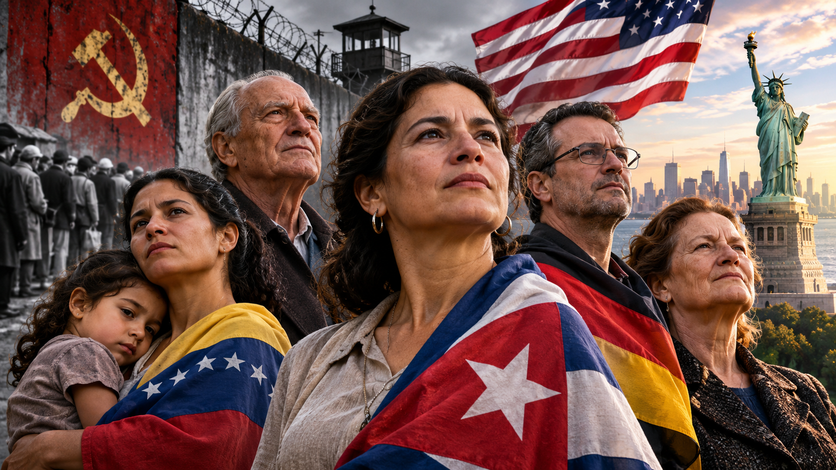
REAL SURVIVORS OF SOCIALISM WARN AMERICANS ABOUT SOCIALISMO
The American Dream is not a promise that everyone will succeed. It is the freedom to try — and the right to keep trying, even when the government would prefer you didn't. --YNOT!
They lived through the promises, experienced the consequences, and escaped. Now they are warning America.
There is something I have noticed about the debate over socialism in America.
Some of the people who speak most enthusiastically about socialism have never lived under a socialist government.
And some of the people who speak most passionately against it are immigrants who escaped countries where socialism became a system of authoritarian government control.
That contrast deserves our attention.
In American universities, political discussions, and social media, socialism is frequently presented as an alternative to capitalism. Its supporters emphasize economic equality, affordable housing, healthcare, education, and protection for working families.
Those are legitimate goals worthy of discussion.
But ask someone who grew up in communist Cuba, lived through Venezuela’s economic collapse, or experienced life behind the Iron Curtain, and you may hear an entirely different perspective.
Not about political theory. Not about what Karl Marx wrote.
Not about what a politician promises during an election.
But about what happens when a government gains extraordinary control over the economy, political institutions, and everyday life.
These people are not simply arguing about economic theories.
They are describing their lives.
And perhaps before Americans decide what kind of economic and political system they want, they should spend a little more time listening to people who have already experienced the alternatives.
A LEGAL IMMIGRANT’S MESSAGE TO AMERICA
“I came here for the freedoms you already have.”
Imagine leaving behind everything familiar.
Your home. Your friends. Your relatives. Your profession. Your language.
Imagine arriving in another country with little money, uncertain employment prospects, and the frightening responsibility of starting your life again.
Why would someone do that?
For millions of immigrants, the answer has been opportunity.
But for people escaping authoritarian governments, the answer often includes something even more fundamental.
Freedom.
The immigrant’s testimony that inspired this article describes a woman who left a country where socialist promises had become associated with shortages, corruption, political intimidation, and restrictions on personal choice.
She emphasizes that she immigrated legally, respecting the laws of the country she hoped would become her new home.
What is striking about her account is not that she describes America as perfect.
She doesn’t need to.
America has poverty. America has corruption. America has economic inequality. America has politicians who make promises they cannot keep.
But America also offers something that authoritarian governments frequently deny their citizens.
The ability to challenge the people in power without automatically becoming an enemy of the state.
You can criticize the president.
You can publish an article attacking the government.
You can establish a business, compete against an established company, and keep the profits if you succeed.
You can organize political opposition.
You can vote against the government.
And you can generally leave the country without asking the government to grant you permission to escape.
These freedoms may seem ordinary to Americans.
To someone who lived without them, they can be extraordinary.
The message of many immigrants who escaped authoritarian socialism is not that America should ignore its problems.
It is that Americans should understand how valuable their existing freedoms are before supporting political systems that could weaken them.
Because once a population loses those freedoms, recovering them can take generations.
A CUBAN MOTHER’S WARNING
When the government promises to provide everything, what happens when it cannot?
To understand Cuba, forget the political speeches for a moment.
Forget the photographs of Havana’s vintage automobiles.
Forget the beautiful beaches, the music, and the romantic images of the Cuban Revolution.
Instead, walk into the kitchen of an ordinary Cuban mother.
Her immediate concern is not capitalism or socialism.
It is finding something for her children to eat.
In March 2026, the Associated Press documented the life of Yuneisy Riviaux, a 42-year-old Cuban mother of two living in Havana.
Her family was struggling with food shortages, deteriorating housing, and economic hardship.
Sometimes she could find food for her daughters.
Other days, she could not even provide lunch.
Her story illustrates what economic statistics often fail to communicate.
When a country experiences a prolonged economic crisis, ordinary families pay the price.
Cuba’s problems have multiple causes, including decades of economic mismanagement, dependence on external support, diminished domestic production, the COVID-19 shock, and U.S. sanctions and embargo restrictions.
But regardless of how responsibility is divided, the result for families like hers is devastating.
Cuba’s great promise
When Fidel Castro came to power in 1959, he promised a transformed society.
The revolution would eliminate exploitation, confront inequality, expand education, and make healthcare available to everyone.
Cuba subsequently developed a Soviet-aligned, one-party socialist state.
Private economic activity was heavily restricted, major industries came under government control, and political opposition was suppressed.
For decades, the government maintained a rationing system intended to guarantee access to basic food.
Supporters pointed to the country’s achievements in education and medicine.
But Cuba also developed serious structural economic problems, including weak productivity, chronic shortages, distorted incentives, and dependence on foreign subsidies.
And the government increasingly controlled what people could publish, organize, own, and criticize.
By 2024, Cuba had formally requested assistance from the United Nations World Food Programme to provide powdered milk to children.
Think about that.
A government that had promised generations of Cubans economic security was asking an international organization to help provide milk for young children.
The Cuban mother’s lesson
A mother does not measure the success of an economic system by how impressive its promises sound.
She measures it by whether her children are fed.
Whether the lights stay on.
Whether medicine is available.
Whether her children have a future.
And whether she can improve her family’s circumstances through her own effort.
This is why so many Cuban Americans have such strong opinions about socialism.
Many remember the confiscation of businesses and property.
Others remember government ration books, political surveillance, or relatives imprisoned for opposing the regime.
Some experienced the economic collapse of the 1990s, when the disappearance of Soviet support plunged the country into extreme hardship.
You can debate the historical causes of Cuba’s economic failures.
You cannot dismiss what generations of Cubans have experienced.
A political promise means very little to a mother who cannot find food for her children.
VENEZUELA — FROM PROSPERITY TO MASS EXODUS
A country with enormous natural wealth
Venezuela provides another important lesson.
Unlike Cuba, Venezuela entered its socialist political transformation with substantial oil wealth and a long-established petroleum industry.
The country possessed some of the world’s largest proven oil reserves.
For decades, oil revenues supported economic development, government spending, and a substantial urban middle class.
But Venezuela also suffered from inequality, corruption, volatile oil revenues, and political instability.
Those problems helped create the conditions for Hugo Chávez’s rise to power in 1999.
Chávez promised a Bolivarian Revolution.
His government expanded social programs, increased state intervention in the economy, and nationalized businesses and industries.
Many poor Venezuelans initially supported those policies, and some experienced real improvements during years of high oil revenues.
But over time, increasingly centralized political authority, economic controls, corruption, declining investment, and destructive fiscal and monetary policies contributed to severe economic deterioration.
After Chávez died in 2013, Nicolás Maduro inherited an increasingly troubled economic and political system.
Venezuela subsequently experienced hyperinflation, collapsing living standards, severe shortages, and intensified political repression.
Falling oil prices and declining petroleum production worsened the crisis. International sanctions later added further economic pressure.
The country became one of the most dramatic examples of economic and institutional collapse in modern Latin American history.
Nearly eight million people left
According to the United Nations refugee agency, nearly 7.9 million Venezuelan refugees and migrants were living outside Venezuela as of its December 2025 update.
Let that number sink in.
Nearly eight million people.
Families separated.
Professionals abandoning their careers.
Parents leaving their children with relatives while searching for employment abroad.
People crossing borders, traveling thousands of miles, and accepting enormous risks because they could no longer see a viable future at home.
And the crisis was not simply economic.
In its 2026 World Report, Human Rights Watch documented arbitrary detention, torture, political intimidation, and severe repression of opposition voices following Venezuela’s disputed 2024 presidential election.
The Venezuelan dissident
Consider the documented experience of Stephanie Salazar Landaeta, a Venezuelan human rights lawyer.
She participated in protests against Maduro’s government in 2017.
According to her personal testimony, government agents subsequently raided her home, abducted her, and imprisoned her in El Helicoide, a detention facility notorious for the treatment of political prisoners.
She described physical and psychological torture.
Her experience was presented in the Victims of Communism Memorial Foundation’s Witness Project.
Whatever someone’s opinion of Venezuela’s economic policies, imprisoning and torturing political opponents is not a legitimate response to political disagreement.
And this is where the discussion must extend beyond economics.
When the same political leadership controls major economic resources, dominates political institutions, and undermines the independence of the judiciary, citizens can lose the ability to hold that leadership accountable.
Economic dependence becomes especially dangerous when combined with political power that cannot be challenged.
THE EASTERN BLOC — THE PEOPLE WHO LIVED BEHIND THE IRON CURTAIN
The wall that tells the story
Perhaps the most powerful symbol of authoritarian communism was the Berlin Wall.
Following World War II, Germany was divided into competing political and economic systems.
West Germany developed a democratic government and a social market economy based largely on private enterprise.
East Germany became a Soviet-aligned socialist state dominated by the Socialist Unity Party.
For years, East Germans fled westward.
They sought political freedom, better economic opportunities, and the ability to determine their own futures.
By 1961, the exodus had become such a serious problem for East Germany that its government constructed the Berlin Wall.
The wall was not designed primarily to stop foreigners from entering East Germany.
It was designed to prevent East Germans from leaving.
Between 1961 and 1989, at least 140 people died at the Berlin Wall in connection with East Germany’s border regime, according to the Berlin Wall Foundation.
That should make anyone think.
A government claims to have established a superior society.
Yet it must build walls, deploy guards, and threaten its own citizens to keep them from escaping.
What does that tell you about the society being defended?
Natan Sharansky — the price of speaking freely
Natan Sharansky grew up in the Soviet Union.
He became an advocate for human rights and for the freedom of Soviet Jews to emigrate.
In 1977, Soviet authorities arrested him.
He was accused of treason and anti-Soviet activities and sentenced to thirteen years of imprisonment.
He ultimately spent nearly nine years in Soviet prisons and labor camps before his release in February 1986.
His imprisonment involved solitary confinement, hunger strikes, and harsh treatment.
After his release, Sharansky became an internationally recognized advocate for human rights and democratic freedom.
One of the most important lessons from his experience concerns fear.
In an authoritarian society, people learn that certain opinions cannot be expressed publicly.
A person may think one thing privately, say something else at work, and repeat the government’s approved position in public.
This creates an extraordinary kind of psychological control.
Citizens begin censoring themselves.
They become suspicious of neighbors.
They avoid discussing politics with colleagues.
And gradually, society loses something essential.
The freedom to think and speak without fear of punishment.
That is one reason the experiences of Soviet dissidents matter today.
They remind us that freedom of expression is not merely another political issue.
It is one of the protections that makes political disagreement possible in the first place.
SOCIALISM THROUGH THE EYES OF THOSE WHO LIVED UNDER IT
The difference between promises and institutions
There is a recurring pattern in the stories of people who escaped authoritarian socialist states.
Many governments initially promised economic fairness, protection from exploitation, greater security, and an improved standard of living.
Those promises attracted supporters because they addressed real social problems.
But in some of the most consequential historical examples, the governments making those promises simultaneously accumulated extraordinary political power.
Opposition parties were suppressed.
Independent journalism was restricted.
Businesses were nationalized.
Property rights were weakened.
Judicial independence disappeared.
Economic decisions became increasingly centralized.
And citizens gradually lost their ability to replace political leaders through genuinely competitive elections.
The central problem was not that governments wanted to help the poor.
The problem was that governments claimed extraordinary authority over society while eliminating the institutions capable of holding them accountable.
The Cuban journalist who refused to remain silent
Consider Yoani Sánchez, the Cuban journalist who became internationally known for documenting everyday life in Cuba.
Her writing has described shortages, censorship, bureaucratic restrictions, and the frustrations of ordinary Cubans.
She established the independent digital newspaper 14ymedio in 2014.
Her journalism challenged the government’s control over information and provided a perspective different from official state media.
In interviews, Sánchez described the difficulties of operating an independent publication under government censorship and the lack of hope driving many Cubans to leave the island.
Her story raises an important question.
If a government is confident that its political and economic system serves the population, why should independent journalists be treated as threats?
Why shouldn’t citizens be allowed to evaluate competing accounts of their government’s performance?
And why shouldn’t voters be able to replace leaders who fail?
A political system’s legitimacy cannot be determined solely by its stated intentions.
It must also be judged by its willingness to tolerate dissent and accept accountability.
BUT WAIT — IS ALL SOCIALISM THE SAME?
This is where the American debate frequently becomes confused.
And it is an important distinction.
Not every policy described as socialist establishes socialism in the historical Marxist-Leninist sense.
A government-funded healthcare program is not the same thing as a one-party communist state.
Social Security is not equivalent to Soviet central planning.
Public education does not automatically lead to dictatorship.
And democratic socialists do not necessarily advocate the political repression practiced by governments in Cuba or the former Soviet Union.
These are important differences.
Countries such as Denmark, Sweden, Norway, and Finland combine extensive social programs with privately owned businesses, competitive markets, constitutional government, and political pluralism.
They are generally described by economists as capitalist mixed economies with substantial welfare states, rather than Soviet-style centrally planned economies.
People can reasonably disagree about whether those countries’ taxation, spending, and regulatory policies would work in America.
But the debate should recognize the actual differences between their institutions and those of authoritarian communist systems.
So what should Americans worry about?
The issue is not simply whether a government provides services.
The more serious questions are about how power is distributed and controlled.
Does the government respect private property?
Can citizens establish businesses without political favoritism?
Can independent journalists investigate corruption?
Can political opponents compete freely in elections?
Can courts rule against the government?
Can citizens criticize government leaders without being imprisoned?
Can people leave the country freely?
And can the population peacefully remove leaders who abuse their authority?
Those questions matter regardless of whether a politician calls himself a socialist, a capitalist, a conservative, or a progressive.
The history of authoritarian governments demonstrates that political repression is not limited to any single economic ideology.
The danger begins when political power becomes concentrated, accountability disappears, and the government places itself beyond the reach of the people.
WHY AMERICANS SHOULD LISTEN BEFORE IT IS TOO LATE
Freedom is easier to lose than to recover
Americans frequently take their freedoms for granted.
We complain about politicians.
We complain about taxes.
We complain about regulations, inflation, healthcare costs, and the price of housing.
And we should.
A free society depends on its citizens questioning government decisions.
But consider something remarkable.
The ability to publicly complain about the government is itself a freedom that millions of people around the world have been denied.
A Cuban can face imprisonment for participating in antigovernment protests.
A Venezuelan opposition activist has faced detention and persecution.
A Soviet dissident could spend years in a prison camp for challenging the political system.
Those are not abstract dangers.
They are documented historical experiences.
And for many immigrants, they are personal memories.
The immigrant who understands the American Dream
I have always found something remarkable about immigrants who arrive in America with almost nothing and eventually build successful lives.
They often understand opportunities that Americans born here overlook.
Some establish small businesses.
Some become contractors, doctors, engineers, restaurant owners, or entrepreneurs.
Many begin with jobs that pay very little.
They work long hours.
They save their money.
They take risks.
And gradually, they build something.
Not everyone becomes wealthy.
Not everyone succeeds.
But they have an opportunity to try.
That distinction matters enormously.
Because economic opportunity is not merely about money.
It is about independence.
When you can earn your living, own property, develop a business, and make decisions about your future, you possess a degree of freedom that can protect you from dependence on political authorities.
That does not mean government has no legitimate economic role.
It means a healthy society needs room for individuals, families, businesses, civic organizations, and communities to operate independently of government control.
The lesson from history
A government does not have to seize every business overnight to begin concentrating excessive power.
Institutional erosion can happen gradually.
Independent courts can become politically controlled.
The press can face increasing intimidation.
Private businesses can become dependent on political connections.
Elections can remain on the calendar while genuine political competition disappears.
And citizens can slowly become afraid to challenge their government.
The consequences can be devastating.
But none of this means that America is inevitably following the path of Cuba, Venezuela, or the Soviet Union.
The United States has a different constitutional structure, political history, economic system, and set of institutions.
Those differences are important.
They are also worth protecting.
THE REAL MESSAGE FROM THE SURVIVORS
Something else deserves consideration.
People who escaped authoritarian socialism are not all politically identical.
Some are conservative.
Some are liberal.
Some support extensive government social programs.
Others believe the government should play a much smaller economic role.
Some fled primarily because of political persecution.
Others left because economic conditions made everyday life unbearable.
And some left because of both.
Their experiences should not be reduced to campaign slogans.
But the patterns in their testimony deserve serious attention.
They tell us about governments that promised security but failed to deliver it.
Governments that promised equality while political elites enjoyed privileges unavailable to ordinary citizens.
Governments that claimed to represent workers while restricting those workers’ freedom to organize independently.
And governments that promised liberation but punished people who disagreed.
These are warnings worth hearing.
Not because every proposed social program will lead to tyranny.
Not because capitalism is perfect.
And certainly not because every immigrant has the same political opinion.
They matter because these survivors understand something that can be difficult to appreciate until it is gone.
Freedom is not simply the ability to receive something from your government.
It is also the ability to make decisions about your life without requiring your government’s permission.
MY FINAL THOUGHT — BEFORE AMERICA DECIDES
I believe America needs to have a serious conversation about capitalism, socialism, economic opportunity, and government’s proper role in society.
Capitalism has produced extraordinary wealth and technological progress.
It has also produced economic inequality, financial crises, corporate abuses, and situations where hardworking people struggle to afford basic necessities.
Those problems deserve solutions.
But before abandoning market competition, private ownership, or economic independence in favor of greater centralized control, we should understand what history teaches us.
And that means listening to the people who experienced systems where government control extended far beyond ordinary regulation or social insurance.
Talk to someone whose family lost its business to nationalization.
Talk to someone who stood in line for hours to purchase basic food.
Talk to someone who was punished for criticizing the government.
Talk to someone whose parents risked their lives escaping across a heavily guarded border.
Talk to someone who left behind everything because remaining in their homeland meant surrendering their future.
Ask them what they miss about their countries.
Many will tell you they miss the food, the music, the language, the neighborhoods, and the people.
They may tell you they love their homeland.
But they may also explain why they could no longer live under its government.
That is a distinction Americans should understand.
You can love your country without loving its government.
And you can support helping the poor without supporting a government that controls every aspect of their lives.
Perhaps the most important question Americans should ask is not whether a politician promises equality, prosperity, or security.
Almost every politician promises those things.
The more important question is:
What powers will the government acquire to deliver those promises, and what prevents those powers from being abused?
That is where history becomes valuable.
Because the survivors of authoritarian socialism are not merely telling us what happened in the past.
They are reminding us why constitutional limits, economic independence, political competition, and individual liberty matter.
And they are reminding us that good intentions do not guarantee good government.
ONE FINAL QUESTION
If someone tells you that a particular political system will solve America’s problems, shouldn’t you first ask the people who have already lived under that system what actually happened?
Listen to their experiences. Examine the evidence.
Understand the differences between political systems.
Then make up your own mind.
Because a free society is not one in which everyone agrees.
A free society is one in which people can disagree with their government, challenge its decisions, and change its leadership without fearing for their freedom.
And that is something worth protecting.
FINAL THOUGHT
“Before you embrace the promises of a political system, listen to the people who lived under it. History is not only written in books. Sometimes it arrives on your shores, carrying a suitcase and a warning.”
The American Dream is not a promise that everyone will succeed. It is the freedom to try — and the right to keep trying, even when the government would prefer you didn’t.