Think of it as Yoga for the brain, we are going to stretch a bit.
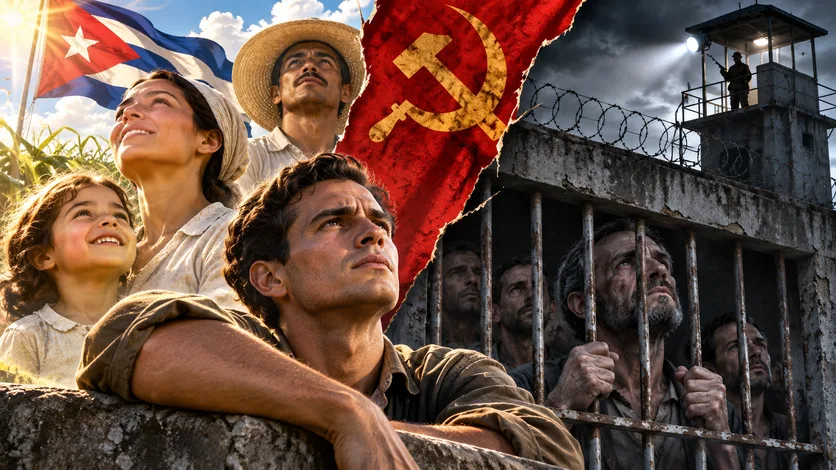
SOCIALISM: DON’T LISTEN TO THE PROMISES. READ WHAT HAPPENED.
Never judge socialism by the paradise it promises. Judge it by the history it leaves behind. The true measure of any political system is not what its leaders promise when they seek power, but how much freedom the people retain once they have it. — YNOT
The Story of Fidel Castro, Mao Zedong, Vladimir Lenin, and the Promises That Changed History.
There is an old lesson about politics that every generation seems determined to learn the hard way.
Never judge a political system exclusively by what its supporters promise. Judge it by what happens when its leaders acquire power, especially when nobody can tell them no.
Throughout history, revolutionary movements have promised equality, justice, opportunity, freedom from exploitation, and a better life for ordinary people.
Those are attractive promises. Most decent people want those things.
But what happens when a government promises to eliminate poverty and inequality, and then begins eliminating the very freedoms people need to challenge its decisions?
What happens when the revolution that promised to liberate workers decides that workers cannot organize independently?
What happens when a government that promised democracy decides elections are no longer necessary?
And what happens when the people who fought to overthrow one dictatorship discover that they have helped establish another?
To understand these questions, we need to study the historical record.
Not slogans. Not campaign speeches. Not promises about what will happen when the right people finally control everything.
We need to examine what actually happened in Cuba, China, and the Soviet Union.
And we need to listen to people who lived through those experiences.
THE CUBAN REVOLUTION: HOW THE PROMISE OF DEMOCRACY BECAME ONE-PARTY RULE
In January 1959, Fidel Castro entered Havana as the victorious leader of a revolution against Fulgencio Batista.
Batista was a dictator. He had seized power through a military coup in 1952, interrupted Cuba’s constitutional system, and presided over a repressive government.
There were legitimate reasons for Cubans to oppose him.
Castro’s revolutionary movement attracted people from across the political spectrum.
Students, workers, farmers, businessmen, professionals, democratic reformers, and even some conservatives supported the struggle against Batista.
Many were not communists.
They believed they were fighting to restore constitutional government, civil liberties, and free elections.
Cuba already had a constitution adopted in 1940, one of the more progressive constitutions in Latin America at the time.
The revolution promised a return to constitutional government.
The new government initially adopted a Fundamental Law based on that constitution, but substantially modified it.
The promised return to competitive multiparty democracy never occurred.
And this is where the story becomes particularly important.
In April 1959, Castro traveled to the United States.
He visited Washington, met American political leaders, appeared before audiences, and participated in an NBC Meet the Press interview on April 19.
During that interview, Castro rejected the suggestion that his government was communist.
He expressed sympathy with Western democracies and said that he disagreed with communism.
He also promised that Cuba would hold general elections within four years, preferably sooner.
These statements were recorded by contemporary American newspapers and preserved in the Congressional Record.
The promises were not invented decades later by Cuban exiles.
They were reported in 1959.
Many Americans believed him.
Many Cubans believed him.
Even American officials initially disagreed about whether Castro was a committed communist.
Historians continue to debate whether he had concealed a fully developed Marxist program or whether his convictions hardened as the revolution unfolded.
But there is no serious dispute about the political system that eventually emerged.
Castro had promised elections.
Cuba did not return to the multiparty electoral system he had promised.
THE MOMENT ELECTIONS BECAME UNNECESSARY
One of the most revealing moments came remarkably early.
During a speech on March 22, 1959, Castro was discussing the possibility of elections.
Someone in the audience interrupted him with the question:
“¿Elecciones para qué?”
“Elections, for what?”
Castro initially responded that elections could be held whenever the people wanted them.
That distinction matters. The famous phrase originally came from his audience in that speech, not directly from Castro.
Nevertheless, the political atmosphere was changing.
By April 1960, Castro was publicly arguing that elections were unnecessary and that returning to parliamentary politics would undermine the revolution.
TIME magazine reported his position in an article published April 4, 1960, titled “Cuba: Elections Are a Myth.”
On May Day 1961, Castro publicly identified Cuba as a socialist regime. At the same mass rally, he asked the crowd whether elections were necessary.
The crowd answered no.
The political message had become unmistakable.
The revolution increasingly presented public demonstrations and revolutionary unity as substitutes for competitive elections.
There was just one problem.
A crowd cheering for a leader is not the same thing as citizens having the right to remove that leader.
A revolution may have tremendous popular support and still need constitutional limits.
Democracy is not simply the ability to applaud a government.
It is the ability to peacefully replace it.
THE REVOLUTION BEGINS ELIMINATING ITS OPPOSITION
As Castro consolidated power, independent newspapers came under increasing political and economic pressure.
By 1960, Cuba’s previously independent newspaper industry had been largely dismantled or brought under revolutionary control.
Publications such as Diario de la Marina and Prensa Libre were among those affected.
Businesses were nationalized.
Agricultural holdings were redistributed or placed under state control.
Foreign-owned properties were confiscated or expropriated.
The government increasingly controlled the institutions through which Cubans worked, communicated, and participated in public life.
The revolutionary government justified many of these actions as necessary to end exploitation, defend national sovereignty, and protect the revolution from its enemies.
Some supporters genuinely believed these measures would establish a fairer society.
But there was a fundamental political consequence.
The government increasingly controlled both the economy and the institutions that might otherwise have challenged its authority.
Consider what that means.
If the government controls your employer, your newspaper, your political organization, and your opportunities for advancement, criticizing that government can become dangerous.
A person may theoretically retain certain rights while losing the practical ability to exercise them.
And when opposition is treated as betrayal, disagreement becomes a matter of personal survival.
HUBER MATOS: THE REVOLUTIONARY WHO TRIED TO RESIGN
Perhaps no early episode illustrates this transformation better than the experience of Huber Matos.
Matos was not a Batista supporter.
He was a schoolteacher and farmer who joined Castro’s revolution and became one of its important military commanders.
He fought to overthrow the dictatorship.
But in October 1959, Matos became increasingly concerned about communist influence and the political direction of the new government.
He attempted to resign his military position.
Instead of being allowed to leave peacefully, he was arrested.
The government accused him of treason and sedition.
He was sentenced to 20 years in prison.
He served the entire sentence, from 1959 until 1979.
Amnesty International later recognized Matos as a prisoner of conscience.
Think about the significance of that.
A man who had risked his life helping overthrow a dictatorship spent the next two decades imprisoned by the government he had helped bring to power.
His crime, according to the revolutionary authorities, was not simply holding a different political opinion. They accused him of undermining the revolution itself.
Matos maintained that he had acted because the revolution was abandoning its democratic principles.
His story raises a question that deserves an answer.
If a revolution genuinely belongs to the people, why can’t the people who helped create it disagree with its leaders?
ARMANDO VALLADARES: 22 YEARS BEHIND BARS
Another extraordinary example is Armando Valladares.
Valladares was a young Cuban who was arrested in 1960 and convicted of counterrevolutionary activity.
He spent approximately 22 years in Castro’s prisons.
He became internationally known for his writings about imprisonment and human rights abuses.
Amnesty International adopted him as a prisoner of conscience.
His memoir, Against All Hope, describes the prison conditions, punishment, humiliation, and suffering he says he experienced and witnessed.
Released in 1982, Valladares continued advocating for human rights.
His book is not simply an abstract debate about Marxism.
It is testimony about what can happen when political authorities determine that opposition is a crime.
Supporters of a revolution may believe they are creating a better society.
But the people imprisoned for opposing that revolution may have a very different understanding of its achievements.
Both Matos and Valladares remind us that political systems must be judged not only by how they treat their supporters, but by how they treat their critics.
DECEMBER 1961: CASTRO FINALLY IDENTIFIES HIS IDEOLOGY
By December 1961, Castro was no longer denying his commitment to Marxism-Leninism.
In a televised address, he declared:
“I am a Marxist-Leninist, and I shall be a Marxist-Leninist to the end of my life.”
That statement was explicit.
Cuba’s political transformation had taken place in less than three years.
The revolutionary coalition that had promised democracy had become a Marxist-Leninist government moving toward a one-party political system.
The Communist Party eventually became the country’s dominant political institution.
Supporters defended this transformation as necessary to preserve the revolution.
Opponents saw it as the betrayal of the revolution’s original democratic promises.
But the practical result was clear.
Cuba did not become the constitutional multiparty democracy many revolutionaries had fought to establish.
MAO ZEDONG: WHEN THE GOVERNMENT INVITES CRITICISM
Now consider China.
Unlike Castro’s ambiguous public position in 1959, Mao Zedong was openly a communist.
He had helped establish the Chinese Communist Party decades earlier.
His revolution was explicitly communist.
Nevertheless, Mao’s government provides another important example of the dangers of concentrating political power.
In 1956, Mao began promoting what became known as the Hundred Flowers Campaign.
The government encouraged intellectuals, teachers, writers, and others to express criticism and offer suggestions.
By 1957, people were increasingly willing to speak openly about government failures, corruption, and Communist Party policies.
Some suggested substantial political reforms.
Others criticized abuses by government officials.
Then the political climate changed.
The Communist Party launched the Anti-Rightist Campaign.
People who had offered criticism were accused of opposing socialism or undermining the revolution.
Approximately 550,000 people were labeled rightists.
Many lost their jobs, suffered public humiliation, or were sent away for political reeducation and labor.
Historians disagree about whether Mao intended the original invitation as a trap from the beginning.
Some evidence suggests the leadership initially expected limited criticism and became alarmed when that criticism threatened its authority.
But the outcome is not disputed.
People were encouraged to speak.
Then many were punished for what they said.
The lesson is larger than Mao.
Freedom of speech is not meaningful if the government reserves the right to punish people after inviting them to use it.
THE GREAT LEAP FORWARD: WHEN POLITICAL IDEOLOGY OVERRULED REALITY
Mao’s economic policies produced an even more devastating example.
In 1958, China launched the Great Leap Forward.
Its ambition was enormous.
China would rapidly transform itself from an agricultural society into an industrial powerhouse.
Agriculture would be reorganized through collective farming.
Labor would be mobilized on a massive scale.
Production targets would demonstrate the superiority of the new economic system.
The government believed centralized planning and political mobilization could produce extraordinary economic results.
But economic reality did not cooperate.
Agricultural production was disrupted.
Officials exaggerated harvest results.
Food procurement policies contributed to shortages.
Local authorities faced political pressure to report success even when conditions were deteriorating.
The result was one of the worst famines in modern history.
Scholarly estimates of excess deaths during the Great Leap famine range from roughly 15 million to 45 million, with the exact number remaining disputed.
The central problem was not simply that government officials made mistakes.
All governments make mistakes.
The danger was that the political system punished disagreement and rewarded conformity.
When political advancement depends on telling leaders that their plans are working, reality becomes an inconvenient obstacle.
And when the government controls the economic system, citizens may have few alternatives when those plans fail.
LENIN: PEACE, LAND, AND BREAD
Long before Castro or Mao, Vladimir Lenin and the Bolsheviks offered another revolutionary vision.
Russia in 1917 was exhausted.
The First World War had devastated the country.
Millions were suffering from food shortages, military losses, and economic instability.
The monarchy had collapsed.
The Bolsheviks appealed to the population with promises summarized by the famous slogan:
“Peace, Land, and Bread.”
The promises addressed genuine problems.
Soldiers wanted an end to war.
Peasants wanted land.
Workers wanted food and economic security.
After taking power, the Bolsheviks did take steps toward some of these objectives.
They issued a decree on land and withdrew Russia from the First World War through the Treaty of Brest-Litovsk, although the peace came at enormous territorial and political cost.
But their treatment of political opposition revealed another side of the revolution.
The Bolsheviks failed to win a majority in the November 1917 election for Russia’s Constituent Assembly.
When the assembly convened in January 1918, the Bolshevik government dissolved it.
A government that claimed to represent the people would not accept an elected institution that challenged its authority.
During the Russian Civil War, the Bolsheviks introduced a policy known as War Communism.
The state nationalized industries and requisitioned grain and other food products from peasants.
These measures were intended partly to supply the Red Army and feed the cities during a devastating civil war.
But they also disrupted production, intensified conflicts with farmers, and contributed to severe economic hardship.
By 1921, Lenin’s government introduced the New Economic Policy, restoring some private trade and limited market activity.
Even Lenin’s government had to retreat from some of its most extreme economic controls.
The lesson is not that every revolutionary promise was immediately abandoned.
Some promises were partially fulfilled.
The lesson is that the same government that promised liberation also eliminated competing centers of political power.
STALIN AND THE UKRAINIAN FAMINE
Lenin died in 1924.
Under Joseph Stalin, the Soviet system became even more centralized and coercive.
Beginning in 1929, Stalin imposed forced agricultural collectivization.
Individual farmers were pressured or compelled to join collective farms.
Those who resisted faced confiscation, deportation, and repression.
Government production demands and grain collection policies had catastrophic consequences.
In 1932 and 1933, famine devastated Soviet Ukraine and other agricultural regions.
Millions died.
Ukraine’s catastrophe became known as the Holodomor.
The precise death toll and some questions of historical interpretation remain subjects of scholarly debate.
But the central historical facts are established.
Forced collectivization, coercive grain procurement, repression, and the Soviet state’s policies contributed to a catastrophe of enormous proportions.
This was Stalin’s policy, not Lenin’s original grain-requisitioning program. The distinction matters because these were separate historical events.
They were nevertheless part of the evolution of the same Soviet political system.
One in which government authorities increasingly exercised extraordinary control over economic production and political life.
SO WHAT IS THE COMMON PATTERN?
Castro, Mao, Lenin, and Stalin were different individuals operating in different societies.
Their revolutions did not unfold identically.
Their motivations, circumstances, and policies differed.
We should not distort the historical record by pretending otherwise.
But several recurring features deserve serious attention.
Revolutionary leaders claimed exceptional authority because they represented the people.
Political opponents were increasingly portrayed as enemies of progress.
Independent institutions lost their ability to challenge government decisions.
Economic activity became more centralized.
Criticism became dangerous.
Eventually, the government itself became the final authority over whether its policies were succeeding.
And when a government becomes the sole judge of its own success, who gets to tell it that it has failed?
That is one of the most dangerous combinations in political history.
A monopoly on political power combined with extensive control over economic life.
It creates the possibility of a government that can punish citizens not only by imprisoning them, but by controlling the resources they need to survive.
BUT WAIT — ISN’T SOCIALISM DIFFERENT FROM COMMUNISM?
This is where the debate often becomes confusing.
Some people argue that Castro, Mao, and Stalin were communists, not socialists.
There is an important distinction.
Socialism is a broad political and economic tradition that generally advocates social or collective ownership or democratic control of productive resources.
It includes several competing schools of thought.
Democratic socialism seeks to achieve socialist economic arrangements through democratic political institutions.
Market socialism proposes forms of social ownership that continue using markets.
Social democracy generally combines capitalist markets and private enterprise with extensive social protections, public services, regulation, and redistribution.
Communist governments inspired by Marxism-Leninism historically pursued a different political structure, built around centralized party authority and extensive state direction of economic activity.
These distinctions are real.
And pretending that a worker-owned cooperative is identical to Stalin’s Soviet Union does not make a convincing historical argument.
But there is another important distinction.
Communist governments frequently described themselves as socialist states.
Castro explicitly called his revolution socialist.
The Soviet Union officially identified itself as socialist.
So the history of these governments cannot simply be dismissed as irrelevant to the history of socialism.
The reasonable question is not whether every socialist favors dictatorship.
Many clearly do not.
The question is which political and economic arrangements create or restrain the conditions under which dictatorship becomes possible.
If a democratic socialist proposes expanding worker ownership while maintaining genuine multiparty elections, independent courts, private civil society, and freedom of speech, that proposal deserves to be evaluated on its actual features.
It is not enough to call it another Cuba.
But it is equally insufficient to claim that the historical experiences of communist states have nothing to teach us.
The relationship between economic control and political power deserves examination regardless of the label.
WHAT ABOUT THE ARGUMENT THAT SOCIALISM DID SOME GOOD?
Another common argument is that socialist governments expanded education, health care, and social services.
Some did.
Cuba’s literacy campaign of 1961 significantly reduced illiteracy.
That was a genuine educational achievement.
China’s subsequent economic development also deserves examination.
Since beginning market-oriented reforms in 1978, China has lifted hundreds of millions of people out of extreme poverty.
That transformation involved a greater role for markets, private and nonstate enterprises, international trade, and decentralized economic decisions.
Neither country’s history can be summarized accurately as nothing but failure.
Nor can the achievements of particular social programs erase political repression.
The relevant question is whether similar social improvements could have been achieved without suppressing independent political institutions and civil liberties.
A government can teach people to read while restricting what they are allowed to publish.
It can provide medical services while imprisoning peaceful political opponents.
It can construct infrastructure while denying people the right to change their government.
Economic and social achievements should be acknowledged.
Human rights violations should not be excused because those achievements occurred.
WHAT ABOUT AMERICAN INTERFERENCE IN CUBA?
This objection deserves a serious response.
The United States had a complicated and often troubling history in Cuba.
American governments had maintained relations with Batista.
Following the revolution, relations deteriorated dramatically.
The United States imposed export restrictions in 1960 and a broad trade embargo in February 1962.
The American-backed Bay of Pigs invasion occurred in April 1961.
These actions contributed to Cuba’s external pressures and political environment.
The embargo has also imposed real economic costs over the decades.
Ignoring those facts would be poor history.
But acknowledging them does not explain away every action taken by Castro.
The arrest of Huber Matos occurred in October 1959.
The dismantling of Cuba’s independent press was already well advanced in 1960.
The decision not to restore competitive multiparty elections was made by Cuba’s revolutionary leadership.
Foreign interference and economic pressure are legitimate parts of the historical explanation.
They do not absolve a government of responsibility for its own political repression.
Both things can be true.
WOULD ARTIFICIAL INTELLIGENCE MAKE CENTRAL PLANNING WORK?
One of the more interesting modern arguments is that today’s technology could make socialist economic planning more effective.
After all, Lenin and Stalin did not have modern computers.
Mao did not have machine learning.
Castro did not have artificial intelligence capable of analyzing millions of economic transactions.
Could AI solve the problems that defeated previous centrally planned systems?
It could certainly improve forecasting, logistics, inventory management, and economic modeling.
Those capabilities are real.
But economic coordination is not simply a mathematical problem.
Consumers have constantly changing preferences.
Businesses respond to local circumstances.
Workers possess knowledge that central authorities may not have.
New opportunities and unexpected shortages emerge continuously.
Economist Friedrich Hayek famously examined this problem in his 1945 essay, The Use of Knowledge in Society.
His argument was that economically relevant information is dispersed throughout society, rather than sitting in one place waiting to be processed.
Modern technology can collect far more information than was possible in 1945.
But collecting information is not the same as obtaining truthful information.
Consider Mao’s Great Leap Forward.
One important failure was that officials exaggerated production results.
Why?
Because they were operating in a political environment where reporting bad news could be dangerous.
Now imagine giving that government a powerful AI system.
If the system receives fabricated production figures, it may produce sophisticated forecasts based on false information.
And if political leaders punish anyone who challenges its recommendations, the technology could reinforce existing mistakes.
AI may help governments make better economic decisions.
It does not eliminate corruption, conflicting interests, political coercion, or the need for democratic accountability.
A supercomputer cannot make an unaccountable government accountable.
FOUR BOOKS EVERYONE SHOULD READ BEFORE DEBATING THIS HISTORY
If you want to understand the historical experience of communist governments, I recommend starting with four books.
Not because four books can settle every argument about socialism.
They cannot.
But because these works confront experiences that are too often reduced to political slogans.
MAO: THE UNKNOWN STORY — JUNG CHANG AND JON HALLIDAY
Published in 2005.
A highly critical biography examining Mao’s rise to power, political leadership, and responsibility for suffering under his rule.
The authors challenge many favorable portrayals of Mao.
However, readers should know that the book has also received substantial criticism from academic historians for selective evidence and disputed interpretations.
It is worth reading alongside more conventional scholarly histories rather than treating every assertion as settled fact.
THE GULAG ARCHIPELAGO — ALEKSANDR SOLZHENITSYN
Originally published beginning in 1973.
One of the most influential works about Soviet repression.
Drawing on personal experience and the testimony of other prisoners, Solzhenitsyn describes the Soviet system of arrests, interrogation, imprisonment, and forced labor.
It is both a literary investigation and an account of human suffering.
The book helped expose the reality of the Gulag system to a wider international audience.
It remains essential reading about the relationship between political ideology and state repression.
RED FAMINE: STALIN’S WAR ON UKRAINE — ANNE APPLEBAUM
Published in 2017.
Applebaum examines Stalin’s collectivization policies, the Ukrainian famine of 1932–1933, and the Soviet government’s campaign against Ukrainian political and cultural independence.
The book draws extensively on historical scholarship and archival evidence.
It demonstrates how political decisions can transform agricultural and economic disruptions into human catastrophes.
It also raises profound questions about the use of starvation and repression as instruments of state power.
AGAINST ALL HOPE — ARMANDO VALLADARES
English edition published in 1986.
A deeply personal memoir describing Valladares’s experience as a political prisoner in Castro’s Cuba.
Unlike a general political history, this book focuses on imprisonment, resistance, and the struggle to retain personal dignity under coercive conditions.
It reminds readers that political systems ultimately affect individual human beings.
For those interested in additional perspectives, Victor Kravchenko’s I Chose Freedom and Whittaker Chambers’s Witness are also worth considering. Solzhenitsyn’s Lenin in Zurich provides a literary interpretation of Lenin’s revolutionary world, although it is a historical novel rather than documentary history.
I would also add Huber Matos’s memoir, How Night Fell, as essential reading on the Cuban Revolution.
One final suggestion: don’t read only authors who agree with your existing political position.
Read sympathetic interpretations of socialism as well.
Compare evidence.
Check sources.
Understand the arguments.
The objective should be historical understanding, not simply collecting quotations that confirm what we already believe.
WHY DO PEOPLE KEEP BELIEVING THAT THIS TIME WILL BE DIFFERENT?
Here is the question that brings everything together.
Why, after the experiences of the Soviet Union, Mao’s China, and Castro’s Cuba, do people continue to support ideas associated with socialism?
There isn’t one simple answer.
First, many people are attracted to socialism because they see real problems in capitalism.
Housing can be unaffordable.
Workers can be exploited.
Health care can be expensive.
Wealth and political influence can become highly concentrated.
Those concerns are not imaginary.
Second, socialist movements frequently appeal to admirable moral objectives.
Fairness.
Security.
Dignity.
Opportunity.
The elimination of poverty.
People may understandably support those objectives without having studied the historical consequences of particular methods proposed to achieve them.
Third, the word socialism describes very different political proposals.
Someone supporting a public health insurance program is not necessarily proposing the nationalization of every business.
Someone advocating worker-owned companies is not necessarily advocating a one-party state.
And someone proposing a democratic socialist economy may genuinely believe it can avoid the political failures of the Soviet model.
Those distinctions must be understood.
But there is also a fourth explanation.
People often judge political ideas by their intentions rather than by the institutions needed to implement them.
They hear the promise of equality without asking who will decide what equality means.
They hear the promise of economic security without asking who will control employment, property, and production.
They hear promises of democracy without asking what happens when the ruling party loses an election.
They hear promises of eliminating exploitation without asking what prevents government officials from becoming the new privileged class.
And they assume that because the people advocating these changes appear sincere, the results must necessarily be good.
History provides ample reasons to question that assumption.
Sincerity is not a substitute for constitutional limits.
Good intentions are not a substitute for economic incentives.
And promises of equality are not a substitute for personal liberty.
THE MOST IMPORTANT QUESTION IS NOT WHAT THEY PROMISE
There is a simple way to evaluate any revolutionary political movement.
Don’t begin by asking what its leaders intend to accomplish.
Ask what will prevent them from abusing their authority.
Can the people vote them out?
Can independent newspapers investigate them?
Can opposition parties organize?
Can citizens criticize government policy without losing their jobs or being arrested?
Can workers organize independently of the government?
Can people form businesses, cooperatives, and other economic organizations without requiring political approval?
Can courts rule against the government?
Can citizens leave the country?
And when government policies fail, can officials be held accountable?
These questions apply to every ideology.
Capitalist, socialist, communist, nationalist, religious, or otherwise.
Any political movement that demands unlimited authority in exchange for promises of a better future deserves intense scrutiny.
Because once a government eliminates the institutions that restrain its power, the people may discover that they have no peaceful way to correct its mistakes.
THE FINAL LESSON
Castro promised democratic restoration.
Mao invited criticism.
Lenin promised peace, land, and bread.
Stalin promised agricultural modernization and a prosperous socialist future.
Their policies and historical circumstances were different.
But their governments demonstrated how dangerous political power can become when it is concentrated and insulated from opposition.
The lesson is not that caring about the poor leads to dictatorship.
The lesson is not that every government program is socialism.
And the lesson is not that capitalism has no failures or injustices of its own.
The lesson is that economic promises must never become an excuse for removing political freedom.
A government cannot claim to represent the people while denying them the right to challenge its authority.
It cannot claim to liberate workers while criminalizing independent opposition.
And it cannot claim to have created a perfect society while preventing its citizens from openly describing what is wrong.
History should not be studied merely to assign blame to the past.
It should be studied to recognize dangerous patterns before they are repeated.
So before supporting any political movement that promises to transform society, ask yourself one final question.
What happens if the people in charge turn out to be wrong?
If the answer is that they can be peacefully removed, their policies challenged, and their mistakes corrected, democracy has a chance to survive.
If the answer is that opposition will be silenced because the government alone knows what is best for everyone, history has already shown us where that road can lead.
And that brings us back to Fidel Castro.
In 1959, he promised that the Cuban people would have elections.
By 1961, his government was defending a very different political system.
The tragedy is not simply that one leader changed his political message.
It is that the people who believed the original promise lost the power to make him honor it.
Remember this: The true test of a political system is not what its leaders promise when they want your support.
It is what rights you still possess when you decide you no longer support them.
Learn the history. Read the books. Question the promises.
And never surrender your freedom on the assumption that the next person who promises paradise will be different.
Because a government that cannot be questioned cannot be trusted to tell you when it has failed.