Think of it as Yoga for the brain, we are going to stretch a bit.
Cuba After Raúl? “El Cangrejo,” the Castro Family, and the Quiet Battle Over Who Controls the Island Next
For more than sixty years, outsiders have tried to answer one deceptively simple question about Cuba:
Who really runs the country?
For decades, the answer seemed obvious.
First there was Fidel Castro.
Then there was Raúl Castro.
Today, officially, there is President Miguel Díaz-Canel.
But Cuba has never operated like an ordinary presidential democracy where political authority can be understood simply by reading an organizational chart.
Real power has traditionally existed at the intersection of the Communist Party, the Revolutionary Armed Forces, the Ministry of the Interior, state security, military-controlled businesses, and personal relationships extending back to the revolution itself.
And now another name has quietly entered the conversation:
Raúl Guillermo Rodríguez Castro.
He is better known by two nicknames:
“Raulito.”
And, more intriguingly:
“El Cangrejo” — “The Crab.”
He is Raúl Castro’s grandson.
He has no prominent elected office.
He is not Cuba’s president.
He is not publicly presented as the next leader of the Communist Party.
Yet according to a March 2026 BBC Mundo report, Rodríguez Castro has emerged as a possible participant in confidential contacts between Cuba and the United States at precisely the moment when Cuba is confronting one of the most serious economic and political crises of the post-revolutionary era.
That makes his story important for reasons that go far beyond one man.
Because the rise of El Cangrejo raises a much larger question:
Is Cuba preparing for life after Raúl Castro — or is the Castro system preparing to survive without Raúl?
The Man Standing Behind Raúl Castro
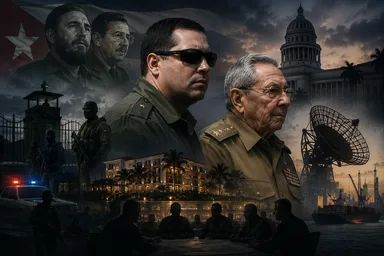
For years, photographs of Raúl Castro have often contained another figure.
He may be standing one step behind him. Sometimes he is wearing an olive-green uniform.
Sometimes dark glasses. Sometimes he appears to lean toward the former Cuban leader, apparently whispering instructions or information.
That man is often Raúl Guillermo Rodríguez Castro.
His public role has traditionally been described as remarkably simple:
He is his grandfather’s bodyguard.
But in a political system such as Cuba’s, being the personal protector of Raúl Castro is not necessarily a minor job.
It means controlling proximity. It means knowing who enters the room.
It means participating in travel, logistics and security.
It means being present during moments that most Cubans — and most government officials — never see.
BBC Mundo reported that various sources place Rodríguez Castro within the Cuban Ministry of the Interior, or MININT, with the rank of lieutenant colonel or colonel. Reports cited by BBC Monitoring have also claimed that Raúl Castro promoted him in 2016 to head the General Directorate of Personal Security, the organization responsible for protecting Cuba’s senior leadership.
If accurate, that would place El Cangrejo considerably closer to the center of power than the label “bodyguard” suggests.
Because in authoritarian systems, there is sometimes an enormous difference between the person with the impressive title and the person with access to the leader.
And access itself can become power.
The First Grandson
Raúl Guillermo was not simply another Castro grandchild.
He was reportedly Raúl Castro’s first grandson.
According to relatives interviewed by BBC Mundo, he developed an unusually close relationship with his grandfather from childhood.
At approximately eleven years old, he reportedly went to live with Raúl Castro.
From that point forward, his upbringing occurred within an environment radically different from that of the average Cuban child.
His cousin Carlos Rodríguez Halley described him as having grown up in something of a bubble, surrounded by military personnel and the institutions of the Cuban state.
He attended Los Camilitos, part of Cuba’s military-oriented educational system, and later studied accounting and finance at the University of Havana.
That biography matters.
El Cangrejo did not enter Cuba’s governing establishment as an outsider.
He was raised inside it. The revolution was not simply political history to him.
It was his family environment. The military was not an institution he encountered as an adult. It surrounded him growing up.
Raúl Castro was not merely the president of Cuba. He was his grandfather.
Why “El Cangrejo”?
Even his nickname has an unusual story.
According to his cousin, Raúl Guillermo was born with polydactyly — an additional finger.
He was operated on as a child, leaving only a small scar.
Within the family, the physical condition apparently led to the nickname:
El Cangrejo — The Crab. For years, the nickname belonged mostly to Cuba’s shadowy world of political insiders.
Now it has become internationally significant.
Because El Cangrejo may be moving from the background of photographs into the background of diplomacy.
The Washington Connection
In early 2026, reports began emerging that representatives connected to Washington and Havana had begun communicating.
Then Cuban President Miguel Díaz-Canel publicly confirmed that Cuba and the United States were engaged in dialogue.
The discussions came at an extraordinary moment.
Cuba was confronting an enormous economic and energy crisis.
The United States was increasing pressure on Havana.
And the Trump administration was publicly discussing Cuba in increasingly aggressive terms.
Within those reports emerged the name of Raúl Guillermo Rodríguez Castro.
Some accounts suggested that advisers connected to U.S. Secretary of State Marco Rubio had met with him during a gathering of Caribbean leaders in Saint Kitts and Nevis.
The Cuban government did not publicly confirm that meeting.
But it did not explicitly deny Rodríguez Castro’s involvement either.
Republican Congressman Mario Díaz-Balart subsequently said that Washington had communicated with “multiple people around Raúl Castro,” although he described the discussions as contacts rather than formal negotiations.
That wording may be the most important part of the entire story.
Not:
People around Díaz-Canel.
But:
People around Raúl Castro.
If that characterization is correct, Washington may be attempting to determine where power actually resides inside Cuba before negotiating what comes next.
Díaz-Canel Is President — But Is He the Final Authority?
Miguel Díaz-Canel became president in 2018.
Raúl Castro formally stepped away from frontline Communist Party leadership in 2021.
On paper, the transition was complete.
But power does not always move as cleanly as titles do.
Many analysts have argued that Raúl Castro retained considerable influence after leaving office, particularly through his relationships with Cuba’s military, Communist Party leadership and security establishment.
BBC Mundo quoted political scientist Armando Chaguaceda describing Cuba’s ruling elite as a relatively small group of elderly military and civilian leaders, with the Castro family remaining an important component of the structure.
This creates an unusual arrangement.
Cuba has an official president.
But behind that presidency sits an older revolutionary generation that still possesses enormous historical legitimacy and institutional relationships.
Raúl Castro may no longer occupy the presidency.
But Raúl Castro remains Raúl Castro.
And that distinction matters.
The Castro Family Becomes More Visible
There was an important difference between Fidel Castro and Raúl Castro.
Fidel cultivated an almost singular political persona.
According to historian Armando Chaguaceda, Fidel generally kept his family relatively removed from formal public political prominence.
The system revolved around Fidel himself.
Raúl’s family, however, became substantially more visible within the structures surrounding government, the military and the economy.
That difference may become increasingly important as the revolutionary generation disappears.
Fidel died in 2016.
Raúl is now an elderly man.
The men who fought the revolution in the 1950s cannot govern indefinitely.
Cuba therefore faces a transition unlike any in its modern history.
Eventually, there will be no Castro brother alive to personally embody the revolution.
The question is what survives afterward.
The party?
The military?
The security apparatus?
The economic structure?
The family?
Or some combination of all of them?
The Other Powerful Man in El Cangrejo’s Family
Raúl Guillermo’s connection to power does not come only through his grandfather.
His father was General Luis Alberto Rodríguez López-Calleja.
And that name opens another enormous chapter in understanding modern Cuba.
Until his death in 2022, Rodríguez López-Calleja headed GAESA — Grupo de Administración Empresarial S.A.
GAESA is the military-controlled conglomerate with extensive interests throughout Cuba’s economy.
Its businesses have been involved in sectors including:
tourism,
retail,
remittances,
hotels,
financial operations,
and port services.
BBC Mundo described Rodríguez López-Calleja as one of the most influential individuals inside the Cuban regime before his death.
Think about the family connections.
Raúl Guillermo Rodríguez Castro is simultaneously:
Raúl Castro’s grandson.
The son of the man who ran GAESA.
A figure reportedly connected to MININT.
A longtime member of Raúl Castro’s personal security apparatus.
And now potentially:
An intermediary in conversations involving the United States.
That combination explains why his emergence deserves attention.
GAESA: Where Military Power Meets Economic Power
To understand Cuba after Raúl, one must understand that modern political power is not simply about ideology.
It is also about control of institutions and money.
Over decades, Cuba’s Revolutionary Armed Forces developed a major role within the country’s economy.
GAESA became perhaps the clearest manifestation of this system.
Military-associated enterprises became deeply involved in tourism and other sectors that generated hard currency.
This created something unusual:
A socialist country in which a significant portion of strategically important commercial activity became linked to the military establishment.
That means the Cuban military is not simply responsible for defending the country.
It has also become intertwined with parts of the country’s economic infrastructure.
So when outsiders speculate about political transition in Cuba, focusing exclusively on the presidency can be misleading.
The more useful question may be:
Who controls the institutions capable of keeping the country functioning?
And among those institutions are the military, internal security services and military-linked economic enterprises.
The Three Pillars of Post-Castro Power
The emerging Cuban succession problem can perhaps be understood through three interconnected pillars.
The Communist Party
The Communist Party supplies ideological legitimacy and the formal political structure.
The Armed Forces and Security Apparatus
The military and MININT provide the coercive infrastructure necessary to maintain state authority.
The Economic Network
GAESA and related enterprises provide control over strategically important sections of the economy and access to hard currency.
For decades, these systems were ultimately connected through the authority of Fidel and Raúl Castro.
But what happens when neither brother remains?
Someone — or some coalition — must keep those pillars connected.
That is where individuals such as El Cangrejo become interesting.
He Doesn’t Need to Become President
One mistake when examining Cuban succession is assuming that Raúl Guillermo would need to become president to become important.
He may never become president.
He may never become first secretary of the Communist Party.
He may never seek a highly visible political position at all.
Power inside closed political systems can operate differently.
A person can exercise enormous influence through:
family relationships,
military connections,
control over security,
control over information,
control over access,
economic networks,
and influence over personnel decisions.
Sometimes the most important person in the room is not sitting at the head of the table.
He is standing behind the chair.
Cuba’s Succession Problem
Every revolutionary government eventually encounters the same problem.
Revolutions are created by individuals. States have to survive without them.
The Cuban Revolution was fundamentally shaped by a generation of men whose legitimacy came from participation in the struggle against Fulgencio Batista.
Fidel Castro.
Raúl Castro.
Che Guevara.
Camilo Cienfuegos.
Juan Almeida.
Ramiro Valdés.
Others from the Sierra Maestra generation.
Their authority was personal as much as institutional.
They were revolutionaries before they were bureaucrats.
But that generation is disappearing.
The next generation cannot claim the same revolutionary biography.
They did not fight Batista.
They did not land from the Granma.
They did not fight in the Sierra Maestra.
They inherited the system created by those who did.
That creates a fundamental legitimacy problem.
How does a revolutionary government remain revolutionary when the revolutionaries are gone?
The Chinese Model? The Vietnamese Model? Or Something Cuban?
Cuba therefore faces several possible futures.
One possibility is continued political continuity under the Communist Party combined with gradual economic liberalization.
China followed one version of that path after Mao.
Vietnam followed another.
The political monopoly survived while substantial portions of the economy became more market-oriented.
Cuba has experimented with limited private enterprise, foreign tourism and small businesses while maintaining political control.
But Cuba has another complication.
It exists only ninety miles from the United States.
It has one of the world’s largest politically active exile communities concentrated in South Florida.
And U.S.–Cuban relations have been intertwined with domestic American politics for generations.
There may therefore be no easy Chinese or Vietnamese blueprint.
Cuba’s transition will almost certainly be uniquely Cuban.
Washington May Already Be Thinking Beyond Díaz-Canel
The reported conversations involving people surrounding Raúl Castro suggest that Washington may already be considering the succession question.
Who can actually make an agreement?
Who could guarantee implementation?
Who controls the armed forces?
Who controls state security?
Who controls the economic institutions?
Who represents continuity?
Who might support reforms?
And perhaps most importantly:
Who can keep Cuba from collapsing while change takes place?
These questions become especially important if Washington believes Cuba is approaching a major economic or political inflection point.
A government can negotiate with a president.
But if the president does not control every power center, meaningful political change may require conversations with several factions simultaneously.
That may explain the references to “multiple people around Raúl Castro.”
“Raúl Without Raúl”
Perhaps the most interesting phrase associated with the entire episode came from Congressman Mario Díaz-Balart.
He warned against what he called:
“Raúl without Raúl.”
The phrase captures the central fear among some Cuban exiles.
Raúl Castro could leave the scene.
The old revolutionary leadership could disappear.
Cuba could announce reforms.
New leaders could emerge.
The names on the doors could change.
But the underlying power structure could remain largely intact.
The Communist Party.
The military.
MININT.
GAESA.
The security apparatus.
And perhaps members of the Castro family.
The revolution would survive its founders by transforming itself into an institutional system.
That is what “Raúl without Raúl” means.
Not necessarily another Castro serving as president.
Rather:
Castroism continuing after Castro.
BBC Mundo reported that Díaz-Balart specifically raised concerns about members of Raúl Castro’s family — including El Cangrejo — potentially retaining influence following some future political arrangement.
The Cuban Exile Community Is Watching Closely
For Miami’s Cuban exile community, this is not an abstract academic question.
For decades, generations of Cuban exiles have waited for the end of Castro rule.
But what exactly constitutes the end of Castro rule?
Fidel’s death?
That already happened.
Raúl leaving the presidency?
That happened too.
Raúl leaving Communist Party leadership?
That has happened.
Yet the political system remains.
So the definition of “the end of Castroism” becomes considerably more complicated.
If Raúl’s grandson remains powerful within the security establishment…
If the military maintains political influence…
If GAESA retains control over large parts of the economy…
If Communist Party rule continues…
Has the Castro era really ended?
Or has it simply evolved?
The Privileged World of Cuba’s Elite
El Cangrejo also embodies another contradiction within contemporary Cuba.
According to relatives and sources cited by BBC Mundo, Raúl Guillermo grew up with access to a world far removed from the daily experience of ordinary Cubans.
His cousin described an upbringing surrounded by military personnel and privilege.
His social circle reportedly included leading athletes and entertainers.
Such reports have contributed to longstanding criticism about the contrast between the lifestyle available to members of Cuba’s political elite and the shortages experienced by the population.
This contradiction has existed within many revolutionary systems.
The revolution begins by attacking privilege.
Eventually the revolution creates its own elite.
The names change.
The ideology changes.
But access remains one of the most valuable currencies in politics.
Cuba’s Greatest Political Mystery
The problem with analyzing Cuba is that outsiders rarely possess complete information.
Cuba’s political system is exceptionally opaque.
There are few reliable public organizational charts explaining who truly possesses influence.
Internal disagreements rarely occur openly.
Leadership succession is normally managed behind closed doors.
Political alliances are difficult to document.
Even experts studying Cuba sometimes must reconstruct relationships through photographs, appointments, family ties and appearances at official ceremonies.
Armando Chaguaceda summarized the problem well in the BBC report:
Cuba has long been a system in which what outsiders know is often little more than partial information surrounded by speculation.
That means claims about El Cangrejo must be treated carefully.
He may become enormously important.
He may remain an influential security figure without ever entering national political leadership.
His reported diplomatic role may prove temporary.
But the network surrounding him is unquestionably worth watching.
Cuba Is Approaching the End of an Era
For sixty-seven years, Cuba’s post-1959 political history has revolved around the revolution created by Fidel Castro and consolidated by his brother Raúl.
That era cannot continue indefinitely.
Biology will accomplish what decades of political pressure could not.
The revolutionary generation will disappear.
And Cuba will enter something genuinely new:
A post-revolutionary revolutionary government.
A system created by men who are no longer alive.
That transition could produce reform.
It could produce continuity.
It could produce internal conflict.
It could produce economic opening without political opening.
It could produce negotiations with Washington.
Or it could produce a new political structure that preserves much of the existing system while changing its public face.
Watch the People Behind the Leaders
For decades, understanding Cuba meant watching Fidel.
Then it meant watching Raúl.
Today it is tempting simply to watch Díaz-Canel.
But the more interesting story may be unfolding several feet behind him.
Watch the generals. Watch MININT.
Watch GAESA. Watch the Communist Party.
Watch the families. Watch the people controlling access.
And watch Raúl Guillermo Rodríguez Castro — El Cangrejo.
Because the most important question facing Cuba may no longer be:
Who replaces Raúl Castro?
It may be:
What replaces Raúl Castro?
And perhaps even more importantly:
How much of the system will actually need to change?
Cuba could someday wake up without Fidel Castro, without Raúl Castro and perhaps even without another Castro serving as its official leader.
Yet the institutions built during their rule could remain.
That is the real meaning behind the warning about “Raúl without Raúl.”
The Castro brothers may eventually disappear from Cuba.
The much larger historical question is whether the system they created disappears with them.